
Your University Chose You. The Home Office Has Not Decided Yet. One Wrong Number on a Bank Statement Changes Everything.
You already know the broad strokes. Get a CAS, prove your finances, apply for the Student visa. After graduation, apply for the Graduate Route. Eventually, find an employer willing to sponsor you. Every university website, education agent, and Reddit thread says the same thing.
None of them mention the part where your bank balance dips £3 below the threshold on Day 19 of the 28-day holding period because a forgotten direct debit hit the account — and the entire financial evidence window resets. Or the part where you submit your Graduate Route application three days after finishing exams, not knowing your university has not yet sent the completion notification to the Home Office — and the application is rejected under rule GR 4.3 before anyone looks at it. Or the part where you spend the full two years on the Graduate Route, secure a Skilled Worker sponsorship at the discounted salary rate, and then discover — in Year 4 — that the New Entrant discount has expired and your employer must either raise your salary by £8,300 overnight or withdraw your visa entirely.
These are not edge cases. They are the structural failure points built into the UK immigration pipeline, and they are invisible until you hit them.
The UK Student Visa + Graduate Route Guide is built around the Pipeline Strategy System — a single strategic roadmap that connects your Student visa application through the Graduate Route and Skilled Worker transition to Indefinite Leave to Remain. This is not a summary of the Immigration Rules you have already Googled. This is the decision framework that shows you how choices made in Year 1 determine your options in Year 5, Year 7, and Year 10 — and how to structure each stage so the next one works.
What's Inside
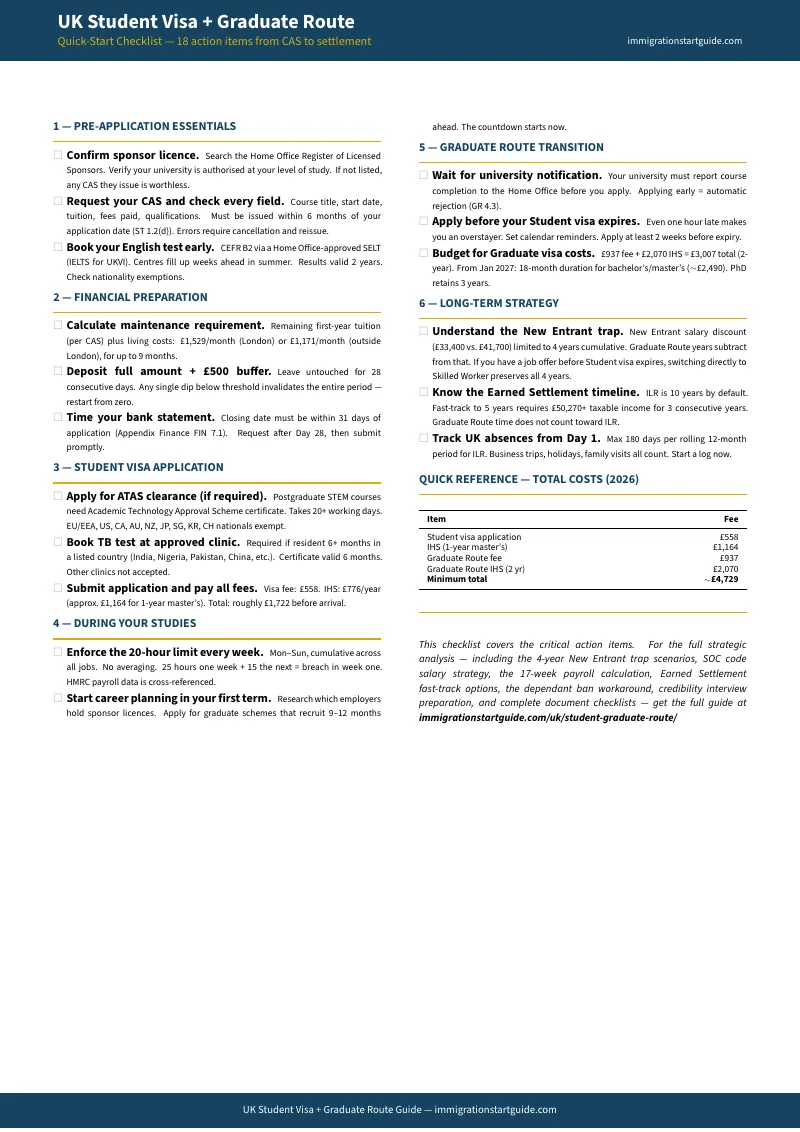
The complete 16-chapter guide plus an 18-item quick-start checklist — covering every stage from pre-arrival financial compliance through the Earned Settlement framework and the road to permanent residence:
Financial Compliance Under Appendix Finance
The 28-day holding rule, the 31-day evidence window, and the exact sequence that prevents the bank statement failures causing the majority of Student visa refusals. Why sudden lump-sum deposits trigger scrutiny for applicants from high-risk markets. How to calculate maintenance thresholds for London (£1,529/month) and outside London (£1,171/month), the £500 currency buffer strategy using OANDA spot rates, and why funds from siblings, uncles, or grandparents are rejected regardless of any supporting letters. You build the financial evidence timeline before anything else.
CAS Verification and Application Timing
Every field on your Confirmation of Acceptance for Studies that must match your offer letter exactly — and the cascading consequences when it does not. The 6-month CAS validity window, the application timing rules for overseas applicants versus in-country switchers, and the 28-day rule for when your current permission expires. These windows are hard limits with automatic refusal for non-compliance.
Credibility Interview Preparation
The Home Office conducts video-link credibility interviews for applicants profiled from Nigeria, Pakistan, Bangladesh, and Sri Lanka. Generic answers about "gaining international experience" fail. The guide teaches you to articulate specific module credits, contrast the UK syllabus with your home country alternatives, and name companies in your domestic market where the qualification applies — the precise, data-backed responses that pass the genuine student test and neutralise level-hopping and study-gap suspicions.
The 20-Hour Work Rule and HMRC Enforcement
How the Monday-to-Sunday week works (no averaging across weeks), why 25 hours one week and 15 the next is a visa breach in the first week, and how HMRC Real Time Information payroll data is now cross-referenced with immigration records. A proven breach during your Student visa period causes mandatory refusal of your Graduate Route application — even if the breach happened two years earlier.
The Graduate Route — Eligibility, Costs, and the University Notification Trap
Why applying before your university submits the completion notification to the Home Office results in automatic rejection. The exact process for confirming when the notification has been sent. The January 2027 reduction from 24 months to 18 months for bachelor's and master's graduates. The £3,007 total cost breakdown (£937 fee + £2,070 IHS). Why Graduate Route time does not count toward settlement — and what that means for your long-term timeline.
The 18-Month Countdown Strategy
What the compressed post-2027 timeline actually looks like month by month. Why graduates who treat the first six months as a settling-in period face a crisis by Month 14. The practical career-planning actions that should start during your final year of study, not after graduation. Which employers recruit 9-12 months ahead and how to use the Register of Licensed Sponsors to focus your applications on companies that can actually sponsor you.
The New Entrant Trap — The Most Consequential Decision in Your Pipeline
The 4-year cumulative limit on the New Entrant salary discount that most graduates walk into without understanding. Two detailed scenarios: using the Graduate Route first (which burns 2 years of your discount and creates a salary cliff where your employer must jump from £33,400 to £41,700 overnight) versus switching directly from your Student visa (which preserves all 4 years of discounted salary). The decision framework showing when each path makes strategic sense — and why students with families waiting to reunite have a completely different optimal strategy due to the dependant ban on taught courses.
SOC Code Salary Strategy
The going rates for different occupation codes vary by more than £20,000 for roles that may involve substantially similar work. A software developer (SOC 2134) needs £38,290 as a New Entrant. A data analyst (SOC 2425) at the same company needs only £33,400. The guide includes a comparison table of common graduate-level SOC codes with their going rates, New Entrant minimums, and the effective threshold — so you evaluate job offers by their legal viability, not just their salary. Plus the 17-week payroll calculation for workers with variable hours.
The Earned Settlement Framework (ILR)
The 2026 reform doubled the baseline path to Indefinite Leave to Remain from 5 years to 10. The guide maps the four pillars — suitability, integration, contribution, and residence — and the three fast-track options: High Earner (£50,270 for 3 years reduces to 5-year settlement), Elite Earner (£125,140 for 3 years reduces to 3-year settlement), and Public Service (5 years in frontline RQF 6+ role reduces to 5-year settlement). Why tracking your UK absences from Day 1 of your Student visa matters for a settlement application filed a decade later. The penalties for public funds reliance, overstaying, and criminal convictions that can extend the timeline to 20+ years.
Master Timeline, Common Mistakes, and Complete Document Checklists
The full pipeline mapped from 12 months before arrival through settlement and naturalisation — with both the Graduate Route path and the direct switch path shown side by side. Eight detailed common mistakes (bank balance dips, premature Graduate Route applications, work-hour averaging, the New Entrant salary cliff, CAS errors, and more) with the exact prevention steps. Complete document checklists for every stage: Student visa, Graduate Route, and Skilled Worker.
Plus 4 Printable Standalone Tools
A fillable financial compliance worksheet for calculating your maintenance requirement and tracking the 28-day evidence sequence. Printable document checklists for all three visa stages. A master timeline wall planner from pre-arrival through citizenship. A one-page quick-reference sheet with all 2026 fees, salary thresholds, and deadlines.
Who This Guide Is For
- International students applying for a UK Student visa — you need the financial compliance sequence, CAS verification protocol, and credibility interview preparation to get the initial visa approved without a refusal that permanently damages your immigration record
- Current UK students approaching graduation — the Graduate Route application has a notification dependency that causes preventable rejections every year, and the January 2027 duration reduction means the clock is shorter than you planned for
- Graduate Route holders looking for sponsored employment — you need to understand SOC codes, the New Entrant salary threshold, and how much of your 4-year discount you have already consumed before you accept an offer that creates a salary cliff in Year 4
- Students with families separated by the dependant ban — a taught master's does not allow dependants, which changes the strategic calculation entirely and may favour a direct switch to Skilled Worker over using the Graduate Route
- Anyone planning for long-term UK settlement — the Earned Settlement framework means decisions made during your Student visa affect your ILR application a decade later, and compliance failures from Year 1 can resurface in Year 10
Why Not Free Resources?
- Your university's international office helps with the initial Student visa and CAS issuance because their mandate is enrolment and tuition revenue. Once you graduate, they will not offer one-on-one Graduate Route application checks, help you understand the New Entrant trap, or advise on SOC code salary strategy. They direct you to generic government portals and move on to the next intake.
- Education agents are paid commissions of £2,000 to £8,000 per enrolled student — by the university, not by you. They have zero financial incentive to counsel you on post-study work realities, the Skilled Worker salary thresholds you will face in three years, or the Earned Settlement framework. Their job ends the day you arrive on campus.
- Immigration solicitors provide accurate legal advice at £150 to £300 per hour. For a standard Student-to-Graduate-to-Skilled Worker pipeline, the total legal fees can run to thousands of pounds — disproportionate for a 22-year-old graduate dealing with applications that are procedurally complex but legally straightforward.
- Reddit (r/ukvisa, r/UniUK) and The Student Room provide emotional support and real-time anecdotes but systematically propagate misinformation about the 28-day financial rule, SOC code thresholds, and the New Entrant discount mechanics. Anonymous answers from people whose variables you cannot see create confusion, not confidence.
This guide fills the strategic gap — the space between the institutional support that ends at graduation and the legal counsel that costs more than the problem warrants. It connects the Student visa, the Graduate Route, and the Skilled Worker transition into a single pipeline strategy, treating decisions made in Year 1 as inputs to outcomes in Year 10.
— Less Than a Single Hour of Immigration Legal Advice
The Student visa application alone costs £558 in fees plus £776 per year in Immigration Health Surcharge — paid upfront and non-refundable even if refused. The Graduate Route costs £937 plus £1,035 per year in IHS. A single consultation with an immigration solicitor runs £150 to £300 and covers one question, not the entire pipeline. If a financial evidence error or a premature Graduate Route application causes refusal, the forfeited fees are the smallest cost — a refusal stamps your immigration record permanently and can trigger a 10-year deception ban on future applications.
This guide does not replace an immigration solicitor for complex legal disputes, judicial reviews, or removal proceedings. But it provides the Pipeline Strategy System — the financial compliance sequences, the New Entrant trap analysis, the SOC code salary strategy, and the step-by-step filing checklists — that prevents the procedural and strategic errors causing refusals and failed transitions in the first place.
If it prevents one bank statement rejection, one premature Graduate Route application, or one salary cliff that would have ended your sponsorship in Year 4, it pays for itself before you finish Chapter 3.
Money-back guarantee, no time limit. If the guide does not make your UK immigration pipeline clearer, you pay nothing.
Download the free Quick-Start Checklist to see the 18 highest-stakes action items across every phase — from financial evidence preparation through Graduate Route timing and the New Entrant decision framework. When you are ready for the complete Pipeline Strategy System, the SOC code salary tables, and the full document checklists, the guide is here.
Your offer letter got you into the university. This is the strategy that gets you through the decade that follows.