
You Passed the OET. You Have an NHS Job Offer. Your Visa Application Still Gets Refused. This Guide Shows You Why — and How to Prevent It Before You Apply.
You are a registered nurse in Nigeria. You passed the OET with a B in every component. You cleared the NMC Computer-Based Test. An NHS Trust offers you a Band 5 position at £31,049. The recruiter tells you the Health and Care Worker visa has lower fees and no Immigration Health Surcharge. You feel relief. You submit.
Then the refusal letter arrives. The NMC still requires your Certificate of Current Professional Status — sent directly from your home country nursing council, not forwarded by you. You sent it yourself. Application rejected. The OET results you spent £330 to earn have a two-year validity window that is now ticking down while you restart the verification process. And the NHS Trust that waited three months is now questioning whether your paperwork will ever clear.
This is not hypothetical. It is the most documented registration failure pattern across NMC forums, r/NursingUK, and immigration advisory groups. And it is entirely preventable — if someone explains how the dual-track system actually works before you enter it.
The problem is not that the rules are secret. The NMC publishes its registration steps. The Home Office publishes the visa requirements. The HCPC publishes its scrutiny process. The GMC publishes the PLAB pathway. But each body assumes you already understand how all the others interact. The NMC does not warn you that your English test results will expire while the HCPC processes your Standards of Proficiency mapping document. The Home Office does not tell you that your NHS Trust cannot legally recruit you from a WHO Red List country — but you can apply directly on your own. Nobody explains that any agency contacting you in Lagos or Harare promising an NHS position is, by definition, either a scammer or violating international ethical recruitment codes.
The UK Health & Care Worker Visa Guide is a Dual-Track Navigation System — the strategic framework that synchronises your professional registration (NMC, GMC, HCPC, or GPhC) with your Home Office visa application, so neither track stalls, no document expires while waiting on the other, and no exploitation trap catches you off guard. It sits between GOV.UK's fragmented statutes and a solicitor's £1,000-to-£3,000 retainer — giving you the tactical execution plan that free resources do not provide and that predatory agencies exploit the absence of.
What's Inside the Dual-Track Navigation System
The Profession-Specific Registration Pipelines — four complete pathways mapped step by step. For nurses: the NMC route from self-assessment through CBT to OSCE, including the Decision-Making Framework and the direct verification rule that trips up more applicants than the clinical exam itself. For doctors: the GMC pathway through PLAB 1 and PLAB 2, MyIntealth verification, and the full registration timeline. For allied health professionals: the HCPC international scrutiny application, the £678.38 non-refundable fee, and the Standards of Proficiency mapping document that demands granular evidence of your clinical curriculum. For pharmacists: the GPhC registration route including the OSPAP conversion programme. Each pipeline includes the exact sequence, the fees at every stage, and the timing dependencies that determine whether your visa application aligns with your registration — or whether one expires while you wait for the other.
The English Language Decision Matrix — OET versus IELTS broken down by profession, cost, and strategic advantage. The OET costs roughly twice as much as IELTS (£330 versus £150), but clinical professionals who struggle with formal academic essay writing consistently pass the OET's healthcare-scenario format on fewer attempts. Failing the cheaper IELTS three times costs more than passing the OET once — in fees, in lost months, and in the two-year validity clock that resets every time your results expire during a stalled registration. The guide maps the exact score requirements for each regulator (NMC, GMC, HCPC, GPhC) and the score-combining rules that let you merge results from two recent sittings.
The IHS Exemption Advantage Calculator — the Health and Care Worker visa exempts you and every dependent family member from the Immigration Health Surcharge. For a standard Skilled Worker, the IHS costs £1,035 per person per year. A family of four on a five-year visa pays over £20,000 in IHS alone. Under the Health and Care Worker route, that cost is zero. The guide maps every financial advantage — reduced application fees (£324 for up to three years, £628 for longer), the lower £25,000 salary threshold protected by the National Pay Scale exemption, and the fast-track processing — so you understand exactly how much this route saves compared to the standard Skilled Worker alternative.
The Exploitation Defence System — the most urgent chapter in the guide. Any recruiter, agency, or employer demanding upfront payment from you for visa sponsorship is operating illegally. The Certificate of Sponsorship costs the employer £239 — you should never pay a penny for it. Yet reports document candidates routinely paying £5,000 to £10,000 for phantom jobs and fake CoS documents. The guide teaches you to identify illegal job-finding fees disguised as "administrative charges," audit repayment clauses in your employment contract (legitimate clauses taper: 100% within 12 months, 50% at 13-24 months, 25% at 25-36 months, zero after 36 months — anything else is a red flag), recognise passport retention and debt bondage tactics, and verify every employer against the Home Office Register of Licensed Sponsors and their CQC rating before you accept a single document.
The WHO Red List Direct Application Protocol — the cornerstone chapter for applicants from Nigeria, Ghana, Zimbabwe, Nepal, and other restricted nations. The UK's Code of Practice prohibits ethical NHS Trusts and agencies from actively recruiting in Red List countries. This means any agency or recruiter that contacts you in a Red List country is violating the code. But the regulations explicitly preserve your right to apply independently. The guide maps the exact process: how to find genuine vacancies on NHS Jobs (jobs.nhs.uk), how to submit a direct application without any intermediary, and how to secure sponsorship from an NHS Trust that is legally unable to seek you out but is legally able — and often eager — to hire you when you find them yourself.
The 60-Day Curtailment Survival Plan — since 2022, over 470 care companies have had their sponsor licences revoked, instantly displacing an estimated 40,000 workers. When your sponsor loses their licence, you receive a curtailment letter giving you 60 days to find a new sponsoring employer or face deportation. The guide details the exact administrative steps: how to access the government's displaced worker job-matching initiative, how to document employer abuse to protect your immigration record, and how to report illegal activity to Immigration Enforcement and Crimestoppers without jeopardising your own visa status.
The Care Worker Route Closure Map — the July 2025 HC 997 changes closed overseas entry for care workers (SOC 6135) and senior care workers (SOC 6136). But a critical transitional concession exists: employers can still sponsor care workers who are already in the UK through in-country switching until July 2028, provided the worker has been employed on the sponsoring employer's UK payroll for at least three continuous months. The guide maps every scenario — who is affected, who is protected, who can still switch, and the exact timeline before the window closes permanently.
The Settlement Pathway Framework — five years of continuous residence on a Health and Care Worker visa leads to Indefinite Leave to Remain. The guide maps the ILR salary requirements, the Agenda for Change exemption that protects NHS staff from the general settlement salary threshold, the continuous residence calculation (no more than 180 days outside the UK in any rolling 12-month period), grandfathering provisions for pre-April 2024 visa holders, and the pathway from ILR to British citizenship. Planning your settlement strategy at the point of your first application is not premature — it is the only way to avoid an absence miscalculation that resets the five-year qualifying clock.
Standalone Printable Tools Included
Every paid download includes the complete 12-chapter guide plus 9 standalone printable PDFs — tools you can print individually and use at every stage of the process:
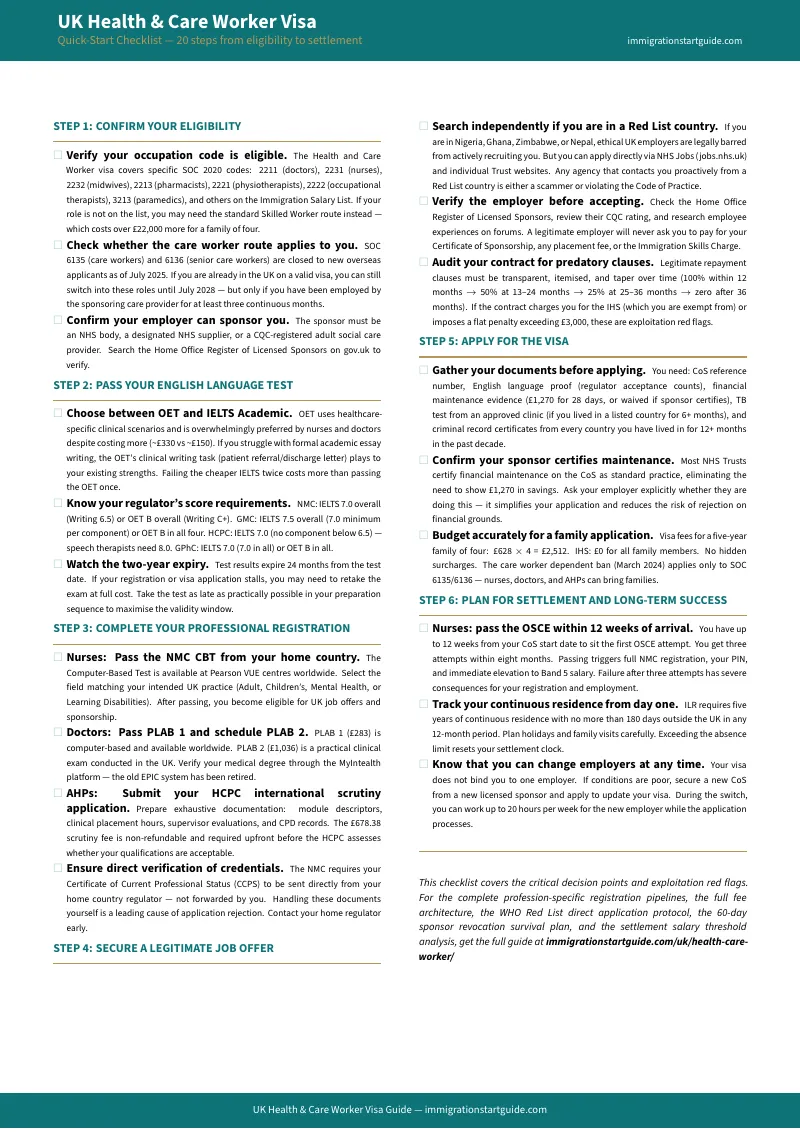
- Quick-Start Checklist — 20 critical action items covering eligibility verification, English test selection, registration pipeline sequencing, employer verification, exploitation red flags, visa application assembly, and settlement planning
- Document Checklist — every document required for your visa application with notes fields, covering both entry clearance and in-country applications
- Registration Pipeline Decision Tree — a visual flowchart showing the exact step-by-step pathway for your profession (NMC, GMC, HCPC, or GPhC) with fees and timelines
- OET vs IELTS Comparison Card — score requirements by regulator, cost comparison, strategic decision guide, and the score-combining rules that could save you a retake
- Fee Schedule Reference — complete cost breakdown by profession with a fill-in budget worksheet for your personal situation, including dependant costs
- Employer Verification Checklist — print and bring to your HR meeting: sponsor licence check, CQC verification, contract audit items, and the red flags that mean walk away
- Exploitation Red Flag Card — the four exploitation patterns to recognise, the repayment clause tapering rules, and all six reporting contacts if you need them
- 60-Day Curtailment Action Plan — the emergency protocol if your sponsor loses their licence, broken into Day 1-7, Day 8-30, and Day 31-60 phases with specific actions at each stage
- Settlement Timeline Tracker — a continuous residence log for tracking travel absences against the 180-day rule, plus ILR qualifying period and settlement milestone tracking
Who This Guide Is For
This guide is built for international doctors, nurses, pharmacists, and allied health professionals with a UK job offer — or the prospect of one — who need to navigate the dual-track registration and immigration process without paying a solicitor thousands of pounds or trusting an agency that profits from their confusion.
- You are a nurse who passed the CBT and is preparing for the OSCE. You have partial NMC registration and a conditional job offer from an NHS Trust. You need to synchronise the OSCE timeline, the CoS assignment, and the visa application so that no document expires while waiting for another — and you need to know exactly what happens if you fail the OSCE on your first attempt.
- You are a doctor navigating the PLAB pathway. You passed PLAB 1 from your home country and need to understand whether to apply for the visa before or after PLAB 2, how MyIntealth verification works, and what the realistic timeline looks like from first application to full GMC registration and independent practice.
- You are an allied health professional facing the HCPC scrutiny process. You need to prepare a Standards of Proficiency mapping document that proves your international qualifications meet highly specific UK standards — and you are about to pay a £678.38 non-refundable fee for the privilege of having it assessed. You need to know what the HCPC actually looks for before you submit.
- You are in a WHO Red List country and every agency promising you an NHS job is a potential scam. You are in Nigeria, Ghana, Zimbabwe, or Nepal. Ethical UK employers cannot legally recruit you. But you can apply directly — and the guide shows you exactly how to bypass the agencies that profit from your isolation and submit independent applications to legitimate NHS Trusts.
- You are already in the UK as a care worker and the overseas route just closed. You need to understand the in-country switching transitional arrangements, the three-month employment rule, the July 2028 sunset clause, and whether upgrading from care worker to registered nurse through an apprenticeship pathway is viable for your situation.
- You are calculating whether the UK is worth it compared to Australia, the Gulf, or North America. You need the real numbers — salary bands, visa costs, family costs, settlement timelines, and the IHS exemption that saves a family of four over £22,000 — so you can compare the UK pathway against the alternatives with actual figures instead of forum speculation.
This guide does not replace a solicitor for complex cases involving criminal history, previous visa refusals, or asylum interactions. It gives you the dual-track execution framework that GOV.UK does not provide, that predatory agencies exploit the absence of, and that solicitors charge £1,000 to £3,000 to explain.
Why Not Free Resources?
- GOV.UK publishes the visa rules. The NMC publishes the registration steps. The HCPC publishes its scrutiny requirements. The GMC publishes the PLAB pathway. None of them explain how the timelines interact with each other. The Home Office page does not warn you that your English test results will expire while your HCPC application processes for months. The NMC page does not explain the visa implications of failing the OSCE. Each body publishes its own rules in isolation — and you are expected to synchronise them yourself, with zero margin for error.
- NHS recruitment programmes focus entirely on the employer's compliance and onboarding obligations. They outline what the rules are for the Trust. They do not teach you how to audit your own employment contract for predatory repayment clauses, how to verify a CoS before it is assigned, or how to independently apply from a Red List country where ethical recruitment cannot reach you.
- Facebook groups and Reddit (r/NursingUK, r/ukvisa) are where someone who applied in 2023 tells you the care worker route still works. Someone confuses NMC requirements with HCPC requirements. Someone recommends an agency that is actively being investigated for illegal fees. You get crowdsourced anxiety from strangers who filed under different rules, for different professions, in a different regulatory era.
- Immigration solicitors publish detailed blog posts analysing every policy change — because their business model is to demonstrate that the system is impossibly complex, then offer £1,000-to-£3,000 retainers. For a nurse in the Philippines earning $400 per month or a care worker in Zimbabwe earning less than $200, retaining a UK-based solicitor is not a realistic option. The solicitor's blog explains the problem. The solution they sell is unaffordable.
This guide fills the execution gap — the space between "I know I need NMC registration and a visa" and "I can verify that both tracks are synchronised, every document is correctly sourced, every fee is budgeted, and every exploitation red flag is identified before I commit thousands in non-refundable costs."
— Less Than One Hour With a Solicitor
A 30-minute phone consultation with an immigration solicitor costs £100 to £300. Full-service Health and Care Worker application support runs £1,000 to £3,000. And the applicant still does the actual work — passing the clinical exams, gathering verified documents, coordinating with the employer on the CoS, navigating the regulator's timeline.
Your total costs will include registration fees (£678.38 for HCPC scrutiny alone, £283 for PLAB 1, £1,036 for PLAB 2), English language testing (£150 to £330 per attempt), visa application fees (£324 to £628), and months of preparation time. This guide represents a fraction of that commitment — and it is the piece that determines whether the other thousands produce an approval or a refusal letter.
Money-back guarantee, no time limit. If the dual-track registration timelines, exploitation defence system, and Red List direct application protocol do not make your pathway clearer, you pay nothing.
Download the free Quick-Start Checklist to see the 20-item action plan covering eligibility verification, English test selection, employer red flags, and your first registration steps. When you are ready for the complete Dual-Track Navigation System — the profession-specific pipelines, the exploitation defence framework, the WHO Red List protocol, the settlement pathway, and the care worker transitional arrangements — the full guide is here.
The NHS needs you. The system was not built to help you get there. This guide was.