
Your Business Idea Could Get You British Residency in Three Years. But First, an Endorsing Body Has to Believe It's Innovative, Viable, and Scalable. This Guide Gets You Through That Gate.
You have a business that works. Customers pay for it. Revenue is growing. Then you open the Innovator Founder visa guidance and discover that none of that matters unless a panel of three assessors at one of four authorised endorsing bodies agrees that your idea is "genuinely innovative," "commercially viable," and "capable of scaling." The Home Office doesn't define what level of innovation qualifies. The endorsing bodies don't publish their scoring rubrics. You have one submission, one non-refundable £1,000 fee, and a success rate of roughly one in three.
So you start researching. You find a Reddit thread where someone got endorsed last year with an AI logistics platform — but their endorsing body has since stopped accepting new applications. You call an immigration solicitor who quotes £7,000 for full representation — but their scope excludes the business plan, which is the actual thing the endorsing body evaluates. You try an AI business plan generator that produces 50 pages in fifteen minutes — but forum posts warn that endorsing bodies are flagging templated plans and rejecting founders who cannot defend their own projections in a live interview.
Here's the structural problem: the Innovator Founder visa is not an immigration process with a business component — it's a business pitch with an immigration outcome, where the most common failures happen because strong founders submit plans that don't speak the language of the specific endorsing body evaluating them. Applications are refused because "innovation" means something different to Envestors (fintech-focused, ROI-interrogative) than to Innovator International (mentorship-oriented, sector-agnostic). Because financial projections use "assume 2% market share" instead of bottom-up calculations that a commercial assessor can verify. Because founders prepare for a visa interview but face what is effectively a hostile investment pitch. Two out of three endorsement applications are rejected. The difference is not the quality of the business. It's the quality of the translation from founder-speak to endorser-speak.
The UK Innovator Founder Visa Guide is an Endorsement Navigation System built for the specific problem that every self-applying founder faces: converting a working business idea into the structured evidence package that endorsing bodies actually approve. Not a rehash of GOV.UK pages. Not a generic business plan template. This is a 13-chapter strategic framework covering all four authorised endorsing bodies and their distinct assessment cultures, the three-pillar test with pass/fail examples, business plan architecture that survives commercial scrutiny, the endorsement pitch and due diligence process, the complete 2026 fee schedule, founding team and equity structures, the two-stage application from endorsement to eVisa, post-arrival compliance through mandatory contact points, and the accelerated three-year settlement pathway with its seven achievement criteria.
What's Inside the Endorsement Navigation System
9 PDFs — the complete guide, a quick-start checklist, and seven standalone tools you can print and use immediately:
The Endorsing Body Strategy Map (Chapter 2)
Four endorsing bodies. Four entirely different cultures, sector preferences, and assessment styles. UKES runs a structured, rigorous process suited to broad business models. Innovator International offers iterative mentorship-style feedback. Envestors interrogates your ROI model like a VC firm. GEP is invitation-only for elite international founders. Applying to the wrong body with the wrong pitch is the single most preventable cause of rejection. The guide maps each body's preferred sectors, fee structures, average timelines, interview format, and the "personality" that a successful submission must match — so you choose once, correctly, before spending £1,000.
The Three-Pillar Endorsement Test (Chapter 3)
Innovation. Viability. Scalability. The Home Office says your business must be "original and different from anything else on the market." That definition is simultaneously too broad and too narrow — and endorsing bodies interpret it differently. A better UI for an existing service? Almost always rejected. A novel application of AI to an underserved industrial process? Strong. The guide provides a pass/fail innovation matrix with real examples drawn from successful and refused applications, a viability stress test that checks whether your plan survives the "can you actually do this yourself?" question, and a scalability framework that shows how to prove your business grows beyond your own working hours. If your idea fails the self-assessment, the guide tells you how to reframe it before you waste a £1,000 submission.
Business Plan Architecture (Chapter 4)
Endorsing bodies expect a 25 to 35-page plan with six mandatory sections, and the structure matters as much as the content. The most common plan failure is financial projections that use top-down market sizing ("the UK AI market is worth £20 billion, we'll capture 0.1%") instead of bottom-up calculations that a commercial assessor can verify customer by customer. The guide covers executive summary structure, the unique selling proposition test, UK-specific market assessment using ONS data, competitor analysis that names names, a 36-month operational roadmap, and financial projection methodology that endorsing bodies actually trust. It also covers the evidence pack — CV, funding proof, letters of intent, IP documentation — and why generic global market reports get your plan flagged.
The Endorsement Pitch and Due Diligence (Chapter 5)
The plan gets you to the interview. The interview gets you endorsed. Most founders prepare for a visa conversation and walk into what is effectively a hostile investment pitch. The guide covers the Fit and Proper person check, AML and KYC requirements, how to structure a 10-minute presentation that addresses innovation, market validation, and first-year milestones, and — critically — how to prepare for 20 minutes of aggressive questions targeting your weakest assumptions. One applicant described the Envestors interview as "an interrogative process where none of the questions are difficult, but they can be time-consuming." The guide prepares you for exactly that dynamic.
The Complete Fee Schedule (Chapter 7)
Most guides mention the visa fee and stop. The actual cost is substantially higher: £1,000 endorsement fee, £1,274 to £1,357 visa application fee, £3,105 Immigration Health Surcharge for three years, plus two mandatory contact point meetings at £500 each. A single applicant's total government costs exceed £6,400 before they've spent a penny on company setup, office space, or their first hire. Add a dependant partner and the total approaches £10,000. The guide itemises every fee, maps the payment timeline, explains the IHS calculation, and includes the hidden costs that catch founders off guard — trademark filings, Companies House registration, VAT registration, and the PAYE setup you'll need once you hire.
Post-Arrival Compliance and Contact Points (Chapter 9)
Getting endorsed and getting the visa are the beginning, not the end. At 12 months and 24 months, your endorsing body will conduct mandatory contact point meetings to assess whether you are actively trading, making progress against your business plan, and still personally leading the business. Failure at a contact point can trigger endorsement withdrawal — and a Home Office curtailment letter giving you 60 days to leave the UK. The guide covers exactly what each endorsing body asks at these meetings, what evidence to prepare, and how to build a monthly tracking system from day one so you're never caught flat-footed.
The Three-Year Settlement Pathway (Chapter 10)
The Innovator Founder visa's headline benefit: Indefinite Leave to Remain in three years — faster than any other business or work visa route. But settlement is not automatic. You must meet at least two of seven achievement criteria, and the most controllable combination for most founders is Criterion 1 (£50,000 invested in your business) plus Criterion 3 (UK intellectual property filed). The guide maps all seven criteria, explains the evidence standard for each, and provides a settlement strategy that starts the day you arrive — because three years passes quickly when you're building a company and the evidence window doesn't extend.
Endorsing Body Comparison Card
A one-page side-by-side reference card of all four authorised endorsing bodies — UKES, Innovator International, Envestors, and GEP — with sector preferences, assessment styles, fee structures, and a quick-pick guide so you can choose the right body before spending £1,000.
Three-Pillar Self-Assessment Worksheet
A fillable one-page worksheet to score your business idea against the innovation, viability, and scalability tests before you apply. Includes the key questions assessors ask, pass/fail indicators, and reframing prompts for each pillar.
Business Plan Structure Reference Card
A one-page overview of the six mandatory business plan sections with what assessors look for in each — plus the four most common errors that cause rejection. Pin it up while you write your 25–35 page plan.
Endorsement Pitch Preparation Worksheet
A fillable one-page worksheet for structuring your 10-minute presentation and preparing answers to the hostile questions assessors will ask. Covers innovation framing, market validation, financial defence, and contingency planning — plus a pre-interview readiness checklist.
Fee Schedule Quick Reference
Every cost on one page — endorsement, visa, IHS, contact points, optional processing, and business setup costs — for single applicants and families. The budget planning card you will reference from day one.
Contact Point Evidence Tracker
A two-page monthly tracking worksheet for documenting customers, revenue, hires, product updates, and IP filings across your first 24 months. Includes the contact point meeting checklist so you arrive prepared at every endorsing body review.
Settlement Criteria Tracker
A one-page quarterly tracker for all seven ILR achievement criteria — investment, customer growth, IP protection, revenue, and job creation. Choose your two target criteria on arrival and track evidence across twelve quarters to your settlement application.
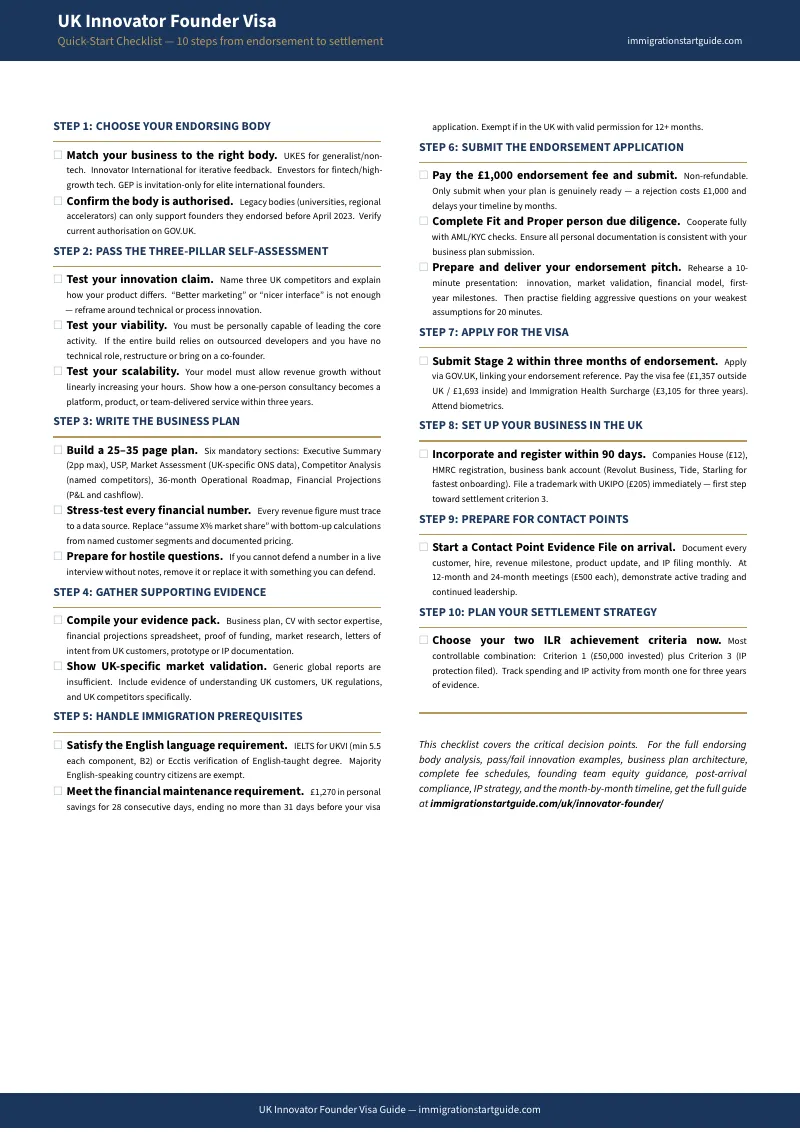
Quick-Start Checklist (free download)
A 20-item action plan covering the essentials: choose your endorsing body, self-assess against the three-pillar test, outline your business plan structure, gather your evidence pack, handle immigration prerequisites, and plan your settlement strategy. Enough to assess your position and identify your next concrete step tonight.
Who This Guide Is For
This guide is for entrepreneurs with innovative business ideas who want to launch a startup in the UK and secure permanent residency through the Innovator Founder visa:
- International founders with a working product or prototype who need UK market access and a path to settlement — not just a visa, but permanent residency in three years
- Graduate visa holders whose two-year window is closing and who would rather build their own company than compete for shrinking Skilled Worker sponsorships
- Serial founders from India, Nigeria, Pakistan, and the UAE who have product-market fit at home and want London as their international headquarters for EU and North American access
- Corporate professionals pivoting from Big Tech or management consulting who want professional autonomy and permanent residency without employer dependence
- UAE-based expat entrepreneurs who want long-term stability and a citizenship pathway that Dubai and Abu Dhabi don't offer
- Founders who have already been refused endorsement and need to understand whether the problem was the business plan, the endorsing body match, the interview performance, or the innovation framing — and how to fix it
This guide is not for: applicants seeking employer-sponsored work visas (use the Skilled Worker route), recognised leaders applying for talent-based immigration (see the Global Talent visa guide), or investors who want a passive route with no business-building requirement.
Why Not Free Resources?
Free information on the Innovator Founder visa is abundant. Here's what it actually delivers:
- GOV.UK guidance tells you the business must be "genuinely innovative" and "viable." It does not define what level of innovation qualifies, whether your SaaS product counts, how endorsing bodies interpret "scalability" for a consultancy, or what evidence of UK market validation they actually expect. You get the rules without the strategy.
- Immigration solicitor blogs describe every possible rejection scenario in vivid detail — because their business model requires you to believe the process is so dangerous that only their £5,000 to £15,000 retainer can protect you. The blog explains the risk. The solution costs thousands. And the solicitor often excludes business plan writing from their scope — the one deliverable the endorsing body actually scores.
- Reddit threads are where you find advice from someone who got endorsed in 2023 through a body that no longer accepts new applications, using a plan structure that reflected the pre-April 2023 rules. You get survivorship bias from strangers who applied under different criteria, to different endorsing bodies, with different innovation thresholds.
- AI business plan generators produce 50 to 80 pages in fifteen minutes for £29 to £85. Endorsing bodies are explicitly warning against AI-generated plans — if you cannot explain the granular assumptions in your financial model during a live interview, the committee will conclude you are a passive investor, not a founder, and refuse your application.
- Business plan writing firms charge £2,000 to £3,500 for an endorser-compliant plan — but they write to a generic template without knowing your endorsing body's assessment culture, and they don't prepare you for the interview that follows.
This guide fills the strategy gap — the space between "I know the requirements" and "I can present my business in the format that my specific endorsing body actually approves." It delivers the same endorsement strategy, three-pillar test preparation, and interview coaching framework that immigration consultants charge thousands to apply, organised so you can execute it yourself.
— Less Than 2% of Your Total Visa Investment
Your Innovator Founder visa application will cost over £6,400 in government fees alone — endorsement, visa, IHS, and contact point meetings. Add company setup, a trademark filing, and your first quarter of operating expenses, and you're well above £10,000 before you've made your first UK sale. This guide represents a fraction of that investment, and it's the component that determines whether the other £6,400 produces an endorsement letter or a rejection and months of delay.
A refused endorsement doesn't just cost you £1,000. It costs the months of business plan preparation. It costs the market timing you planned around a UK launch. It costs the settlement clock that starts ticking the day your visa is granted — every month of delay is a month added to your three-year path to Indefinite Leave to Remain.
Immigration solicitors charge £5,000 to £15,000 for full Innovator Founder representation. A specialist business plan writing firm charges £2,000 to £3,500. And here's the part most founders discover too late: the endorsing body assesses your business knowledge, your market understanding, your ability to defend projections under pressure. A solicitor can file your paperwork, but they cannot sit in your endorsement interview. You are the domain expert. The guide gives you the framework to present that expertise in the structure endorsing bodies actually approve.
Money-back guarantee, no time limit. If the endorsing body strategy map, the three-pillar test framework, and the business plan architecture don't make your application stronger, you pay nothing.
Download the free Quick-Start Checklist to assess your business idea against the three-pillar test and identify your best-fit endorsing body tonight. When you're ready for the full endorsement strategy, the business plan architecture, the interview preparation framework, and the settlement roadmap, the complete guide is here.
You've already built the business. Now build the case that gets it endorsed.