
Your Application Fee Is £1,839. It's Non-Refundable. This Guide Makes Sure You Don't Lose It.
You have lived in the UK for six years. You own property. Your children attend British schools. You hold Indefinite Leave to Remain. You are ready to naturalise. You pay the £1,709 application fee and the £130 ceremony fee. You submit Form AN. And then the caseworker counts your absences differently than you did.
You were abroad for 92 days in the final year. The limit is 90. You missed it by two days because the Home Office counts the day of departure and the day of return differently depending on which part of the assessment they are applying. The refusal letter arrives. The £1,839 is gone. You must wait, recalculate, and pay again.
This is not hypothetical. The physical presence requirement is the single most common reason straightforward naturalisation applications fail. The rules are published. The formula is not. GOV.UK tells you the limit is 90 days. It does not tell you how the caseworker actually counts those days — because that logic lives in a 70-page technical PDF written for Home Office staff, not for you.
The problem compounds from there. The "Good Character" requirement is not a criminal background check. It is a six-category discretionary assessment that covers NHS debts, undisclosed parking fines, council tax arrears, and — since the February 2025 guidance update — a permanent bar for historical illegal entry, regardless of how long ago it occurred. A single undisclosed Fixed Penalty Notice for speeding, even one with no court action, is treated as "Deception" and triggers an automatic refusal. Not because the fine matters. Because the non-disclosure does.
The UK British Citizenship (Naturalisation) Guide is a Refusal-Proofing System — the complete technical framework that mirrors what the Home Office caseworker actually checks, in the order they check it, so you can verify every threshold before you commit £1,839 in non-refundable fees. It translates 70 pages of caseworker guidance into a sequenced, verifiable process where every absence is counted correctly, every character question is answered safely, and every common rejection trigger is neutralised before your application reaches a caseworker's desk.
What's Inside the Refusal-Proofing System
The Caseworker Mirror Residence Calculator — the exact formula the Home Office applies when counting your physical presence and absences. The guide walks you through the "Day 1" rule (you must have been physically inside the UK on the precise date five years or three years before the Home Office receives your application), the 450-day total absence limit for Section 6(1) applicants and the 270-day limit for spouses, and the 90-day final-year ceiling that catches more applicants than any other single rule. You input your travel dates, and you see what the caseworker sees — including the departure and arrival day logic that GOV.UK does not explain.
The 2026 Good Character Diagnostic — a structured self-assessment that mirrors the six categories caseworkers evaluate: criminality (custodial vs. non-custodial, "spent" status under the Rehabilitation of Offenders Act), financial integrity (NHS debts of £500+, council tax arrears, HMRC discrepancies), immigration compliance (the 2025 illegal entry bar, visa overstays, working restrictions), deception (the difference between a disclosed minor offence and an undisclosed one — the first is a factor, the second is terminal), and notoriety. Each category includes the specific disclosure threshold so you know exactly what to declare on Form AN and what falls below the reporting line.
The Referee Vetting Decision Tree — the Home Office requires two referees with specific qualifications, and most applicants do not realise how narrow the criteria actually are. One must be a "professional person" from the approved list (a director of a VAT-registered company qualifies; a "business owner" may not). The other must be a British passport holder over 25 or a professional. Both must have known you personally for at least three years. The guide provides the vetting flowchart, the approved professions list, and a sample request letter so your referee knows exactly what the Home Office will ask them to confirm.
Form AN — Field-by-Field Walkthrough — every section of the naturalisation application decoded. The qualifying period dates. The "Future Intentions" question (stating you intend to have your principal home in the UK does not mean you can never travel — but a caseworker can refuse if they believe you are naturalising specifically to leave). The employment and address history spanning five years. The criminal and civil history disclosure. The referee declaration sections. Each field includes the specific refusal risk it carries and the safe answer format.
Nationality-Specific Transition Maps — what happens after the ceremony depends on where you come from. Indian nationals face a mandatory passport surrender and OCI (Overseas Citizen of India) application with a 2-to-4-month travel gap. South African nationals benefit from the May 2025 Constitutional Court ruling that restored citizenship to those who lost it — no Letter of Retention required. Nigerian and Pakistani professionals need a travel integrity reconstruction strategy for complex multi-country work histories. The guide maps the post-ceremony sequence for each major nationality so you are not blindsided by obligations that most generic citizenship guides ignore entirely.
The Post-Ceremony Countdown — you have 5 working days after the ceremony to destroy your Biometric Residence Permit or face a £1,000 fine. You must apply for your first British passport immediately because the 2026 mandatory passport rule means you cannot enter the UK on your foreign passport alone. Your first passport application requires a counter-signatory (different from your naturalisation referees), submission of the original Naturalisation Certificate, and potentially a 30-minute identity interview. The guide sequences every deadline and document so the final stretch does not become a new source of costly errors.
Standalone Printable Tools Included
Every paid download includes standalone PDFs designed to be printed and used at each stage of the process — at your desk, during document gathering, before submission, and after the ceremony:
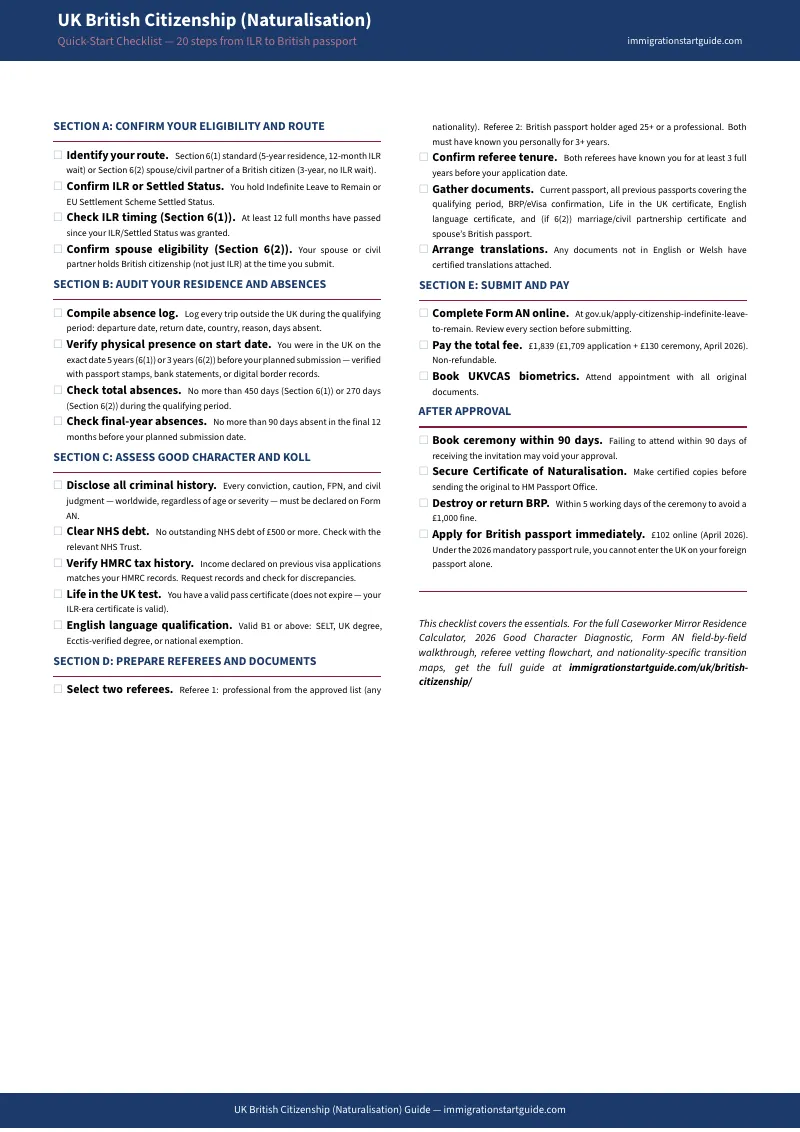
- Quick-Start Checklist — the complete 20-item action plan covering eligibility confirmation, residence audit, good character assessment, referee preparation, document assembly, and post-ceremony obligations
- Absence Tracking Worksheet — structured travel log for recording every trip outside the UK during your qualifying period, with columns for departure date, return date, days absent, and running totals against the 450-day and 90-day limits
- Good Character Self-Assessment — the six-category diagnostic in a printable fill-in format, mirroring the caseworker's evaluation categories
- Document Checklist — every required item for Section 6(1) and Section 6(2) applications with checkboxes and notes fields
- Referee Vetting Flowchart — the decision tree for confirming each referee meets the Home Office criteria, with the approved professions list
- Post-Ceremony Action Card — the BRP destruction deadline, passport application steps, and nationality-specific transitions on a single reference card
Who This Guide Is For
This guide is built for ILR holders and Settled Status holders who want to handle their naturalisation application without paying a solicitor £1,500 to £2,500 for work that is primarily administrative — but who also understand that a single counting error or disclosure failure costs £1,839 in non-refundable fees.
- You hold ILR and the 12-month waiting period is approaching. You want to submit the moment you are eligible, not six months later because you miscounted your absences and need to wait for a new qualifying window. The residence calculator shows you the earliest safe submission date based on your actual travel history.
- You are a spouse of a British citizen ready to apply under Section 6(2). You can apply immediately upon receiving ILR — no 12-month wait. But the 3-year qualifying period, the 270-day absence limit, and the requirement that your partner holds British citizenship (not just ILR) at the time you submit create a tighter timeline with less margin for error.
- You have a minor driving offence or an old parking fine and you are terrified. The 2025 Good Character guidance tightened the assessment. You need to know whether your situation requires full disclosure, delayed application, or is genuinely below the threshold. The diagnostic gives you a clear answer based on the current caseworker criteria — not forum anecdotes from people who applied under different rules.
- You are an Indian professional planning your OCI transition. India prohibits dual citizenship. The moment you receive your naturalisation certificate, you must surrender your Indian passport and apply for OCI status. There is a travel gap of 2 to 4 months. The guide maps the timing so you can coordinate your passport surrender, British passport application, and OCI application without being stranded.
- You are a South African who assumed you needed a Letter of Retention. The 2025 Constitutional Court ruling changed everything. You no longer need prior permission to naturalise. The guide explains the restoration process and the border control rules for entering South Africa as a dual national.
- You relied on Reddit or Immigration Boards and the advice contradicts itself. Someone who naturalised in 2022 tells you a council tax debt does not matter. Someone from 2025 says it triggers refusal. Both are right — for their year. The Home Office updates the caseworker guidance regularly, and advice based on a different version of the rules is worse than no advice at all.
This guide does not cover child registration (Section 3(1)), BN(O) or Windrush routes, or cases involving terrorism, national security, or complex asylum interactions. For those situations, you need a solicitor. For the overwhelming majority of ILR holders with clean records and straightforward residence histories, this guide gives you the same technical verification framework that a solicitor would apply — at a fraction of the cost.
Why Not Free Resources?
- GOV.UK publishes every rule. It does not explain how the rules interact. Guide AN describes the 90-day absence limit. It does not explain how the caseworker counts departure and arrival days. It does not warn you that the "Day 1" physical presence check is a separate assessment from the total absence count. The government pages assume you already understand the caseworker's evaluation framework — because the pages were written to describe the rules, not to help you pass them.
- Immigration solicitor blogs publish detailed analysis of every Good Character guidance update — because their business model depends on demonstrating that the system is too complex to navigate alone. The blog explains the risk. The solution is a £1,500 retainer. For a straightforward application, the solicitor's primary contribution is administrative verification — the same verification this guide provides.
- Reddit and Immigration Boards are where someone who naturalised in 2022 tells you that a Fixed Penalty Notice does not need disclosure. Under the current guidance, non-disclosure of an FPN is classified as "Deception" — an automatic refusal ground. Forum advice is experience-based, not rule-based. When the rules change, the experience becomes a trap.
- YouTube citizenship vlogs provide genuine emotional reassurance about the ceremony and the passport process. They rarely address the technical precision required for the residence calculation, the disclosure rules for the Good Character assessment, or the nationality-specific transitions that follow the ceremony. The emotional content helps after you apply. The technical content determines whether you succeed.
This guide fills the verification gap — the space between "I know the rules exist" and "I can confirm that my application passes every caseworker checkpoint before I commit £1,839 in fees that I will never get back."
— Less Than One Solicitor Phone Call
A 30-minute consultation with an immigration solicitor costs £100 to £300. Full-service naturalisation support runs £1,500 to £2,500. And the applicant still does the work — compiling the travel history, gathering the documents, finding the referees, filling out Form AN.
Your total naturalisation costs will exceed £1,839 in Home Office fees alone. Add the Life in the UK test (£50), the English language test (£150+), and the first British passport (£102 online). The administrative investment is substantial. This guide is the piece that determines whether that investment produces a certificate and a British passport — or a refusal letter and months of waiting to try again.
Money-back guarantee, no time limit. If the residence calculator, Good Character diagnostic, and referee vetting framework do not make your application materially stronger, you pay nothing.
Download the free Quick-Start Checklist to see the 20-item action plan and run your first absence count tonight. When you are ready for the complete Refusal-Proofing System — the field-by-field Form AN walkthrough, the nationality-specific transition maps, and the post-ceremony countdown — the full guide is here.
You spent years building this life. This guide makes sure the paperwork matches the achievement.