
You Have 65 Points, Seven Years of Experience, a BCom From UP — and No Idea Whether ACS Will Deduct Two Years or Four. Your SAPS Clearance Takes Up to Twelve Weeks. Your Invitation Window Is Sixty Days. And the Migration Agent Quoting R80,000 Cannot Write Your Career Episodes, Order Your Transcripts, or Make the Points Test Add Up Differently.
You have done the research. You know the 189 needs 95 points for software engineers, you know the 190 adds 5, and you know the 491 adds 15. You have a spreadsheet with your points and a gap that will not close. You have read every Home Affairs page, every MyBroadband thread, every Reddit post from someone who "got their grant in 8 months." You have bookmarked SkillSelect. You are ready to commit R90,000 to R350,000 in government fees, skills assessments, English tests, and medicals for your family.
And then the South African side of the process starts.
ACS deducts two years from your work experience if your degree is "closely related" to IT. Four years if it is not. Six years if they classify your qualification as non-ICT. That seven years of real experience? It might count as five. Or three. Or one. You will not know until you have paid the R6,875 assessment fee and waited eight weeks. If you chose the wrong ANZSCO code, you pay the full fee again.
Your BTech from a former Technikon is NQF Level 7 in South Africa. But Engineers Australia may assess it as AQF Level 6 — a diploma, not a degree. That costs you 5 education points and locks you out of professional-level occupation codes. Nobody told you this before you applied.
Your SAPS police clearance is quoted at 15 working days. The Criminal Record Centre backlog pushes it to four to twelve weeks. It is valid for twelve months. Your SAQA verification takes ninety working days. Your PTE score is valid for three years. Your medical results feed directly into eMedical. When you finally receive an invitation, you have exactly sixty days to lodge a complete application with every document current, certified, and uploaded in the correct format — or the invitation expires and you go back into the pool.
The Australian side of skilled migration is well documented. The South African side — the ACS deductions, the NQF-to-AQF mapping, the SAPS bottleneck, the SAQA delay, the SARB transfer limits, the SARS exit tax — is where applications stall, points calculations collapse, and families lose months they cannot get back.
The South Africa to Australia Skilled Migration Guide is the SA-to-AU Points Maximiser — built specifically for South African professionals navigating the 189, 190, and 491 visa subclasses from within the South African administrative system. This is not a translation of the Home Affairs website. This is the complete filing system covering the NQF-to-AQF qualification mapping table with the BTech assessment trap that costs engineers 5 points, profession-specific skills assessment walkthroughs for ACS, Engineers Australia, VETASSESS, TRA, ANMAC, AITSL, and CPA Australia, the points test marginal gains strategy for South African profiles, the SAPS police clearance timing method that prevents the sixty-day sprint panic, SA employer reference letter templates formatted for Australian case officers, the state nomination Offshore Strategy Matrix showing which states are pro-offshore and which occupations have the lowest thresholds, the NAATI CCL Afrikaans pathway for 5 bonus points, the complete cost breakdown in ZAR for singles and families, SARB exchange controls and SARS exit tax planning, and the post-grant settlement chapter covering dual citizenship retention, passport renewal from Australia, and the first ninety days after landing.
What's Inside the SA-to-AU Points Maximiser
Ten chapters, a quick-start checklist, and the qualification mapping and state nomination tools that no other guide provides — covering every step from your first points calculation through your first week in Australia:
The Points Test Strategy for South African Profiles
The points test is not a form — it is the ranking mechanism that determines whether you receive an invitation at all. The guide breaks down every scoring category with South African-specific analysis: the NQF-to-AQF qualification mapping that determines whether your degree scores 10, 15, or 20 points, the age cliff warnings at 33, 40, and 45, and the "marginal gains" strategy that identifies the five highest-leverage improvements for a typical South African applicant. A worked example follows a 31-year-old developer with a BCom Informatics from UP through the scoring — 70 own points, not competitive for 189, but 95 with a PTE retake and a 491 nomination. Those 25 points do not appear by accident. They come from knowing exactly where to find them.
The NQF-to-AQF Qualification Mapping Table
No other migration resource provides this. Australian assessing authorities do not accept South African NQF levels at face value — they examine the structure, duration, and learning outcomes of your degree. The guide includes the complete mapping from National Certificate (NQF 5) through Doctorate (NQF 10), with the corresponding AQF level, migration points, and risk notes for each. The BTech warning is here: if your BTech was built on top of a National Diploma, Australian authorities may assess it as AQF Level 6 instead of Level 7, costing you 5 points and excluding you from professional occupation codes. The guide explains how to mitigate this — including the SAQA evaluation certificate strategy and the Sydney Accord pathway through Engineers Australia — before you pay the assessment fee and discover the problem.
Profession-Specific Skills Assessment Walkthroughs
Seven separate walkthroughs for the assessing authorities South African professionals actually face. ACS for IT professionals — the experience deduction table, the "closely related" versus "not closely related" classification, the RPL pathway for self-taught developers, and the ANZSCO code selection that determines which occupation list you compete on. Engineers Australia — the Washington Accord shortcut for BEng holders from accredited programs, the CDR writing requirements for BTech holders (budget forty to eighty hours), and the Professional Engineer versus Engineering Technologist distinction. VETASSESS for general professionals. TRA for tradespeople. ANMAC for nurses, including the SANC verification bottleneck. AITSL for teachers, including the asymmetric English requirement. CPA Australia for accountants, including the Australian taxation law gap that every SA-qualified accountant must bridge. Each walkthrough includes the assessment fee in ZAR, processing time, and the specific pitfalls for South African applicants.
The English Language 20-Point Strategy
You speak English natively. It does not matter — you still need a formal test score, and the difference between Proficient (10 points) and Superior (20 points) is the single highest-leverage improvement most South African applicants can make. The guide covers why PTE Academic is the preferred test for South Africans, the score thresholds, test locations and costs in Johannesburg, Pretoria, Cape Town, and Durban, and the NAATI CCL Afrikaans pathway that awards 5 bonus migration points for a single online test at R10,175. For an applicant stuck at 80 points, those 5 NAATI points plus a PTE retake from Proficient to Superior can add 15 points — enough to transform a hopeless 189 into a competitive 491.
The South African Document Extraction Guide
This is the chapter that no Australian migration resource covers properly. The SAPS police clearance process, including the all-previous-surnames requirement that catches married applicants, the standard versus expedited options (R190 to R6,900), and the twelve-month validity window that determines when to start. SAQA verification — ninety working days standard, the expedited option, and whether your assessing authority actually requires it. Ordering transcripts from UNISA (four to eight weeks), Wits, UCT, and the merger-era institutions where Technikon Witwatersrand became UJ and you apply to the successor university. Document certification — Commissioner of Oaths versus Notary Public, why the Notary costs R100 to R300 more but eliminates any risk of rejection, and the colour scan at 300 dpi minimum requirement that catches applicants who use black-and-white scans or smartphone photos.
The State Nomination Offshore Strategy Matrix
State nomination is what transforms marginal applications into successful ones. But not all states are equally receptive to offshore South African applicants, and the 2025-2026 program year has introduced dramatic shifts. Queensland has increased its allocation by 117 percent and is actively seeking offshore applicants in healthcare, engineering, and IT. New South Wales has cut by 28 percent and favours high-points onshore applicants. Victoria cut by 32 percent. South Australia cut by 41 percent. Western Australia cut by 32 percent but Perth is classified as regional — meaning a WA 491 gives you 15 bonus points and lets you live in a major city. The guide provides the state-by-state analysis with occupation alignment, processing times, and offshore friendliness ratings so you target the states where your occupation and profile have the best chance, not just the states you have heard of.
The 60-Day Post-Invitation Sprint
When you receive an invitation, you have sixty calendar days to lodge a complete application through ImmiAccount. Miss it and you go back into the pool. The guide covers ImmiAccount setup, document upload naming conventions that prevent case officer delays, employment reference letter templates in the format Australian authorities require — because the standard South African reference letter that says "we wish him well in his future endeavours" is not enough. Each letter must include company letterhead, your full name and title, start and end dates, weekly hours, detailed duties aligned to your ANZSCO code, and salary. The guide includes the template so you can draft it yourself and present it to your employer for signing. It also covers Form 80 — every address, every trip, every employer for ten years — and the medical examination at panel physicians in Johannesburg, Pretoria, and Cape Town, including the TB X-ray that every South African applicant requires because of South Africa's high-TB classification.
The Complete Cost Breakdown in ZAR
Not in AUD with a footnote about exchange rates. In ZAR, with separate tables for single applicants (R90,000 to R110,000) and families of four (R150,000 to R350,000). The visa application charge alone is R61,375 for the primary applicant. Skills assessments range from R3,750 to R15,625 depending on the authority. English tests cost R4,300 to R6,200 per attempt. The guide includes the migration agent versus DIY cost comparison — agents charge R50,000 to R120,000, but they do not write your CDR, they do not order your transcripts, they do not sit your PTE, and they do not stand in the SAPS queue for you.
SARB Exchange Controls and SARS Exit Tax Planning
Moving to Australia triggers South African financial implications that most migration guides ignore entirely. The R1 million Discretionary Allowance and the R10 million Foreign Investment Allowance — which requires a TCS pin from SARS. The "deemed disposal" exit tax on worldwide assets under CGT rules. The forex transfer strategy that saves R5,000 to R15,000 compared to your bank's standard forex desk. The timing strategy based on the South African tax year. The guide covers the practical steps so you understand the financial side before you leave, not after your income is frozen in a Non-Resident account you did not set up properly.
Post-Grant Settlement Preparation
Dual citizenship retention — you must apply before acquiring Australian citizenship or you automatically lose your SA citizenship. SA passport renewal from Australia — budget six to twelve months through the High Commission, not the six weeks it takes in South Africa. Banking transition from FNB, Standard Bank, ABSA, Nedbank, or Capitec to the Big Four Australian banks, most of which allow remote account opening with a visa grant letter. Pension and retirement fund access, including the R550,000 tax-free withdrawal threshold and the retirement annuity lock until age 55. And the first ninety days — TFN application, Medicare registration, driver's licence exchange, and the Australian resume format that drops the photo, date of birth, and marital status your South African CV includes.
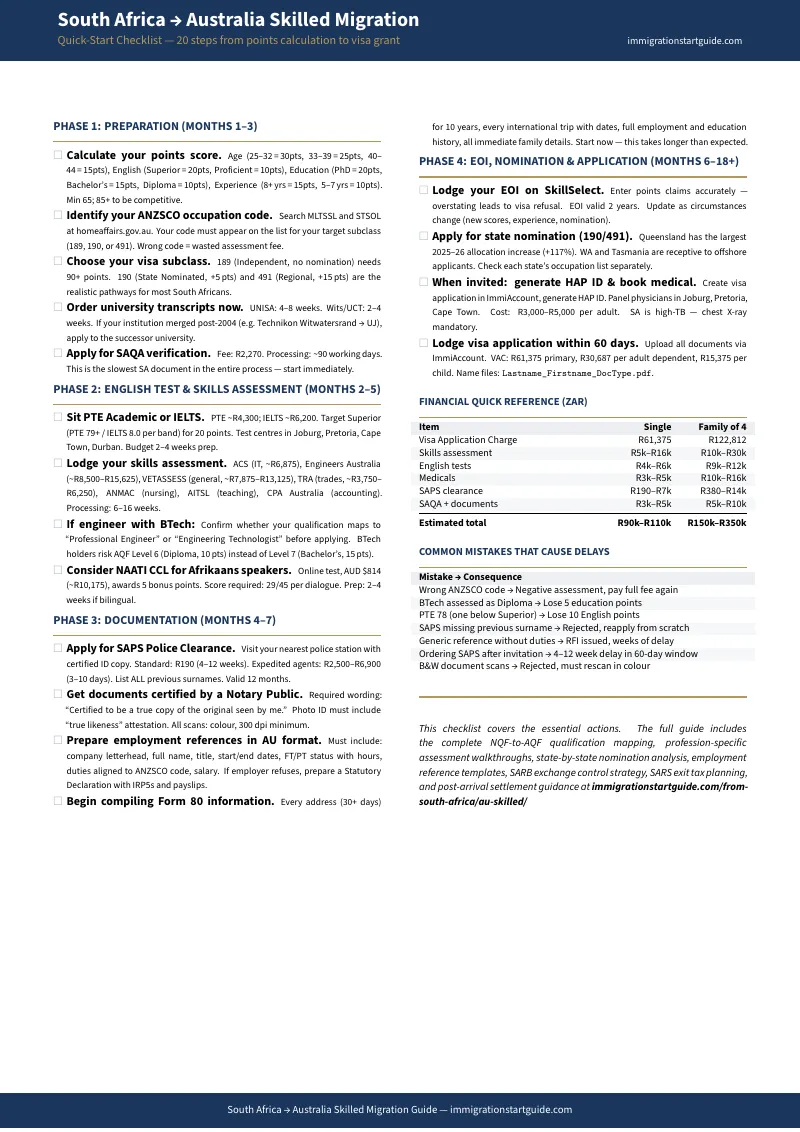
Quick-Start Checklist (free download)
Twenty critical actions distilled into a single action sheet organised across four phases: Preparation, English Test and Skills Assessment, Documentation, and EOI through to Application. Enough to calculate your points tonight, identify your ANZSCO code, and start ordering the long-lead documents — because the SAQA verification alone takes ninety working days, and every week you delay is a week added to a timeline that already stretches eighteen to thirty-six months.
Who This Guide Is For
This guide is for South African skilled professionals applying for the 189, 190, or 491 visa from within South Africa:
- IT professionals in Johannesburg, Pretoria, or Cape Town dealing with ACS experience deductions, ANZSCO code selection, and invitation thresholds that have climbed to 95 points for software engineers — you need the deduction table, the RPL pathway details, and the state nomination strategy that adds 5 or 15 points to a score that is not competitive on its own.
- Engineers with a BTech who risk being assessed at AQF Level 6 instead of Level 7 — you need the NQF-to-AQF mapping table, the BTech mitigation strategy, the Sydney Accord versus CDR pathway comparison, and the ANZSCO code implications before you pay the R8,500 to R15,625 assessment fee and discover you are classified as a Technologist instead of a Professional Engineer.
- Nurses navigating the ANMAC assessment and the SANC verification bottleneck, teachers facing AITSL's asymmetric English requirement, accountants bridging the Australian taxation law gap through CPA Australia — you need the profession-specific walkthrough for your authority, not generic "lodge your skills assessment" advice.
- Families facing R150,000 to R350,000 in total costs who need the ZAR breakdown, the SARB transfer strategy, and the SARS exit tax planning — not an AUD figure with a "check the current exchange rate" footnote.
- Applicants weighing the migration agent question — whether to pay R50,000 to R120,000 for a firm to manage the filing — you need to understand that the agent does not write your CDR, does not order your SAPS clearance, does not sit your PTE, and does not draft the employment reference letters that Australian case officers actually require. The hardest parts of this application fall to you regardless. The question is whether you have the procedural knowledge to do them correctly.
This guide is not for: employer-sponsored visa applicants (Subclass 482 or 494 — those require a sponsoring employer and follow different rules), students transitioning to PR after graduating from an Australian university (the onshore student pathway has its own dynamics), or business/investor visa applicants. If you are considering the UK instead, see the South Africa to UK Ancestry Visa Guide.
Why Not Free Resources or a Migration Agent?
Free information about Australian skilled migration exists. Here is what it actually covers:
- homeaffairs.gov.au lists the visa subclasses, the points test categories, and the document requirements. It does not explain how ACS deductions interact with South African IT qualifications, how to mitigate the BTech assessment trap, how to time your SAPS clearance so it does not expire before your invitation arrives, or how to draft employment reference letters in the format case officers require. The Australian government tells you what they need. It does not tell you how to extract it from the South African system.
- MyBroadband and Reddit's r/AusVisa give you anecdotes. One person's ACS assessment took six weeks. Another waited sixteen. A third was assessed at AQF Level 6 for their BTech. Each story is real. None tells you which scenario applies to your qualification, your ANZSCO code, or your state nomination target. The advice is scattered across hundreds of threads, often years out of date, and written by applicants who may or may not have received a grant.
- Migration agents charge R50,000 to R120,000 on top of R90,000 or more in government fees. They review your documents and lodge your application. They do not write your Engineers Australia Career Episodes — those forty to eighty hours of writing fall to you. They do not order your SAPS clearance or SAQA verification. They do not sit your PTE. They do not draft the detailed employment reference letter your HR department has never produced before. The tasks where South African applicants actually fail are document preparation and timeline management. An agent adds a review layer, not the procedural knowledge itself.
This guide fills the gap between "I meet the points threshold" and "my visa is granted" — the space where South African professionals fail because ACS deducted four years instead of two, because their BTech was assessed as a diploma, because their SAPS clearance expired during the sixty-day sprint, because their employment reference letter said "we wish him well" instead of listing duties aligned to an ANZSCO code, or because they transferred R500,000 through their bank's forex desk at a 3 percent spread and lost R15,000 in hidden costs.
— Less Than One Hour of a Migration Agent's Time
A migration agent consultation costs R1,000 to R2,000 per hour. A full-service engagement runs R50,000 to R120,000. The visa application charge alone is R61,375 for the primary applicant. For a family of four, total government fees reach R150,000 to R350,000. A mistake — the wrong ANZSCO code, a BTech assessed as a diploma, a SAPS clearance missing a previous surname — does not just delay you. A negative skills assessment means paying the full fee again. An expired document during the sixty-day sprint means losing your invitation and going back into the EOI pool. A visa refusal can trigger a ban on future applications.
This guide costs less than one hour of a migration agent's consultation fee, and it covers the complete SA-to-AU pathway: the NQF-to-AQF mapping table, seven profession-specific assessment walkthroughs, the state nomination strategy, the sixty-day sprint checklist, the employment reference templates, the SARB exchange controls, and the SARS exit tax planning. The qualification mapping table alone can save you 5 points you did not know you were losing. The state nomination matrix can add 5 or 15 points to a score that is not competitive without it. The SAPS timing strategy prevents the clearance expiry that forces applicants to restart a twelve-week process during a sixty-day window.
You have the qualifications. You have the experience. You have the English. You have the professional skills Australia is actively seeking through a migration program that allocates 82,900 skilled places for 2025-2026. What stands between you and a visa grant is not eligibility — it is the gap between the South African administrative system and the Australian points-based system that will evaluate you. The ACS deduction. The ANZSCO code. The NQF-to-AQF mapping. The SAPS timeline. The state nomination target. The sixty-day sprint. Every one of these is solvable. Every one of them, if mishandled, costs you months, tens of thousands of rands, or the visa itself.
Money-back guarantee, no time limit. If the NQF-to-AQF mapping table, the profession-specific assessment walkthroughs, the state nomination Offshore Strategy Matrix, the sixty-day sprint checklist, and the SARB/SARS financial planning chapter do not make your skilled migration application stronger than anything you could assemble from Home Affairs pages, MyBroadband threads, and agent consultations, you pay nothing.
Download the free Quick-Start Checklist to calculate your points tonight, identify your ANZSCO occupation code, and understand the eighteen-to-thirty-six-month timeline from first document to visa grant. When you are ready for the complete SA-to-AU Points Maximiser — the full guide with the qualification mapping, the profession walkthroughs, the state nomination matrix, the reference letter templates, and the financial planning — the full guide is here.
Your qualifications earned you the right to apply. The points test, the skills assessment, and the sixty-day sprint are the only things standing between you and permanent residency in Australia. Start the process today — because every month you wait is a month closer to the next age cliff, the next state allocation cut, and the next invitation threshold increase.