
You Have a Bachelor's Degree From Wits, Six Years of Engineering Experience, a Job Lead in Auckland — and No Idea Whether NZQA Will Map Your Degree to Level 7 or Level 8, Whether Your Occupation Is Green List Tier 1 or Tier 2, or Whether Your SAPS Clearance Will Arrive Before Your Job Offer Expires. The Licensed Immigration Adviser Quoting NZD $5,000 Cannot Obtain Your Police Clearance, Order Your Unabridged Birth Certificate, or Make the 6-Point System Add Up Differently.
You have done the research. You know the Skilled Migrant Category needs 6 points. You know a Bachelor's degree gives you 3 points and you need 3 more years of New Zealand work experience to make up the difference — unless your occupation is on the Green List, in which case you might get Straight to Residence. You have read the Immigration New Zealand website, joined the "South Africans in New Zealand" Facebook group, scrolled through Reddit threads, and maybe even bookmarked the NZQA qualification assessment page. You are ready to commit R450,000 to R650,000 in visa fees, qualification assessments, flights, shipping, and settlement funds for your family.
And then the South African side of the process starts.
Your SAPS police clearance costs R190 at the station. The Criminal Record Centre in Pretoria takes 4 to 12 weeks to process it. It is valid for 6 months. Your NZQA International Qualification Assessment costs NZD $746 and takes 10 weeks. Your unabridged birth certificate from Home Affairs takes 8 weeks to 6 months — and if you were born before 2013 or changed your name at marriage, you may need a Vault Copy from the Pretoria archives. Your medical examination results expire. Your IELTS score expires. Your job offer has a start date. When these timelines collide, you either have every document current and certified — or you are paying R6,900 for an expedited SAPS clearance while your employer wonders whether to withdraw the offer.
Your Honours degree from a South African university is NQF Level 8. But NZQA may or may not recognise it at NZQF Level 8 — Honours degrees are frequently excluded from the automatic exemption list and almost always require a full IQA to confirm Level 8 equivalence. That is the difference between 4 base points and 3 base points — the difference between needing 2 years of NZ work experience and needing 3 years. You will not know until you have paid NZD $746 and waited 10 weeks. For South African engineers with a four-year BEng, the degree might actually map to Level 8 through the IQA — giving you a point advantage you did not know existed.
The New Zealand side of skilled migration is well documented. The South African side — the NZQA qualification mapping, the SAPS clearance bottleneck, the Home Affairs document delays, the HPCSA Certificate of Status for healthcare workers, the ECSA-to-Engineering NZ registration pathway, the SARB exchange controls, and the SARS financial emigration process — is where applications stall, timelines collapse, and families lose months they cannot get back.
The South Africa to New Zealand Skilled Migrant Guide is the SA-to-NZ Migration Roadmap — built specifically for South African professionals navigating the Skilled Migrant Category, Green List, and Accredited Employer Work Visa pathways from within the South African administrative system. This is not a translation of the Immigration New Zealand website. This is the complete filing system covering the NZQF qualification mapping table showing exactly how your South African degree translates into SMC points (with the Honours degree assessment trap that can cost you a full point), profession-specific registration walkthroughs for Engineering NZ, CA ANZ, Medical Council, Nursing Council, and the Teaching Council, the SAPS police clearance timing strategy that prevents the 6-month expiry from torpedoing your application, the accredited employer job search playbook with CV conversion templates for the Kiwi market, the complete cost breakdown in ZAR for singles and families, SARB exchange controls and SARS tax clearance planning, and the Green List Tier 1 versus Tier 2 strategy that determines whether you arrive as a permanent resident or spend 24 months on a work visa first.
What's Inside the SA-to-NZ Migration Roadmap
Ten chapters, a quick-start checklist, and the qualification mapping and professional registration walkthroughs that no other guide provides — covering every step from your first points calculation through your first week in New Zealand:
The 6-Point System Strategy for South African Profiles
The new Skilled Migrant Category is built on a simplified 6-point threshold — but the simplicity is deceptive. A South African Bachelor's degree gives you 3 points. A Master's gives you 5 points. A PhD gives you 6 points outright. But an Honours degree? It depends on the IQA result. And your professional registration might give you more points than your degree — if you know which pathway to claim. The guide breaks down every scoring pathway with South African-specific analysis: the qualification pillar, the occupational registration pillar, the income pillar (1.5x, 2x, or 3x the NZD $35/hr median wage), and the NZ work experience supplement that bridges the gap. A worked example follows a 32-year-old software engineer from Johannesburg with a BSc from Wits through the scoring — 3 qualification points, Green List Tier 1 eligibility for Straight to Residence, zero NZ work experience required. Those three extra points do not come from luck. They come from knowing which pillar to claim.
The South African Qualification to NZQF Mapping Table
No other migration resource provides this. The NZQA does not accept South African NQF levels at face value — they examine the structure, duration, and research depth of your specific degree from your specific institution. The guide includes the complete mapping from the LQEA exemption list (UCT, Wits, Pretoria, Stellenbosch, UNISA, UJ, Rhodes, UKZN — Bachelor's from 2009, Master's from 2012) to the full IQA process for non-exempt degrees. The Honours warning is here: your four-year Honours degree is NQF Level 8 in South Africa, but it is almost always excluded from the automatic NZQF Level 8 exemption and requires a formal IQA (NZD $746, 10 weeks). Conversely, if your four-year professional degree (BEng, MBBCh) includes a significant research component, the IQA might assess it at NZQF Level 8 — giving you 4 points instead of 3. The guide explains how to navigate this before you pay the fee and discover the outcome.
Profession-Specific Registration Walkthroughs
Five separate walkthroughs for the professional bodies South African applicants actually face. Engineering — the Washington Accord shortcut for ECSA-accredited BEng holders, the competency assessment for Chartered Professional Engineer (CPEng) status, and the 8-to-10-week processing timeline. Accounting — the SAICA-to-CA ANZ reciprocal membership pathway, the Letter of Good Standing requirement (within 3 months), and the 40-business-day processing. Healthcare — the HPCSA Certificate of Status that costs R6,700 for overseas courier, the MCNZ registration pathways for doctors, the CGFNS verification for nurses (USD $300), and the NCNZ competence assessment including the in-person OSCE exam. Teaching — the SACE-to-Teaching Council pathway, the Teaching IQA, and the distinction between Tier 1 (secondary teachers, immediate residence) and Tier 2 (primary and ECE teachers, 24-month work requirement). Each walkthrough includes fees in both NZD and ZAR, processing times, and the specific South African documentation pitfalls.
The South African Document Extraction Guide
This is the chapter no New Zealand migration resource covers properly. The SAPS police clearance process, including the Form 91(a) fingerprint submission, the all-previous-surnames requirement that catches married applicants, the standard versus expedited options (R190 standard at 4-12 weeks, R3,000-R6,900 expedited at 3-20 days through agents like Apostil.co.za), and the 6-month validity window that determines when to start. Unabridged certificates from the Department of Home Affairs — birth certificates (8 weeks to 6 months), marriage certificates, the Vault Copy requirement for pre-2013 births or name discrepancies. Medical examinations — INZ-approved panel physicians in Johannesburg, Pretoria, Cape Town, and Durban, the TB chest X-ray that every South African applicant requires because of South Africa's high-TB classification, and the eMedical system that submits results directly to INZ.
The Accredited Employer Job Search Playbook
The most significant hurdle for South Africans is the reluctance of New Zealand employers to hire offshore candidates. The guide covers the Accredited Employer Work Visa (AEWV) system — which employers are eligible to sponsor you, the Job Check process, and the Green List exemption that streamlines hiring for shortage occupations. The CV conversion guide that transforms a 5-page South African CV into the 2-page Kiwi format New Zealand recruiters expect — results-focused, ATS-compliant, with LinkedIn references instead of "available on request." The recruitment agency ecosystem: Robert Walters for IT and finance, TRS for engineering, HealthStaff Recruitment for nursing. And the interview resilience strategy — because a load-shedding power outage during a Zoom interview with an Auckland hiring manager at 10 PM South African time is not a theoretical risk.
The Green List Strategy: Tier 1 vs Tier 2
The Green List bypasses the standard SMC points system for occupations in critical shortage. Tier 1 (Straight to Residence) lets you apply for permanent residency with a job offer — no work-in-NZ requirement. Tier 2 (Work to Residence) requires 24 months of skilled work first. The guide covers every Green List occupation relevant to South African professionals — engineers, software developers, registered nurses, midwives, surgeons, GPs, psychiatrists, secondary teachers, electricians, plumbers, dairy farm managers — with their current Tier status, salary requirements, and the registration bottleneck for each. The critical detail: the Green List is dynamic. Occupations move between Tier 1 and Tier 2 as shortages shift. The guide provides the current 2025-2026 classification and explains how to verify your occupation's status before committing to a pathway.
The Complete Cost Breakdown in ZAR
Not in NZD with a footnote about exchange rates. In ZAR, with separate tables for single applicants and families of four. The SMC visa fee alone is NZD $6,450 (R77,400). The NZQA IQA costs NZD $746 (R9,000). Medical exams for a family of four cost NZD $1,500-$2,000 (R18,000-R24,000). Shipping a three-bedroom house costs R83,000-R137,000. Pet relocation costs R16,000-R23,000. The guide includes the total migration capital calculation: R450,000 to R650,000 for a family of four. It also includes the immigration adviser versus DIY cost comparison — advisers charge NZD $3,000-$8,000 (R36,000-R96,000), but they do not obtain your SAPS clearance, they do not order your unabridged certificates, they do not sit your IELTS, and they do not write your professional registration application.
SARB Exchange Controls and SARS Tax Planning
Moving to New Zealand triggers South African financial implications that most migration guides ignore entirely. The R1 million Single Discretionary Allowance per year without a tax clearance certificate. The Approval for International Transfers (AIT) process via SARS for amounts exceeding R1 million. The 2025-2026 tightening of SARB compliance requirements for remittances to non-residents. The guide covers the practical financial transfer steps so you understand the SARB process before you leave, not after your income is frozen in an account you cannot access from Auckland.
NZ vs Australia Comparison for South Africans
The primary secondary decision for South African professionals. Australia offers higher salaries but a competitive points system requiring 85-95 points for an invitation, an age cap at 45, and a 5-year Resident Return Visa renewal cycle. New Zealand offers a fixed 6-point threshold (meet it and you are in), ages up to 55, Straight to Residence for Tier 1 Green List occupations, and a lifelong Permanent Resident Visa with no renewal. The guide provides the head-to-head comparison — residency speed, cost, lifestyle, safety, SA community size — so you can make the decision with data instead of anecdotes.
Post-Arrival Settlement Guide
Bank account activation at ANZ, BNZ, or Westpac — pre-opened from South Africa but deposit-only until you visit a branch with your passport and visa. IRD number application. Driver's licence conversion — South Africa is an exempt country, so your SA licence converts without a practical test. School enrolment with the zone and Equity Index system. GP registration and the ACC no-fault injury system. The first 90 days, chapter by chapter, so you are not figuring out administrative basics while adjusting to a new country.
Quick-Start Checklist (free download)
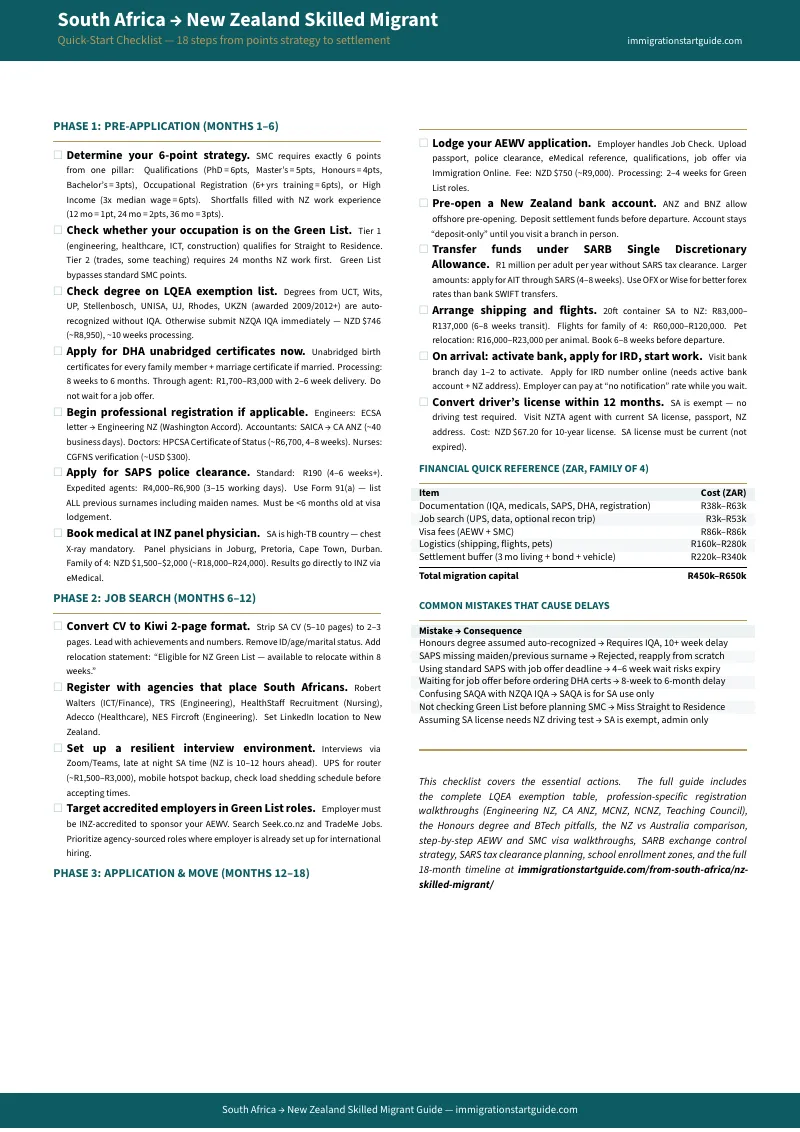
Fifteen critical actions distilled into a single action sheet organised across three phases: Pre-Application (months 1-6), Job Search (months 6-12), and Application and Move (months 12-18). Enough to check whether your degree is on the NZQA exemption list, identify your Green List status, and start ordering the long-lead documents — because the NZQA assessment alone takes 10 weeks, the SAPS clearance takes 4 to 12 weeks, and the DHA unabridged certificate takes 8 weeks to 6 months.
Who This Guide Is For
This guide is for South African skilled professionals applying for the NZ Skilled Migrant Category or Green List Resident Visa from within South Africa:
- Engineers with ECSA registration who need to understand the Washington Accord pathway to Engineering New Zealand, the CPEng competency assessment, and whether their BEng maps to NZQF Level 7 or Level 8 — because that single-level difference determines whether they need 3 years of NZ work experience or 2.
- IT professionals and software developers on the Green List Tier 1 who can apply for Straight to Residence but need the accredited employer strategy, the CV conversion from 5-page SA format to 2-page Kiwi style, and the offshore job search playbook to actually secure the job offer that activates the pathway.
- Nurses and doctors navigating the HPCSA Certificate of Status (R6,700 courier fee), the CGFNS verification (USD $300), the MCNZ or NCNZ registration, and the in-person OSCE competence exam — the most demanding professional registration pathway of any occupation.
- Teachers determining whether their role is currently Tier 1 or Tier 2, obtaining the Teaching IQA from NZQA, and registering with the Teaching Council for a Tōmua (Provisional) Practising Certificate.
- Chartered accountants using the SAICA-to-CA ANZ reciprocal membership — one of the most streamlined pathways available, but with specific Letter of Good Standing requirements and a 40-business-day processing window.
- Families facing R450,000 to R650,000 in total costs who need the ZAR breakdown, the SARB transfer strategy, and the DHA document timing plan — not an NZD figure with a "check current exchange rate" footnote.
This guide is not for: visitor or tourist visa applicants, Working Holiday visa holders (different age and nationality requirements), business/investor visa applicants (Subclass Investor 1 and Investor 2 follow different rules), or applicants already in New Zealand transitioning from a student or work visa to residence (the onshore pathway has its own dynamics). If you are considering Australia instead, see the South Africa → Australia Skilled Migration Guide.
Why Not Free Resources or an Immigration Adviser?
Free information about New Zealand skilled migration exists. Here is what it actually covers:
- immigration.govt.nz lists the visa categories, the points system, and the document requirements. It does not explain how South African Honours degrees interact with the NZQF exemption list, how to time your SAPS clearance so it does not expire before your application is processed, how to draft the employment reference letter in the format INZ case officers require, or how to navigate the HPCSA Certificate of Status process from a different province. The New Zealand government tells you what they need. It does not tell you how to extract it from the South African system.
- Facebook groups and Reddit give you anecdotes. One person's SAPS clearance took 3 weeks. Another waited 4 months. A third had their NZQA IQA downgraded from Level 8 to Level 7. Each story is real. None tells you which scenario applies to your qualification, your institution, or your graduation year. The advice is scattered across hundreds of threads, often outdated, and written by applicants operating on survivor bias — they remember the relief of getting the visa, not the specific technical hurdles they cleared months earlier.
- Licensed Immigration Advisers charge NZD $3,000 to $8,000 (R36,000-R96,000) on top of the NZD $6,450 visa fee. They review your documents and lodge your application. They do not obtain your SAPS police clearance. They do not order your unabridged birth certificate from Home Affairs. They do not sit your IELTS. They do not write your ECSA-to-Engineering NZ registration application. They do not draft your CGFNS nursing verification. The tasks where South African applicants actually fail are document gathering and professional registration — and an adviser adds a review layer, not the procedural knowledge itself.
This guide fills the gap between "I meet the 6-point threshold" and "my residence visa is granted" — the space where South African professionals fail because NZQA assessed their Honours at Level 7 instead of Level 8, because their SAPS clearance expired while they waited for the NZQA result, because their employment reference letter said "we wish her well" instead of listing duties aligned to an ANZSCO code, because the HPCSA took 3 months to issue a Certificate of Status, or because they transferred R500,000 through their bank's forex desk at a 3% spread and lost R15,000 in hidden fees.
— Less Than One Hour of an Immigration Adviser's Time
A Licensed Immigration Adviser consultation costs NZD $200-$500 per hour. A full-service engagement runs NZD $3,000-$8,000 (R36,000-R96,000). The visa application fee alone is NZD $6,450 (R77,400). For a family of four, total government fees and relocation costs reach R450,000-R650,000. A mistake — a SAPS clearance that expires before submission, an NZQA assessment that maps your degree to the wrong level, a professional registration application that is rejected because of a missing HPCSA Certificate of Status — does not just delay you. A negative qualification assessment means paying the full NZD $746 fee again. An expired document means restarting a process that took months. A visa decline can affect future applications.
This guide costs less than one hour of an immigration adviser's consultation fee, and it covers the complete SA-to-NZ pathway: the qualification mapping table, five profession-specific registration walkthroughs, the SAPS and DHA document timing strategy, the accredited employer job search playbook with CV conversion templates, the complete cost breakdown in ZAR, the SARB exchange controls, the NZ vs Australia decision framework, and the post-arrival settlement chapter. The qualification mapping table alone can reveal a point you did not know you had — or prevent a 10-week wait that ends with the wrong assessment. The document timing strategy prevents the clearance expiry that forces applicants to restart a 4-to-12-week process while their job offer ticks toward its deadline.
You have the qualifications. You have the experience. You have the English. You have the professional skills New Zealand is actively recruiting through the Green List and Skilled Migrant Category. What stands between you and a residence visa is not eligibility — it is the gap between the South African administrative system and the New Zealand immigration system that will evaluate you. The NZQA assessment. The SAPS clearance. The professional registration. The accredited employer requirement. The document timing. Every one of these is solvable. Every one of them, if mishandled, costs you months, tens of thousands of rands, or the visa itself.
Money-back guarantee, no time limit. If the qualification mapping table, the profession-specific registration walkthroughs, the SAPS and DHA timing strategy, the accredited employer playbook, and the SARB/SARS financial planning chapter do not make your skilled migration application stronger than anything you could assemble from Immigration NZ pages, Facebook groups, and adviser consultations, you pay nothing.
Download the free Quick-Start Checklist to check whether your degree is on the NZQA exemption list, identify your Green List Tier status, and understand the 18-month timeline from first document to visa grant. When you are ready for the complete SA-to-NZ Migration Roadmap — the full guide with the qualification mapping, the registration walkthroughs, the document timing strategy, the job search playbook, and the financial planning — the full guide is here.
Your qualifications earned you the right to apply. The 6-point system, the NZQA assessment, and the South African document gauntlet are the only things standing between you and permanent residency in New Zealand. Start the process today — because every month you wait is a month closer to the next Green List revision, the next median wage adjustment, and the next SAPS clearance backlog.