
You Found a Program That Grants Permanent Residency Without a Net Worth Requirement, Without a Passive Investment, Without a Condition That Your Business Succeeds. Then You Discovered That 46,000 Applications Are in the Backlog, Non-Priority Applicants Wait 10+ Years, and Bill C-12 Can Cancel Your File Without Review. This Guide Turns Confusion Into a Priority-Tier Strategy.
You already know the Start-Up Visa exists. You read the IRCC page, confirmed you need a Letter of Support from a designated organization, a CLB 5 language score, and settlement funds. You understand that up to five co-founders can apply under one business. You know that PR is unconditional — if the startup fails, your residency stands.
And then the reality set in. The program suspended new intake on January 1, 2026. If you hold a 2025 commitment certificate, you have until June 30, 2026 to file. If you do not, you are preparing for a replacement "High-Impact Entrepreneur Pilot" that has not been announced yet. IRCC publishes a list of 56 designated organizations, but only 12 incubators receive Priority Processing — and the website does not tell you which 12. The difference between choosing a priority incubator and a non-priority one is the difference between a 3-year wait and a decade-long queue that Bill C-12 may cancel entirely.
You checked Reddit. Someone recommended an incubator that charges $40,000 for a Letter of Support. Another poster warned that the same incubator had cohort members refused for "non-artificial transaction" — IRCC concluded the business was created to acquire immigration, not to build a company. A YouTube video from 2024 walked through the application forms but did not mention that Ministerial Instructions MI72 now cap each incubator at 10 group applications per year. A Canadavisa thread from 2023 described a 37-month processing time — for a priority applicant. Non-priority applicants in that same thread are still waiting.
Here is the problem no free resource will solve: the SUV is the only immigration program where your choice of sponsor determines whether your application is processed in 3 years or 10, and where a single team member's inadmissibility can destroy five families' immigration plans simultaneously. The IRCC website lists the rules. It does not tell you how to pitch a designated organization like a venture investor, which of the 12 priority incubators match your sector, how to structure a founding team to avoid the "Essential Person" cascade failure, or what the seven fatal errors are that account for 89% of all SUV rejections.
The Canada Start-Up Visa Guide is a Priority Path System — built to solve the three problems that separate qualified entrepreneurs from permanent residency: identifying and securing a priority-tier designated organization, structuring your team and application to avoid the seven grounds that cause 89% of rejections, and positioning your file for maximum processing priority in a system where backlog management is the defining challenge of 2026.
What's Inside the Priority Path System
12 chapters + 2 appendices + the quick-start checklist + 6 standalone printable tools — the complete guide covering designated organization strategy, the Innovation Standard, team structuring, the priority processing hierarchy, Bill C-12 risk mitigation, the seven fatal application errors, the complete cost breakdown, and a 90-day execution plan. Plus standalone worksheets you can print and use at your desk: the Priority Incubator Card, the Rejection Prevention Card, the Document Checklist, the Cost Breakdown Worksheet, the Team Structure Worksheet, and the 90-Day Execution Plan:
Designated Organization Strategy (Chapter 3)
The Letter of Support is the single most important document in your SUV application — and securing one is the step that every free guide glosses over. The guide explains the three DO types (Venture Capital at $200K minimum, Angel Groups at $75K minimum, Incubators with no investment but capped at 10 groups per year), identifies the 12 Priority Processing incubators in Canada's Tech Network by name (Genesis, The DMZ, Waterloo Accelerator Centre, Platform Calgary, ventureLAB, VIATEC, North Forge, Innovation Factory, Innovate Niagara, Spark, YEDI, YSpace), explains why choosing an incubator not on this list may mean a 10-year wait or mass cancellation under Bill C-12, and provides the four-step approach process: research and shortlist, pitch materials, intake application, and term negotiation. It also covers the "letter mill" red flags — the $30,000–$100,000 fees, the no-portfolio operators, the instant-acceptance promises — that lead to "non-artificial transaction" refusals when IRCC determines the arrangement was not genuine.
The Innovation Standard (Chapter 2)
IRCC does not publish a list of approved technologies. Instead, it evaluates three qualitative pillars: innovation (something meaningfully different from what exists), job creation potential (a scalable venture that will hire Canadians, not a one-person consultancy), and global scalability (competing beyond Canadian borders). The guide maps the sectors that designated organizations favor — CleanTech, HealthTech, AgriTech, Advanced Manufacturing, FinTech and SaaS — and explicitly identifies the business types that IRCC will refuse: franchises, standard retail, consulting firms, real estate agencies. If your venture cannot pass the "genuineness" provisions of IRPR Section 89, the guide tells you before you spend $60,000 finding out.
Team Structuring and the Essential Person Risk (Chapter 4)
The SUV allows up to five co-founders on one commitment certificate — one qualifying business can generate permanent residency for five families. But it also creates a chain-link failure mechanism: if any "Essential Person" is refused for any reason — medical inadmissibility, a prior visa refusal, a misrepresentation finding — every other member's application is automatically refused. The guide covers the 10%/50% ownership threshold, the strategic choice between single and multiple essential person designations, the due diligence checklist for co-founders (prior refusals, medical history, security clearances, independent settlement funds), and the couples-as-co-founders scenario where both spouses' applications are tied to a single admissibility outcome.
Priority Processing Strategy (Chapter 6)
Processing time is the defining challenge. With 46,000 applications in the inventory and annual admission targets of only 500 entrepreneurs, Tier 3 applicants face wait times exceeding a decade. The guide explains the three-tier priority system (Maximum Priority for in-Canada VC/Angel-backed applicants at 24–36 months, Priority for Tech Network incubator applicants at 40–52 months, Final Priority for everyone else at 10+ years) and teaches the three specific moves that elevate your priority: securing VC or Angel backing instead of an incubator, getting to Canada on a C-11 work permit, and demonstrating active operations with Canadian employees, revenue, and product milestones. It introduces the Quarterly Founder Update Pack (QFUP) — the documentation system that strengthens your priority position and preemptively addresses IRCC's genuineness concerns.
The Seven Fatal Application Errors (Chapter 7)
In 2023, IRCC issued 230 SUV rejection decisions. Seven grounds accounted for 89% of all failures. The guide analyzes each one with the percentage breakdown: Basic Federal Requirements at 54.8% (documentation errors, ownership structure failures), Lack of Intent to Engage at 7.9% (not actively working on the business), Non-Artificial Transaction at 7.1% (the "letter mill" refusal), Immigration Act Non-Compliance at 6.0%, Re-entry/Document Issues at 5.6%, Non-Truthful Presentation at 5.0% (misrepresentation — a five-year ban), and Essential Member Commitment at 2.3%. Each error includes the specific prevention strategy. You cannot avoid what you do not know exists.
Bill C-12 Risk Mitigation (Chapter 8)
Bill C-12 grants the Minister of Immigration power to cancel entire classes of pending applications without individualized review and without the right to appeal. If you are in the non-priority stream, your application could be terminated through a ministerial instruction rather than an individual assessment. The guide covers who is most at risk (non-priority incubator applicants, offshore founders, paper-company arrangements), the four mitigation strategies (upgrading your DO relationship, establishing Canadian operations, preparing a Mandamus legal strategy, maintaining a Bill C-12 audit file), and the evidence-building approach that distinguishes genuine ventures from visa-acquisition schemes in IRCC's eyes.
The Complete Cost Architecture (Chapter 9)
The SUV has no "investment fee" payable to the government, but the total journey costs $60,000–$120,000+ CAD when you account for government fees ($2,495 for principal applicant including RPRF), incubator program fees ($10,000–$50,000), business plan preparation ($2,000–$10,000), immigration lawyer fees ($5,000–$15,000), incorporation costs, language testing, medical examinations, police certificates, and the mandatory settlement funds ($28,362 for a family of four). Under-capitalized applications are a red flag — IRCC views insufficient funding as evidence that the venture lacks genuineness. The guide maps every cost across the complete timeline so there are no surprise fees at any stage.
90-Day Execution Plan (Chapter 11)
Whether you hold a 2025 commitment certificate racing the June 30, 2026 deadline or you are preparing for the High-Impact Entrepreneur Pilot, the execution plan organizes your next 90 days into three phases: Days 1–14 (confirm DO priority status, verify documents, take language test, order police certificates, schedule medicals), Days 15–30 (incorporate, update business plan, document business activities, create your first QFUP, verify cap table), and Days 31–90 (assemble all IRCC forms, compile evidence, submit through the Permanent Residence Portal, file the work permit application, and begin Canadian operations). Every task has a clear milestone and a reason for its position in the sequence.
Quick-Start Checklist (free download)
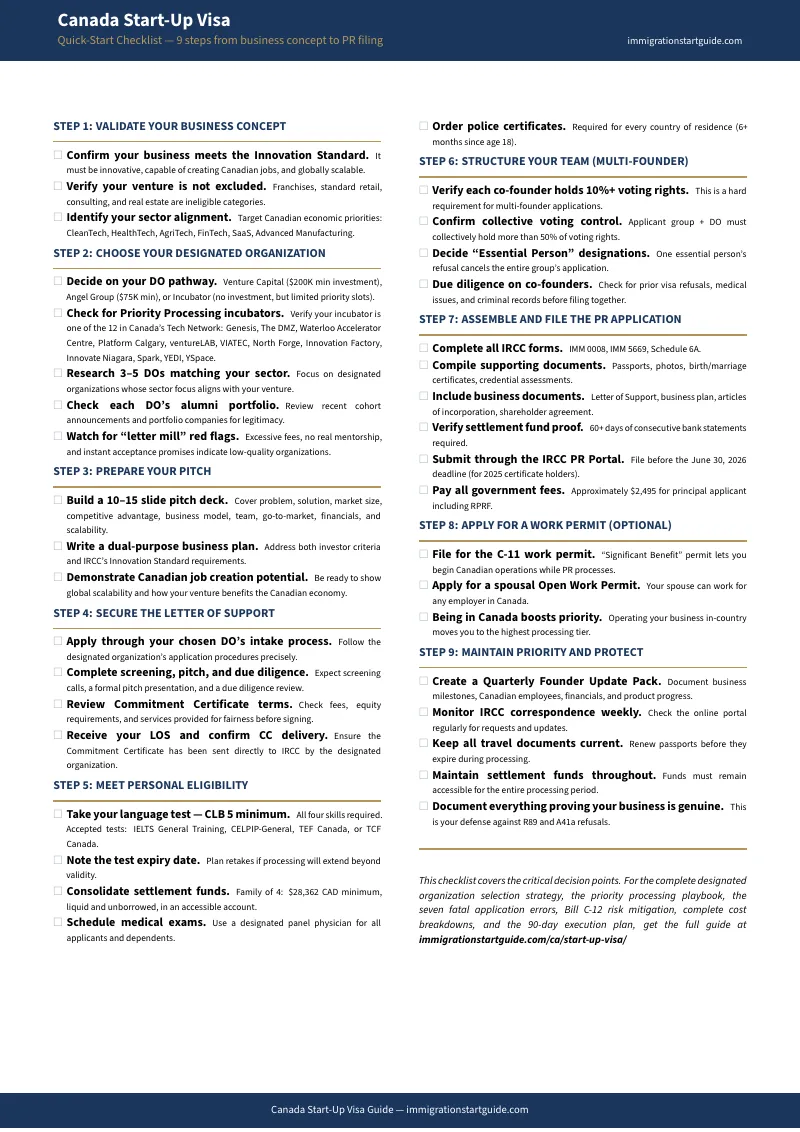
A 9-section action plan covering the essentials: validate your business concept against the Innovation Standard, choose your designated organization strategically, prepare your pitch, meet personal eligibility requirements, structure your team, assemble the PR application, apply for the work permit, and maintain priority. Enough to assess your position and identify your next move tonight.
Who This Guide Is For
This guide is for entrepreneurs who meet the SUV's basic requirements — an innovative business concept, CLB 5 language proficiency, and settlement funds — and who need to convert that eligibility into a priority-tier application, because meeting the requirements and navigating the designated organization landscape are two entirely different challenges:
- Founders holding 2025 commitment certificates who must file before the June 30, 2026 deadline — the guide provides the complete document assembly sequence and the priority positioning strategy that determines whether your application is processed in 3 years or lost in a decade-long backlog
- Entrepreneurs preparing for the High-Impact Entrepreneur Pilot expected later in 2026 — the guide covers the expected requirements (proven traction, elite partnerships, selection by invitation) and the operational evidence-building that positions you for a program with higher standards than the legacy SUV
- Tech founders evaluating which of the 56 designated organizations to approach — the guide identifies the 12 priority incubators by name, explains why the other 44 may mean a 10-year wait, and provides the four-step approach process from shortlisting to term negotiation
- Multi-founder teams who need to structure ownership and essential person designations to protect all five families from a single member's inadmissibility cascading into group-wide refusal
- International students in Canada considering the SUV as a "Plan B" when Express Entry points are insufficient — the guide covers the university-to-incubator pathway and the work permit bridge strategy that positions you in the highest priority tier
- Founders who have been approached by facilitators charging $25,000–$50,000 for a Letter of Support and need an independent framework to evaluate whether the arrangement is legitimate or a "letter mill" that will trigger a non-artificial transaction refusal
- Anyone who has spent weeks reading IRCC pages, Reddit threads, and immigration lawyer blogs without being able to determine which incubators are priority, which are accepting applications, and which have been flagged for compliance issues — and who needs a single, current, strategic resource
This guide is not for: people seeking a general Canadian immigration overview. If you want to compare Express Entry, PNPs, and business immigration at a surface level, this is not that resource. This is a single-program deep dive — every chapter, every strategy, every risk assessment is specific to the Start-Up Visa and the 2026 regulatory environment.
Why Not Free Resources?
Free information on the Start-Up Visa is abundant. Here is what it actually delivers:
- The IRCC website lists the requirements: a qualifying business, a Letter of Support, CLB 5, settlement funds. It publishes the list of 56 designated organizations. It does not tell you which 12 are Priority Processing, which are accepting applications, or which have been flagged for compliance issues. It does not explain how a designated organization evaluates your pitch, what terms to negotiate, or what red flags indicate a letter mill. You get the rules. You do not get the strategy.
- Immigration consultant websites publish detailed SUV overviews — because their business model is to demonstrate overwhelming complexity, then offer $10,000–$25,000 retainers. Some "facilitators" charge $30,000–$50,000 for introductions to incubators. The overview is free. The solution costs more than many founders' initial business investment.
- Reddit and forum posts provide real experiences from applicants at different stages, in different years, under different rules. A poster describing their 2023 incubator experience may cite processing timelines that predated MI72. Another recommends an incubator that has since been flagged for letter-mill behavior. You get anecdotes from strangers whose regulatory environment no longer exists.
- YouTube walkthroughs cover the basics in 10-minute videos. Some still reference pre-2026 rules. None explain the three-tier priority hierarchy, the Essential Person cascade failure, the seven rejection grounds, or the Bill C-12 cancellation risk. You cannot assemble a priority strategy from fragments.
This guide fills the strategy gap — the space between "I know the SUV exists and I have an innovative idea" and "I can identify a priority designated organization, pitch them like a venture investor, structure my team to avoid cascade failure, position my application in the fastest processing tier, and navigate the Bill C-12 environment without a $25,000 facilitator." It gives you the strategic framework that government resources describe but never provide, structured so you can execute it yourself — or engage a lawyer for a targeted document review rather than paying for full representation.
— Less Than a Single Immigration Consultation
Immigration consultants charge $10,000–$25,000 CAD for full SUV representation. Facilitators offering incubator introductions charge $30,000–$50,000. A one-hour strategy session costs $300–$500 — and in that hour, you get verbal advice that disappears when the call ends. No priority incubator list. No pitch framework. No team structuring strategy. No Bill C-12 risk assessment.
Your total SUV journey will cost $60,000–$120,000+ CAD when you include government fees, incubator program fees, business plan preparation, legal counsel, incorporation, language testing, medical exams, police certificates, and settlement funds. This guide is the piece that determines whether those costs produce a Confirmation of Permanent Residence or a refusal letter — and whether you wait 3 years or 10.
A refused application does not just cost you in fees. It costs you the years of processing time you cannot recover. It costs you the commitment certificate that may not be replaceable under the new pilot program. For multi-founder teams, it costs every family in the group.
Money-back guarantee, no time limit. If the designated organization strategy, the priority processing playbook, the team structuring framework, and the Bill C-12 risk mitigation do not make your SUV application stronger, you pay nothing.
Download the free Quick-Start Checklist to validate your business concept, assess your designated organization options, and identify your next steps tonight. When you are ready for the complete priority path strategy, the pitch framework, the seven-error prevention system, and the 90-day execution plan, the guide is here.
The SUV is the most generous entrepreneurial immigration program in the developed world — but the open-door era has closed. The entrepreneurs who navigate 2026 successfully will be the ones who understood the priority system, chose the right designated organization, and built a genuine business. This guide is that understanding.