
Your CRS Score Will Never Reach 520. Your Work Permit Expires in Eight Months. Your Boss in Halifax Told You "I Would Sponsor You, But I Don't Know How." This Guide Turns That Willing Employer Into a Designated Sponsor — and That Job Offer Into Permanent Residency.
You already know the Atlantic Immigration Program exists. You found the IRCC page, read the eligibility requirements, and confirmed you qualify. CLB 4 or 5 — you have that. One year of work experience or an Atlantic degree — you have that too. A job offer from an employer in Nova Scotia, New Brunswick, PEI, or Newfoundland — you have that, or you are close to one.
And then you hit the wall. Your employer said "I would sponsor you" — but they think sponsorship means an LMIA. Their HR department went quiet. You searched for "designated employer list" and found a Nova Scotia PDF buried three clicks deep that does not include contact details or current hiring status. New Brunswick's list exists but tells you nothing about which employers are actively sponsoring. PEI publishes 360+ designated employers without indicating which sectors the province has paused. Newfoundland introduced an Expression of Interest system in 2025 that means having a job offer is no longer enough to apply.
You checked Reddit. Someone said "just get a designated employer" as though that is something you do between lunch and dinner. A Canadavisa thread described the settlement plan meeting with an SPO — but the poster applied in 2023 under rules that changed twice since then. A YouTube video from 2021 still referenced the "Atlantic Immigration Pilot." You cannot tell which advice is current, which is outdated, and which applies to your specific province.
Here is the problem the government websites will never solve: the AIP is an employer-driven program where the applicant must be the expert. Your employer does not know what designation means. Your HR department does not know the process costs them nothing in federal fees beyond a $230 compliance fee. Your Settlement Service Provider (SPO) appointment is a mandatory meeting that no other Canadian immigration pathway requires — and nobody has explained what they ask, what documents to bring, or how your answers affect your endorsement. The provinces operate on annual allocations that can close mid-year, sector-specific pauses that disqualify entire industries without notice, and endorsement processing windows that vary by quarter.
The Canada Atlantic Immigration Program Guide is an Employer-to-PR Execution System — built to solve the three problems that separate AIP-eligible workers from permanent residency: educating a willing employer on designation, navigating the settlement plan process that no one explains, and timing the provincial endorsement window that determines whether your application is accepted this year or deferred to the next.
What's Inside the Employer-to-PR Execution System
12 chapters + the quick-start checklist — the complete guide covering the employer designation pitch, the three AIP streams, the mandatory settlement plan, province-by-province endorsement strategies, the C18 work permit, the federal PR application, and the refusal risks that government resources never warn you about:
The Employer Pitch Strategy (Chapter 2)
The single biggest obstacle in the AIP is not your eligibility — it is your employer's misunderstanding. Most Atlantic employers who say "I don't do LMIAs" would qualify for AIP designation if they understood what it actually involves: a one-time provincial application, no Labour Market Impact Assessment, no federal fees beyond the $230 compliance fee for your work permit, and a direct pathway to retaining you permanently. The guide provides the complete employer pitch framework — the specific talking points that reframe "sponsorship" as "a one-time process that costs you nothing and keeps your trained worker," the provincial portal links for the designation application, and the employer compliance requirements so you can walk into that conversation as the expert your boss needs you to be. Many AIP applicants succeed not because they found a designated employer, but because they created one.
Three Program Streams Decoded (Chapter 3)
The AIP has three streams with different eligibility logic, and choosing the wrong one wastes months. The Atlantic High-Skilled stream covers TEER 0–3 occupations with a one-year post-secondary education minimum and CLB 5. The Intermediate-Skilled stream covers TEER 4 occupations — retail, food service, manufacturing — with only a high school diploma and CLB 4 required. The International Graduate stream waives the work experience requirement entirely but imposes a 16-month residency documentation requirement that creates stress for students who studied partially online or traveled during breaks. The guide maps the precise eligibility decision tree for each stream, the 1,560-hour work experience calculation (paid, non-seasonal, non-self-employed, within the last five years), and the critical "non-seasonal" clause that disqualifies otherwise valid positions in fisheries, tourism, and agriculture unless the job offer is structured correctly.
The Settlement Plan Walkthrough (Chapter 5)
No other Canadian immigration program requires a mandatory meeting with a Settlement Service Provider Organization. The AIP does. Official guidance says "contact an SPO" and stops there. The guide opens the black box: who the designated SPOs are in each province (ISANS in Nova Scotia, YMCA in New Brunswick, PEI Association for Newcomers, Association for New Canadians in Newfoundland), what the Needs Assessment and Referrals Services (NAARS) assessment actually covers, the exact documents to bring (passport, language test results, ECA report, job offer details, family information), the types of integration questions asked during the 30-to-60-minute session, and how to prepare so the mandatory meeting builds your endorsement case rather than complicating it. If you are outside Canada, the guide covers the virtual assessment process through S.U.C.C.E.S.S. or the YMCA of Greater Toronto.
Province-by-Province Endorsement Strategy (Chapter 6)
The AIP is a federal program, but endorsement is managed provincially — which means four different portals, four different processing timelines, four different sector priorities, and four different allocation schedules. Nova Scotia has paused food service and accommodation sector endorsements due to demand. New Brunswick has exhausted its AIP allocation early in recent years, creating mid-year processing freezes. PEI has shifted priority toward healthcare, construction, and manufacturing. Newfoundland's new Expression of Interest model means a job offer alone no longer guarantees you can apply. The guide covers the application mechanics for each province's portal (LaMPSS in Nova Scotia, INB Portal in New Brunswick, eServices PEI, Immigration Accelerator in Newfoundland), the sector-specific pauses and priority sectors, the allocation timing cycle, and the processing windows that determine whether your endorsement is processed this year or rolls into the next.
The C18 LMIA-Exempt Work Permit (Chapter 7)
Once you have your provincial endorsement, you do not need to wait 12 months for PR processing before you can work. The C18 work permit is an LMIA-exempt mechanism unique to the AIP that lets you start working immediately — but it is a closed permit tied to your AIP employer, not a Bridging Open Work Permit. The guide covers the provincial referral letter, the IMM 0156 undertaking (your commitment to apply for PR within 90 days), the employer compliance fee and Offer of Employment Number, and the critical distinction between the C18 and the BOWP that determines whether you can change jobs during federal processing.
Federal PR Application Filing (Chapter 8)
The provincial endorsement is the midpoint, not the finish line. The federal PR application is a document-intensive sprint where one expired test result or missing police certificate can delay processing by months. The guide provides the complete document checklist sequenced by lead time, the IRCC Online Portal walkthrough, biometrics timing, medical examination scheduling strategies (upfront exams speed processing), police certificate requirements for every country you have lived in for six or more months since age 18, proof of settlement funds calculations, and the "biometric silence" period where months of no updates after biometrics submission is normal and does not indicate a problem.
Refusal Risk Mitigation (Chapter 10)
Atlantic applications face "Intent to Reside" scrutiny that is uniquely aggressive compared to other Canadian immigration pathways. IRCC has flagged applications where applicants showed insufficient ties to the Atlantic region, had previously lived in Toronto or Vancouver, or could not demonstrate a genuine plan to remain in their endorsing province. The guide covers the evidence-building strategies for Intent to Reside, the employer designation expiry risk that can torpedo your application mid-processing, common provincial endorsement rejections, federal admissibility grounds, and the realistic assessment of whether a refusal warrants reapplication or a pivot to a different pathway.
Special Situations (Chapter 11)
Healthcare workers eligible for fast-tracking in provinces actively recruiting medical professionals. Fish processing and seasonal industry workers who need to frame cyclical employment as permanent. French-speaking applicants in New Brunswick who access dedicated allocation spaces. Workers already in Canada on temporary permits who may qualify for the TR-to-PR fast-track initiative targeting 33,000 workers in smaller communities. And the process for changing employers during federal processing without losing your application — because twelve months of processing is a long time to stay at one job.
Full 2026 Cost Architecture (Chapter 9)
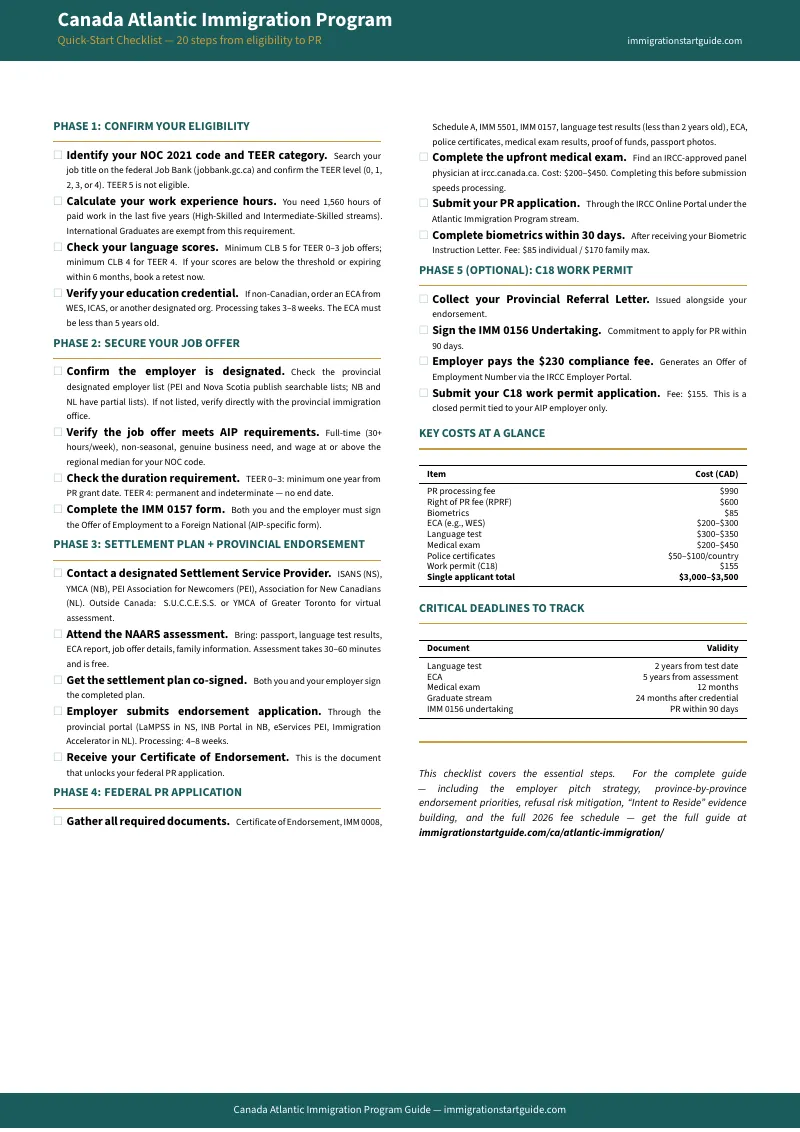
Every federal fee (post-April 2026 increase), provincial cost, ECA fee, language test, medical exam, police certificates, work permit fee, and spousal application costs — mapped across the complete timeline from job offer through Confirmation of Permanent Residence. Single applicant total: $3,000–$3,500 CAD. Family projections included. No hidden costs, no surprise fees at the federal stage that you did not budget for at the provincial stage.
Quick-Start Checklist (free download)
A document checklist and action plan covering the essentials: confirm your TEER category and stream eligibility, verify your employer's designation status, check language score validity, calculate work experience hours, prepare for the SPO meeting, and start police certificates before your endorsement arrives. Enough to assess your position and identify your next move tonight.
5 Standalone Printable Tools — Print, Use, Execute
Beyond the 59-page guide, your download includes five standalone PDFs designed to be printed and used at the moment they matter most:
- Employer Pitch Sheet — Five talking points that reframe AIP designation as a business win. Print it and bring it to the conversation with your employer. Includes provincial portal links and the step-by-step designation process.
- Settlement Plan Prep Sheet — SPO contacts for all four provinces, the documents to bring to your NAARS assessment, what the meeting covers, and key tips. Print it before your mandatory SPO appointment.
- Provincial Endorsement Reference — A one-page comparison of Nova Scotia, New Brunswick, PEI, and Newfoundland: portals, priority sectors, sector pauses, allocation timing, and province-specific strategy notes.
- Federal Document Checklist — Every document needed for the federal PR application, grouped by lead time. Start the 8-to-12-week items (police certificates, ECAs) now so they are ready when your endorsement arrives.
- Cost Worksheet — The complete 2026 fee breakdown with fillable "Your Cost" columns. Budget your application from provincial endorsement through Confirmation of Permanent Residence.
Who This Guide Is For
This guide is for workers with job offers in Atlantic Canada — or the realistic prospect of one — who need to convert that employer relationship into permanent residency through the AIP, and who have discovered that meeting the eligibility requirements and actually navigating the employer-driven process are two entirely different challenges:
- Post-Graduation Work Permit holders whose permits expire in months, whose CRS scores sit below 500 with no realistic path up, and whose employers have said "I would help but I don't know how" — the guide gives you the employer pitch that turns willingness into designation
- Overseas applicants sending dozens of job applications to Atlantic employers with no way to determine which are designated, which are actively sponsoring, and which provinces have paused specific sectors — the guide consolidates the four-province designated employer landscape so you stop wasting effort on positions that cannot lead to PR
- TEER 4 workers in retail, food service, manufacturing, and fish processing who would never qualify through Express Entry — the AIP's Intermediate-Skilled stream is designed for you, but the "non-seasonal" and "indeterminate" job offer requirements create documentation challenges that the guide addresses specifically
- International graduates from Atlantic institutions who need to document the 16-month residency requirement — especially those who studied partially online or traveled during academic breaks and face a non-straightforward documentation situation
- Workers with designated employers whose settlement plan appointment is next week and who have no idea what the SPO will ask, what documents to bring, or how their answers affect their provincial endorsement
- Anyone who has researched the AIP for weeks across government websites, Reddit, Canadavisa, and YouTube — accumulating contradictory information from different years and program versions — and needs a single, current, sequenced playbook
- Applicants deciding between a $5,000 immigration consultant and doing it themselves — the guide makes the DIY path strategic, or at minimum helps you engage a consultant for a targeted $500 document review rather than paying for full representation on a straightforward application
This guide is not for: people seeking a general Canadian immigration overview. If you want to compare Express Entry, PNPs, and the AIP at a surface level, this is not that resource. This is a single-program deep dive. Every chapter, every decision tree, and every strategy is specific to the Atlantic Immigration Program.
Why Not Free Resources?
Free information on the AIP is abundant. Here is what it actually delivers:
- The IRCC website publishes the eligibility requirements in precise, clinical government language. It tells you that you need a designated employer. It does not tell you how to find one, how to verify their status on four different provincial portals, or how to pitch designation to a willing employer who thinks "sponsorship" means an LMIA. It tells you that a settlement plan is required. It does not explain what happens inside the SPO meeting. You get regulations, not strategy.
- Immigration consultant blogs publish excellent AIP overviews — because their business model is to demonstrate overwhelming complexity, then offer $3,500 to $6,000 retainers. The blog explains the problem. The solution costs two months of an Atlantic worker's salary.
- Reddit and Canadavisa forums provide real-world insights from applicants in different provinces, under different streams, in different years. Many still reference the "Atlantic Immigration Pilot" requirements that changed in 2022. A poster describing their New Brunswick experience in 2023 may cite allocation timelines that shifted when the province exhausted its cap early. You get survivorship bias from strangers whose situations bear no resemblance to yours.
- YouTube walkthroughs show fragments of the process in ten-minute videos. Some still reference the pilot program. Reconstructing a complete strategy requires dozens of videos from different creators with different accuracy levels. You still do not have an employer pitch script, a settlement plan prep sheet, or a province-by-province endorsement timeline when you are done watching.
This guide fills the execution gap — the space between "I know the AIP exists and I qualify" and "I can educate my employer on designation, prepare for the settlement plan meeting, time the provincial endorsement window, and file the federal PR application without a $5,000 consultant." It gives you the strategic framework that government resources describe but never provide, structured so you can execute it yourself.
— Less Than a Single Immigration Consultation
Immigration consultants in Atlantic Canada charge $3,500 to $6,000 CAD for a single AIP application. A 30-minute strategy session costs $150 to $325 CAD — and in that session, you get verbal advice that disappears the moment the call ends. No employer pitch script. No settlement plan prep sheet. No province-by-province endorsement timeline. No document checklist sequenced by lead time.
Your total AIP costs will exceed $3,000 CAD for a single applicant — the $990 federal processing fee, the $600 Right of Permanent Residence fee, biometrics, language testing, ECA, medical exams, police certificates, and the C18 work permit. This guide represents a fraction of that investment, and it is the piece that determines whether the other $3,000+ produces a Confirmation of Permanent Residence or a refusal letter.
A refused application does not just cost you in processing fees. It costs you the months of provincial endorsement processing time. It costs you the employer who may not go through designation again. It costs you the work permit validity you can never recover.
Money-back guarantee, no time limit. If the employer pitch strategy, the settlement plan walkthrough, the province-by-province endorsement timing, and the federal filing playbook do not make your AIP application stronger, you pay nothing.
Download the free Quick-Start Checklist to verify your eligibility, check your employer's designation status, and identify your next steps tonight. When you are ready for the complete employer pitch strategy, the settlement plan preparation, the four-province endorsement playbook, and the federal PR filing sprint, the guide is here.
The AIP processes approximately 4,000 applicants per year. Provincial allocations close mid-year. Your employer is willing. Make sure the execution is right.