
Your CRS Score Qualifies. Your Philippine Documents Will Sink the Application.
You ran the numbers. CRS 470, maybe 490. Competitive for a healthcare category-based draw — maybe even enough for the general pool if you can squeeze out another 20 points. You created your Express Entry profile, picked Canadian Experience Class or Federal Skilled Worker, and started imagining a life without contract renewals and family separation. And then the document procurement began.
Your WES evaluation came back. Your four-year BSN from a provincial university — a degree that got you hired across three Gulf countries — was assessed correctly. But your colleague who graduated in 2017? Her Bachelor's degree was evaluated as a two-year diploma. She lost 30 CRS points overnight. The difference: she finished under the old 10-year basic education system before K-12 was fully implemented. Nobody in the Facebook groups told her that pre-2019 graduates face a different WES outcome. By the time she found out, she'd already paid the $220 CAD evaluation fee and waited eight weeks.
Meanwhile, you need your PSA birth certificate apostilled. You heard about the eApostille — launched March 16, 2026 — but every YouTube tutorial you find still shows the old red ribbon process at DFA Aseana. You order through PSAHelpline with the "Direct to DFA Apostille" option, receive the digital certificate, and print it out to include in your WES packet. Your application is rejected. Because printing an eApostille immediately invalidates it. The digital file must be transmitted directly to WES. Nobody in the 400,000-member Filipino-Canadian Immigration Facebook group mentioned this, because most of them authenticated their documents in 2024.
And then there's the NBI clearance. You applied online, went to your appointment, and got flagged with a "HIT" — a namesake match with someone who shares your common Filipino surname. From abroad, resolving this requires an Affidavit of Denial, notarized locally, authenticated by the Philippine Consulate General, and submitted to NBI Manila. That's 4-8 weeks you didn't plan for. Your IRCC submission deadline doesn't care.
The Philippines → Canada Express Entry Guide is the Filipino Migration Protocol — the document procurement and strategy playbook that sits between your competitive CRS score and the bureaucratic reality of getting Philippine documents past IRCC adjudication in the post-eApostille era. It covers the March 2026 digital authentication rules that most guides still get wrong, the K-12 credentialing divide that silently penalizes pre-2019 graduates, the multi-country PCC logistics for Gulf OFWs, and the NNAS Expedited Service pathway that gets Filipino nurses into category-based draws at CRS 462 while the general pool sits at 510.
What's Inside the Filipino Migration Protocol
15 chapters covering the complete Philippines-to-Canada Express Entry journey, plus a printable quick-start document checklist and 5 standalone reference cards you can use independently:
Express Entry and the 2026 Category-Based Draw Landscape (Chapter 1)
Express Entry is not a single visa — it's a ranking system with three federal programs, and in 2026 the selection logic has fundamentally changed. Healthcare category-based draws now invite nurses at CRS 462 while general draws require 507-511. The 12-month experience requirement (up from 6 months) means Gulf OFW contracts must now span a full year to qualify. This chapter maps which program fits your profile, explains the new targeted categories (Healthcare, Trade Occupations, French Proficiency), and shows Filipino professionals exactly where category-based selection creates realistic pathways that general draws don't. Because understanding which draw type you're actually competitive for determines every decision that follows.
The K-12 Credentialing Divide — WES Evaluation for Philippine Degrees (Chapter 2)
If you graduated before 2019, your Bachelor's degree was built on a 10-year basic education foundation. WES frequently evaluates these as two-year Canadian diplomas — a 20-30 point CRS penalty that drops you below every meaningful draw cutoff. Post-K-12 graduates (2019 onward) get full Bachelor's equivalency. This chapter provides the decision framework: which graduates are affected, the Master's degree mitigation strategy (a Philippine Master's typically evaluates as a Canadian Bachelor's, recovering lost points), and the specific documentation WES requires from CHED and your university registrar. Because the $220 CAD evaluation fee is trivial. The 30-point CRS swing between Bachelor's and Diploma is not.
The March 2026 eApostille System — Digital Authentication Protocol (Chapter 3)
On March 16, 2026, the DFA launched the fully digital eApostille under the HCCH Electronic Apostille Programme. This is not a scanned copy of a paper document — it's a cryptographically signed digital certificate that is invalidated by printing. Most online resources, Facebook posts, and YouTube tutorials still reference the physical red ribbon process. This chapter covers the complete "start-to-finish" digital pathway: PSAHelpline ordering with the "Direct to DFA Apostille" option, CHED Electronic CAVs for academic records, which documents are eligible for digital-only processing, which still require physical DFA appointments, and the exact transmission protocol for sending eApostilles to WES, NNAS, and IRCC without breaking cryptographic integrity.
NBI Clearance and the HIT Resolution Framework (Chapter 4)
Common Filipino surnames trigger "HIT" flags at rates that would paralyze any other country's police clearance system. A namesake HIT adds 2-4 weeks. A derogatory HIT adds 8-12 weeks. For OFWs abroad, resolving a namesake HIT requires an NBI Quality Report, a sworn Affidavit of Denial notarized locally, PCG authentication, and submission to NBI Manila. This chapter covers the complete resolution workflow for applicants in the Philippines, in the Gulf, and in Canada — including the timeline management strategy that prevents an NBI delay from expiring your 60-day IRCC submission window.
Multi-Country Police Clearance for Gulf OFWs (Chapter 5)
IRCC requires a PCC from every country where you've lived more than six months since age 18. For a Filipino nurse who worked in Saudi Arabia for five years and then moved to the UAE, that's three PCCs: NBI, Saudi MOI, and UAE. The Saudi PCC is the nightmare — if your Iqama has expired and you can't access Absher, you need a fingerprint card from your current country, attested by MOFA, then the Saudi Embassy, then submitted to the MOI. Processing: 3-6 weeks. This chapter provides the exact attestation chain for Saudi, UAE, Singapore, Hong Kong, Qatar, and Kuwait — with alternative pathways for each when the primary route is blocked.
NNAS Expedited Service — The Nursing Licensure Fast-Track (Chapter 6)
The National Nursing Assessment Service is the mandatory first step for Filipino nurses seeking Canadian licensure. In 2026, the Expedited Service ($750 CAD, 5 business days) has replaced the regular pathway ($845 CAD, 12 weeks) as the standard for Filipino applicants. This chapter covers the complete NNAS application, which provincial nursing bodies accept the Expedited Report, how to run NNAS in parallel with your Express Entry profile, the NCLEX-RN testing bottleneck in Makati (4-5 month wait times), and the "testing tourism" strategy to Vietnam, Thailand, or Guam for earlier exam slots. It also covers the Nova Scotia expedited pathway specifically designed for Philippine-licensed nurses.
CRS Optimization for Filipino Profiles (Chapter 7)
A typical Filipino nurse with a BSN, 5 years of Gulf experience, and IELTS 7.0 scores approximately 460-475 CRS — competitive for healthcare draws but below general draw cutoffs. This chapter ranks the fastest CRS boosters by effort-to-point ratio: language score improvement (CLB 9 to 10 adds 12-24 points), French as a second language (up to 50 bonus points, draw cutoffs as low as 393), Provincial Nomination (600-point boost), and the spousal language test strategy. It also covers the IELTS vs. PTE Core decision for Filipino speakers — including the specific pronunciation patterns (TH sounds, final consonant clusters, intonation) that hold Filipino test-takers at Band 6.5.
IELTS and Language Test Strategy for Filipino Speakers (Chapter 8)
Filipino English speakers have a unique testing profile: strong reading and listening (Band 7.0-8.0 is common), but Writing and Speaking often plateau at 6.5 due to L1 transfer patterns. This chapter provides the diagnostic for choosing between IELTS Academic, IELTS General Training, PTE Core, and CELPIP based on your specific weaknesses. It covers the Filipino-specific pronunciation fixes, the formal register trap in IELTS Writing (Tagalog-influenced circumlocution), and the PTE Core advantage for speakers whose grammar is strong but whose spoken rhythm differs from the IELTS examiner's expectations.
Provincial Nominee Programs from the Philippines (Chapter 9)
A Provincial Nomination adds 600 CRS points and guarantees an ITA. For Filipino nurses, Nova Scotia's Internationally Educated Nurse stream is purpose-built for Philippine-licensed RNs. For IT professionals facing 23 months of STEM draw dormancy, Saskatchewan's SINP and BC's Skills Immigration offer direct application routes. This chapter covers the top PNPs accessible from the Philippines, which provinces to target based on your NOC code, and the settlement-intent audit that catches nominees who use smaller-province nominations as stepping stones to Toronto or Vancouver.
Proof of Funds and Financial Documentation (Chapter 10)
A single applicant needs approximately CAD $15,263. A family of four needs CAD $28,362. For OFWs with savings split across BDO, Metrobank, and a Gulf bank account, the challenge is consolidating and documenting funds in a way IRCC accepts. This chapter covers which Philippine and Gulf assets qualify, the bank certificate format IRCC requires (most Philippine branch managers have never issued one), the remittance documentation strategy for OFWs whose savings flowed through multiple countries, and the 6-month balance history requirement that catches applicants who move money at the last minute.
Post-ITA — The 60-Day Submission Countdown (Chapter 11)
You have exactly 60 days from ITA to submit your complete PR application. No extensions. For Filipino applicants juggling NBI clearance, multi-country PCCs, eApostille transmission, medical exams, and document scanning from abroad, 60 days is tight. This chapter provides the week-by-week countdown: NBI and PCC applications in week 1, medical exams in weeks 2-3, document procurement and eApostille transmission in weeks 3-5, and final submission by day 55. It includes the IRCC portal document upload mapping and the common Filipino-specific rejection reasons with prevention steps.
Costs, Timeline, and the Parallel Processing Strategy (Chapter 12)
A complete PHP cost breakdown for every expense from WES to COPR: approximately ₱130,000-₱180,000 for a single applicant, ₱220,000-₱280,000 for a family of four (excluding settlement funds). A realistic 8-14 month timeline. And the parallel processing strategy that saves months — start WES and IELTS simultaneously, initiate NNAS while your Express Entry profile is pending, apply for NBI clearance before you receive an ITA, and begin multi-country PCC procurement on day one.
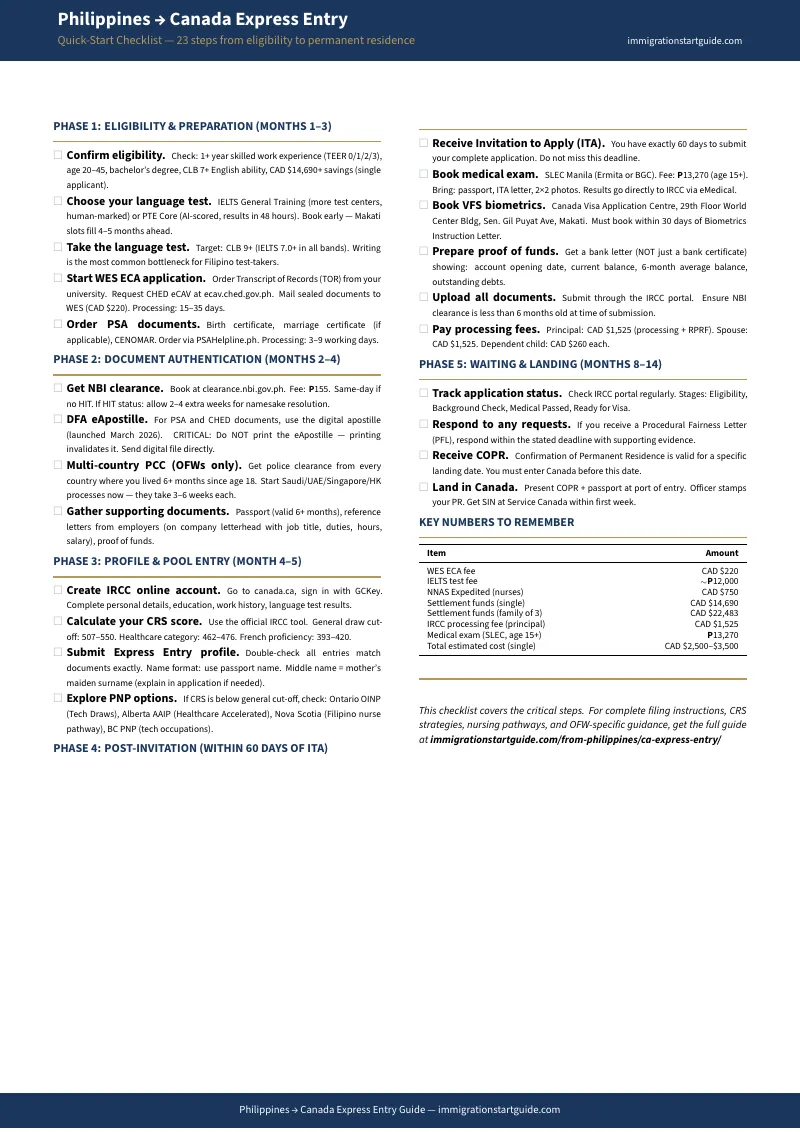
Quick-Start Document Checklist (free download)
Every Philippines-specific document you need for your Express Entry application, distilled into a single printable checklist: PSA documents, DFA eApostille requirements, WES packet, NBI clearance, multi-country PCCs, NNAS documents, proof of funds, and medical exam items. Enough to start gathering documents tonight.
Standalone Reference Cards and Printables
Five standalone PDFs you can print and use independently — no need to carry the full guide to your DFA appointment, consulate visit, or bank meeting:
- eApostille Decision Matrix — One-page reference: which documents qualify for full digital processing, which still need physical DFA appointments, and the exact transmission protocol for each receiving authority (WES, NNAS, IRCC)
- K-12 Credential Evaluation Guide — Decision tree for pre-2019 vs. post-2019 graduates showing WES outcomes, mitigation strategies, and the Master's degree recovery pathway
- Multi-Country PCC Attestation Chains — Country-by-country procurement roadmap for Saudi Arabia, UAE, Singapore, Hong Kong, Qatar, and Kuwait with exact agency sequences and processing times
- NNAS Expedited Service Checklist — Complete document list, application steps, provincial acceptance chart, and the parallel-processing timeline for running NNAS alongside Express Entry
- 60-Day Post-ITA Countdown — Week-by-week checklist from Day 1 to Day 60 with IRCC portal upload mapping and Filipino-specific document preparation notes
Who This Guide Is For
This guide is for Filipino professionals navigating Canada's Express Entry system — whether you're an OFW planning your exit from the Gulf, a nurse building your NNAS file, or an IT professional watching STEM draws stay dormant for two years:
- You're a registered nurse in Saudi Arabia or the UAE and you know healthcare draws are pulling at CRS 462 — but you have no idea how to run NNAS, multi-country PCCs, and your Express Entry profile simultaneously without one deadline destroying another
- You graduated before 2019 under the old 10-year basic education system and you've heard conflicting advice about whether your Bachelor's degree will be downgraded by WES — but nobody explains the specific criteria or the Master's degree mitigation strategy that recovers the lost points
- You need your PSA birth certificate and academic records apostilled but every resource you find still describes the red ribbon process that was replaced by the eApostille system in March 2026 — and you can't afford a $220 WES rejection because you transmitted the document incorrectly
- You worked in Saudi Arabia for five years and your Iqama expired — you can't access Absher, you can't get your Saudi PCC online, and IRCC won't accept your application without it
- You applied for NBI clearance and got flagged with a HIT because your surname matches 47 other people in the database — and you're abroad with no idea how to resolve it through the consulate before your IRCC deadline expires
- You're an IT professional with a CRS of 470 and the STEM category hasn't drawn in 23 months — you need to know whether French language study, a PNP nomination, or pivoting to a trade occupation category is your highest-probability path
- You're married with a family and you're trying to figure out whether your spouse's language score helps or hurts your CRS, how to document proof of funds split across Philippine and Gulf bank accounts, and how to budget ₱130,000-₱280,000 across a realistic timeline
Why Not Free Resources?
Free information about Express Entry for Filipinos is everywhere. Here's what it actually gives you:
- Facebook groups (Filipino-Canadian Immigration, OFW Canada PR) have 400,000+ members posting draw results, success stories, and advice. The problem: most active advice-givers authenticated their documents in 2024 or earlier. They'll tell you to "get red ribbon at DFA Aseana" — a process that was replaced by the eApostille system in March 2026. They'll tell you WES evaluates all BSN degrees the same — without mentioning the K-12 graduation year divide. And a single wrong answer about eApostille transmission protocol means a rejected WES application and two months lost.
- YouTube channels (MaryK Rebato, Kabayan Hub, Immigration ATBP) are excellent for draw updates and general motivation. They deliver information in 10-minute fragments that don't build into a procurement strategy. A nurse in Riyadh needs to coordinate NNAS, Saudi PCC, NBI clearance, eApostille, and Express Entry across four countries and six agencies simultaneously. No playlist does this.
- Immigration consultants (RCICs) charge $1,500-$5,000 CAD for end-to-end representation. Many are generalists who handle Filipino cases the same way they handle Indian or Nigerian cases — they don't know the eApostille invalidation rule, the K-12 credentialing divide, or the NBI HIT resolution process for OFWs. You're paying for form-filling and portal submissions. Whether you're paying for the Filipino-specific document procurement strategy is a different question.
- Generic Express Entry guides explain the CRS system for applicants from any country. They don't know what an eApostille is. They've never navigated PSAHelpline. They think police clearance means one country. They have no concept of the attestation chain required to get a Saudi PCC when your Iqama has expired and Absher is locked.
- IRCC's website (canada.ca) lists requirements without explaining how to fulfill them from the Philippines or as an OFW. It says "police clearance from every country of residence." It doesn't tell you that Hong Kong sends the certificate directly to IRCC and you'll never see it, that Singapore issues it digitally through FileSG, or that Saudi Arabia requires a three-country attestation chain that takes 3-6 weeks.
This guide fills the Philippine documentation gap. It doesn't replace an RCIC or immigration lawyer — it handles the entire Filipino-specific procurement layer that generic guides ignore and consultants charge $1,500-$5,000 to manage. The eApostille protocol, the K-12 credential evaluation strategy, the multi-country PCC logistics, the NNAS parallel-processing timeline, and the NBI HIT resolution workflow that only matter when you're filing from the Philippines or as a Filipino OFW.
— Less Than a Single IELTS Registration Fee
An IELTS exam costs ₱12,000+. A WES evaluation costs $220 CAD. Transmitting your eApostille incorrectly means paying WES again, waiting another 8 weeks, and watching your age tick past the next CRS penalty threshold. An NBI HIT you didn't anticipate burns 4-8 weeks of your 60-day submission window. A consultant charges $1,500-$5,000 CAD for services that include form-filling you can do yourself on the IRCC portal.
The guide doesn't replace an immigration consultant. It handles the Filipino-specific document procurement strategy that sits between your competitive CRS score and an approved PR application. It turns months of fragmented Facebook advice and outdated YouTube tutorials into a structured protocol built for Philippine government agencies, Gulf attestation chains, and the March 2026 digital authentication rules that most resources still haven't caught up with.
Money-back guarantee, no time limit. If the guide doesn't give you clearer control over the Philippine documentation side of your Express Entry application, you pay nothing.
Download the free Quick-Start Checklist to see every Philippines-specific document you need for Express Entry. When you're ready for the eApostille transmission protocol, the K-12 credential strategy, the multi-country PCC roadmap, the NNAS fast-track, and the complete 60-day post-ITA countdown, the full guide is here.
Your CRS score earns you a place in the pool. Your Philippine documents — authenticated correctly, transmitted properly, procured from the right agencies in the right order — determine whether you get out of it.