
Your CRS Score Qualifies. Your Pakistani Documents Will Kill the Application.
You ran the numbers. CRS 485, maybe 510. Competitive for a STEM category-based draw — maybe within striking distance of the general pool if you can push past CLB 9. You created your Express Entry profile, selected Federal Skilled Worker, and started imagining a life where your engineering degree actually matches your earning potential. And then the document procurement began.
Your colleague in Lahore sent his sealed envelope from HEC to WES. Eight weeks later, the evaluation came back: his four-year BS in Computer Science was correctly assessed as a Canadian Bachelor’s. But your friend with the old-system 2-year BA plus 2-year MA? WES evaluated the Bachelor’s alone as two years of post-secondary — 98 CRS points instead of 135. A 37-point penalty that drops him below every meaningful draw cutoff. Nobody in the WhatsApp group mentioned that the 2+2 combination only evaluates as a Master’s if both degrees are attested separately and WES recognizes the research component. He’d already paid the $220 CAD evaluation fee and waited two months.
Meanwhile, you need your proof of funds certified. You have PKR 3.2 million in your Meezan Bank account — above the $15,263 CAD minimum at today’s rate of 205 PKR/CAD. But the Rupee has devalued 10% twice in the last eighteen months. If it moves to 225 before IRCC processes your file, your compliant balance becomes non-compliant overnight. And your bank manager has never heard of the specific letter format IRCC requires. Then there’s the naming mismatch: your degree says “Ahmad s/o Bashir,” your passport says “Ahmad Bashir,” and IRCC’s system requires separate given name and surname fields that neither document agrees on. That’s an Additional Document Request that stalls your file for months. And your security screening? Pakistani applications routinely take 3–6 months beyond the standard processing target — long enough for your PCC to expire, your proof of funds to drift below the minimum, and your IELTS scores to approach their two-year limit.
The Pakistan → Canada Express Entry Guide is the HEC-to-COPR Playbook — the document procurement and strategy manual that sits between your competitive CRS score and the bureaucratic reality of getting Pakistani documents past IRCC adjudication. It covers the HEC attestation pipeline that adds 4–7 weeks to your timeline if you don’t manage it proactively, the PKR volatility buffer strategy that keeps your proof of funds compliant through months of security screening, the naming discrepancy solutions for “s/o” conventions and single-name passports, the NOC-to-category alignment that gets Pakistani engineers into STEM draws at CRS 480 while the general pool sits at 530+, and the provincial PCC variations that mean a 3-day turnaround in Punjab and a 4-week ordeal in Sindh.
What’s Inside the HEC-to-COPR Playbook
15 chapters covering the complete Pakistan-to-Canada Express Entry journey, plus a printable quick-start document checklist and 5 standalone reference cards you can use independently:
Why This Guide Exists — The Pakistan–Canada Corridor (Chapter 1)
The Pakistan-to-Canada corridor has specific bureaucratic landmines that generic Express Entry guides ignore. HEC is a gatekeeper that no other major source country has to deal with. PKR volatility is a structural risk to your proof of funds. Security screening adds 3–6 months that can expire your PCC and IELTS. Naming conventions create friction that triggers Additional Document Requests. And the informal employment sector makes reference letters harder to obtain than in countries with standardized HR departments. This chapter maps the five Pakistan-specific risks and explains why a 91% success rate for properly documented Pakistani files tells you everything: the system works if you get the paperwork right.
Express Entry Overview — How the System Actually Works (Chapter 2)
Express Entry is not a single visa — it’s a two-stage ranking system managing three federal programs. Most Pakistani professionals enter through the Federal Skilled Worker Program, which requires 67 points on a selection grid before your profile even enters the pool. This chapter breaks down the 67-point gate, explains the CRS ranking (general draw cutoffs have exceeded 530 in 2024–2025), and covers category-based selection — the game changer since June 2023 that lets STEM professionals get invited at CRS 480 and healthcare workers at CRS 425. Because understanding which draw type you’re competitive for determines every decision that follows.
CRS Score Optimization — Maximizing Your Points From Pakistan (Chapter 3)
Your CRS score determines whether you receive an ITA or sit in the pool until your profile expires. This chapter maps every point source: age (you lose ~5 points per year after 30 — every month of delay costs you), education (the difference between a 2-year BA at 98 points and a 4-year BS at 120 points is 22 CRS points), language (the jump from CLB 8 to CLB 9 unlocks Skill Transferability bonuses worth up to 50 additional points), and the “hidden multipliers” that most Pakistani applicants underestimate. It includes a quick-reference CRS booster table ranking every action by effort-to-point ratio — from IELTS improvement to French language study to PNP nomination.
HEC Attestation & the WES Pipeline — The Critical Bottleneck (Chapter 4)
This is the chapter that justifies the entire guide. WES will not accept your documents unless HEC attests them and sends them in a sealed envelope signed and stamped across the back flap by an HEC official. The single most common mistake: applicants open the sealed envelope “just to check” the documents. WES rejects opened envelopes immediately. This chapter provides a click-by-click walkthrough of the HEC E-Services portal (eservices.hec.gov.pk), the fee schedule (PKR 1,000 per original, PKR 700 per copy via 1-link), Walk-in Mode vs. Courier Mode, the sealed envelope protocol with WES Reference Number placement, the 2+2 vs. 4-year degree evaluation rules that determine whether you get 98 or 135 CRS points, ICAS as an alternative when HEC is slow, and exactly when IBCC attestation is required for O/A Levels, DAE holders, or 2-year Bachelor’s programs.
Language Testing Strategy — Hitting CLB 9 From Pakistan (Chapter 5)
Language is the most controllable variable in your CRS score. The difference between CLB 8 and CLB 9 can be worth 30–60 CRS points when you factor in Skill Transferability bonuses. This chapter covers the IELTS vs. PTE Core decision (IELTS is cheaper at 68,500–72,000 PKR, available in more Pakistani cities, and offers the One Skill Retake via IDP for 45,300 PKR — a massive advantage if you miss your target in one module), test center locations across Islamabad, Karachi, Lahore, Faisalabad, Gujrat, and Sialkot, the specific preparation strategy for Pakistani speakers (British and Australian accent training for Listening, the Writing Band 7 structure, Speaking fluency drills), and why booking with IDP specifically gives you the retake safety net that British Council and AEO don’t offer.
NADRA Documents — CNIC, NICOP, and FRC (Chapter 6)
NADRA is the single source of truth for identity verification in Pakistan. Three documents are needed: CNIC, NICOP (for overseas applicants), and the Family Registration Certificate. The FRC is the critical one — it proves family composition for CRS spousal points and sibling-in-Canada claims. But it blocks if any family member’s CNIC record is outdated (a spouse’s CNIC still showing their father’s name is the most common blocker). This chapter covers all three document types, the Pak-ID portal and mobile app for overseas applicants, FRC types (By Birth, By Marriage, By Adoption), and the NADRA update process you should complete before you start HEC attestation.
Police Character Certificate — Provincial Variations (Chapter 7)
Pakistan’s PCC process is decentralized and varies dramatically by province. Punjab and Islamabad use the modernized Police Khidmat Markaz (PKM) system — apply at any branch, processing in 3–10 working days. Sindh and KPK are still manual: apply at the District Police Office, 2–4 weeks, and if you’re overseas you need a notarized Authority Letter attested by the Pakistani Consulate. This chapter covers each province’s process, the 180-day validity window that determines your timing strategy, the 2026 Lahore High Court ruling (Writ Petition No. 75151/2025) that protects applicants with dismissed FIRs from having them disclosed on their PCC, and the renewal strategy for when security screening outlasts your certificate’s validity.
Proof of Funds — Navigating PKR Volatility (Chapter 8)
A single applicant needs $15,263 CAD. A family of four needs $28,362 CAD. At 205 PKR/CAD, that’s PKR 3.1 million to PKR 5.8 million — and IRCC calculates the CAD equivalent on the day they process your file, not the day you submitted it. If the Rupee devalues during your 10–18 months of processing, your compliant balance becomes non-compliant overnight. This chapter provides the 15% buffer strategy (the single most actionable financial advice for Pakistani applicants), the six-month average balance rule that catches applicants who dump money in at the last minute, the specific bank letter format that HBL, Meezan, UBL, MCB, and Standard Chartered relationship managers need to produce, the Gift Deed mechanism (Rs. 100 stamp paper, Notary Public attestation, irrevocable language) for funds provided by parents, and the July 28 annual update deadline that can flag your profile as non-compliant if you miss it.
NOC Code Mapping — Aligning Pakistani Job Titles With Canadian Categories (Chapter 9)
The National Occupational Classification determines whether you qualify for Express Entry and whether you’re eligible for a category-based draw. Most Pakistani engineers default to generic NOC codes and miss category-eligible alternatives. This chapter provides a complete crosswalk table mapping Pakistani job titles (Full Stack Developer, Cloud Architect, Site Engineer, QA Lead, Chartered Accountant, General Practitioner) to their optimal NOC 2021 codes and 2026 category targets (STEM, Healthcare, Education, Trade). It includes the 70% duty-match rule, the category-based strategy for dual-eligible roles, and the misrepresentation risk that comes with choosing the wrong code.
Employment Reference Letters — Dealing With the Informal Sector (Chapter 10)
IRCC has specific requirements for reference letters: company letterhead, job title, dates, hours per week, salary, and a detailed duty list. Pakistani employers — especially family businesses, small private firms, and the informal economy — are often unfamiliar with these requirements. This chapter covers the exact letter format IRCC needs, the Statutory Declaration alternative (stamp paper, Notary Public) when formal letters aren’t available, the supporting documentation bundle (salary certificates, bank deposit records showing salary, FBR tax returns, EOBI records), and the Letter of Explanation strategy for gaps and inconsistencies. Because the reference letter you can’t get in six months is the one you should be requesting today.
The ITA & Post-ITA Process — The 60-Day Clock (Chapter 11)
From the date you receive your Invitation to Apply, you have exactly 60 days to submit your complete application. No extensions. This chapter provides the week-by-week countdown: PCC procurement in week 1, IOM medical exam booking in weeks 1–2 (Islamabad at Maroof Hospital F-10, Karachi at PECHS Block-6, Lahore at Gulberg III — approximately 30,500–31,000 PKR per adult), reference letter collection in weeks 2–4, proof of funds bank letter in week 4, application submission by day 45, and VFS biometrics after receiving the Biometric Instruction Letter (book early during May–August peak season — slots in Karachi and Lahore fill up for 2–3 weeks). It includes IRCC application fees ($1,365 CAD principal, $1,365 CAD spouse, $230 per child) and the form checklist (IMM 0008, IMM 5669, IMM 5406).
Pakistan-Specific Challenges — Naming, Security Screening, and Document Validity (Chapter 12)
These are the issues that don’t appear in generic Express Entry guides but routinely derail Pakistani applications. The “s/o” naming convention that makes your degree and passport disagree on your surname. Single-name passports where IRCC records your given name as “XXX.” Transliteration inconsistencies (“Muhammad” vs. “Mohammad” vs. “Mohammed”). Enhanced security screening that adds 3–6 months and makes your total processing time 10–18 months. The document validity timing matrix that prevents your PCC, IELTS, and medical exam from expiring mid-process. This chapter provides the Letter of Explanation templates, the “One and the Same Person” affidavit procedure, and the renewal strategy for when security screening outlasts your documents.
Provincial Nominee Programs — The 600-Point Backup Strategy (Chapter 13)
If your CRS is competitive but not guaranteed, a Provincial Nomination adds 600 points and virtually guarantees an ITA. This chapter covers the top PNP options for Pakistani applicants: Ontario’s Human Capital Priorities stream (the default destination — GTA has the largest Pakistani community in Mississauga, Scarborough, Milton), Alberta’s AAIP Express Entry stream (Calgary and Edmonton — proactive Expressions of Interest, lower CRS thresholds), BC PNP for tech workers and healthcare professionals, and Saskatchewan’s in-demand occupation list. It includes the settlement-intent audit warning and the mobility strategy for nominees who plan to settle somewhere other than the nominating province.
Post-Landing Integration (Chapter 14)
Getting PR is the beginning. For Pakistani engineers, the path to licensure in Ontario through PEO requires a WES Course-by-Course ICAP evaluation, potential technical exams, and 12 months of Canadian experience. For MBBS doctors, bridging programs at Humber Polytechnic and AIMGA provide non-licensed healthcare roles while pursuing full licensure (plus the new 2026 Express Entry category reserving 5,000 spaces for international doctors). For IT professionals — no licensure required, but resume formatting, Canadian references, and professional networking are the real transition hurdles. For CAs from ICAP, CPA Canada reciprocity involves bridging exams. This chapter also maps the Pakistani-Canadian diaspora hubs and the settlement agencies that help with housing, employment, and community integration.
The Complete Timeline — Pakistan to COPR (Chapter 15)
A realistic 10–18 month timeline from HEC registration to COPR, broken into seven phases with week-by-week milestones. Phase 1: Preparation (IELTS, HEC, NADRA). Phase 2: Credentialing (HEC attestation, WES evaluation). Phase 3: Profile creation and CRS audit. Phase 4: Waiting in the pool. Phase 5: Post-ITA 60-day sprint. Phase 6: Processing and security screening. Phase 7: COPR and landing. It includes a complete PKR cost breakdown for every expense (IELTS at 68,500–72,000 PKR, HEC attestation, WES at $220 CAD, IOM medical at 30,500–31,000 PKR, IRCC fees at $1,365 CAD, courier at 3,000–5,000 PKR) and the parallel processing strategy that saves 2–3 months by running HEC, IELTS, and NADRA simultaneously.
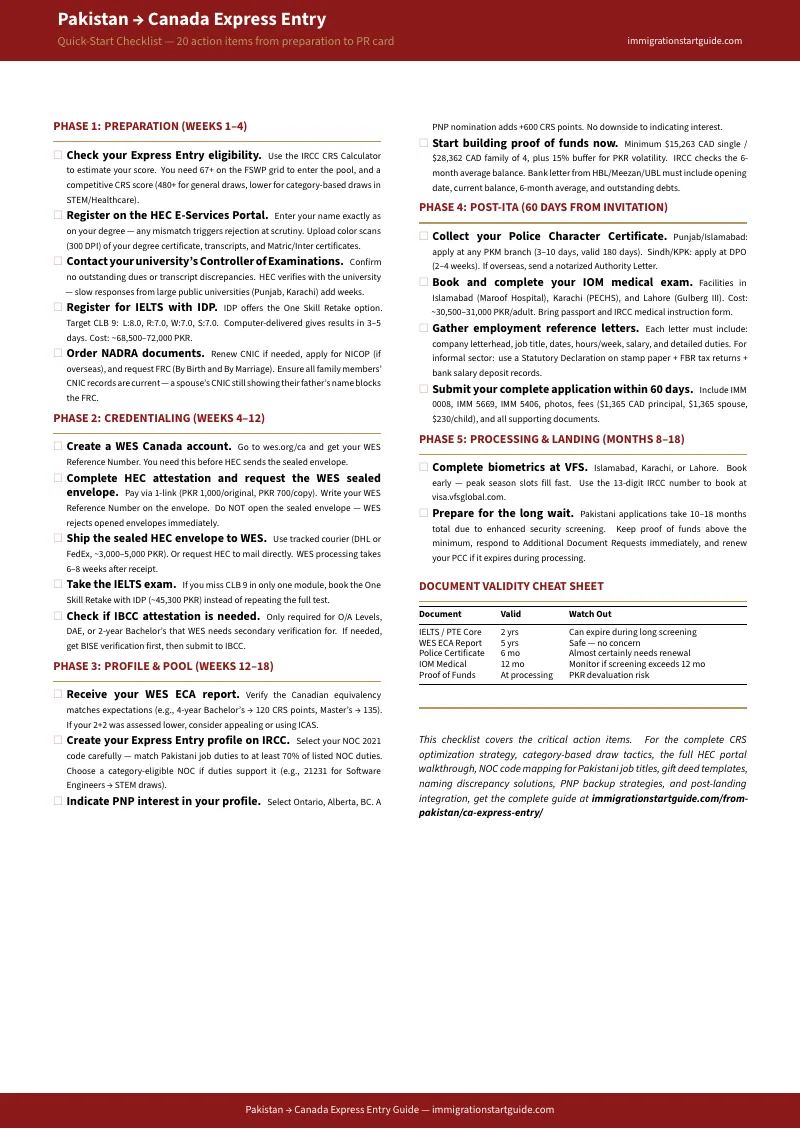
Quick-Start Document Checklist (free download)
Every Pakistan-specific document you need for your Express Entry application, distilled into a single printable checklist across five phases: NADRA identity documents, HEC attestation and WES pipeline, IELTS registration, proof of funds preparation, and the post-ITA sprint. Enough to start gathering documents tonight.
Standalone Reference Cards and Printables
Five standalone PDFs you can print and use independently — no need to carry the full guide to your HEC appointment, bank meeting, or VFS visit:
- HEC-to-WES Pipeline Tracker — One-page reference covering every step from HEC E-Services registration to WES report receipt, with expected durations, the sealed envelope protocol, and the WES Reference Number placement instructions
- 2+2 vs. 4-Year Degree Evaluation Guide — Decision tree showing WES outcomes for old-system 2-year Bachelor’s, 4-year integrated BS, and the 2+2 Master’s combination strategy that recovers lost CRS points
- PKR Buffer Calculator — Proof of funds worksheet with the 15% buffer formula, settlement fund thresholds by family size, bank letter format requirements, and the Gift Deed documentation checklist
- Pakistani NOC Crosswalk Table — Complete mapping of Pakistani job titles to NOC 2021 codes with TEER levels, category-based draw eligibility (STEM, Healthcare, Education, Trade), and the 70% duty-match verification guide
- 60-Day Post-ITA Countdown — Week-by-week checklist from ITA Day to Day 60 with PCC provincial timelines, IOM medical exam logistics, VFS biometrics booking strategy, and IRCC portal document upload mapping
Who This Guide Is For
This guide is for Pakistani professionals navigating Canada’s Express Entry system — whether you’re a software engineer in Lahore timing your HEC attestation, an accountant in Karachi building your proof of funds, or a doctor in Islamabad trying to align your MBBS with the new healthcare category draws:
- You’re a software engineer or data scientist and you know STEM category-based draws are pulling at CRS 480–491 — but you’re not sure if your Pakistani job title maps to a category-eligible NOC code, and choosing the wrong code means sitting in the general pool at 530+ indefinitely
- You hold an old-system 2-year BA plus 2-year MA and you’ve heard conflicting advice about how WES will evaluate them — some say Master’s equivalency (135 CRS points), others say only two years of post-secondary (98 points), and getting this wrong costs you $220 CAD and two months of wasted time
- You started the HEC attestation process and your application has been stuck at “task assigned” for three weeks because your name on the portal doesn’t match your degree exactly, or your university registrar is slow to respond to HEC’s verification request
- Your proof of funds is compliant today at 205 PKR/CAD, but your application will take 10–18 months to process and you have no strategy for maintaining compliance through Rupee devaluation — and your bank manager doesn’t know what format IRCC requires for the bank letter
- Your degree says “Ahmad s/o Bashir,” your passport says “Ahmad Bashir,” your IELTS certificate says “Muhammad Ahmad,” and you don’t know whether IRCC will treat these as one person or flag your file for misrepresentation
- You work at a family business or a small firm without a formal HR department, and you need an employment reference letter that meets IRCC’s specific requirements but have no idea how to get one — or what alternatives IRCC accepts
- You’re married with children, trying to figure out whether your spouse’s credentials help or hurt your CRS, how to budget the PKR 3.1–5.8 million in proof of funds across a realistic timeline, and how to time your PCC, IELTS, and medical exam so none of them expire during Pakistan’s extended security screening window
Why Not Free Resources?
Free information about Express Entry for Pakistanis is everywhere. Here’s what it actually gives you:
- WhatsApp and Facebook groups have thousands of Pakistani professionals sharing draw results, success stories, and HEC tips. The problem: most advice is anecdotal and conflicting. One person says open the sealed envelope to verify the documents before sending. Another says WES accepted their 2-year BA as a full Bachelor’s. A third says IBCC attestation is always required. Following the wrong advice costs you $220 CAD in WES fees, 8 weeks in processing time, and CRS points you can’t recover.
- YouTube channels are excellent for draw updates and general motivation. They deliver information in 10-minute fragments that don’t build into a procurement strategy. An engineer in Lahore needs to coordinate HEC attestation, WES evaluation, IELTS preparation, NADRA documents, proof of funds accumulation, and PCC timing across a 10–18 month timeline where each component’s expiry date constrains the others. No playlist does this.
- Immigration consultants (RCICs) charge $150–$200 USD for a 30-minute consultation. Full representation costs $1,500–$3,500 CAD — often higher than a mid-career Pakistani professional’s monthly salary. Many are generalists who handle Pakistani cases the same way they handle Indian or Nigerian cases. They don’t know the HEC sealed envelope protocol, the PKR buffer strategy, or the provincial PCC variations between Punjab and Sindh. You’re paying for form-filling and portal submissions. Whether you’re paying for the Pakistan-specific document procurement strategy is a different question.
- Generic Express Entry guides explain the CRS system for applicants from any country. They don’t know what HEC attestation is. They’ve never navigated the Degree Attestation System. They think police clearance is one standardized process. They have no concept of PKR volatility risk, naming convention discrepancies, or the 3–6 month security screening extension that makes Pakistani timelines fundamentally different.
- IRCC’s website (canada.ca) lists requirements without explaining how to fulfill them from Pakistan. It says “Educational Credential Assessment.” It doesn’t tell you that HEC is the mandatory intermediary, that the sealed envelope must remain unopened, that Walk-in Mode at HEC books out weeks in advance, or that your 2+2 degree combination needs separate attestation for both credentials to have any chance at a Master’s evaluation.
This guide fills the Pakistani documentation gap. It doesn’t replace an RCIC or immigration lawyer — it handles the entire Pakistan-specific procurement layer that generic guides ignore and consultants charge $1,500–$3,500 CAD to manage. The HEC-to-WES pipeline, the PKR proof of funds strategy, the naming discrepancy solutions, the provincial PCC variations, the informal sector reference letter alternatives, and the document validity timing that only matters when you’re filing from Pakistan with a 10–18 month processing horizon.
— Less Than a Single IELTS Sitting
An IELTS exam costs 68,500–72,000 PKR. A WES evaluation costs $220 CAD. Sending the wrong sealed envelope format to WES means paying again, waiting another 8 weeks, and watching your age tick past the next CRS penalty threshold. A proof of funds shortfall because you didn’t buffer for PKR devaluation means immediate disqualification. A consultant charges $1,500–$3,500 CAD for services that include form-filling you can do yourself on the IRCC portal.
The guide doesn’t replace an immigration consultant. It handles the Pakistan-specific document procurement strategy that sits between your competitive CRS score and an approved PR application. It turns months of conflicting WhatsApp advice and outdated YouTube tutorials into a structured protocol built for HEC, NADRA, VFS, the PKR, and the extended security screening timeline that makes Pakistani applications fundamentally different from every other source country.
Money-back guarantee, no time limit. If the guide doesn’t give you clearer control over the Pakistani documentation side of your Express Entry application, you pay nothing.
Download the free Quick-Start Checklist to see every Pakistan-specific document you need for Express Entry. When you’re ready for the HEC-to-WES pipeline walkthrough, the PKR buffer strategy, the NOC crosswalk table, the naming discrepancy solutions, and the complete 60-day post-ITA countdown, the full guide is here.
Your CRS score earns you a place in the pool. Your Pakistani documents — attested correctly, sealed properly, timed to survive 10–18 months of processing — determine whether you get out of it.