
You Have a BSc From BUET, Four Years of Software Development Experience, a CRS Score of 453 — and No Idea Whether WES Will Classify Your National University Three-Year Pass Degree as a "Bachelor's" or "Three Years of Post-Secondary Study." Your Special Branch Police Clearance Takes Two to Four Weeks After the Thana Verification. Your Invitation to Apply Window Is Sixty Days. And the Dhaka Consultant Quoting BDT 3 Lakh Cannot Start Your WES Transcript Process, Cannot Sit Your IELTS, and Cannot Make the CRS Draws Come Down to 453.
You have done the research. You know Express Entry has three programs — Federal Skilled Worker, Canadian Experience Class, and Federal Skilled Trades. You know the CRS scoring grid, you have run the calculator on the IRCC website, and you have a number between 440 and 470 that feels close but is not close enough. The draws have been sitting at 500 or higher for general rounds. You have read every Facebook group post in "Canadian PR from BD," every Reddit thread on r/canadaexpressentry, and every YouTube explainer from Dhaka creators who "got their ITA in three months." You have bookmarked the IRCC portal. You are ready to commit BDT 15 to 17 lakh in credential evaluations, language tests, settlement funds proof, and biometrics for your family.
And then the Bangladeshi side of the process starts.
If you graduated from a National University-affiliated college — and the majority of Bangladeshi graduates did — your transcript process begins with an online application to the NU website, a physical visit to the One Stop Service Center in Gazipur, a fee of BDT 746 per transcript, a separate attestation application for BDT 1,246, another BDT 823 for the WES form completion, and a requirement that the envelope be sealed and stamped across the back flap by the Controller of Examinations. If the seal is broken, WES in Toronto rejects the documents and you start again. If the transcript does not include credit hours, WES requests additional documents. If you graduated from Dhaka University, you go to Room 305 of the Registrar's Building. The official timeline is four to eight weeks. The community reality is that it can be faster if you know the right people and follow up in person, or much slower if you submit and wait.
Your three-year "Pass" Bachelor's degree from a National University college is where the real damage happens. WES frequently assesses this as equivalent to "three years of post-secondary study" — not a completed Canadian Bachelor's degree. That classification costs you 30 to 45 CRS points. In a system where the difference between receiving an ITA and sitting in the pool indefinitely is 20 to 30 points, this WES evaluation turns a competitive profile into an indefinite wait. And you find out only after you have spent BDT 20,000 on the WES fee and waited 35 business days for processing.
If you worked in Saudi Arabia or the UAE — and millions of Bangladeshi professionals have — IRCC requires a police clearance certificate from every country where you lived for more than six months. The Saudi PCC requires a fingerprint card attested by the Bangladesh Ministry of Foreign Affairs and the Saudi Embassy in Dhaka. If your former Gulf employer has closed — a common reality for project-based construction firms — obtaining a reference letter on company letterhead is impossible. Your employment contract is in Arabic with a generic job title that does not match your NOC code. IRCC requires specific duties, hours per week, salary, and dates. Without these, your years of Gulf experience count for nothing in the CRS.
The Canadian side of Express Entry is well documented by IRCC. The Bangladeshi side — the NU Gazipur transcript gauntlet, the DU Room 305 protocol, the three-year Pass degree downgrade, the Gulf returnee documentation challenge, the Special Branch PCC with its Thana verification and e-Challan codes, the credit card limit problem when paying CAD $1,365 in IRCC fees — is where applications stall, CRS scores collapse, and families lose months they cannot recover.
The Bangladesh to Canada Express Entry Guide is the BD-to-CA Express Entry Playbook — built specifically for Bangladeshi professionals navigating the Federal Skilled Worker, Canadian Experience Class, and Provincial Nominee Programs from within the Bangladeshi administrative system. This is not a translation of the IRCC website. This is the complete filing system covering the WES transcript pipeline university by university with exact fees and steps for National University Gazipur, Dhaka University Room 305, BUET, and private universities, the three-year Pass degree downgrade trap and the Master's degree fix that recovers lost CRS points, the CRS score optimisation strategy for Bangladeshi profiles including the French language bonus through Alliance Française de Dhaka that drops draw thresholds to 393, the spouse CRS optimisation that adds up to 40 points, the Provincial Nominee Program matrix showing which provinces nominate offshore Bangladeshi professionals, the category-based draw strategy for STEM, healthcare, French proficiency, and trades, the Special Branch police clearance timing method with e-Challan code and Thana verification, the Gulf returnee documentation system for Arabic contracts and closed companies, the settlement funds proof with Bangladeshi banking requirements, the IRCC fee payment strategies for Bangladeshi credit card limits, and the post-landing settlement chapter covering SIN registration, provincial healthcare, and banking.
What's Inside the BD-to-CA Express Entry Playbook
Twelve chapters, a quick-start checklist, and reference tools — the WES transcript pipeline sheet, NOC code mapping for Bangladeshi occupations, PNP province matrix, cost breakdown in BDT, settlement funds calculator, document validity table, employment reference letter template, and the 60-day post-ITA countdown — covering every step from your first CRS calculation through your first week in Canada:
The CRS Score Strategy for Bangladeshi Profiles
The Comprehensive Ranking System is not a checklist — it is the algorithm that determines whether you receive an Invitation to Apply or sit in the pool while draws happen around you. The guide breaks down every CRS factor with Bangladesh-specific analysis: the education credential trap where a four-year Honours degree scores full points but a three-year Pass degree gets downgraded — a 30 to 45-point swing determined entirely by how WES classifies your NU degree. The age cliff warnings at 30, 35, and 40 where you lose 5 to 6 points per year. The work experience scoring where four years of Bangladeshi or Gulf experience earns significant points but only if your NOC code is correctly mapped and your reference letters meet IRCC requirements. A worked example follows a 28-year-old BUET software engineer through the scoring — 451 on own profile, not competitive for general draws at 500+, but competitive for STEM category draws at 470–490 with the CLB 9 upgrade. The difference between CLB 8 and CLB 9 is not "a few extra language points" — it triggers Skills Transferability bonuses that add 30 to 50 points, transforming a dead-zone profile into a competitive one.
The WES Transcript Pipeline — University by University
No other migration resource walks you through the exact process for each Bangladeshi institution. National University Gazipur: online application for transcripts (BDT 746), physical visit to the One Stop Service Center, separate WES attestation application (BDT 1,246 for verification, BDT 823 for form completion), WES reference number on the sealed envelope, the Controller of Examinations seal that must not be broken, and courier logistics to WES Toronto via DHL. Dhaka University: Academic Records Request Form downloaded from the Registrar's website, Room 305 of the Registrar's Building, fee of BDT 300–500, the credit hours requirement that older transcripts may not include, and the "consolidated marksheet" request if needed. BUET and private universities: more streamlined but still requiring physical presence or authorized representative. Which private universities have electronic transmission to WES, bypassing the sealed envelope process entirely. The guide covers every institution type because the process is different at each one, and an error at any step — an unsealed envelope, a missing credit hour listing, a WES reference number not included — means rejection and restart.
The Three-Year Pass Degree Trap
This is the single most devastating credential issue for Bangladeshi applicants. The three-year "Pass" Bachelor's degree from NU-affiliated colleges is evaluated by WES as "three years of post-secondary study" — not a completed Bachelor's degree. The CRS impact: 30 to 45 points lost. The guide covers the Master's degree fix — completing a two-year Master's degree in Bangladesh so WES evaluates the combination as a Canadian Bachelor's equivalency, recovering the lost points. Alternative ECA agencies — IQAS (Alberta) and CES (University of Toronto) — that may evaluate the same degree differently. The four-year Honours degree pathway for applicants who have not yet completed their education. And the MBBS exception: if you hold an MBBS from a Bangladeshi medical college, you must use the Medical Council of Canada (MCC) for evaluation, not WES. Understanding this before you pay BDT 20,000 in WES fees prevents discovering the problem after your ECA report arrives.
The IELTS CLB 9 Power Move
Moving from CLB 8 to CLB 9 is the single highest-ROI action for a Bangladeshi applicant. The score thresholds: Listening 8.0, Reading 7.0, Writing 7.0, Speaking 7.0. What most applicants miss: CLB 9 does not just add language points — it unlocks Skills Transferability bonuses that multiply across education and work experience, adding 30 to 50 additional points. A BDT 28,000 IELTS retake that moves you from CLB 8 to CLB 9 is worth more than BDT 200,000 in consultant fees. The guide covers test centre logistics in Dhaka, Chittagong, and Sylhet, coaching centres (Mentors, Saifur's, Luminedge), the Speaking and Writing weaknesses common to Bangladeshi test-takers, the PTE Core alternative at BDT 25,000–28,000 with faster results, and the preparation timeline.
The French Language Strategy — Alliance Française de Dhaka
IRCC conducts French-language category-based draws with CRS cutoffs as low as 393 — more than 100 points below general draws. Achieving NCLC 7 in French adds up to 50 CRS points through the bilingual bonus. Alliance Française de Dhaka (Dhanmondi and Gulshan branches) is the sole provider of TCF Canada and TEF Canada exams in Bangladesh. The investment: BDT 50,000–100,000 for 6–12 months of study plus BDT 24,000 for the exam. The return: 50 CRS bonus points plus eligibility for draws where your 460 CRS score is 67 points above the cutoff instead of 40 points below it. No other single investment creates this combination of direct point gain and alternative draw eligibility.
The Special Branch Police Clearance and Gulf Country PCCs
The PCC from Bangladesh's Special Branch begins at pcc.police.gov.bd with an e-Challan payment of BDT 500 (code: 1-7301-0001-2681). After online submission, the application routes to your local Thana for a verification visit. Processing: 2–4 weeks. Validity: approximately six months. The timing strategy prevents your PCC from expiring during the 60-day ITA window. For Gulf returnees: the Saudi PCC requires MoFA Dhaka attestation and Saudi Embassy processing through agencies like Helpline Group or Trueway International (4–8 weeks). The UAE PCC through Dubai Police or MOI (2–4 weeks). The guide sequences all parallel PCCs so the longest-running one — typically Saudi Arabia — does not become your bottleneck.
The Gulf Returnee Documentation System
Bangladeshi professionals who worked in Saudi Arabia, the UAE, or Qatar face documentation challenges that domestic applicants do not. Arabic-language contracts with generic job titles that do not match NOC codes. Companies that have closed, making reference letters impossible. Cash or fragmented WPS wage payments that are difficult to verify retroactively. The guide provides the Manager Affidavit template — a sworn statement from your former manager describing your duties, even if they have also left the company. The statutory declaration approach using bank statements, old pay stubs, Iqama copies, and workplace photographs. The Letter of Explanation (LOE) template for IRCC. The WPS records download strategy for Gulf countries that maintain electronic wage records. For a Bangladeshi civil engineer who spent five years managing a construction project in Riyadh for a company that no longer exists, this chapter is the difference between claiming those five years of experience and losing them entirely.
The Provincial Nominee Program Matrix
A PNP nomination adds 600 CRS points — a guaranteed ITA. Saskatchewan SINP International Skilled Worker stream: no job offer required, 60/110 points on the SINP grid, targets healthcare, agriculture, and STEM. Ontario OINP Human Capital Priorities: searches the Express Entry pool for specific NOCs, Bangladeshi tech professionals often receive NOIs at CRS 450–480. Manitoba MPNP Skilled Worker Overseas: favours applicants with family connections in Manitoba. Nova Scotia Labour Market Priorities: targets nurses and early childhood educators. Atlantic Immigration Program: requires a job offer but increasingly viable for Bangladeshi healthcare workers. The guide maps each province's eligibility, draw history, target occupations, and accessibility for offshore Bangladeshi applicants.
Settlement Funds and the Bangladeshi Credit Card Problem
Single applicant: CAD $15,263 (~BDT 13.7 lakh). Family of three: CAD $23,360 (~BDT 21 lakh). Funds must be unencumbered and maintained for six months. The "large deposit" risk: if a lump sum appears in your account shortly before the application, IRCC investigates the source. The Gift Deed solution for family gifts on non-judicial stamp paper. IRCC fee payment (CAD $1,365 total): many Bangladeshi credit cards have international limits below this amount. Dual-currency card solutions (EBL Aqua, City Bank American Express), temporary limit increases, and offshore payment through a relative in Canada. The guide covers the financial logistics that generic guides never mention because they assume you have a Canadian or American credit card.
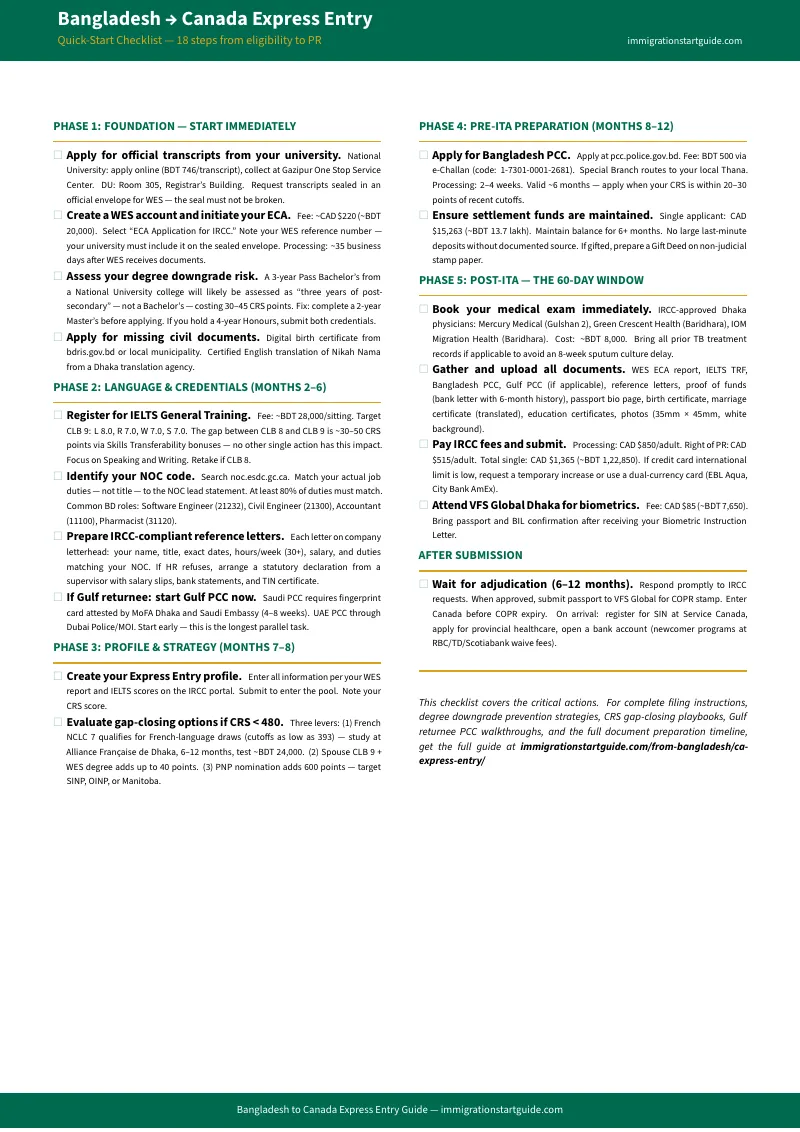
Quick-Start Checklist (free download)
Eighteen critical actions distilled into a single action sheet organised across six phases: Foundation, Language and Credentials, Profile and Strategy, Pre-ITA Preparation, Post-ITA 60-Day Window, and After Submission. Enough to identify your NOC code tonight, understand whether your three-year degree will be downgraded, and calculate whether the IELTS CLB 9 upgrade closes the gap to your target draw — because the WES pipeline alone takes four to five months from transcript request to evaluation result, and every week you delay is a week added to a timeline that already stretches twelve to eighteen months.
Who This Guide Is For
This guide is for Bangladeshi skilled professionals applying through Express Entry from within Bangladesh or from a Gulf state:
- Software engineers, data analysts, and IT professionals from BUET, DU, or private universities with CRS scores between 440 and 480 who need the category-based STEM draw strategy, the CLB 9 upgrade path, and the French language bonus to close the gap — because general draws at 500+ are out of reach on own profile alone.
- Graduates of National University-affiliated colleges with a three-year Pass degree who risk losing 30 to 45 CRS points if WES evaluates their credential as "three years of post-secondary" instead of a completed Bachelor's — you need the Master's degree fix, the alternative ECA agencies, and the WES evaluation reality before you pay BDT 20,000 in fees and wait 35 business days for a result that cripples your CRS score.
- Gulf returnees from Saudi Arabia, the UAE, or Qatar who face the double challenge of proving work experience from Arabic-contract employers (some of whom no longer exist) and obtaining multiple country police clearance certificates — you need the Manager Affidavit templates, the LOE format, the WPS records strategy, and the Gulf PCC sequencing that prevents the Saudi PCC from becoming a three-month bottleneck.
- Pharmacists, nurses, and healthcare professionals whose occupations qualify for healthcare category-based draws at CRS thresholds as low as 430 — you need the NOC code mapping, the draw history, and the PNP healthcare stream details for provinces actively recruiting your profession.
- Families facing BDT 2 lakh in application costs plus BDT 13.7–21 lakh in provable settlement funds who need the BDT cost breakdown, the Bangladeshi banking proof requirements, the Gift Deed documentation, and the credit card payment workaround — not a CAD figure with a "check the current exchange rate" footnote.
- Applicants weighing the consultant question — whether to pay BDT 2–5 lakh for a Dhaka immigration consultant — you need to understand that many Dhaka consultants are unlicensed "ghost consultants" whose submissions can result in a five-year ban for misrepresentation. Even legitimate RCICs cannot start your WES transcript process, cannot sit your IELTS, cannot obtain your Special Branch PCC, and cannot draft the employment reference letters IRCC officers require. The hardest parts of this application fall to you regardless.
— Less Than an Hour of a Dhaka Consultant's Time
A Dhaka immigration consultant charges BDT 2 lakh to 5 lakh for full-service Express Entry representation. Even the initial consultation costs BDT 5,000–15,000. The WES evaluation alone costs BDT 20,000 in fees. IELTS costs BDT 28,000 per attempt. Settlement funds proof requires BDT 13.7 lakh for a single applicant or BDT 21 lakh for a family of three — money you must show, not spend. For a family, total application costs including settlement funds exceed BDT 15 lakh. A mistake — the wrong NOC code, a three-year degree evaluated as post-secondary rather than a Bachelor's, a Special Branch PCC expiring during the ITA window, a WES submission rejected because the sealed envelope was damaged — does not just delay you. A rejected WES evaluation means paying BDT 20,000 again. An expired document during the sixty-day ITA window means losing your invitation. A CRS miscalculation means sitting in the pool while draw after draw passes you by.
This guide costs less than an hour of a Dhaka consultant's time, and it covers the complete BD-to-CA pathway: the WES transcript pipeline for every major Bangladeshi institution, the three-year Pass degree trap and the Master's fix, the CRS score optimisation strategy, the CLB 9 power move, the French language bonus, the spouse optimisation, the PNP matrix, the category-based draw strategy, the Special Branch PCC timing, the Gulf returnee documentation system, the settlement funds proof, the credit card payment solutions, and the month-by-month timeline. The WES chapter alone can save you BDT 20,000 in wasted fees. The French language strategy can drop your required draw threshold by over 100 points. The PNP matrix can add 600 CRS points to a profile that would otherwise sit in the general pool indefinitely.
You have the qualifications. You have the experience. You have the English. You have the professional skills Canada is actively seeking through an immigration program that targets over 110,000 Express Entry admissions per year. What stands between you and permanent residency is not eligibility — it is the gap between the Bangladeshi administrative system and the Canadian points-based system that will evaluate you. The NU transcript gauntlet. The three-year degree classification. The CRS optimisation. The PNP targeting. The Special Branch timing. The sixty-day ITA sprint. Every one of these is solvable. Every one of them, if mishandled, costs you months, lakhs of taka, or the ITA itself.
Money-back guarantee, no time limit. If the WES transcript pipeline walkthrough, the credential evaluation trap analysis, the CRS score optimisation strategy, the PNP matrix, the French language bonus chapter, the Gulf returnee documentation system, the sixty-day ITA sprint checklist, and the settlement funds chapter do not make your Express Entry application stronger than anything you could assemble from IRCC pages, Facebook group posts, and YouTube videos, you pay nothing.
Download the free Quick-Start Checklist to identify your NOC code tonight, understand whether your degree will be downgraded by WES, and calculate whether the CLB 9 IELTS upgrade closes the gap to your target draw. When you are ready for the complete BD-to-CA Express Entry Playbook — the full guide with the WES pipeline, the PNP matrix, the French language strategy, the Gulf returnee templates, and the financial compliance planning — the full guide is here.
Your qualifications earned you the right to apply. The CRS score, the credential evaluation, the PNP nomination, and the sixty-day ITA sprint are the only things standing between you and permanent residency in Canada. Start the process today — because every month you wait is a month closer to the next age cliff, the next PNP allocation change, and the next CRS draw that passes you by.