
You Have 10 Years of Experience, a Trade Qualification From Your Home Country, and a CRS Score of 410. Every General Draw Passes You By at 525+. But Trade-Specific Draws Accepted Scores as Low as 433 Last Year — and You Did Not Even Know They Existed. The Problem Was Never Your Score. It Was That Nobody Told You How to Make the System See a Tradesperson Instead of a Low-Scoring Applicant. This Guide Is the Trades-Specific CRS Optimisation System That Turns a 410 Into an Invitation.
You already know the basics. Canada's Federal Skilled Trades Program lets qualified tradespeople — electricians, plumbers, welders, carpenters, heavy-duty mechanics, millwrights — apply for permanent residency through Express Entry with lower language requirements than the Federal Skilled Worker Program. You need CLB 5 for speaking and listening, CLB 4 for reading and writing, 3,120 hours of post-qualification work experience in a TEER 2 or 3 occupation, and either a valid job offer or a Certificate of Qualification from a Canadian province.
What you probably did not know: in 2024, category-based trades draws had CRS cutoffs as low as 433. General all-program draws stayed above 520. That means a tradesperson with a score of 435 — who would never receive an invitation through a general draw — received an Invitation to Apply through a trades draw. And the 50-point Certificate of Qualification bonus, the CLB 7 skill transferability multiplier, the Educational Credential Assessment for trade school diplomas, and the strategic principal applicant switch for couples are all levers that exist specifically for tradespeople — but appear in no generic immigration guide because those guides assume you have a bachelor's degree and a desk job.
The Canada Federal Skilled Trades Guide is a Trades-Specific CRS Optimisation System — built for the three problems that separate tradespeople who get PR from tradespeople who stagnate in the Express Entry pool: qualifying for the category-based draws that accept scores 100 points lower than general draws, obtaining the Certificate of Qualification from abroad that unlocks both program eligibility and a 50-point CRS boost, and engineering your Express Entry profile so the system classifies you as a tradesperson eligible for trades draws instead of a generic low-scoring candidate.
What's Inside the Trades-Specific CRS Optimisation System
14-chapter guide + 9 printable tools — a 10-PDF toolkit covering occupational eligibility and the NOC 2021 TEER framework, the 3,120-hour work experience calculation with the 30-hour weekly cap, the job offer versus Certificate of Qualification binary, provincial certification pathways in Ontario, Alberta, and British Columbia, Red Seal endorsement as a mobility and immigration strategy, CRS optimization for candidates without degrees, category-based selection and trades draws, PNP streams targeting tradespeople across five provinces, the IEC-to-PR pipeline, employer reference letter templates for trade-specific duties, the 2026 fee schedule after the April increase, common refusal pitfalls, and the post-landing roadmap from PR to citizenship. Includes a fillable CRS scoring worksheet, a work hours tracker, a document preparation checklist, a 60-day post-ITA sprint plan, a provincial certification comparison, a PNP comparison card, a fee schedule reference card, and employer reference letter templates — all as standalone printable PDFs.
The Certificate of Qualification Pathway From Abroad (Chapter 4)
The FST has a hard gate: you must have either a valid job offer or a Certificate of Qualification from a Canadian province. For most offshore applicants, getting a job offer without a work permit is impractical — so the certificate is your realistic lever. But the process of obtaining provincial certification from abroad is almost entirely undocumented in the free immigration space. The guide covers Ontario's Trade Equivalency Assessment ($265.55 application fee, 8–12 weeks processing), Alberta's Trade Qualifier Work Experience Program with its panel interview requirement for international experience, and British Columbia's SkilledTradesBC pathway requiring 1.5 times the apprenticeship length in documented hours. This is the chapter that replaces the $3,000 consultant — because the consultant understands immigration law but cannot tell you whether your UK Level 3 NVQ maps to a Red Seal challenge in BC, or whether your Filipino TESDA hours satisfy Alberta's Trade Qualifier pathway.
CRS Optimisation for Tradespeople Without Degrees (Chapter 6)
The FST candidate faces a structural CRS disadvantage: no bachelor's degree means fewer education points, and age penalties start hitting after 30. Generic advice says "improve your CRS" without accounting for the fact that trades draws operate at fundamentally different cutoffs. The guide covers the Certificate of Qualification bonus (up to 50 points through skill transferability when combined with CLB 7+ language scores), the Educational Credential Assessment for trade school diplomas that most applicants skip because they assume ECAs are only for university degrees, the strategic principal applicant switch for couples where the tradesperson — not the degree-holding spouse — should be the principal applicant for trades draws, and the French proficiency shortcut that drops draw cutoffs to 380–420. In a draw where the cutoff is 433, a 15-point ECA for your two-year trade certificate is not a "nice to have" — it is the difference between an invitation and another six-month wait.
Category-Based Selection and Provincial Nominee Programs (Chapter 8)
Since 2023, IRCC has run dedicated draws targeting trade occupations with CRS cutoffs roughly 100 points below general draws. The guide maps exactly which NOC codes are targeted — and which were removed in the February 2026 changes (cooks and chefs lost their category-based advantage while butchers were added). It explains how to ensure your Express Entry profile is correctly "flagged" for trades draws, and covers the PNP streams in Alberta, Ontario, Saskatchewan, British Columbia, and Manitoba that actively recruit tradespeople with a +600 CRS boost that virtually guarantees an Invitation to Apply. If your CRS score is 400 and you qualify for Alberta's Express Entry stream, your effective score becomes 1,000. The PNP is the override pathway.
The 3,120-Hour Work Experience Calculation (Chapter 3)
The FST requires at least two years of full-time work experience in your trade within the last five years — but "full-time" has specific rules that trip up applicants. The 30-hour weekly cap means overtime cannot compress your timeline. Hours worked before you were formally qualified to practice do not count. Shift work patterns common in trades — 4-on-3-off at 12-hour shifts — require a specific calculation method. Self-employment requires a significantly higher evidentiary bar. If you have been working as a "General Labourer" or "Electrician's Helper," the guide explains exactly which hours count and which do not, before you spend two years accumulating experience that IRCC will reject.
The Employer Reference Letter for Trade-Specific Duties (Chapter 10)
The single most common reason for FST refusals is a generic reference letter. IRCC requires letters that describe your actual daily duties in language that aligns with your NOC code's lead statement — but not copied verbatim, because officers flag word-for-word reproductions as fabricated. The guide provides reference letter frameworks for electricians, plumbers, welders, carpenters, and mechanics, with the specific duty language that satisfies IRCC without triggering red flags. Your employer's letter needs to say you "installed, tested, and maintained electrical wiring and fixtures in residential and commercial buildings" — not that you "did electrical work."
The IEC-to-PR Pipeline (Chapter 9)
Thousands of tradespeople from the UK, Ireland, and Australia are in Canada on International Experience Canada working holidays. Many spend their first year as "General Labourers" or "Helpers" — TEER 4 or 5 roles that do not qualify for the FST or the Canadian Experience Class. The guide explains how to ensure your job title and duties align with a qualifying TEER 2 or 3 NOC code from Day 1, the Bridging Open Work Permit that prevents a status gap when your IEC expires, and the timing strategy so you can stay on the job site while your PR is processed. Because the worst outcome is not a low CRS score — it is discovering after 12 months in Canada that your job title disqualifies all of your accumulated work experience.
Red Seal Endorsement Strategy (Chapter 5)
The Red Seal is the interprovincial certification stamp that lets a certified tradesperson work in any province or territory in Canada without additional testing. It is not an immigration program — it is a labour mobility tool. For immigration, the Red Seal matters because the Certificate of Qualification that carries it satisfies the FST's job-offer-or-certification requirement and adds up to 50 CRS points. After landing, it means you are not locked to the province where you first certified. The guide covers the exam format, the 70% passing grade, province-by-province study resources, and the strategic case for pursuing the Red Seal during your immigration process rather than after landing.
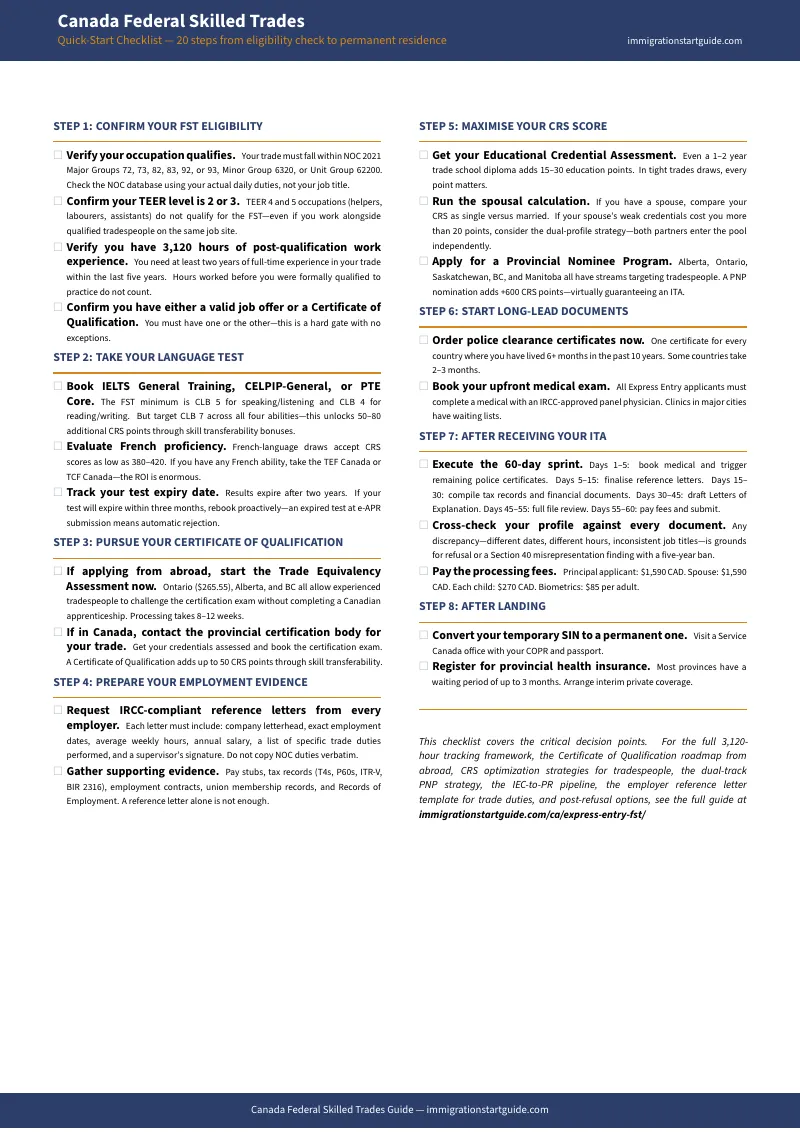
Quick-Start Checklist (free download)
A 20-step action plan covering eligibility confirmation (NOC code, TEER level, 3,120 hours, job offer or certificate), language testing strategy, Certificate of Qualification pursuit, employment evidence preparation, CRS maximisation, long-lead document ordering, the 60-day ITA sprint, and post-landing steps. Enough to confirm your eligibility and identify your next move tonight.
Who This Guide Is For
This guide is for skilled tradespeople who want to immigrate to Canada through the Federal Skilled Trades Program — who have discovered that the immigration system was built for people with degrees and the generic guides assume you have one:
- You are a qualified tradesperson applying from abroad — an electrician in the UK, a welder in the Philippines, a plumber in South Africa, a carpenter in India — with years of post-qualification experience and a trade certificate from your home country. You know Canada needs your skills, but you cannot figure out how to translate your credentials into something the Express Entry system recognises
- You are in Canada on an IEC working holiday or LMIA work permit and your temporary status is expiring. You have been working as a tradesperson but you are not sure if your hours count, whether your job title maps to the right NOC code, or how to convert your Canadian experience into a permanent residency application before your permit runs out
- Your CRS score is stuck between 400 and 450 and every general draw passes you by. You do not have a degree, you are over 30, and the generic advice to "improve your CRS" does not account for the category-based draws that accept scores 100 points lower
- You are part of a couple and the "default" principal applicant calculation is wrong — your spouse has the degree but you have the trade certification, and in a trade-specific draw only the tradesperson is eligible
- You consulted an immigration professional and were quoted $2,000 to $12,500 for a case with no complications. The FST application is a document-organisation and experience-verification exercise with specific vocational requirements — you want structured guidance that understands trade credentials, not immigration law alone
This guide is not for: knowledge workers, IT professionals, or healthcare workers without trade certifications. It does not cover the Federal Skilled Worker Program or the Canadian Experience Class. Every chapter, every checklist, every cost projection is specific to the Federal Skilled Trades pathway and the 2026 regulatory environment.
Why Not Free Resources?
Free information on Canadian immigration exists everywhere. Here is what it actually delivers for tradespeople:
- The IRCC website (canada.ca) tells you that you need a Certificate of Qualification but not how to get one from Manila or Dublin. It lists the NOC codes but does not explain the February 2026 changes that removed cooks from category-based draws. Provincial certification body websites — SkilledTradesBC, Alberta TradeSecrets, Ontario OCOT — were built for domestic apprentices, not international applicants trying to challenge the exam from abroad.
- Reddit (r/ImmigrationCanada, r/electricians, r/Welding) has thousands of tradespeople asking "do I have any chance with a CRS of 400?" and getting twenty different answers, none backed by the actual draw data showing that trade-specific draws accepted 433. One wrong answer about whether your "helper" hours count can cost you two years of work experience that IRCC will not credit.
- Immigration consultants ($2,000–$5,000) and lawyers ($3,000–$12,500) understand immigration law but rarely understand vocational requirements. They cannot tell you whether your UK City & Guilds maps to a Red Seal challenge in British Columbia, or how to structure a reference letter for a welder versus an electrician. Forum users consistently report that consultants "just fill out the forms" and do not provide the trades-specific strategic advice that maximises CRS points for candidates without degrees.
- Generic immigration blogs are written by consultancy firms to capture leads. They restate the basic eligibility rules found on the government website but offer no insider strategies — no Certificate of Qualification pathway from abroad, no skill transferability calculations, no principal applicant switching for couples, no PNP targeting for tradespeople.
This guide fills the trades-specific gap — the space between "I know Express Entry exists" and "I have an optimised profile tagged for trades draws, a Certificate of Qualification application in progress, reference letters with NOC-matching duty language, and a clear understanding of which PNP stream gives me a +600 point override." Free resources tell you the rules. This guide tells you the strategy.
— Less Than One Hour of a Consultant's Time
Immigration consultants charge $2,000 to $5,000 for Express Entry representation. Lawyers charge $3,000 to $12,500. A single one-hour consultation runs $150 to $325, and you walk away with verbal advice that disappears when the call ends. No reference letter templates. No provincial certification roadmaps. No CRS optimisation calculations.
Your total PR application will cost approximately $2,500 to $4,000 in government and ancillary fees — the $990 processing fee (increased April 2026), the $600 Right of Permanent Residence Fee, $85 biometrics, a $200–$450 medical exam, $200–$350 for the Educational Credential Assessment, $300–$400 for the language test, and police certificates from every country where you lived 6+ months. If you are sponsoring a spouse, add another $1,590. That is money you cannot recover if your application is returned because a reference letter said "did electrical work" instead of describing your actual NOC-aligned trade duties.
A returned application does not just cost you in fees. It costs months of processing time that restart from zero. For a tradesperson whose CRS score qualifies for a trades draw but not a general draw, missing one draw cycle can mean waiting six months for the next one — and in six months, the proposed Federal High-Skilled Class consolidation could change the rules entirely.
Money-back guarantee, no time limit. If the Certificate of Qualification pathway, the CRS optimisation strategies for tradespeople, the category-based draw targeting, the employer reference letter frameworks, the provincial certification roadmaps, and the PNP comparison do not make your application stronger, you pay nothing.
Download the free Quick-Start Checklist to confirm your NOC code, verify your TEER level, check your 3,120-hour work experience calculation, and identify whether to pursue a Certificate of Qualification or a job offer. When you are ready for the complete trades-specific CRS optimisation system, the full guide is here.
Canada needs 700,000 tradespeople by 2028. The immigration system was built for people with degrees — but the trades draws accept scores of 433, the Certificate of Qualification adds 50 CRS points, and the PNP gives you a +600 override. The door is open. This guide is how you walk through it as a certified tradesperson, not a low-scoring applicant.