
IRCC Charges $1,595 in Non-Refundable Fees, Then Refuses Applications Where Genuine Couples Submitted the Right Documents Without the Right Strategy
You built a life across borders — the video calls that replace goodnight kisses, the airport arrivals that end too soon, the constant arithmetic of tourist visa durations and when you can be together again. Now you are staring at the IRCC website and discovering that bringing your spouse to Canada permanently requires convincing an immigration officer — someone professionally trained to detect fraud — that your relationship is genuine under Regulation 4(1) of the Immigration and Refugee Protection Regulations.
The immigration consultant you contacted wants $3,000 to $5,000. The lawyer quoted $5,000 to $7,000. For those fees, you still gather every bank statement, every photograph, every translation yourself — they review what you hand them and submit it. The free alternative is worse. IRCC publishes the application guide IMM 5289, which lists required forms without explaining how officers actually evaluate the subjective question that determines whether your family stays together: is this relationship genuine, or was it entered into primarily for immigration purposes?
Reddit and Facebook groups fill the gap with panic. Someone whose Inland application was approved in 11 months tells you their approach worked — and their advice is dangerously irrelevant to your Outland situation. Someone whose application was returned after four months of waiting shares that they used an outdated form version. Someone warns about a five-year misrepresentation ban under section 40 of IRPA triggered by a discrepancy between a previous visitor visa and the sponsorship application. You cannot tell which advice applies to your situation and which will destroy your application.
Meanwhile, the DIY kits sold by immigration consultancies cost $100 to $200 and consist of compiled government forms with generic advisory notes — zero guidance on the subjective genuineness assessment that actually determines refusal or approval.
The Canada Spousal Sponsorship Guide is a Genuineness Defence System — not a textbook explaining immigration law, but a structured process that builds your evidence across the four pillars IRCC officers actually evaluate, routes you into the correct processing stream based on your specific circumstances, constructs the Relationship Narrative that preemptively dismantles officer skepticism, and audits your PR Portal submission against the technical specifications that trigger immediate returns. It replaces weeks of contradictory forum advice with one linear path from eligibility assessment through permanent residency.
What's Inside the Genuineness Defence System
A complete guide with 12 chapters, a Quick-Start Checklist, and 7 standalone printable tools — covering the full spousal sponsorship lifecycle from sponsor eligibility through eCOPR issuance, with every 2026 fee schedule, processing timeline, and regulatory citation current as of May 2026:
The Four-Pillar Evidence Framework
IRCC officers do not check that you submitted documents — they evaluate whether your evidence triangulates across four dimensions. Financial: active commingling of funds through a joint bank account with ongoing shared transactions, not a dormant account with a token $50 deposit. Social: contextual photographs showing the couple with family and community at events over time, not cropped selfies of just the two of you. Physical: joint-address government documents for cohabitating couples, or exhaustive travel records (boarding passes, passport stamps, hotel bookings) for long-distance couples. Emotional: curated monthly communication samples demonstrating daily interdependence and future planning, not 2,000 pages of unfiltered WhatsApp logs. The guide teaches you to think like the officer evaluating your file — and build evidence that triangulates across all four pillars so no single dimension is left unproven.
The Inland vs Outland Decision Decoded for 2026
This is not a generic comparison table. Outland processes in approximately 15 months with full travel flexibility and preserved appeal rights to the Immigration Appeal Division. Inland takes approximately 21 months, locks the sponsored partner inside Canada (leaving risks automatic application abandonment), and eliminates the right to appeal — your only recourse after an Inland refusal is an expensive Federal Court judicial review that evaluates procedural fairness, not the merits of your relationship. The guide includes the Hybrid strategy that lets you file Outland while your spouse lives in Canada under dual intent, preserving both mobility and legal protections. It provides a decision worksheet that weighs your specific circumstances: travel needs, work authorisation urgency, current immigration status, and risk tolerance for the appeal rights trade-off.
The Relationship Narrative — the Most Important Document You Will Write
This is not an official IRCC form, but it is the strategic document that ties your entire evidence package together. It presents the chronological story of your relationship and preemptively addresses every weakness, inconsistency, and red flag before the officer can question them. How you met, the proposal, the wedding, financial integration, daily domestic life, and concrete future plans in Canada. The guide provides the structure, the approach to common vulnerabilities, and the mistakes that signal a rehearsed or fabricated narrative — because an officer reading a Relationship Narrative that sounds like a love letter instead of a factual chronology will doubt it before they finish the first page.
Red Flag Mitigation for High-Scrutiny Applications
Large age gaps. Rapid marriages after brief courtships. Arranged marriages where officers scrutinise cultural compatibility factors. Long-distance relationships with limited cohabitation history. Couples who cannot communicate fluently in a shared language. Applicants from countries historically associated with heightened IRCC scrutiny. Previous visa refusals or inconsistencies with prior immigration filings. The guide does not pretend these factors do not matter — it provides the specific evidence strategies to neutralise each one, and the critical principle that anomalies are not automatic grounds for refusal if they are preemptively explained with robust contextual evidence.
The IRCC PR Portal Submission Protocol
The technical requirements that cause immediate returns before your application is ever assessed. Every uploaded file must be under 4 MB. Documents must follow strict naming conventions (LastName - FirstName - DocumentType). The portal registers pages as "complete" even when mandatory fields are blank — allowing incomplete applications to be submitted and returned months later. Photographs require specific formatting including the studio stamp on the reverse. IMM 5669 (Schedule A) demands a continuous 10-year history with zero gaps — a single unaccounted month triggers an automatic return. The guide provides the exact specifications and the pre-submission audit that prevents a two-to-three-month return delay over a technicality.
Spousal Open Work Permit Eligibility and Timing
The 2026 public policy updates that expanded SOWP access, eligibility criteria (active PR application with AOR, physical residence in Canada, valid temporary status), how to apply regardless of whether you chose Inland or Outland, and the realistic timeline from Acknowledgement of Receipt to work authorisation. Includes the SOWP public policy expiration date and what it means for your planning.
Complete 2026 Cost Breakdown
Every fee across the entire process: the $1,080 sponsorship application fee, the $515 right of permanent residence fee, $85 per person biometrics, $255 for the Open Work Permit, medical examination costs ($150–$220), police certificate fees by country, and the Quebec-specific CSQ requirement that adds $328+ and months of provincial processing. Total budget: $1,600 to $2,500 depending on circumstances. A clear calculation showing that a refused application does not just cost you the filing fees — it costs you months or years of separation while you diagnose what went wrong and reapply.
Refusal Prevention: Procedural Fairness Letters and the Genuineness Interview
If the officer has doubts, you receive a Procedural Fairness Letter — one final, time-limited chance to address specific concerns before refusal. Or you are called for a genuineness interview where the couple is separated and questioned about intimate daily details to test for discrepancies: who attended the wedding, what side of the bed your partner sleeps on, the colour of their toothbrush. The guide covers how to respond to a PFL with structured factual rebuttals (not emotional appeals), and how to prepare for interview questions that test whether your relationship exists in lived reality, not just on paper.
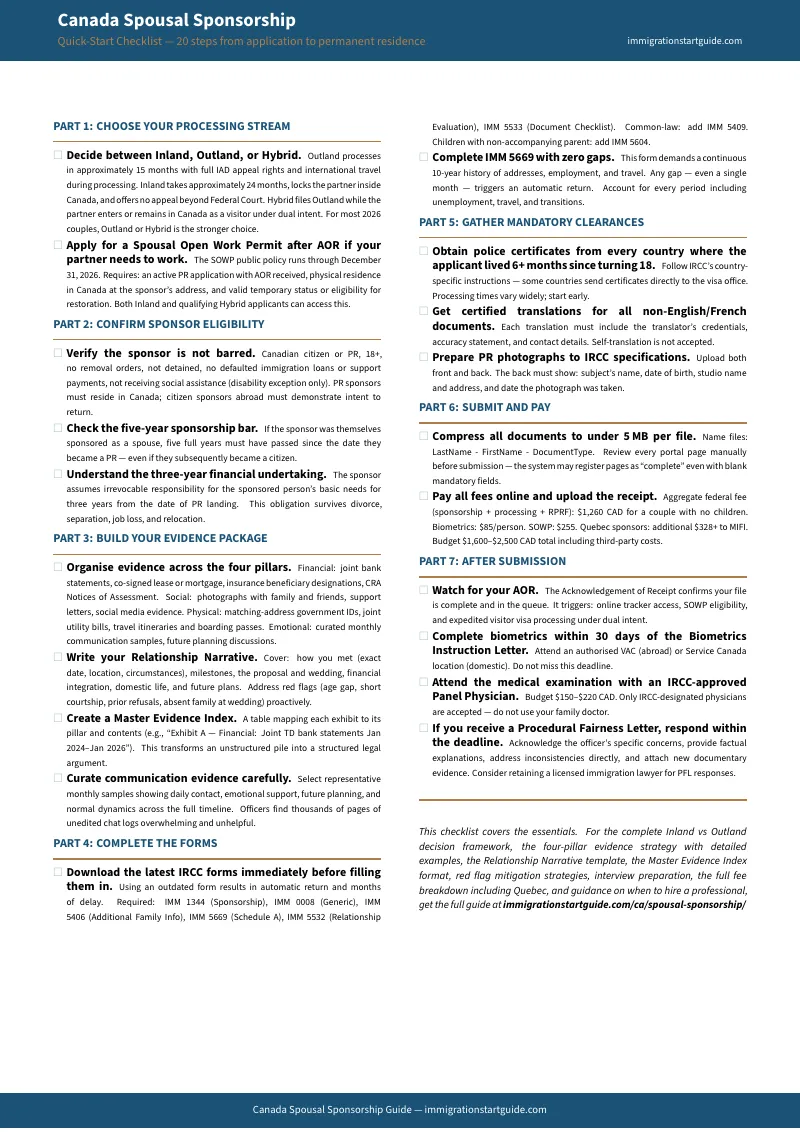
Quick-Start Checklist (free download)
A 20-item action plan covering the essentials: choose your processing stream, verify sponsor eligibility, organise evidence across the four pillars, write your Relationship Narrative, complete the forms with zero gaps, gather mandatory clearances, and submit through the PR Portal. Enough to start tonight — and enough to see whether a structured approach makes the process feel manageable for the first time.
7 Standalone Printable Tools
Print-ready worksheets and reference cards extracted from the guide so you can use them at your desk without flipping through chapters: the Relationship Narrative Template (fill-in sections for each part of your chronological story), the Master Evidence Index (map every exhibit to its pillar before submission), the Inland vs Outland Decision Worksheet (side-by-side comparison with diagnostic questions), the Complete Document Checklist (every form and supporting document with checkboxes), the PR Portal Pre-Submission Audit (file sizes, naming conventions, photograph specs, zero-gap verification), the 2026 Fee Breakdown (every government and third-party cost on one page), and the Genuineness Interview Preparation (practice questions organised by theme for both partners to complete independently).
Who This Guide Is For
This guide is for Canadian citizens and permanent residents sponsoring a spouse or common-law partner who:
- Are filing a straightforward application with a genuine relationship and want to make sure the evidence strategy is airtight — because you have read enough forum horror stories about legitimate couples refused over weak documentation to know that being genuinely married is not, by itself, enough
- Are in a long-distance relationship and worried about proving genuineness when you have limited cohabitation history, visits documented only by passport stamps, and a relationship that exists primarily through screens
- Have red flags you cannot eliminate — a significant age gap, a rapid timeline from meeting to marriage, an arranged marriage, a previous visa refusal, or a partner from a country that IRCC subjects to heightened scrutiny — and need the mitigation strategy, not reassurance that it will probably be fine
- Are deciding between Inland and Outland and every forum post gives contradictory advice based on someone else's circumstances from two years ago — and need the 2026 decision framework that accounts for processing times, travel restrictions, work authorisation, and appeal rights specific to your situation
- Have a spouse currently in Canada on a temporary visa that is expiring and need to understand whether filing Inland creates a travel trap for 21 months or whether the Hybrid strategy preserves both status and mobility
- Consulted an RCIC or lawyer and were quoted $3,000 to $7,000 for a case with no criminal complications and no prior refusals — and want to file with the same strategic depth, knowing exactly when the guide is sufficient and when you should hire a professional
- Had a previous application refused and need to understand whether the refusal grounds involve misrepresentation risk, what evidence to strengthen in the resubmission, and how to address the officer's specific concerns without triggering contradictions with the original filing
Why Not Free Resources?
Free information exists. Government pages, consultant blogs, immigration forums, YouTube advisors — all free, all abundant. Here is what they actually deliver:
- IRCC (canada.ca) publishes the application guide IMM 5289 and the document checklist IMM 5533. They tell you to submit "relationship evidence" without explaining what officers actually look for. They list the required forms without teaching you how to structure evidence across the four pillars. You get requirements, not strategy.
- Reddit (r/ImmigrationCanada) and Facebook groups are invaluable for emotional support and processing timeline data. But a filing strategy that worked for an Inland application from a Canadian-born couple is irrelevant to an Outland application involving a long-distance arranged marriage. Applying another couple's evidence approach to your own application — especially when the processing streams, relationship categories, and red flag profiles differ — is one of the fastest paths to a refusal. Every new horror story makes you more anxious, not more prepared.
- YouTube immigration consultants produce excellent content about sponsorship complexity and refusal risks. Their business model is to demonstrate how terrifying the process is, then offer a $3,000+ consultation. They explain why you need an RCIC. They never hand you the evidence framework or the decision worksheets.
- DIY kits from immigration consultancies cost $100 to $200 and consist of compiled government forms with generic advisory notes. They do not cover the four-pillar evidence strategy, the Relationship Narrative structure, red flag mitigation, or the PR Portal submission traps. They help you fill in forms. They do not help you prove a relationship.
This guide fills the execution gap — the space between "I understand I need to prove my relationship" and "I can build an evidence package that triangulates across all four pillars, choose the processing stream that matches my circumstances, construct the Relationship Narrative that preemptively addresses every vulnerability, and submit through the PR Portal without triggering a technical return." The same structured approach an experienced immigration professional would use internally, at a fraction of the cost of a single consultation.
— Less Than One Hour with a Consultant
An immigration consultant charges $3,000 to $5,000. A lawyer charges $5,000 to $7,000. The mandatory government fees alone exceed $1,595 before medical exams, police certificates, and translations. Before you have paid for any professional help, the baseline sunk cost exceeds $2,000. A refused application forfeits those fees and costs you months of separation while you diagnose what went wrong and reapply.
This guide does not replace a consultant for cases involving criminal inadmissibility, section 40 misrepresentation findings, complex immigration histories, or active removal proceedings. But for the majority of spousal sponsorship applications that are procedurally manageable, it provides the same evidence strategy and submission protocol — at a cost lower than one hour of a consultant's time.
Money-back guarantee, no time limit. If the Genuineness Defence System does not make your application stronger, you pay nothing.
Download the free Quick-Start Checklist to see the 20-point action plan. When you are ready for the complete four-pillar evidence framework, the Relationship Narrative template, the Inland vs Outland decision worksheet, and the PR Portal audit protocol, the guide is here.
You crossed borders to build a life together. Now build the application that keeps it.