
You Ran the Physical Presence Calculator Three Times This Week. You Got Three Different Numbers. The Five-Year Window Slid Forward, the Pre-PR Half-Day Credits Shifted, and That Weekend in Buffalo You Almost Forgot About Just Changed Your Eligibility. The Government Fee Is $630 and There Are No Refunds for Returned Applications. This Guide Is the Residency Audit System That Ensures Your 1,095 Days Are Bulletproof Before You Submit.
You know the basics. Canada requires 1,095 days of physical presence within a five-year window. You need three years of tax filings, a CLB 4 language score, and a clean criminal record. The citizenship test is 20 multiple-choice questions from the Discover Canada study guide. You pass with 75%.
What you probably did not know: the five-year eligibility window shifts forward by one day every day you delay submitting. Pre-PR days count at half credit, but only up to 365 days — meaning you need 730 pre-PR days to maximize the credit, and most applicants miscalculate this. Day trips to the US count as days present in Canada, but declaring them incorrectly triggers discrepancies when IRCC cross-references your application against CBSA border records. And 19% of citizenship applications are currently sitting in backlog beyond the 12-month service standard — most of them flagged for inconsistencies in the travel declaration, missing tax filings, or documentation gaps that could have been caught before submission.
The Canada Citizenship Guide is a Residency Audit System — built for the three problems that separate permanent residents who get citizenship from permanent residents who get returned applications: calculating the weighted physical presence formula correctly with pre-PR credits, CBSA reconciliation, and a safety buffer; verifying CRA tax compliance before IRCC's automated cross-check flags you; and assembling the document package so no field inconsistency or missing scan triggers non-routine processing.
What's Inside the Residency Audit System
12-chapter guide + quick-start checklist — covering the complete naturalization pathway from eligibility verification through your first Canadian passport, including the 2026 regulatory changes under Bill C-3 and the new biometrics requirement.
The 1,095-Day Physical Presence Calculation (Chapter 3)
The calculation that causes more returned applications than any other element. The guide breaks down the weighted formula: post-PR days count as full days, pre-PR days count at 50% with a strict 365-day cap (requiring 730 actual pre-PR days in Canada to maximize). Travel days — both departure and return — count as days of presence because you were in Canada for a portion of those calendar days. But the calculator output is only valid for the day you print it — the five-year window advances daily, and signing the printout on a different day than you sign the application can shift your count below the threshold. The guide includes the 35-day buffer strategy that prevents borderline refusals when your declared absences differ from CBSA entry records by even a single day.
CBSA Travel History Reconstruction (Chapter 3)
If you have lost an old passport, cannot find stamps for a trip, or have gaps in your travel records — the CBSA has your complete border crossing history and will give it to you for free through a Privacy Act (ATIP) request. Processing takes approximately 30 days. Most applicants do not learn this recovery pathway exists until after their application has been returned for insufficient evidence of physical presence. The guide covers how to submit the request, how to reconcile CBSA data with passport stamps, and how to prepare a Letter of Explanation for remaining gaps. This single chapter has prevented more returned applications than any other section.
Tax Filing Compliance (Chapter 4)
IRCC requires at least three taxation years of filings within the five-year window, verified automatically through a CRA data-sharing agreement. The catch: stay-at-home parents with zero income still need to file. Students who worked part-time in September but not the rest of the year still need to file. Filing a nil return takes minutes, but discovering you missed it after submitting your citizenship application costs months. The guide covers how to check your filing record in CRA My Account, how to file late returns with no penalty when you owe nothing, how long to wait for Notices of Assessment after e-filing (2–4 weeks), and the specific NOA data IRCC looks for during their compliance check.
Bill C-3 Citizenship by Descent (Chapter 11)
The December 2025 legislation that removed the first-generation limit on passing Canadian citizenship to children born abroad. If you are a Canadian citizen born outside Canada, your children born abroad are now eligible for citizenship — but only if you can prove 1,095 days of physical presence in Canada at any point before the child's birth. Children born before December 15, 2025 receive retroactive automatic citizenship. Children born after must meet the new "substantial connection" test. The documentation requirements involve proving Canadian presence from potentially decades ago using school transcripts, employment records, old tax filings, and even childhood vaccination records. Official IRCC guidance on this is still minimal — the guide consolidates the documentation strategy that the government has not yet published in plain language.
Dual Citizenship by Country (Chapter 10)
Canada allows dual citizenship. Your home country may not. The IRCC website does not tell you what happens to your original nationality when you take the Canadian oath. India requires full renunciation — your Indian passport is legally cancelled the moment you become Canadian, and you must apply for the OCI card to retain travel and property rights. China considers your Chinese citizenship automatically forfeited, with no equivalent recovery pathway. The Philippines allows retention through an Oath of Allegiance at a Philippine consulate. Pakistan formalized dual citizenship with Canada in 2024. Germany requires prior permission to retain nationality. The guide covers each major source country's rules and the post-naturalization procedures you need to follow — so you answer "what am I losing by becoming Canadian?" before you take the oath, not after.
The IRCC Online Portal Application Walkthrough (Chapter 7)
Step-by-step instructions for the digital application: required document scans (passport biographical pages, PR card or COPR, government photo ID), citizenship photo specifications (50mm × 70mm, commercially taken), the $630 adult fee and $100 minor fee, and the field-by-field consistency checks. The most common processing delays come from inconsistencies between the address history, employment history, and travel history sections — where an address change that overlaps with a trip triggers a manual review. The guide identifies these cross-reference points before you submit.
Quick-Start Checklist (free download)
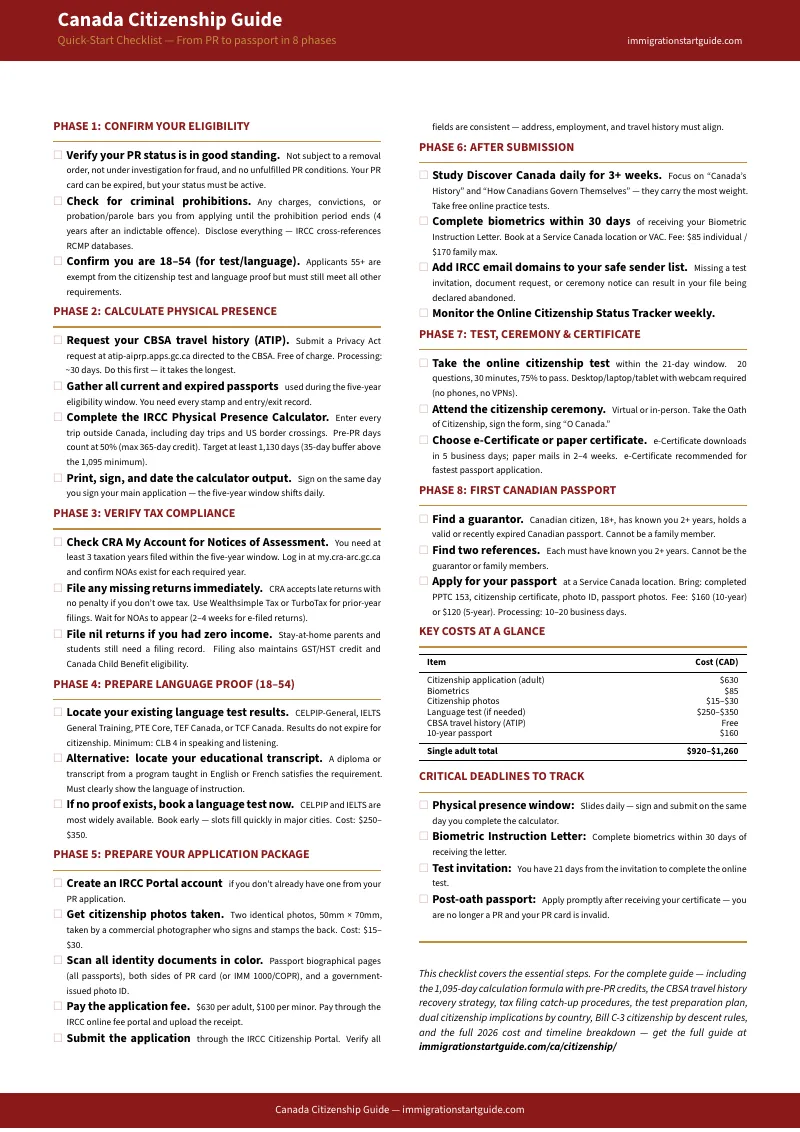
An 8-phase action plan covering eligibility confirmation, CBSA travel history request, physical presence calculation, tax compliance check, language proof, application assembly, post-submission study plan, and the passport application. Enough to identify your next move and start the CBSA ATIP request tonight — the single action that takes 30 days and should be first.
8 Standalone Printable Worksheets & Reference Cards
Print what you need, when you need it. The Physical Presence Calculation Worksheet for tallying your 1,095 days with pre-PR half-credits. The CBSA Travel History Request card with step-by-step ATIP instructions. The Tax Filing Compliance Checklist with a fillable NOA tracking table. The Document Assembly Checklist covering every scan, photo spec, and fee. The Dual Citizenship Quick Reference showing country-by-country consequences for India, China, Philippines, Pakistan, Germany, and the US. The 2026 Cost Breakdown with budget estimates for singles, couples, and families. The Citizenship Test Study Planner with a 3-week schedule. And the Post-Submission Tracking Sheet to monitor your milestones from AOR through passport.
Who This Guide Is For
This guide is for permanent residents of Canada who are approaching or have passed the 1,095-day threshold and want to apply for citizenship — who have discovered that the administrative complexity of proving eligibility is far more challenging than the citizenship test itself:
- You have been calculating your physical presence days for weeks and keep getting different numbers. Your pre-PR time as a student or worker should count at half credit, but you are not sure how the formula works, whether day trips need to be declared, or what happens when your calculator output drifts as the five-year window slides forward
- You travel frequently for work or family visits and your trip history is scattered across expired passports, some of which you no longer have. You need to reconstruct your travel record before you can determine whether you are eligible — and you did not know you could request your complete CBSA border crossing history for free
- You are a stay-at-home parent or former student who did not file tax returns for one or more years during the eligibility window. You assumed zero income meant no obligation, and you just learned that IRCC automatically flags applicants whose CRA records show missing filings
- You are from India and need to understand the full renunciation and OCI sequence — or from China, the Philippines, Pakistan, or another country where your original citizenship is affected by taking the Canadian oath. The IRCC website tells you nothing about your specific country's implications
- You have children born in Canada or abroad whom you want to include in your application, and you need to understand whether to file concurrently or separately, what Bill C-3 changes for families, and what documentation minors require
- You are 55 or older and know you are exempt from the test and language requirement, but every resource you have found is focused on test preparation — leaving you with no guidance on the physical presence, tax filing, and application process that still applies to you
- You are considering hiring an RCIC but want to understand the process first — so that if you engage one, it is for a targeted $425 review rather than a $1,250 full-service retainer on a case you could handle yourself
This guide is not for: individuals applying for a proof of citizenship (section 3 certificate), citizens seeking to resume citizenship after renunciation, or cases involving criminal inadmissibility, misrepresentation findings, or loss-of-status appeals that require a licensed consultant or lawyer.
Why Not Free Resources?
Free information on Canadian citizenship exists everywhere. Here is what it actually delivers for someone preparing to submit:
- The IRCC website (canada.ca) tells you that you need 1,095 days of physical presence but not how to handle the weighted pre-PR credit formula, the sliding five-year window, day trip declarations, or what to do when CBSA records contradict your passport stamps. It tells you to meet tax filing obligations but does not explain that zero-income years require nil returns or how to catch up through CRA without triggering penalties.
- Reddit (r/ImmigrationCanada) has thousands of users sharing contradictory advice — one person says day trips do not need to be declared, another had their application returned for not listing them. Someone says test results expire; they do not, for citizenship purposes. The contradictions are systemic because the rules changed in 2017 (Bill C-6), again in 2025 (Bill C-3), and most forum advice predates one or both changes.
- "Citizenship Test 2026" apps ($6.99/week or $14.99/month) are excellent for the 20-question multiple-choice exam. They do nothing for the 80% of the process that actually causes failures — the physical presence calculation, the tax compliance check, the document assembly, or the country-specific dual citizenship implications. And a $14.99 monthly subscription quickly approaches the one-time cost of a guide that covers the entire process.
- Immigration consultants ($650–$1,250 for standard cases) perform the same residency audit, tax verification, and document review that this guide teaches you to do yourself. For straightforward cases — no criminal record, no misrepresentation concerns, no complex status history — the consultant is doing document organization, not legal strategy. The guide gives you the same checklists and verification procedures at a fraction of the cost.
This guide fills the execution gap — the space between "I know I need 1,095 days" and "I have reconciled my CBSA records with my passport stamps, verified three years of CRA filings, assembled my document package with consistent address and employment history, understand exactly what happens to my original citizenship, and am submitting a complete application that will not be returned." Free resources tell you the rules. This guide tells you how to prove you meet them.
— Less Than One Hour of a Consultant's Time
Immigration consultants charge $650 to $1,250 for standard citizenship cases. A one-time "peace of mind" application review runs $425 to $650. A single consultation is $150 to $250 for 30–60 minutes of general advice — no checklists, no residency audit tools, no country-specific dual citizenship guidance.
The government fee for a citizenship application is $630 per adult. If your application is returned for a physical presence miscalculation, a missing tax filing, or a document inconsistency, you lose months of processing time. And the five-year eligibility window keeps sliding — meaning a returned application may shift your count below the threshold, forcing you to wait additional months to reaccumulate enough days. For applicants who travel frequently, a six-month delay can genuinely change the math.
In the context of $920 to $1,260 in government and ancillary fees (application fee, biometrics, photos, language test, passport) plus three to five years of building your life in Canada — this guide is the verification layer that ensures your application does not join the 19% in backlog because of a preventable documentation error.
Money-back guarantee, no time limit. If the physical presence calculation system, the CBSA travel history reconstruction protocol, the tax filing compliance verification, the dual citizenship analysis for your country, and the document consistency checks do not make your application stronger, you pay nothing.
Download the free Quick-Start Checklist to start your CBSA travel history request tonight — the single most important preparation step, and it takes 30 days to process. When you are ready for the complete Residency Audit System, the full guide is here.
You have spent three to five years building a life in Canada — working, paying taxes, raising children who think of this country as home. Citizenship makes that permanent. Not a conditional status that can be revoked for an extended absence, but an irrevocable constitutional right. A Canadian passport with visa-free access to 185+ countries. The ability to vote, to hold security-cleared positions, to pass citizenship to your children. The test is 20 questions and a study guide. The application is where careers in Canada are protected or delayed by preventable paperwork errors. This guide ensures yours is not one of them.