
You Scored 469. The Cut-Off Is 515. Now What?
You created an Express Entry profile. You entered your Colombian degrees, your IELTS scores, your work experience. The system gave you a Comprehensive Ranking Score somewhere around 460-480. Then you looked at the general draw cut-offs for 2025 and 2026 — consistently above 515 — and realized you are 40 to 60 points short with no obvious way to close the gap.
You have already explored the standard advice: get a year of Canadian work experience (requires a work permit you do not have), pursue a Canadian master's degree (80-120 million COP and two years), or find an employer willing to sponsor an LMIA (the job market says good luck). Every path either requires money you should not have to spend or time you cannot afford to lose.
Meanwhile, RCIC consultants in Bogotá charge 5-15 million COP for what often amounts to filling out the same online forms you can fill out yourself. Study-in-Canada agencies push pathways costing 120-180 million COP. And the free YouTube content repeats the same surface-level CRS breakdown without ever addressing how Colombian credentials specifically interact with Canadian immigration systems — how WES evaluates a Tecnólogo, what happens when your Certificado Laboral does not match NOC format requirements, or why your Policía Nacional antecedentes need specific handling for IRCC.
The French Fast-Track System
Spanish and French share approximately 75% lexical similarity. They are both Romance languages derived from Latin, with overlapping grammar, cognates, and sentence structure. This linguistic proximity means a native Spanish speaker can reach NCLC 7 in French — the threshold that unlocks Canada's French-language immigration category — in 6 to 9 months of dedicated study. An English-only speaker typically needs 12 to 18 months to reach the equivalent level.
The impact on your Express Entry profile is transformative. Adding French proficiency at NCLC 7 or higher yields 50 or more additional CRS points through both the official language proficiency scoring and the French-language category bonus. A profile scoring 469 with English only jumps to approximately 531 with French — well above the general draw cut-off. And the French-language category draws have had cut-offs as low as 379, meaning you would not even need a competitive CRS score to receive an Invitation to Apply.
This guide is built around that strategy. It is not a generic Express Entry walkthrough with a paragraph about French tacked on. The French language pathway is the structural foundation, and every other chapter — credential evaluation, documentation, provincial nomination, proof of funds — is organized around making that pathway work for a Colombian applicant.
What You Get
French Language Strategy
The complete roadmap for a Spanish speaker reaching NCLC 7 in French: which test to take (TEF Canada vs TCF Canada), the specific competency benchmarks, a month-by-month study plan exploiting Spanish-French cognate overlap, recommended resources, and how to time your test relative to your Express Entry profile submission. Includes the CRS point calculations showing exactly how French proficiency changes your score at each NCLC level.
WES Colombian Degree Mapping
How World Education Services evaluates Colombian credentials — and where it goes wrong. The Tecnólogo is routinely downgraded to a two-year diploma instead of a three-year credential, costing you points. This chapter covers the documentation strategy for accurate assessment, how to combine a Tecnólogo with an Especialización Tecnológica for the "two or more credentials" CRS bonus, and the specific WES submission process for degrees issued by Colombian institutions including SENA, universities, and institutos tecnológicos.
IELTS Prep for Colombian Test-Takers
Colombian English learners have predictable weak points in IELTS General Training — particularly Writing Task 1 (letter format) and the Listening module's accent diversity. This chapter covers the minimum CLB scores that maximize CRS points, the specific score combinations that trigger point thresholds, where to take IELTS in Bogotá and Medellín, and preparation strategy targeted at the areas where Colombian test-takers most commonly lose points.
Colombian Documentation Chain
Every document IRCC requires, traced through the Colombian institutions that issue them. Cancillería digital apostille process for birth certificates and academic records. Policía Nacional Certificado de Antecedentes Judiciales — the judicial background certificate that must be obtained within the validity window. Registraduría Nacional for civil status documents. Omnitempus third-party verification for employment records when your employer's Certificado Laboral does not meet IRCC format. PILA social security records as backup employment evidence. Screen-by-screen portal navigation where applicable, with costs in COP.
IRCC-Compliant Reference Letters
Colombian employers issue Certificados Laborales — a one-page confirmation of employment dates and title. IRCC requires detailed reference letters specifying duties, hours per week, and salary. Most Colombian HR departments have never seen this format. This chapter provides the exact template to give your employer, explains what to do when a former employer has closed or will not cooperate, and covers the alternative evidence strategy using PILA records, contracts, and sworn declarations.
NOC Code Mapping
The 2021 NOC system replaced the old four-digit codes. Your Colombian job title almost certainly does not map directly to a NOC title. This chapter shows how to match your actual work duties — not your title — to the correct TEER category, why choosing the wrong NOC code can disqualify your application, and how to verify your mapping using the NOC matrix search before you submit.
CRS Optimization Strategy
A chapter-length breakdown of every CRS factor and how to maximize each one from a Colombian starting position. Age timing (when to submit based on your birthday and the 10-point-per-year penalty after 30). Education points with WES-evaluated Colombian credentials. Language test score targets for the exact CLB thresholds that trigger point jumps. The spouse/common-law partner factor — when adding a partner helps and when applying as single scores higher. Skill transferability cross-factors that most applicants miss entirely.
Provincial Nominee Program Pathways
Express Entry-linked PNP streams that add 600 CRS points — enough to guarantee an invitation regardless of your base score. Ontario's French-Speaking Skilled Worker stream (requires NCLC 7, no job offer needed). New Brunswick's Strategic Initiative stream (NCLC 5, lower threshold). Alberta Advantage Immigration Program. British Columbia's Skills Immigration Express Entry stream. Eligibility criteria, application process, and processing times for each.
Proof of Funds and CDT Handling
IRCC requires proof of settlement funds in a specific format — typically six months of bank statements showing a minimum balance. This chapter covers how to present Colombian CDT (Certificado de Depósito a Término) and savings accounts to meet the requirement, currency conversion documentation, the specific dollar amounts required by family size, and how to handle funds held across multiple Colombian banks including Bancolombia, Davivienda, and Banco de Bogotá.
Post-ITA 60-Day Sprint
When you receive an Invitation to Apply, you have 60 days to submit a complete application with every supporting document. This chapter provides the day-by-day timeline for a Colombian applicant: police certificate validity windows, medical exam scheduling with designated panel physicians, document upload specifications, biometrics appointment booking, and the common errors that trigger procedural fairness letters or outright refusal.
Complete Cost Breakdown
Every fee from profile creation to landing, in both CAD and COP: WES evaluation ($260 CAD), IELTS ($340 CAD), TEF Canada ($400 CAD), application processing fee ($1,365 CAD per adult), right of permanent residence fee ($515 CAD), biometrics ($85 CAD), medical exam, police certificate, and settlement funds requirement. Total baseline for a single applicant and for a family of four. Comparison against RCIC consultant fees and study-permit pathway costs.
Who This Guide Is For
- Colombian professionals with a CRS score in the 440-490 range who need a realistic strategy to close the gap without spending years or tens of millions of COP
- Tecnólogo graduates who suspect their credential was undervalued by WES and want to know how to fix or supplement it
- Spanish speakers who have never studied French but want to understand exactly how the Romance language advantage works for Express Entry
- Colombians already in the Express Entry pool who keep watching draws go by above their score and need a different approach
- Families evaluating Canada against other destinations (US, Spain, Australia) who need the real cost and timeline numbers before committing
Why Not Free Content?
Generic Express Entry guides explain the point system in general terms. They do not explain how WES evaluates a SENA Tecnólogo versus a university Profesional degree. They do not cover the Cancillería apostille portal or the Omnitempus verification workaround for employers who refuse to issue IRCC-format reference letters. They do not provide the French language study plan calibrated for Spanish speakers or the CRS arithmetic showing exactly which score thresholds to target.
The Express Entry system penalizes mistakes with processing delays, procedural fairness letters, or outright refusal — and you cannot simply resubmit. A WES evaluation with the wrong document set means months of delay. An NOC code mismatch means your work experience points vanish. A reference letter in Certificado Laboral format instead of IRCC format means your employment history is not counted. Each error has a specific cost in time, money, or both, and the free content does not cover the Colombian-specific details that prevent them.
What's Included
- Complete Guide (PDF) — 13 chapters covering CRS optimization, French language strategy, WES credential mapping, IELTS prep, Colombian documentation chain, employment reference letters, NOC code selection, PNP pathways, proof of funds, the post-ITA sprint, timeline, and common mistakes
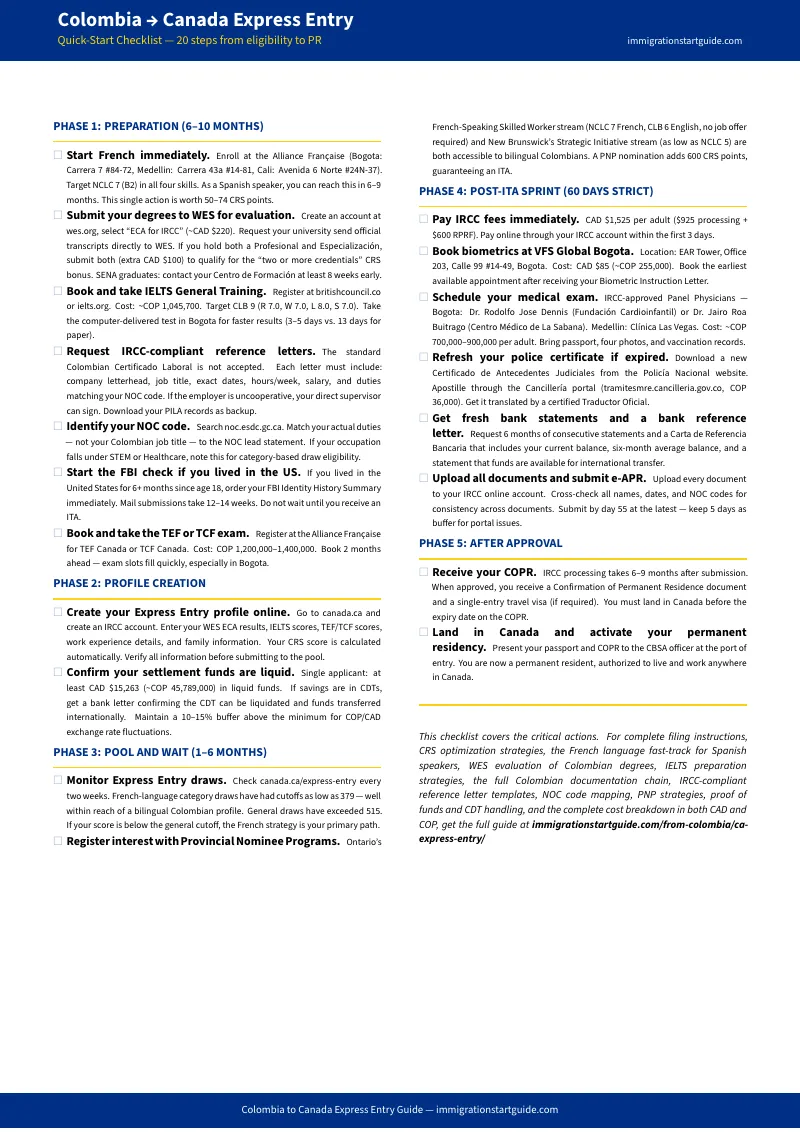
- Quick-Start Checklist (PDF) — 20-step action plan from profile creation to permanent residency — also available as a free download
- 6 Standalone Printables (PDF) — Reference letter template for Colombian employers, WES document pipeline, Colombian documentation chain tracker, post-ITA 60-day countdown, PNP province comparison matrix, and complete cost breakdown in CAD and COP
Satisfaction guarantee. If the guide does not give you a clearer path to a competitive Express Entry score, email us at any time for a full refund.
— Less Than Your WES Evaluation Fee
The WES credential evaluation alone costs $260 CAD. A single RCIC consultation in Bogotá runs 1-3 million COP. The total cost of the Express Entry process exceeds $3,000 CAD per adult before you include settlement funds. This guide costs less than the biometrics fee — and it covers the entire strategy from CRS optimization through landing.
Download the free checklist to see the action plan. When you are ready for the full technical roadmap — the French language strategy, the WES evaluation fix, the Colombian documentation chain, and the PNP pathways — the complete guide is here.