
You Scored a 440 on the CRS Calculator. You Cannot Figure Out Whether SEP or SEGOB Apostilles Your Título. WES Might Evaluate Your Licenciatura as a Two-Year Diploma. And You Are One French Exam Away From an Invitation to Apply That Arrives in Weeks Instead of Never.
You have the degree. You have the work experience. You know that Canada runs a transparent, points-based system — no lottery, no employer dependency, no 60-day departure clock if your company lays you off. You have calculated your CRS score on the IRCC website. You have read the r/ImmigrationCanada threads. You are ready to create your Express Entry profile.
What you are not ready for is the document chain that will stall your application before IRCC reviews a single page of your profile.
The number one confusion for Mexican Express Entry applicants is the apostille authority maze. Since Canada joined the Hague Apostille Convention on January 11, 2024, every Mexican document submitted to IRCC must carry an apostille — but which government office issues it depends on who issued the document, and getting this wrong means a rejected document package. Your Acta de Nacimiento from a state civil registry goes to the state Secretaría de Gobierno. Your Constancia de Antecedentes Penales Federales from OADPRS goes to SEGOB at Avenida Río Amazonas 62 in Mexico City. Your Título Profesional from a private university with federal RVOE must first be authenticated by SEP's Dirección General de Acreditación, Incorporación y Revalidación (DGAIR) before it can be apostilled by SEGOB — skip the DGAIR authentication and SEGOB will refuse the apostille. Your Título from UNAM goes directly to SEGOB because it is a federal autonomous institution. None of this is explained in any generic Express Entry guide because no generic guide is written for Mexicans.
Behind the apostille maze sits a second problem that determines whether your degree is worth 112 CRS points or 68: the WES evaluation of your Mexican credential. WES requires the Título Profesional and the Certificado de Estudios — not the Cédula Profesional, not the Carta de Pasante. If you submit a Carta de Pasante because you completed coursework but have not yet received your Título, WES evaluates it as incomplete study — and your Licenciatura drops from a Bachelor's equivalent (112 points) to a one-year credential (68 points). That 44-point difference is the gap between receiving an ITA and sitting in the pool indefinitely. And if your private university's program lacks RVOE status on the SIRVOES registry, WES may refuse to evaluate the credential entirely.
Behind the credential trap sits a third reality that most Mexican applicants do not discover until they have been waiting in the pool for months: at a CRS score below 520, general all-program draws will not reach you. The minimum cutoff in 2024 general draws hovered between 524 and 546. With a Licenciatura, three years of experience, and a CLB 9 in English, a 30-year-old Mexican professional scores roughly 440-470. Competitive, but not enough for general draws. Every generic guide tells you to "improve your English score" or "get more work experience" — advice that takes years to execute. None of them tells you about the strategy that can close the gap in months, because none of them is written for Spanish speakers.
The Mexico → Canada Express Entry Guide is the Mexican Apostille-to-ITA Blueprint — built for the specific bureaucratic, linguistic, and credential reality that Mexican professionals face: navigating the SEP/SEGOB/state apostille authority maze, ensuring WES classifies your Licenciatura or Maestría correctly, deploying the French bilingual strategy that gives Spanish speakers a 50-point CRS advantage most applicants from other countries cannot access, leveraging CUSMA professional work permits as a stepping stone to Canadian Experience Class eligibility, and assembling every Mexican document with the exact authentication sequence and timing that prevents rejection. This is not a translation of the IRCC website. This is the integrated system covering the CRS optimization strategy with the French language shortcut for Spanish speakers, the WES credential evaluation playbook for Mexican degrees, the complete Mexican apostille procurement chain with SEP/SEGOB/state routing, the CUSMA work permit pathway for 60+ LMIA-exempt professional categories, the police clearance process through OADPRS with digital apostille timing, the proof of funds calculation and IMSS Semanas Cotizadas documentation, the cost breakdown and relocation financial planning, and the IRCC portal submission strategy.
What's Inside the Mexican Apostille-to-ITA Blueprint
A 42-page guide, a quick-start checklist, and 9 standalone printable tools (11 PDFs total) — covering every step from your first CRS calculation through your Confirmation of Permanent Residence:
CRS Optimization Strategy with the French Bilingual Advantage
This is the strategy that transforms a competitive-but-stuck CRS score into one that guarantees an ITA — and it is uniquely accessible to Mexican applicants because of the linguistic bridge between Spanish and French. The guide covers the complete CRS scoring breakdown, how each factor (age, education, language, work experience, Canadian connections) maps to your specific Mexican profile, and then introduces the French bilingual strategy: by achieving NCLC 7 on the TCF Canada, you gain 25 points for second-language proficiency and unlock the 50-point bilingual bonus (NCLC 7 French plus CLB 5 English). That 50-point jump takes a 440 score to 490, and simultaneously qualifies you for category-based French-language draws where cutoffs drop as low as 379 — compared to the 524+ required in general all-program rounds. For native Spanish speakers, reaching NCLC 7 in French takes 8-12 months of focused study because of the thousands of shared cognates: nación/nation, político/politique, información/information. The guide provides the study timeline, resource list (Alliance Française Mexico, online platforms), the TCF Canada exam registration process, and the scoring thresholds that convert test performance into CRS points. A Mexican applicant who invests 10 months in French study gains more CRS points than someone who spends two years upgrading their English from CLB 9 to CLB 10.
WES Credential Evaluation Strategy for Mexican Degrees
Whether WES classifies your Licenciatura as a Bachelor's degree or a two-year diploma changes your CRS by 44-50 points — and the difference depends on which documents you submit, whether your university has RVOE status, and whether you send the Título Profesional or only the Carta de Pasante. The guide covers the complete WES process for UNAM, IPN, and Tec de Monterrey graduates: how UNAM's DGAE provides sealed transcripts, how Tec campuses can transmit credentials electronically through their Document Verification Services, how IPN's registrar process works, and the specific pitfalls for graduates of private universities whose programs may lack RVOE on the SIRVOES database. It includes the "Highest Credential Rule" — if you hold a Maestría (Stricto Sensu), you generally only need to evaluate your Master's degree, saving time and money on the Licenciatura evaluation. The guide maps the WES timeline (35 business days standard, 20-30 for electronic submissions), the cost ($250-$325 CAD), and the exact document package that ensures your degree evaluates at its correct Canadian equivalent.
Mexican Apostille Authority Routing and Document Procurement
This is the section that does not exist in any general Express Entry guide — because it cannot. The apostille routing depends entirely on the Mexican federal structure: who issued the document determines who apostilles it. The guide provides the complete routing table: state-issued documents (Acta de Nacimiento, Acta de Matrimonio) go to the state Secretaría de Gobierno. Federal police clearance from OADPRS goes to SEGOB. Private university degrees with federal RVOE must be authenticated by SEP's DGAIR before SEGOB will apostille them. UNAM degrees go directly to SEGOB. The guide maps every document IRCC requires — birth certificate, police clearance, educational credentials, marriage certificate if applicable, IMSS employment records — to the correct apostille authority, with the physical addresses, online portals, costs ($232-$240 MXN for police clearance, variable for apostille), processing times (72 hours for electronic criminal clearance), and validity windows (criminal clearance expires in 90 days — apostille timing must synchronize with your ITA response deadline). It covers the digital police clearance option through the OADPRS portal and the online apostille for certificates with a digital folio issued within three natural days.
CUSMA Professional Work Permit Pathway
Most Mexican professionals learn about Express Entry first and CUSMA second — but for many, the strategic move is to reverse the order. Under the Canada-United States-Mexico Agreement, Mexican professionals in over 60 categories — Engineers, Computer Systems Analysts, Management Consultants, Scientific Technicians, and dozens more — can obtain a Canadian work permit without a Labor Market Impact Assessment. The guide covers how to use a CUSMA permit as the fastest entry point into Canada: secure a job offer in your CUSMA-eligible profession, enter Canada at a port of entry with your Título Profesional and job offer documentation, work for one year, and then apply through the Canadian Experience Class stream within Express Entry — which is often prioritized in invitation rounds and requires a lower effective CRS score because of the Canadian experience points. This "work first, then PR" strategy is the fastest route for Mexican IT professionals, engineers, and management consultants who have a competitive profile but fall 30-50 points short in the general Express Entry pool.
IMSS Employment History and Work Experience Documentation
IRCC requires proof of work experience that goes beyond a simple employer reference letter. Mexican applicants have a powerful verification tool that most other nationalities lack: the IMSS Semanas Cotizadas record, which provides an irrefutable, government-verified history of every week your employer paid social security contributions on your behalf. The guide covers how to download your IMSS digital record, how it maps to the National Occupational Classification (NOC) codes IRCC uses to evaluate work experience, how to supplement it with employer letters that describe duties at the TEER 0/1/2/3 level required for Express Entry, and how to handle gaps in IMSS records for periods of self-employment or work under a different regime. Combined with CTPS-style employer letters aligned to NOC descriptions, your work experience documentation becomes audit-proof.
Cost Breakdown and Relocation Financial Planning
The guide provides the complete cost structure for a Mexican applicant: IRCC application and Right of Permanent Residence Fee ($1,450 CAD), biometrics ($85 CAD), WES evaluation ($250-$325 CAD), medical examination at designated panel physicians in Mexico City, Guadalajara, or Monterrey ($220-$240 CAD), certified translations of all Spanish-language documents ($300-$600 CAD), apostille fees (variable by document and authority), and IELTS or CELPIP exam fees. Total mandatory preparation costs run approximately $2,600-$3,200 CAD — roughly 40,000-50,000 MXN. Additionally, applicants without a valid Canadian job offer must demonstrate proof of funds of approximately $14,000 CAD (around 200,000 MXN) for a single applicant. The guide compares these costs against CAD $3,000-$5,000 for full Express Entry representation from an RCIC consultant — and identifies exactly which steps you can execute yourself and which might warrant professional review.
Quick-Start Checklist (free download)
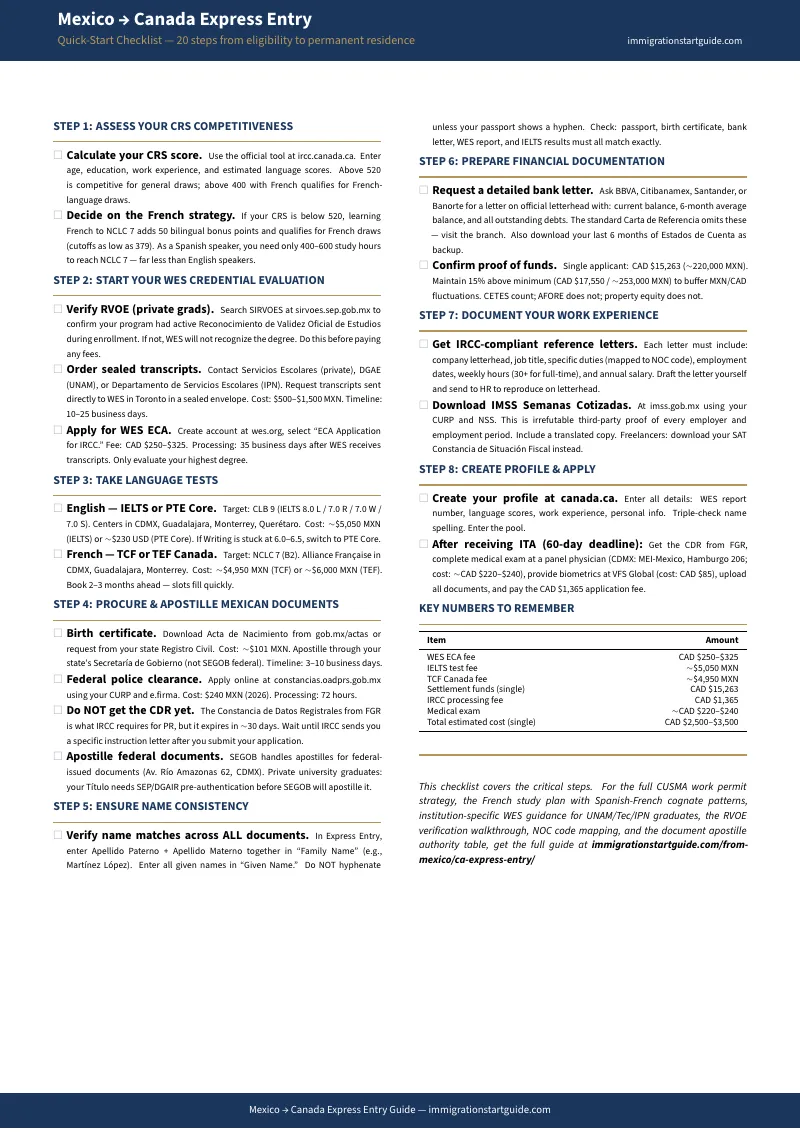
The critical steps distilled into a single action sheet organized by phase: CRS score calculation with the French bonus estimate, WES credential evaluation preparation, apostille authority identification for your specific documents, police clearance and medical exam timing, CUSMA eligibility check, and proof of funds verification. Enough to calculate your realistic CRS score tonight — including the French bilingual bonus you did not know you could access — and identify whether your Mexican degree will evaluate correctly at WES.
Who This Guide Is For
This guide is for Mexican professionals pursuing Canadian permanent residency through the Express Entry system:
- IT professionals, software engineers, and systems analysts earning 25,000-80,000 MXN per month who score 430-470 on the CRS and need a concrete strategy to close the gap — the French bilingual bonus is designed for exactly this profile, and your NOC codes align with category-based selection rounds that IRCC has been running since 2023.
- UNAM, IPN, and Tec de Monterrey graduates who need their Título Profesional evaluated correctly by WES — because whether WES classifies your Licenciatura as a Bachelor's (112 CRS points) or as incomplete study (68 points) depends on which documents you submit and whether your program has RVOE status.
- H-1B refugees — Mexican professionals in the United States who entered on TN status, have been waiting for the H-1B lottery for years, or face the 60-day departure clock after a layoff. Canada offers a direct-to-PR pathway with no lottery, no employer dependency after approval, and open work permits for your spouse.
- CUSMA-eligible professionals — engineers, management consultants, scientific technicians, and the 60+ other professional categories who can enter Canada on an LMIA-exempt work permit and convert to permanent residency through the Canadian Experience Class within 12 months.
- Mexican professionals with a Maestría who qualify for the Federal Skilled Worker Program's education maximum but need to navigate the WES evaluation, the apostille chain, and the CRS optimization to ensure their profile is competitive in invitation rounds.
- Applicants who have been quoted CAD $3,000-$5,000 by an RCIC for Express Entry representation and want to understand exactly what the consultant would do — so they can evaluate whether to self-file, use the guide as preparation for a focused consultation, or combine both approaches.
This guide is not for: applicants seeking Canadian family-class sponsorship (different process entirely), Provincial Nominee Program applicants (see the Ontario PNP Guide or other province-specific guides), Canadian study permit applicants (see the Canada Study Permit & PGWP Guide), or non-Mexican applicants (see the general Canada Express Entry FSW Guide).
Why Not Free Resources?
Free information about Express Entry for Mexicans is everywhere. Here is what it actually delivers:
- The IRCC website lists the eligibility criteria: minimum CLB 7 for the Federal Skilled Worker Program, one year of continuous full-time skilled work experience, an Educational Credential Assessment from a designated organization. It does not explain that your Título Profesional needs DGAIR authentication before SEGOB will apostille it, that submitting a Carta de Pasante instead of a Título costs you 44 CRS points, that RVOE status determines whether WES will evaluate your private university degree at all, or that the French bilingual bonus is worth more CRS points than two years of additional work experience. The government tells you what the system requires. It does not tell you how the Mexican credential and document system maps onto those requirements.
- Reddit and Mexican Facebook groups give you real-time anecdotes. One person received an ITA in three weeks after adding French. Another waited 14 months in the pool with a CRS of 460. A third had their WES evaluation delayed because UNAM sent transcripts to the wrong address. Each story is real. None tells you which scenario applies to your specific degree, your specific apostille situation, or your specific CRS profile.
- YouTube immigration consultants produce content for a global audience. Their Express Entry videos explain how the CRS works, what the cutoff scores have been, and why language scores matter. They do not cover the SEP vs SEGOB apostille distinction. They do not explain the DGAIR pre-authentication requirement for private university degrees. They do not know what RVOE is or why it matters for WES. They do not discuss the IMSS Semanas Cotizadas as work experience verification. And they have no reason to explain the French advantage to Spanish speakers specifically — because their audience is not specifically Mexican.
- RCIC immigration consultants charge CAD $3,000-$5,000 for full Express Entry representation. They manage the profile and submission. They do not teach you how to determine whether your degree will evaluate correctly before you pay the retainer, how to time the OADPRS police clearance so it does not expire before your ITA response deadline, how the French bilingual strategy could make your profile competitive enough to self-file, or whether a CUSMA work permit might be a faster path to PR than waiting in the Express Entry pool.
This guide fills the gap between "I calculated my CRS score" and "My Confirmation of Permanent Residence arrived" — the space where qualified Mexican professionals still fail because they submitted a Carta de Pasante instead of a Título, sent their degree to SEGOB without DGAIR authentication, let their police clearance expire before responding to the ITA, never learned about the French bilingual strategy that would have made their score competitive, or spent $4,000 on an RCIC when a CUSMA work permit could have put them in Canada within weeks.
— Less Than One Hour of an RCIC's Consultation Fee
An RCIC immigration consultant charges CAD $3,000-$5,000 for full Express Entry representation. A WES credential evaluation costs $250-$325 CAD. A rejected ITA response because your apostille came from the wrong authority or your police clearance expired costs you months of waiting for the next draw and the real risk of your CRS score declining as you age out of the maximum age bracket. The wrong credential submission — a Carta de Pasante when WES needs a Título, a degree from a non-RVOE program that WES refuses to evaluate — costs you the evaluation fee and weeks of delay that could push you past a category-based draw cutoff.
This guide costs less than one hour of an RCIC's consultation fee and covers every step, every apostille routing, every WES strategy, every CRS optimization including the French bilingual shortcut, every CUSMA pathway, and every document timing chain between your first CRS calculation and your Confirmation of Permanent Residence. The French bilingual strategy alone — the 50-point CRS bonus that is uniquely accessible to Spanish speakers and that no generic Express Entry guide explains in the context of Mexican linguistic advantages — can be the difference between sitting in the pool for 14 months and receiving an ITA in weeks.
You have the degree. You have the experience. You have the linguistic advantage that applicants from India, China, and the Philippines cannot access — thousands of shared cognates between Spanish and French that make NCLC 7 achievable in months instead of years. What stands between you and Canadian permanent residency is not qualification — it is execution. The apostille maze catches applicants who sent documents to the wrong authority. The WES evaluation catches applicants who submitted the wrong credential. The CRS ceiling catches applicants who never learned about the French advantage. Every one of these is avoidable with the right preparation.
Money-back guarantee, no time limit. If the French bilingual strategy, the WES credential playbook, the apostille routing system, the CUSMA pathway, and the document timing chain do not make your Express Entry application stronger than anything you could assemble from IRCC's website, Reddit threads, and generic YouTube guides, you pay nothing.
Download the free Quick-Start Checklist to calculate your realistic CRS score with the French bonus estimate, verify whether your Mexican degree will evaluate correctly at WES, and identify the apostille authority for each of your documents. When you are ready for the complete Mexican Apostille-to-ITA Blueprint — the full guide with the French study plan, the WES playbook, the CUSMA pathway, the apostille procurement chain, the IMSS documentation strategy, and the complete cost and timeline planning — the full guide is here.
Express Entry is transparent. The CRS is calculable. The French advantage is real. Now build the profile that gets invited — with the Mexican-specific preparation that generic guides cannot provide.