
Your CRS Score Is Strong. Your Indian Documents Will Kill the Application.
You calculated your CRS. You scored 470, maybe 490. Competitive enough for a STEM category-based draw. You created your Express Entry profile, selected Federal Skilled Worker, and started feeling cautiously optimistic about a life in Canada. And then the real process began.
Your WES evaluation came back. Your three-year B.Com from Mumbai University — a degree you spent three years earning, that got you hired at one of India's top IT firms — was assessed as a two-year diploma. You just lost 30 CRS points. You're now below every draw cutoff that matters. You check Reddit. One person says IQAS evaluates 3-year degrees more generously. Another says IQAS takes 20 weeks. A third says it depends on NAAC accreditation grade. Nobody agrees. Nobody cites their specific degree or university. And the 20-week clock is already running against your age — because every birthday after 29 costs you another 5 points.
Meanwhile, your employer — TCS, Infosys, Wipro, HCL, or one of a dozen other Indian IT giants — has refused to issue the reference letter IRCC requires. Their HR portal gives you an Experience Certificate with your name, employee ID, and dates of service. No job duties. No salary. No weekly hours. No supervisor contact. You know from the Reddit horror stories that submitting this bare certificate gets your work experience rejected. But you also know that forging a letter on company letterhead is misrepresentation — a five-year ban from Canada. You need a third option, and you need to know exactly how to build it.
The India → Canada Express Entry Guide is the India Documentation Protocol — the administrative playbook that sits between your strong CRS profile and the bureaucratic reality of getting Indian documents past IRCC adjudication. It covers the credential evaluation arbitrage that generic guides don't know exists, the employment evidence workaround that Indian IT professionals actually need, and the proof-of-funds, PCC, and VFS logistics that only apply when you're filing from India.
What's Inside the India Documentation Protocol
13 chapters covering the complete India-to-Canada Express Entry journey, plus a printable quick-start document checklist and 6 standalone reference cards you can print and use independently:
Express Entry Overview and the 2026 Draw Landscape (Chapter 1)
Express Entry is not a visa — it's a ranking system, and in 2026 the rules have changed. General draws now require CRS scores above 520. Most Indian applicants get their ITA through category-based draws (STEM at 480-500, Healthcare at 440-470) or Provincial Nominee Programs (instant 600-point boost). This chapter maps the three federal programs, explains why the minimum work experience for category-based draws increased to 12 months in 2026, breaks down the FSWP 67-point grid versus the CRS ranking system, and shows you exactly where category-based selection gives Indian IT professionals a realistic path when general draws don't. Because understanding which draw type you're actually competitive for determines every strategic decision that follows.
CRS Score Optimization for Indian Applicants (Chapter 2)
A typical Indian IT professional with a B.Tech, 3 years of experience, and IELTS 7.0 across all bands scores approximately 454 CRS. That's below the general draw cutoff but competitive for STEM draws — if you find the missing 26-46 points. This chapter ranks the five fastest CRS boosters by effort-to-point ratio: language score improvement (CLB 9 to 10 adds 12-24 points), French as a second language (up to 50 bonus points), Provincial Nomination (600-point boost), ECA optimization (8-30 points from choosing the right evaluator), and the Skill Transferability cross-factors that most applicants leave on the table. It also covers the tie-break rule that determines who wins when thousands of Indian IT professionals share the same CRS score — and why submitting your profile with all documents ready on day one gives you a competitive edge over those who submit a placeholder and update later.
The ECA Evaluator Arbitrage — WES vs. IQAS vs. ICES (Chapter 3)
This is the single most consequential decision in your Express Entry application, and no free resource gives you a definitive answer. WES evaluates most 3-year Indian B.Com and B.Sc degrees as two-year diplomas — a 30-point CRS penalty. IQAS, run by the Alberta government, has historically been more lenient with 3-year degrees from NAAC B-grade and below institutions, but takes 15-20 weeks instead of WES's 7-35 days. This chapter provides the University-Evaluator Decision Matrix covering the most common Indian degree types: which evaluator gives the best result for a B.Tech from a NAAC A+ institution (WES), a B.Com from a non-NAAC institution (IQAS), a PGDM from an AICTE-approved standalone institute without AIU equivalence (IQAS), and an ICAI Chartered Accountancy qualification (WES). It also explains the MBA-versus-PGDM distinction that traps applicants whose business degree is legally classified as a "diploma" under Indian education law — and the specific criteria (6-month thesis, AIU recognition) that determine whether it evaluates as a Master's or a Post-Graduate Diploma. Because the $200 evaluation fee is trivial. The 45-point swing between Master's and Diploma is not.
Indian Document Procurement — University Transcripts and Degree Verification (Chapter 3, continued)
WES and IQAS require transcripts sent directly from your degree-granting institution. For graduates of autonomous colleges, the most common mistake is sending transcripts from the college instead of the affiliating university — which gets your ECA application rejected outright. This section covers the step-by-step process for affiliating universities (Anna University, Mumbai University, JNTU), autonomous institutions (BITS Pilani, VIT, SRM), and deemed universities (Manipal, Amity). It explains which universities support WES Gateway digital transmission, which require sealed-envelope courier, and what the actual processing times are. It also covers the provisional-versus-final degree certificate problem, the NAAC/UGC/AICTE verification steps, and what to do when your university registrar stops responding to emails. Because a phone call to the right office in India resolves more problems in five minutes than three weeks of follow-up emails.
Language Testing Strategy — IELTS vs. PTE Core vs. CELPIP (Chapter 4)
Language scores are your single biggest CRS lever. Going from CLB 9 to CLB 10 adds 12-24 points. But thousands of Indian applicants get stuck at IELTS Writing 6.5 despite strong English proficiency — because the IELTS scoring rubric penalizes Indian formal register ("It is hereby submitted that..."), overgeneralization, and template dependency. This chapter provides the diagnostic for choosing between IELTS, PTE Core, and CELPIP based on your specific profile: PTE Core's AI grading and built-in spell-checker rewards structure and grammar over style (making it ideal for Indian IT professionals stuck at IELTS Writing 6.5), while CELPIP's North American accent suits engineers who've spent a decade on calls with US and Canadian clients. It includes specific pronunciation fixes for Indian speakers — V/W confusion, TH sounds, word-final consonant dropping, syllable stress patterns — and test centre booking strategy for Bangalore, Mumbai, and Hyderabad where slots fill up weeks in advance.
Employment Reference Letters from TCS, Infosys, Wipro, and Indian IT Companies (Chapter 5)
IRCC requires reference letters with detailed job duties, weekly hours, salary, and supervisor contact information on company letterhead. India's largest IT employers issue Experience Certificates with none of this — and they explicitly refuse to provide more. This chapter provides the complete Alternative Evidence Package: how to get a Colleague Reference Letter on plain paper (not letterhead — using unauthorized letterhead is misrepresentation), what credentials to attach to verify the letter writer's authority (business card, LinkedIn profile, employee directory screenshot), how to build the Financial Audit Trail from Form 16s, salary slips, and bank statements that objectively prove your employment, and how to write the Letter of Explanation that ties the package together. It includes the critical rule on NOC duty descriptions — why copy-pasting NOC language from the IRCC website triggers a credibility red flag, and how to translate your actual Indian IT projects into natural language that maps to your claimed NOC code without sounding scripted.
Proof of Funds from Indian Assets (Chapter 6)
A single applicant needs approximately CAD $15,263 (roughly ₹9.5 lakhs). A family of four needs CAD $28,362 (roughly ₹17.6 lakhs). The problem isn't the amount — most Indian IT professionals can arrange it. The problem is that IRCC's definition of "liquid and unencumbered" clashes with how Indians actually save. Real estate, gold, and PPF accounts are rejected outright. EPF/PF funds are accepted only with a withdrawal-eligibility letter from EPFO that is notoriously difficult to obtain. A large recent deposit without a paper trail triggers an immediate rejection. This chapter covers the IRCC-Compliant Bank Letter template (most Indian branch managers have never seen one), the Gift Deed process for parents contributing settlement funds (notarized deed, bank-to-bank NEFT/RTGS transfer, parent's source-of-funds statement), and the specific six-month balance history and debt disclosure requirements. It also lists exactly which Indian assets count and which don't — so you stop wasting time on property valuations and gold appraisals that IRCC will ignore.
Police Clearance Certificate from Passport Seva (Chapter 7)
The PCC process is straightforward until you've lived in three cities in five years — which describes most Indian IT professionals. The PSK initiates police verification at every address you've listed, and each local police station processes independently. A verification request sitting at a station in Pune while you wait in Bangalore can stretch your PCC timeline from one week to eight. This chapter covers the PSK application process, the multiple-cities protocol (including the tip about calling the Station House Officer directly), and the Receipt-as-Placeholder Strategy — the officially recognized procedure that lets you submit your Express Entry application with just your PCC application receipt and a Letter of Explanation when the 60-day deadline is approaching and the PCC hasn't arrived. Because declining an ITA because of a slow police station is a catastrophic waste of everything you've invested.
VFS India and Biometrics Logistics (Chapter 8)
VFS appointment slots in Bangalore, Mumbai, and Hyderabad are the scarcest in India. They release new slots at irregular intervals and fill up within hours. And the most common reason applicants lose their appointment slot is an identity mismatch — if your VFS appointment says "RAVI K SHARMA" but your passport says "RAVI KUMAR SHARMA," you get turned away. This chapter covers the 10 VFS centres in India with location details, the appointment booking strategy (including the cancellation slot tactic for weekday mornings), the character-for-character name matching checklist, and the Passport Request submission process after IRCC approval — including the two-way courier service for applicants in non-VFS cities.
Provincial Nominee Programs from India (Chapter 9)
A Provincial Nomination adds 600 CRS points and effectively guarantees an ITA. This chapter covers the top three PNPs for Indian applicants: Ontario's Human Capital Priorities Stream (NOIs sent to candidates in the 450-480 CRS range, no direct application), Saskatchewan's International Skilled Worker stream (direct application through the SINP portal if your occupation is on their in-demand list), and BC's Skills Immigration stream (strongest with a BC job offer). It explains how to apply from India, which provinces to target based on your occupation, and the critical warning about IRCC auditing nominees who use smaller-province nominations as a stepping stone to Toronto without genuinely intending to settle in the nominating province.
The French Language Strategy — 50-Point CRS Arbitrage (Chapter 10)
French is the most underused CRS booster among Indian applicants. CLB 7 in French adds up to 50 bonus points and makes you eligible for French-language draws with cutoffs of 380-420 — over 100 points below general draws. For an applicant sitting at CRS 460, French CLB 7 could push them to 510. This chapter provides a realistic 10-12 month study plan for Indian professionals starting from zero French, covering the TEF Canada exam format, Alliance Française centers across India, costs, and a month-by-month study progression. It also covers when French does NOT make sense — if you're already at 490+ and eligible for a STEM draw, the 6-12 months spent learning French may not be the highest-ROI use of your time.
Spouse and Family Strategy (Chapter 11)
If you're married, your CRS calculation changes fundamentally. Your spouse's education, language, and work experience contribute directly to your score. A spouse with CLB 5 in English (IELTS 5.0 in each module — a relatively low bar) adds 10-20 CRS points. This chapter covers the spousal CRS impact, why your spouse should almost always take a language test, how to handle proof of funds for a family of four (₹17.6 lakhs), and the common family mistakes that trigger misrepresentation findings — including the consequences of not declaring a separated-but-not-divorced spouse.
Post-ITA Submission — The 60-Day Countdown (Chapter 12)
You have exactly 60 days from ITA to submit your complete PR application. No extensions. If you miss it, your profile goes back in the pool with a reset timestamp. This chapter provides the week-by-week countdown checklist: PCC and VFS appointments in week 1, medical exams and bank letters in weeks 2-3, document scanning and form completion in weeks 4-6, and final review and submission by day 55. It includes the complete document upload mapping for IRCC's online portal, the medical exam process from IRCC-designated panel physicians across India (₹5,000-₹10,000), and the common rejection reasons — from insufficient work documentation to unexplained proof-of-funds deposits — with specific prevention steps for each.
Costs, Timeline, and Parallel Processing (Chapter 13)
A complete INR cost breakdown for every expense from ECA to COPR: ₹1.6-1.85 lakhs for a single applicant, ₹2.7-3.2 lakhs for a couple, ₹3.2-3.8 lakhs for a family of four (excluding settlement funds). A realistic 12-18 month timeline from starting your ECA to landing in Canada. And the parallel processing strategy that saves months — start ECA and language prep simultaneously, have your spouse test while you prepare, apply to PNPs the moment your profile is active, and begin French from day one instead of waiting to see if a general draw comes through.
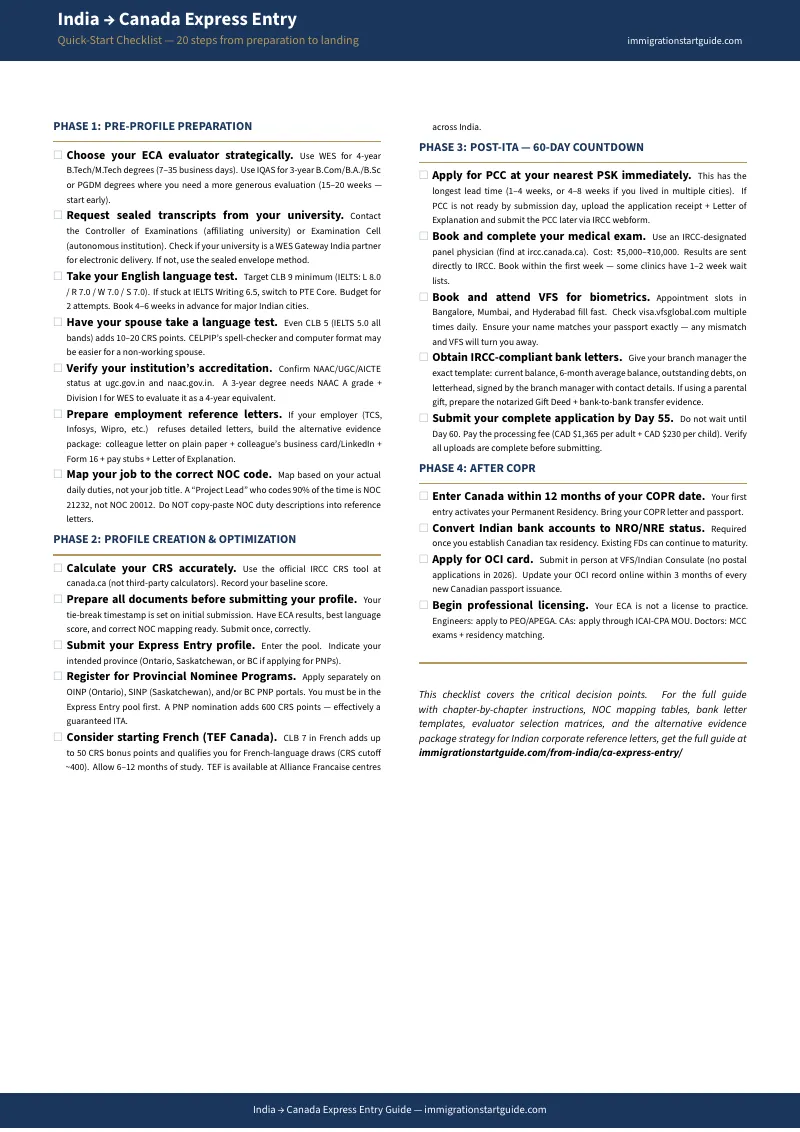
Quick-Start Document Checklist (free download)
Every India-specific document you need for your Express Entry application, distilled into a single printable checklist: ECA documents, university transcripts, reference letters, proof of funds, PCC, VFS appointment items, and medical exam requirements. Enough to start gathering documents tonight.
Standalone Reference Cards & Printables
Six standalone PDFs you can print and use independently — no need to carry the full guide to your bank, VFS appointment, or HR meeting:
- ECA Evaluator Decision Matrix — One-page reference: which evaluator (WES, IQAS, ICES) for your specific Indian degree type, with expected Canadian equivalencies and CRS points
- NOC Code Mapping for Indian Job Titles — 10 common Indian IT and professional roles mapped to Canadian NOC codes, with the key duties that must appear in your reference letter
- IRCC-Compliant Bank Letter Template — The exact language to give your branch manager, plus the Gift Deed process for parental contributions
- Alternative Evidence Package — The four-component evidence package for TCS/Infosys/Wipro employees whose HR refuses IRCC-format letters
- 60-Day Post-ITA Countdown — Week-by-week checklist from Day 1 to Day 60 with the IRCC portal document upload mapping
- Complete Cost Breakdown — Every expense in INR, the 12-18 month timeline, and budget planning for singles, couples, and families
Who This Guide Is For
This guide is for Indian professionals navigating Canada's Express Entry system — whether you're calculating your CRS for the first time or you've been in the pool for months watching draws pass you by:
- You hold a 3-year B.Com, B.A., or B.Sc and you've read contradictory advice about whether WES or IQAS will give you a higher equivalency — but nobody mentions NAAC accreditation grade, which is the actual variable that determines the outcome, and you can't afford to spend ₹17,000 on the wrong evaluator and lose 20 weeks waiting for the right one
- You work for TCS, Infosys, Wipro, HCL, or another Indian IT company that refuses to issue the detailed reference letter IRCC requires — and you need the exact Alternative Evidence Package format (colleague letter, financial audit trail, Letter of Explanation) that Indian IT professionals have successfully used to get their work experience accepted
- Your CRS is stuck in the 440-480 range and you're watching draw after draw pass you by — you need to know whether improving your IELTS, learning French, or targeting a PNP nomination is the highest-ROI use of the next six months
- You received an ITA and you have 60 days to submit everything — but you've lived in three Indian cities in five years and your PCC could take eight weeks, your university transcript hasn't arrived, and your bank branch manager has never heard of an "IRCC-compliant bank letter"
- Your parents are contributing to your settlement funds and you need to know how to structure a Gift Deed, NEFT transfer, and source-of-funds documentation so the money doesn't get flagged as an unexplained large deposit
- You hold a PGDM from an AICTE-approved institute that is not a university — and you're trying to figure out whether your business degree will evaluate as a Master's or a Post-Graduate Diploma, because the difference is 45 CRS points
- You're married and you're not sure whether your spouse should take a language test, which test to take, or how spousal factors actually affect your CRS score — and whether declaring your spouse helps or hurts your ranking
Why Not Free Resources?
Free information about Express Entry is everywhere. Here's what it actually gives you:
- IRCC's website (canada.ca) explains Express Entry eligibility, the CRS formula, and the list of required documents. It says nothing about which ECA evaluator gives the best result for a 3-year Indian degree, how to build an alternative evidence package when your Indian employer won't cooperate, or how to get an IRCC-compliant bank letter from an SBI branch manager who has issued exactly zero of them.
- Immigration consultants (Y-Axis, Canam, Kansas Overseas) charge ₹70,000 to ₹2,00,000 for end-to-end representation. Many use a one-size-fits-all approach and are slow to adapt to 2026 changes like the 12-month work experience requirement for category-based draws. You're paying for comfort and hand-holding. Whether you're paying for the granular strategy that maximizes your specific CRS profile is a different question.
- Reddit (r/canadaexpressentry, r/ImmigrationCanada) is full of draw results, CRS calculators, and personal timelines — from 2023, 2024, and 2026, all mixed together with no way to tell which advice applies after the category-based draw changes. One commenter says WES evaluated their B.Com as a 4-year equivalent. Another says it was downgraded. Neither mentions their university's NAAC grade, which is the variable that determines the outcome.
- YouTube RCICs and immigration influencers are excellent at explaining the process at a high level and sharing draw updates. They don't provide university-by-university ECA guidance, Indian bank letter templates, or the specific TCS/Infosys reference letter workaround. Their content is built for all nationalities, not for the Indian administrative reality that sits between your CRS score and an actual ITA.
- Generic Express Entry guides on Amazon ($15-$25) explain the process for applicants from any country. They don't know the difference between an affiliating university and an autonomous institution. They've never heard of Form 16. They think proof of funds means showing a bank balance, not navigating EPFO withdrawal letters and Gift Deed notarization.
This guide fills the India documentation gap. It doesn't replace an RCIC or immigration lawyer — it handles the entire India-specific administrative layer that generic guides ignore and consultants charge ₹1-2 lakhs to manage. The credential evaluation strategy, the employer evidence workaround, the proof-of-funds architecture, and the PCC and VFS logistics that only matter when you're filing from India.
— Less Than a Single WES Evaluation Fee
A WES credential evaluation costs ₹17,000-₹20,000. Choosing the wrong evaluator for your degree type means paying twice, losing 15-20 weeks, and potentially starting your application from scratch. An immigration consultant charges ₹70,000 to ₹2,00,000 for services that include basic form-filling you can do yourself. And if your proof of funds is rejected because you submitted a property valuation instead of liquid assets, or your work experience is rejected because you submitted a bare Experience Certificate without the alternative evidence package — your ₹1.6 lakh IRCC processing fees are gone.
The guide doesn't replace an immigration consultant. It handles the India-specific documentation strategy that sits between your CRS score and an approved PR application. It turns months of contradictory Reddit research into a structured playbook built for Indian institutions, Indian employers, and Indian bureaucracy.
Money-back guarantee, no time limit. If the guide doesn't give you clearer control over the India-side documentation of your Express Entry application, you pay nothing.
Download the free Quick-Start Checklist to see every India-specific document you need for Express Entry. When you're ready for the ECA evaluator strategy, the TCS/Infosys reference letter workaround, the proof-of-funds architecture, and the complete 60-day post-ITA countdown, the full guide is here.
Your CRS score earns you a place in the pool. Your Indian documents determine whether you get out of it.