
Your PGWP Expires in 8 Months. Your HR Department Won't Write the Reference Letter. This Guide Gets You to PR Anyway.
You've done everything right. You came to Canada, finished your degree, landed a skilled job, and spent the past year proving you belong here. You checked your CRS score on the official IRCC calculator. You expected to be competitive. Instead, you're looking at a number that sits below every CEC draw cutoff in 2026 — and your work permit has an expiration date that gets closer every week.
So you start researching. You read Reddit threads where someone who filed in 2022 gives advice based on NOC skill levels that no longer exist. You find a YouTube video that says retaking IELTS is the answer and another that says to chase a Provincial Nomination. You email your HR department asking for a reference letter, and they respond with a two-line template confirming your dates and job title — nothing about your duties, hours, or salary. IRCC will reject it. HR won't change it. You're trapped between a government that demands specificity and an employer that refuses to provide it.
Here's what nobody tells you: the CEC is not a form-filling exercise. It's a documentation and positioning problem where the most common failures happen before you ever submit. Applications are refused because reference letters don't map to NOC duties. Because part-time hours were calculated wrong. Because the alternative evidence portfolio was incomplete when HR stonewalled. CRS cutoffs for CEC-specific draws ran between 514 and 547 in late 2025 — but French-language draws accepted 393 and healthcare draws cleared in the mid-400s. The difference between receiving an ITA and watching your permit expire is not your qualifications. It's whether you know the specific tactics that close the gap.
The Canada Express Entry (Canadian Experience Class) Guide is an Inland PR Playbook built exclusively for workers already in Canada. Not a rehash of government pages. Not a generic Express Entry guide that wastes half its content on the Federal Skilled Worker Program. This is a structured execution framework for the specific problems that CEC candidates face: the employer reference letter crisis, the 1,560-hour calculation trap, CRS optimization for inland applicants, the BOWP timing that prevents status loss, and the 60-day post-ITA sprint that turns an invitation into a confirmed permanent residence.
What's Inside the Inland PR Playbook
7 PDFs — the complete guide, 5 standalone printable tools, and a quick-start checklist you can print and work from tonight:
The Employer Reference Letter Crisis Toolkit (Chapter 4)
This is the single highest cause of CEC application failures — and nobody prepares you for it. IRCC requires your reference letter to include exact employment dates, weekly hours, annual salary, and 5 to 8 specific daily duties that substantively align with your NOC code. Most Canadian HR departments will only confirm dates and title. Some outsource verification to third-party payroll companies that refuse all customization. The guide provides a structured negotiation framework for approaching HR, a direct-supervisor fallback strategy, and a complete alternative evidence blueprint for when HR flatly refuses: Letter of Explanation templates, notarised colleague affidavit guidance, and the supporting document portfolio (T4s, NOAs, pay stubs, ROEs, employment contracts) that proves your experience through multiple independent sources.
The 1,560-Hour Audit Framework (Chapter 2)
IRCC enforces a 30-hour weekly cap on countable work hours. Working 50 hours one week and 10 the next does not average to 30 — you get 30 for the first week and 10 for the second. Overtime is meaningless for CEC purposes. If you hold two part-time jobs at 18 and 16 hours per week, you can only claim 30 of those 34 hours. The guide provides a week-by-week tracking framework that forces you to apply the cap correctly, so you know the exact date you cross the 1,560-hour threshold — and you don't submit a premature application that gets refused because you miscounted.
CRS Optimization for Inland CEC Candidates (Chapters 5 and 6)
Your CRS score isn't fixed — it's engineered. The guide ranks every available intervention by point gain per dollar and month invested. Moving from CLB 8 to CLB 9 on your language test can generate 50 to 70 CRS points through the skill transferability multiplier — the single highest-ROI action for most CEC candidates. Basic French proficiency opens category-based draws at CRS scores over 120 points below general cutoffs. The spousal penalty analysis shows when including your partner costs more points than it returns — and explains the dual-profile strategy where both partners enter the pool independently to use whichever score is higher. A Provincial Nominee nomination injects 600 points that virtually guarantee an invitation.
Category-Based Selection and PNP Strategy (Chapter 7)
Since 2023, IRCC runs targeted draws for French speakers, healthcare workers, STEM professionals, tradespeople, transport workers, and education workers — all at CRS cutoffs dramatically lower than general draws. The guide maps your NOC code to every applicable category and identifies which Provincial Nominee streams are actively recruiting from the Express Entry pool in 2026. Ontario's Human Capital Priorities Stream targets tech and healthcare workers. Alberta routinely selects candidates with CRS scores as low as 300. British Columbia prioritises Care, Build, and Innovate sectors. The guide tells you which streams accept inland applicants already working in the province and how to apply while keeping your federal Express Entry profile active.
NOC 2021 TEER Classification Walkthrough (Chapter 3)
IRCC officers don't evaluate your NOC code based on your job title. They compare the duties in your reference letter against the lead statement and main duties in the NOC matrix. If you claim a TEER 1 classification but your letter describes TEER 4 responsibilities, your experience is invalidated. The salary cross-reference catches mismatches too — a claimed management role with an entry-level salary raises immediate flags. The guide explains how to verify your classification based on actual duties, not optimistic self-assessment, and why conservative classification beats aggressive classification every time.
The Bridging Open Work Permit Timing Guide (Chapter 8)
If your work permit expires while IRCC processes your PR application, the BOWP is the legal mechanism that keeps you working. But timing is everything. You must have submitted your PR application and received the Acknowledgment of Receipt before applying — a pending Express Entry profile is not sufficient. And you must apply before your current permit expires. Waiting even one day past expiry kills your work authorisation and legal status, even with a pending PR application. The guide provides the exact timeline: when to apply, what triggers maintained status, and how to avoid the gap that forces thousands of applicants into illegal work or voluntary departure every year.
The 60-Day Post-ITA Sprint Plan (Chapter 10)
You receive an Invitation to Apply. You have exactly 60 calendar days to submit a flawless electronic Application for Permanent Residence. Missing documents, a police clearance certificate that arrives on day 61, or a reference letter discrepancy means your ITA expires — and months of preparation plus $1,590 CAD in processing fees are gone. The sprint plan breaks the 60 days into five phases with specific deliverables: Days 1–5 trigger medical exams and police certificates. Days 5–15 finalise reference letters. Days 15–30 lock in T4s, NOAs, and pay stubs. Days 30–45 draft Letters of Explanation. Days 45–60 are final assembly and submission.
The Strategic Return Framework (Chapter 6)
If your permit expires before you receive an ITA, the conventional advice is to stay in Canada at all costs — enrol in another program or convert to a visitor record. This is usually a mistake. A visitor record doesn't authorise work, your CRS score stagnates or declines as you age, and you burn savings without gaining any competitive advantage. The guide introduces the strategic return: leave Canada, preserve your Canadian experience (valid for three years), and accumulate foreign skilled work experience that triggers CRS multipliers worth 37 to 50 additional points. It also covers the critical pre-departure document checklist — reference letters, T4s, NOAs, ROEs — because obtaining these from a former employer overseas is nearly impossible.
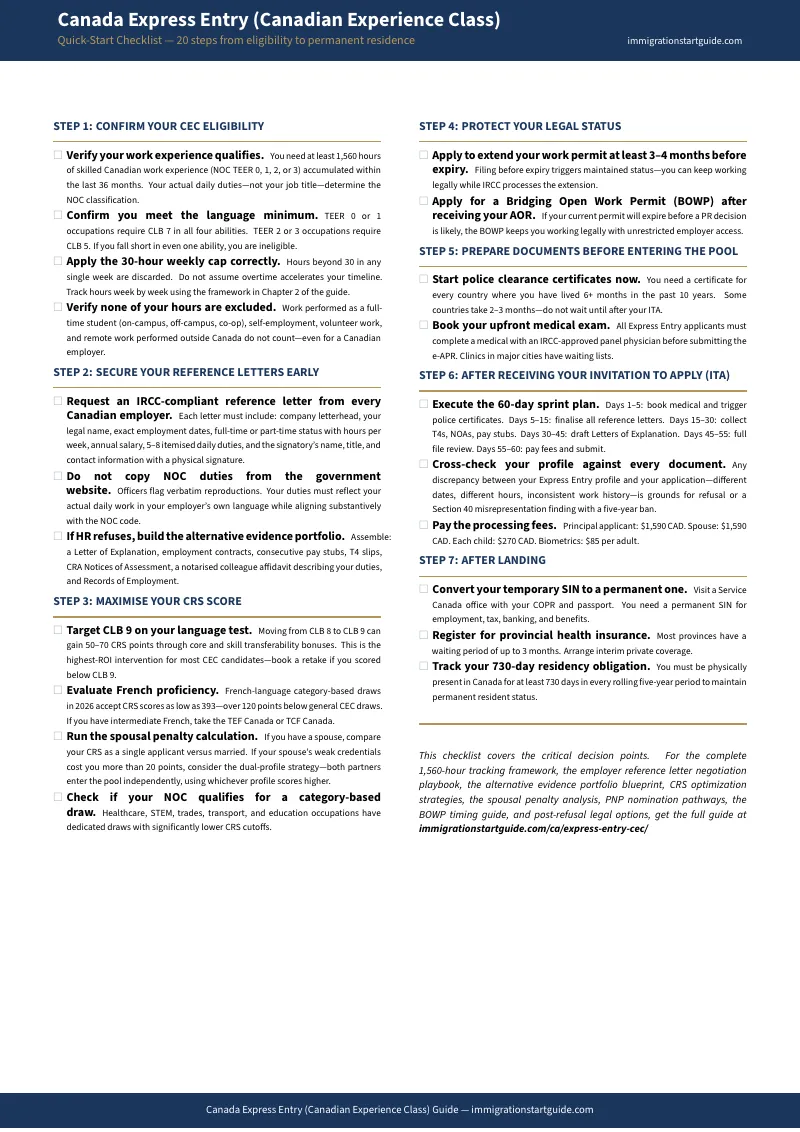
Quick-Start Checklist (free download)
A 20-item action plan covering the essentials: confirm CEC eligibility with the 30-hour weekly cap, verify your NOC code against actual duties, assess CRS optimization options, protect your legal status timeline, and understand the 60-day post-ITA sprint. Enough to assess your position and identify your next move tonight.
Who This Guide Is For
This guide is for foreign nationals already living and working in Canada who are pursuing permanent residency through the Canadian Experience Class:
- PGWP holders approaching expiry who need to convert temporary status into permanent residency before the clock runs out
- Workers on LMIA-based permits, IEC working holidays, or spousal open work permits who have accumulated (or are approaching) one year of skilled Canadian work experience
- CEC candidates whose CRS score is below the current draw cutoff and need a structured plan to close the gap — through language optimization, French proficiency, category-based draws, or Provincial Nomination
- Applicants whose HR department has refused to write an IRCC-compliant reference letter and need the alternative evidence strategy that proves their experience without employer cooperation
- Anyone who received an Invitation to Apply and needs a day-by-day sprint plan to assemble a flawless application within the 60-day deadline
- Applicants deciding between hiring an immigration consultant at $2,500 to $5,000 CAD and doing it themselves — and want a resource that makes the DIY path strategic, not risky
This guide is not for: people applying from outside Canada with no Canadian work history. If you have never worked in Canada, you need the Federal Skilled Worker Program, not the CEC. This guide deliberately excludes FSWP content so every page is relevant to your situation.
Why Not Free Resources?
Free information on the CEC is abundant. Here's what it actually delivers:
- The IRCC website tells you that you need a reference letter with duties listed. It will never tell you that HR departments at half the employers in Canada refuse to write one, or that copying duties verbatim from the NOC website is a flag for misrepresentation. You get regulations, not execution guidance.
- Immigration consultant blogs publish excellent analysis of policy changes — because their business model is to demonstrate that the system is overwhelmingly complex, then offer $2,500 to $5,000 full-representation retainers. The blog explains the problem. The solution costs thousands.
- Reddit and CanadaVisa forums are where you read advice from someone who filed in 2021 under NOC skill levels that were replaced by the TEER system in 2022. You get survivorship bias from strangers who filed under different rules, in different categories, with different CRS cutoffs.
- YouTube creators publish 10-minute videos that each cover one fragment of the process. To reconstruct a complete strategy, you'd need dozens of videos from different creators with different accuracy levels — and you still wouldn't have a framework, a tracking tool, or a negotiation script.
- Etsy templates sell a generic reference letter for $3 to $5. They aren't updated for 2026 TEER classifications, they don't address the HR refusal problem, and they don't connect to any broader strategy. You get a single page that may or may not match current IRCC requirements.
This guide fills the execution gap — the space between "I know the CEC rules" and "I can navigate the real-world obstacles that actually cause refusals." It gives you the same documentation frameworks and optimization strategies that immigration consultants charge thousands to apply, structured so you can execute them yourself.
— Less Than One Immigration Consultation
Immigration consultants charge $2,500 to $5,000 CAD for standard Express Entry representation. A 30-minute phone consultation costs $200 to $300 CAD. And the applicant still does the work — passing the language test, chasing reference letters, tracking down police certificates, assembling the evidence portfolio.
Your total CEC application costs will exceed $2,500 CAD for a single applicant — processing fees, RPRF, biometrics, language tests, medical exams. This guide represents a fraction of that total investment, and it's the piece that determines whether the other $2,000+ produces an approval or a refusal letter.
A refused application doesn't just cost you $1,590 CAD to re-file. It costs months of processing time. It costs the work permit that expired while you waited. It costs the career and the life you've spent years building in Canada.
Money-back guarantee, no time limit. If the reference letter toolkit, hours audit framework, and CRS optimization strategies don't make your application stronger, you pay nothing.
Download the free Quick-Start Checklist to see the 20-item action plan and assess your CEC eligibility tonight. When you're ready for the employer reference letter crisis toolkit, the 1,560-hour audit framework, category-based draw strategy, and the complete 60-day post-ITA sprint plan, the full guide is here.
You've already built the career. Now build the application that secures it permanently.