
You Have a Master's from Sharif, Five Years of Software Engineering Experience, and a Job Offer from a Munich Tech Company Paying EUR 52,000. But Between You and a German Blue Card Are Three Barriers No Other Nationality Faces Simultaneously: No German Embassy in Tehran Since It Closed for Visa Services, SWIFT Sanctions That Make It Impossible to Fund a EUR 11,904 Blocked Account Directly, and a Section 73 AufenthG Security Screening That Adds Months to Your Processing While Your Application Sits in Silence.
You researched the EU Blue Card. You meet the salary threshold. You are a Sharif or Amirkabir or University of Tehran graduate, a software engineer or mechanical engineer or researcher, and you have read enough Reddit threads and Telegram group messages to know that Germany's Skilled Immigration Act has created one of the fastest pathways to permanent residency in Europe. But every step of the official German process assumes things that are not true for you. It assumes you can walk into the German Embassy in Tehran for a visa appointment. That embassy suspended visa services following regional security escalations — your application has been rerouted to Yerevan, Armenia. It assumes you can transfer EUR 11,904 from your bank to a Sperrkonto at Expatrio or Fintiba. Your bank is cut off from SWIFT. It assumes your documents carry an Apostille. Iran is not a member of the Hague Apostille Convention — every document needs four separate stamps in a specific sequence through the Ministry of Justice and Ministry of Foreign Affairs, and if you get the order wrong, your trip to Yerevan is wasted.
You need your degree recognized. The Anabin database says your university is "H+" — but which branch? Sharif University of Technology and the University of Tehran are clearly listed. Islamic Azad University is a different story: the Tehran Central branch may receive full recognition while a provincial branch receives "H+/-," requiring an individual ZAB Statement of Comparability that takes four to six months. You need to know your institution's exact Anabin status before you board a plane to Yerevan, because a degree recognition failure after you have already paid for flights, accommodation, and document legalization is not a bureaucratic inconvenience — it is a financial loss you cannot recover.
You need a police clearance certificate. The official guidance says "national police authority." In practice, you must obtain it through the Police+10 centers in Iran, have it translated by a Ministry of Justice-certified translator, stamped by the Iranian Ministry of Justice, authenticated by the Iranian Ministry of Foreign Affairs, and then legalized for German use — a four-stamp chain that must happen in exactly that order. If you are already outside Iran, you need a relative with a Vekalatnameh (power of attorney) to navigate the Ministry offices in person. The certificate must be less than six months old at the time of your Yerevan appointment — generate it too early and it expires before your biometric slot opens.
You need EUR 11,904 in a German blocked account. But you cannot wire money from Bank Mellat or Pasargad Bank to a German IBAN. SWIFT is blocked. The mechanism is the Sarrafi exchange house system: you deposit Iranian Rial into a Sarrafi's domestic account, and the Sarrafi uses liquidity pools in the UAE, Turkey, or Malaysia to transfer Euros to Expatrio or Fintiba. This costs 4% to 8% in commission. In 2026, German blocked account providers have implemented rigorous "Source of Funds" checks — you need letters from the Sarrafi, proof of asset sales, or employment income documentation that satisfies German anti-money laundering regulations. Use an undocumented Sarrafi and your visa application can be questioned at the embassy interview.
You need German language certification. But DSIT — the German language institute in Tehran — has been affected by the same closures. Goethe-Institut testing options inside Iran are limited. You may need to travel to Istanbul, Yerevan, or Dubai to sit a B1 or B2 exam, adding another international trip on top of the one you already need for your visa appointment. And if you are targeting the EU Blue Card's accelerated permanent residency at 21 months, you need B1 proficiency — a requirement that starts the clock the day you arrive in Germany, not the day you apply.
And then there is Section 73 AufenthG — the security screening. Every Iranian visa application is subject to a security check that can add weeks or months to processing. Your application does not show "denied." It shows nothing. You wait. Your employer in Germany waits. Your job offer has a start date, and the embassy sends no updates. This is not rejection. This is standard procedure for Iranian nationals — but the official processing timeline does not account for it, and no generic German immigration guide mentions it because it does not apply to most other nationalities.
You are not short on qualifications. You are short on a systematic method for navigating three simultaneous barriers — closed embassy, frozen banking, extended security screening — that no generic German skilled worker guide addresses because no other nationality faces all three at the same time.
The Iran-to-Germany Migration Playbook
This is not a generic German immigration explainer. This is the Iran-specific operational playbook for every step where the German skilled worker process collides with Iranian geopolitical reality: the Anabin database lookup for Iranian universities — institution-by-institution status (H+, H-, H+/-) for Sharif, Tehran, Amirkabir, Azad University branches, Tabriz, Isfahan, Shiraz, and the ZAB individual assessment pathway for institutions with conditional recognition. The four-stamp document legalization chain — translation by a Ministry of Justice-certified translator, Ministry of Justice authentication, Ministry of Foreign Affairs authentication, and German consular legalization — in the exact sequence required, with the TLScontact workaround for legalization services during the Tehran closure. The Sarrafi blocked account funding — how to identify reliable exchange houses, the Source of Funds documentation that satisfies German AML checks, and the Expatrio vs. Fintiba comparison for Iranian applicants. The Yerevan consular strategy — digital.diplo.de pre-review uploads, biometric appointment booking in a system managing thousands of rerouted files, travel logistics, and what to do when wait times stretch to 8-16 weeks. The Section 73 AufenthG security screening — realistic timelines, the Untaetigkeitsklage (failure-to-act lawsuit) as a legal remedy after six to nine months, and the document renewal planning when your police clearance expires during the wait. The EU Blue Card, Skilled Worker Visa (Section 18a/18b), and Opportunity Card (Chancenkarte) pathways — mapped to the specific profile of Iranian STEM professionals, with 2026 salary thresholds, shortage occupation categories, and the points calculation for the Chancenkarte. And the 21-month accelerated permanent residency timeline that makes the Blue Card the fastest path to settlement in Europe for qualified Iranian engineers.
Immigration lawyers in Germany charge EUR 2,000 to 5,000 for application management that covers document preparation but none of the Sarrafi funding logistics, none of the four-stamp legalization sequence, none of the Yerevan trip planning, and none of the security screening timeline management that determines whether you plan for three months or nine. The lawyer files your application. The playbook builds your entire migration system — designed for the three barriers that only Iranian applicants face.
What Is Inside
Anabin Database and Degree Recognition
Your visa application begins not at the embassy but at the Anabin database. The guide provides institution-by-institution Anabin status for the major Iranian universities: Sharif University of Technology (H+), University of Tehran (H+), Amirkabir University of Technology (H+), University of Tabriz (H+), and the Islamic Azad University system — where recognition depends on the specific branch (Tehran Central vs. provincial branches) and the year of graduation. For H+/- institutions, the guide walks through the ZAB Statement of Comparability application: the documentation required, the three-to-six-month timeline, the accelerated procedure under Section 81a AufenthG when an employer sponsors the fast-track process, and the common rejection reasons that force a restart. One incorrect ZAB submission means losing four to six months — and potentially your job offer.
Document Legalization Chain
Iran is not a member of the Hague Apostille Convention. Every document — degree, marriage certificate, birth certificate, Shenasnameh, police clearance — must pass through a four-stamp legalization sequence: (1) Translation by an Iranian Ministry of Justice-certified translator. (2) Ministry of Justice stamp on the translation. (3) Ministry of Foreign Affairs authentication of the Ministry of Justice stamp. (4) German consular legalization. The guide covers the sequence in precise order, the TLScontact legalization service as a workaround during the Tehran embassy closure, the digital legalization alternatives being piloted in 2026, the common sequencing errors that void documents, and the workaround for applicants already outside Iran who must delegate the legalization chain through a Vekalatnameh. Get one stamp out of order and the German embassy in Yerevan rejects the document — sending you back to Tehran to restart the chain.
Sarrafi Blocked Account Funding
German visa applications require a Sperrkonto (blocked account) with EUR 11,904 for a skilled worker visa or EUR 13,092 for the Opportunity Card. Iranian banks cannot transfer to German IBANs. The guide covers the Sarrafi exchange house mechanism: how to identify reputable Sarrafis with liquidity pools in the UAE, Turkey, or Malaysia, the typical 4-8% commission structure, the Source of Funds documentation (employment income letters, asset sale contracts, bank statements) that satisfies the anti-money laundering checks at Expatrio and Fintiba, and the red flags that trigger additional scrutiny. The Expatrio vs. Fintiba comparison for Iranian applicants — which provider processes Iranian source documents faster, which issues the Visa-Ready certificate that the Yerevan embassy requires, and which has the lower rejection rate for Sarrafi-funded deposits. Use an undocumented funding path and your blocked account provider may freeze the funds — leaving you without the mandatory financial proof at your embassy appointment.
Yerevan Consular Strategy
The German Embassy in Tehran suspended visa services. All Iranian D-Visa applications are rerouted to the German Embassy in Yerevan, Armenia. The guide covers the end-to-end Yerevan trip: Armenian entry requirements for Iranians (visa-free, 90-day stay), the digital.diplo.de Consular Services Portal for mandatory document pre-upload, biometric appointment booking in a system managing a backlog of thousands of rerouted files, wait times of 8-16 weeks for appointment slots, what documents to bring in original and copy, the interview expectations, accommodation and transport logistics in Yerevan, and the alternative consulates (Ankara, Istanbul) if Yerevan wait times become unmanageable. The guide also covers the Accelerated Skilled Worker Procedure (Section 81a AufenthG) — available when a German employer initiates the application through the local Foreigners Authority (Auslaenderbehorde) — which can compress the processing timeline to four to six weeks.
Section 73 Security Screening and Legal Remedies
Iranian visa applications are subject to security screening under Section 73 AufenthG. The guide covers the realistic processing timeline for Iranian applicants — which can add months beyond the standard processing period — the silence during screening (no status updates from the embassy), the document renewal requirements when your police clearance or medical certificate expires during the wait, and the Untaetigkeitsklage (failure-to-act lawsuit) under Section 75 VwGO. The lawsuit is filed through a German lawyer in the Administrative Court in Berlin after six to nine months without a decision. The guide explains when to initiate the Untaetigkeitsklage, the cost (typically EUR 500-1,500 for the lawyer plus court fees), and the success rate — which is high, because filing often compels a decision within weeks. The guide does not replace a German lawyer — it helps you manage the months before and after the screening so you know exactly when legal escalation becomes appropriate.
EU Blue Card, Skilled Worker Visa, and Opportunity Card Pathways
Three primary pathways exist for Iranian professionals in 2026. The EU Blue Card (Section 18g AufenthG) requires a recognized degree and a job offer meeting the 2026 salary thresholds: EUR 50,700 for standard professions, EUR 45,934 for shortage occupations (IT specialists, civil engineers, healthcare) and new entrants who graduated within three years. The Skilled Worker Visa (Section 18a/18b) serves applicants with vocational qualifications or degrees that do not meet Blue Card thresholds. The Opportunity Card (Chancenkarte, Section 20a/20b) is a points-based one-year job-seeker permit requiring no job offer — relevant for Iranians who cannot secure employment from outside Germany due to the sanctions environment limiting remote interviews and contract execution. The guide maps each pathway to specific Iranian professional profiles: which route is optimal for a Sharif mechanical engineer with five years of experience, which for an Azad University IT graduate with three years of experience, which for a PhD researcher transitioning from academia to industry.
German Language Strategy
The Blue Card does not require German proficiency at the time of application — but the accelerated path to permanent residency (21 months instead of 33 months) requires B1 proficiency. For Iranians, the language preparation challenge is compounded by limited testing availability inside Iran following the DSIT disruption. The guide covers the Goethe-Institut exam options in Istanbul, Yerevan, and Dubai, the OKF (OSD) alternative for German certification, the telc exam as a third option, and the online preparation resources that specifically target B1 from a Persian-language starting point. The guide also covers the language requirement for each visa type, the Integration Course system you enter upon arrival in Germany, and the timeline planning for reaching B1 within 21 months of arrival to unlock the accelerated settlement permit.
Settlement and Citizenship Timeline
The Blue Card offers the fastest path to permanent residency in Europe for Iranian professionals. At B1 German proficiency: 21 months to a Settlement Permit. At A1 proficiency: 33 months. For other skilled worker visa holders: 36 months with B1 and pension contributions. The guide covers each settlement timeline, the documentation required for the Settlement Permit application, the 2026 German Citizenship Act allowing naturalization after five years of residency, and the specific requirements — financial independence, democratic order commitment, German language proficiency — that the Iranian professional demographic typically meets. From visa application to EU passport in under seven years, with permanent residency possible in under two.
12-Month Execution Timeline
The complete migration timeline from first Anabin lookup to arriving at your German employer's office — calibrated for the security screening reality, not the standard processing timeline. Month 1: Anabin status check, ZAB application if needed, blocked account funding initiated, German language preparation begun. Months 1-3: Document legalization chain through the four-stamp sequence, police clearance from Police+10, Sarrafi transfer to blocked account. Months 3-5: Visa-Ready certificate received, digital.diplo.de pre-upload completed, Yerevan biometric appointment booked. Months 5-8: Yerevan trip, biometrics and document submission, security screening period. Months 8-12: Visa issued, residence registration in Germany, Blue Card issuance at local Auslaenderbehorde. With the parallel task structure that runs Anabin recognition, document legalization, blocked account funding, and German language preparation simultaneously instead of sequentially.
Who This Is For
- Iranian STEM professionals — software engineers, mechanical engineers, civil engineers, IT specialists, data scientists, chemical engineers — in Tehran, Isfahan, Shiraz, and Tabriz who have a job offer from a German employer or are planning to secure one and need the Iran-specific protocol for sanctions, security screening, and third-country consular logistics
- Graduates of Sharif University, University of Tehran, Amirkabir, Iran University of Science and Technology, and University of Tabriz who need to verify their Anabin H+ status, navigate the ZAB process if their specific degree program requires individual assessment, and handle the four-stamp legalization chain from inside or outside Iran
- Graduates of Islamic Azad University who need to understand which branches receive H+ recognition in Anabin, which receive H+/- requiring a ZAB individual assessment, and what documentation prevents a rejection that costs four to six months
- PhD holders and postdoctoral researchers in Germany or applying from Iran who need to convert an academic position into a permanent Blue Card through the "New Entrant" salary threshold and navigate the transition from a research visa to a skilled worker residence permit
- Iranian professionals already in Turkey, the UAE, Armenia, or Europe as a stepping stone — who need to coordinate the document legalization chain remotely, fund a blocked account from a third country, and plan the Yerevan consular trip without returning to Iran
- IT professionals without a formal degree who qualify for the Blue Card through the 2026 experienced IT worker pathway (three or more years of professional experience at EUR 45,934 minimum salary) and need to document their experience for an Iranian profile where employer reference letters may not meet German standards
- Male applicants whose military service status (Kart-e Payan-e Khedmat) and branch of service (Artesh, Sepah, NAJA) directly affect their Section 73 security screening duration and who need the documentation strategy for IRGC conscription service
Why Not Telegram Groups, Free Guides, or the Make-it-in-Germany Website?
Telegram groups — the "Germany Visa for Iranians" and "Blue Card Iran" channels with thousands of members — are where someone tells you their blocked account was approved in "two weeks" without mentioning they had a relative in Germany who transferred the funds from a German bank account, not through a Sarrafi. Where another person says the Yerevan appointment took "six weeks to book" without disclosing they used the Accelerated Skilled Worker Procedure through their employer, which bypasses the standard queue entirely. Where a third person says their visa was processed in "three months" without mentioning they are not Iranian — or they served in Artesh, not Sepah, and the branch of service is a major variable in security screening duration. The advice is real but uncontextualized, undated, and filtered through survivorship bias — the people posting are the ones whose applications succeeded, not the ones whose documents were rejected at Yerevan for incorrect legalization order or whose blocked account was frozen for insufficient Source of Funds documentation.
Free guides and the Make-it-in-Germany website explain the Blue Card salary thresholds, the Skilled Immigration Act, and the documents you need. They do not explain that Iran is not a Hague Apostille member and your documents require a four-stamp chain instead of a single Apostille. They do not explain how to fund a blocked account when your bank is cut off from SWIFT. They do not explain that the German Embassy in Tehran is closed and your application goes through Yerevan. They do not explain the Section 73 security screening timeline or the Untaetigkeitsklage remedy when processing exceeds six months. They do not explain the Anabin H+/- status for Azad University branches or the ZAB individual assessment timeline. Official resources describe the rules for all applicants. They do not describe the Iranian starting point.
Your Options
- DIY from free resources — Telegram groups, Reddit, Make-it-in-Germany website. Cost: zero. Risk: Anabin status misread leading to a ZAB application you did not need or a ZAB application you needed but did not file, documents legalized in the wrong sequence and rejected at Yerevan, blocked account frozen for insufficient Source of Funds documentation, Yerevan appointment missed because the digital.diplo.de pre-upload was incomplete, police clearance expired during security screening, German language certification obtained at the wrong level for your target visa. One document rejection at Yerevan means rebooking a flight, rebooking an appointment in a system with 8-16 week wait times, and restarting the legalization chain from step one.
- This guide — the complete Iran-to-Germany Migration Playbook. Cost: . Covers Anabin lookup and ZAB assessment, four-stamp document legalization, Sarrafi blocked account funding with Source of Funds compliance, Yerevan consular strategy, Section 73 security screening and Untaetigkeitsklage escalation, Blue Card and Chancenkarte pathway mapping, German language strategy, settlement and citizenship timeline, and the 12-month execution plan.
- German immigration lawyer — licensed Rechtsanwalt for immigration law. Cost: EUR 2,000-5,000. Covers application preparation and filing but not the Sarrafi funding logistics, not the four-stamp legalization navigation, not the Yerevan trip planning, not the security screening timeline management, and not the Anabin status analysis that determines whether you need a ZAB assessment at all.
What You Get
The guide includes everything designed for the Iranian pathway to Germany — 8 printable PDFs:
- Complete Guide (guide.pdf) — 10 chapters covering Anabin database and ZAB recognition for Iranian universities, the four-stamp document legalization chain, Sarrafi blocked account funding with Source of Funds compliance, the Yerevan consular strategy with digital.diplo.de pre-upload, Section 73 security screening and Untaetigkeitsklage, EU Blue Card and Chancenkarte and Skilled Worker Visa pathway mapping for Iranian profiles, German language certification strategy, settlement and citizenship timeline, and the 12-month execution plan
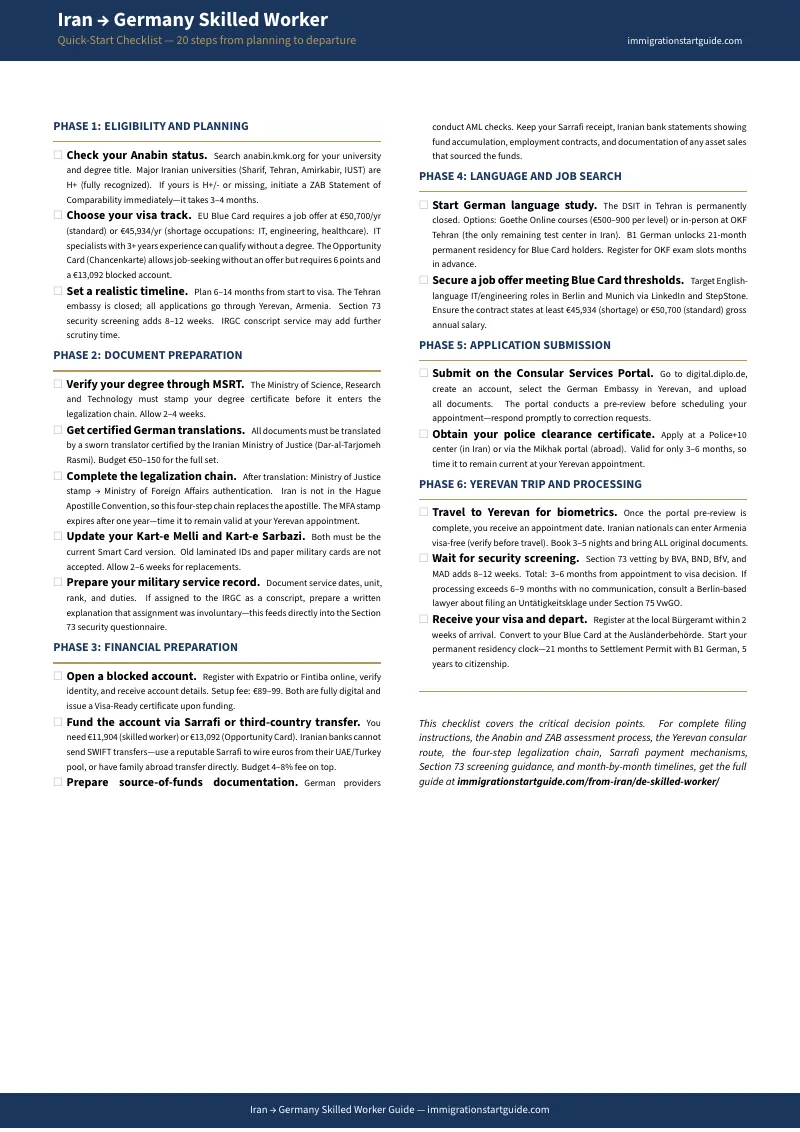
- Quick-Start Checklist (checklist.pdf) — every step from Anabin lookup to Blue Card issuance, with the exact sequence, government fees, processing times, and the parallel task structure that runs degree recognition, document legalization, blocked account funding, and language preparation simultaneously
- Anabin Lookup Worksheet (anabin-worksheet.pdf) — fillable worksheet for checking your institution's Anabin status, degree title equivalency, and the decision tree for whether you need a ZAB individual assessment or can proceed directly to the visa application
- Document Legalization Tracker (legalization-tracker.pdf) — the four-stamp sequence for every document type (degree, transcripts, birth certificate, marriage certificate, Shenasnameh, police clearance) with status columns, validity windows, and the delegation workflow for applicants outside Iran
- Blocked Account Funding Checklist (funding-checklist.pdf) — Sarrafi selection criteria, Source of Funds documentation requirements, Expatrio vs. Fintiba comparison, the Visa-Ready certificate timeline, and the red flags that trigger AML scrutiny
- Security Screening Timeline Card (security-card.pdf) — month-by-month reference for the Section 73 process, document renewal schedule, Untaetigkeitsklage decision framework, and the lawyer engagement timeline
- Yerevan Trip Planner (yerevan-planner.pdf) — end-to-end logistics for the embassy trip — Armenian entry requirements, digital.diplo.de upload checklist, appointment preparation, accommodation options, transport from Tehran, and the document package you must bring in original and copy
- Pathway Comparison Card (pathway-card.pdf) — side-by-side comparison of EU Blue Card, Skilled Worker Visa (Section 18a/18b), and Opportunity Card (Chancenkarte) — salary thresholds, degree requirements, settlement timelines, and which pathway fits your specific profile
The Free Checklist vs. The Full Guide
The free Quick-Start Checklist gives you the critical action items — every step from Anabin status check through document legalization, blocked account funding, Yerevan appointment booking, and security screening monitoring. It is enough to see the full scope of what stands between you and a German Blue Card, and to identify the long-lead-time items (ZAB assessment, document legalization chain, blocked account funding, German language certification) that need to start moving immediately.
The full guide gives you how — plus seven standalone printable tools you will use throughout the 12-month process: the Anabin Lookup Worksheet that determines your degree recognition path in ten minutes. The Document Legalization Tracker with the four-stamp sequence for every document type. The Blocked Account Funding Checklist with Sarrafi compliance and Source of Funds documentation. The Security Screening Timeline Card with Untaetigkeitsklage decision framework. The Yerevan Trip Planner with end-to-end logistics. The Pathway Comparison Card mapping Blue Card, Skilled Worker Visa, and Chancenkarte to your profile. Eight PDFs total — the complete Iran-to-Germany Migration Playbook from Anabin lookup to Blue Card issuance.
— Less Than One Hour of an Immigration Lawyer's Time
A German immigration lawyer charges EUR 2,000 to 5,000 for application management that covers document preparation but leaves you without the Sarrafi funding strategy, without the four-stamp legalization sequence, without the Yerevan trip logistics, without the security screening timeline management that determines whether you plan for three months or nine, and without the Anabin analysis that tells you whether a ZAB assessment is necessary at all. The lawyer files your application. The playbook builds your entire migration system — designed for the three barriers that only Iranian applicants face.
If the information in one chapter — the Anabin lookup that prevents a ZAB application you did not need or catches a ZAB requirement you would have missed, the four-stamp legalization sequence that prevents a document rejection and a rebooking at Yerevan, the Sarrafi Source of Funds checklist that prevents a frozen blocked account, the security screening timeline that sets realistic expectations so you do not panic at month three and hire a EUR 3,000 lawyer two months too early, or the pathway comparison that reveals the Chancenkarte is a better entry point for your profile than waiting six months for a job offer you cannot secure from Tehran — saves you a single rejected document, a single unnecessary trip to Yerevan, or a single month of avoidable delay, the guide has paid for itself before you finish the first chapter.
100% satisfaction guaranteed. If the guide does not meet your expectations, email [email protected] for a full refund.