
You Are 20 Points Short. And Nobody in Nairobi Will Tell You Which 20.
You have the degree from UoN or JKUAT. You have five years in IT, nursing, or engineering. You have been reading the Home Affairs website for months, and you know you want the 189, the 190, or the 491. You are qualified, you are motivated, and you are ready to leave.
And between you and an Australian permanent residency sits a points threshold that has silently climbed to 85-95 for competitive occupations — while every free calculator on the internet still tells you the minimum is 65. A PTE Speaking requirement that jumped to 88 in August 2025, because the AI scoring engine now penalises the exact intonation patterns that Kenyan English speakers use naturally. An ACS skills assessment that "deducts" two years of your work experience before it starts counting points — so your five years of development work in Nairobi is actually worth three. A DCI Certificate of Good Conduct on Kiambu Road that promises five days and takes fourteen. An IOM medical at the Gigiri clinic that must be booked before the queue fills up in peak season. And a KES 300,000 to KES 600,000 migration agent fee that you are paying not for expertise, but for someone to tell you what this guide will show you for 98% less.
You are not going to be rejected because you are unqualified. You are going to be rejected because you filed an EOI at 70 points when the real invitation floor is 90. Because you scored 82 on PTE Speaking instead of 88 — and nobody explained the "chunking" technique that compensates for Sheng intonation. Because your ACS assessment came back with a "Deemed Skilled Date" two years after your actual start date, and you did not know that was coming. Because you submitted an M-Pesa salary statement that the assessing authority could not open because Safaricom PDFs are password-locked by default.
The Nairobi-to-PR Pipeline
This is the guide that treats your Australian skilled migration the way it needs to be treated in 2026: as a points optimisation game where every decision — which English test to take, which state to target for nomination, which ANZSCO code to select, when to file — is calibrated to the specific realities of applying from Kenya. Not "general Australia PR tips." Not a recycled Reddit thread. The precise, Kenya-specific pipeline strategy that MARA-registered agents charge KES 300,000 to KES 600,000 to provide — and that YouTube videos and Facebook groups cannot give you because they are built for Indian and Filipino applicants whose institutional landscape, credential systems, and logistical bottlenecks are completely different from yours.
This guide covers what happens inside Kenya during the migration process. The DCI on Kiambu Road. The IOM clinic in Gigiri. The VFS biometrics centre in Westlands. The eCitizen portal. The KNEC and CUE verification offices. The ACS, Engineers Australia, ANMAC, and CPA Australia assessment pipelines mapped to Kenyan qualifications. Every institutional touchpoint where Kenyan applicants lose points, lose months, or lose their application entirely.
What You Get
The Points Maximisation Framework
The complete points architecture for 189, 190, and 491 visas — not the theoretical table from the Home Affairs website, but the competitive reality of 2026 invitation rounds. Your profile starts at 55 points (age 30, bachelor's degree, five years of experience). The guide shows you exactly how to close the gap to 85-95: the 20-point "Superior English" lever, the 5-point state nomination for 190, the 15-point regional nomination for 491, the 10-point partner skills strategy, and the specific occupation codes where Kenyans face lower competition. Includes a fill-in calculator so you can map your personal score and identify the fastest path to an invitation.
English Test Strategy — The PTE 88 Speaking Protocol
The August 2025 PTE changes raised the Speaking threshold for "Superior English" from a flat 79 to 88. This is not a general English problem — it is a scoring-algorithm problem. The PTE's AI engine penalises self-correction, filler words, and specific intonation patterns common in Kenyan English influenced by Sheng and regional phonetics. The guide covers the "chunking" technique for grouping words into academic phrases the AI rewards, the rhythm calibration that eliminates the score penalty, the head-to-head comparison of PTE versus IELTS for Kenyan speakers, and the 48-hour PTE result turnaround that lets you retake strategically before an age-point drop or a state nomination window closes. This is frequently the single chapter that moves a Kenyan applicant from a 70-point wait pool to an 85-point invitation pool.
Skills Assessment Roadmap — ACS, Engineers Australia, ANMAC, CPA Australia
Every assessing authority mapped to the Kenyan qualifications they evaluate. For IT professionals: the ACS "General Skills" pathway for JKUAT and UoN graduates, the two-year experience deduction that most applicants discover too late, and the documentation format that prevents a "Not Suitable" outcome. For engineers: the Competency Demonstration Report (CDR) pathway — three career episodes written in first-person technical narrative, the summary statement matrix, and Engineers Australia's strict plagiarism detection that flags AI-generated content. For nurses: the ANMAC Full Skills Assessment, the AHPRA registration dual-track, the NCK verification bottleneck, and the clinical hours documentation that Kenyan Diploma (KRN) holders must verify. For accountants: the ICPAK-to-CPA Australia Member Pathway Agreement and the nine core knowledge areas your degree must cover.
The Gulf Returnee Chapter
If you are a Kenyan professional currently working in the UAE or Saudi Arabia — in engineering, construction, healthcare, or IT — your Gulf experience is valuable but faces heightened scrutiny. VETASSESS conducts site visits to UAE employers to verify roles. Generic "Certificate of Service" letters are rejected — reference letters must detail specific ANZSCO-aligned duties with a direct supervisor's corporate email and phone number. The guide covers the integrity checking process, the financial proof requirements (salary credits into UAE or Saudi bank accounts), the degree notarisation chain if your Kenyan qualification was attested in the Gulf, and the exit-permit documentation you must collect before leaving.
State Nomination Tactics — NSW, WA, and Regional Pathways
The 189 Skilled Independent visa is brutally competitive. The guide maps the alternative: the 190 State Nominated visa (5 extra points) and the 491 Regional visa (15 extra points) with the specific states that are actively recruiting Kenyan professionals. NSW priority sectors for 2025-2026: healthcare, ICT, and engineering — the three fields where Kenyans are strongest. Western Australia's aggressive 10,000-place allocation that treats offshore applicants with the same priority as onshore candidates. The WASMOL Schedule 2 occupation list, the General Stream requirements, and the Graduate Stream for Kenyans who completed Australian studies. Plus the tactical decision: which state to target based on your occupation, your points score, and your timeline.
The Nairobi Logistics Roadmap
Every Kenya-side appointment and document, sequenced in the order that prevents bottlenecks and expiry. The DCI Certificate of Good Conduct via the eCitizen portal: the KES 1,050 M-Pesa payment, the C24 fingerprint form that must be printed double-sided on a single A4 sheet, which Huduma Centres have shorter queues (City Square, GPO, Eastleigh), and the realistic 10-to-14-day processing timeline. The IOM Migration Health Assessment at 78 United Nations Crescent, Gigiri: booking with your HAP ID, the chest X-ray and physical exam battery, and the peak-season timing strategy. The VFS biometrics appointment at Parkfield Building, 5th Floor, Muthangari Drive, Westlands: the strict appointment-only policy, the KES 4,222 fee, and the valid passport requirement. The Aga Khan University Hospital alternative in Parklands for medical exams. The complete document procurement sequence so nothing expires before submission.
M-Pesa and Financial Documentation
Safaricom M-Pesa statements are password-protected by default. If you upload a locked PDF as part of your financial evidence, the assessing officer cannot open it and will not ask you for the password. It will be marked as "missing evidence." The guide covers the unlock procedure, the salary entry highlighting strategy for demonstrating consistent income, and the documentation approach for proving funds source — critical for applicants whose savings mix M-Pesa, Equity, KCB, and Co-operative Bank accounts.
Complete Cost Calculator in KES
Every expense itemised and exchange-rate adjusted with real bank markups. Visa application fee. Skills assessment fee (ACS: AUD 1,498, Engineers Australia: AUD 820+, ANMAC: AUD 680+). English test fee (PTE: KES 25,000, IELTS: KES 30,000). DCI clearance: KES 1,050. IOM medical. VFS biometrics: KES 4,222. Police clearances for other countries lived in. The fill-in calculator shows your total investment and helps you budget the full pipeline before you commit to the first fee.
Who This Is For
- IT professionals and software developers in Nairobi — navigating the ACS skills assessment, the two-year experience deduction, the ANZSCO code selection between 261313 (Software Engineer) and 261312 (Developer Programmer), and the NSW or WA state nomination for ICT occupations
- Kenyan engineers targeting the CDR pathway through Engineers Australia — civil, electrical, mechanical, or telecommunications engineers who need to write three career episodes from their Kenyan project experience without triggering the plagiarism or AI-detection filters
- Nurses and midwives facing the ANMAC Full Skills Assessment — the dual-track AHPRA registration and ANMAC migration assessment, the NCK verification bottleneck, the 1,000 clinical hours documentation, and the English language strategy (IELTS 7.0 or OET Grade B)
- Kenyan accountants with ICPAK membership — leveraging the CPA Australia Member Pathway Agreement while ensuring the nine core knowledge areas are covered in their Kenyan degree
- Gulf returnees in the UAE or Saudi Arabia — Kenyan professionals whose 3 to 8 years of Gulf work experience is valuable for points but requires VETASSESS integrity verification, ANZSCO-specific reference letters, and financial proof from Gulf bank accounts
- Professionals aged 25 to 39 earning KES 80,000 to KES 300,000 per month — ready to invest in migration but not willing to spend KES 300,000 to KES 600,000 on a MARA agent when the same strategic intelligence is available for 98% less
Why Not Free Resources, YouTube, or an Agent?
MARA-registered migration agents charge KES 300,000 to KES 600,000 — nearly four months of gross salary for a Kenyan professional earning KES 150,000 per month. Their value is hand-holding through the process. But if you are a professional who can navigate the eCitizen portal, fill out an ImmiAccount form, and book your own IOM appointment, what you actually need is not someone to click "Submit." You need the Kenya-specific points strategy, the institutional logistics, and the assessment-authority playbook that agents provide — without the four-month salary bill.
YouTube videos and Reddit threads are built for Indian, Filipino, and South Asian applicants. They cover PTE prep for Hindi speakers, not Kenyan English speakers. They reference assessment timelines for Mumbai and Manila, not Nairobi. They do not cover the DCI process, the IOM Gigiri clinic, the VFS Westlands centre, or the NCK verification pipeline. When the advice is built for a different country's applicants, you are filling the gaps yourself — and gaps in a points-based system cost you invitations.
Free points calculators tell you the theoretical minimum is 65. They do not tell you the competitive floor is 85 to 95 for most occupations. They do not model the ACS two-year deduction. They do not account for the August 2025 PTE Speaking threshold increase. The gap between the calculator result and the invitation reality is where applications stall for years in the EOI queue.
4 Standalone Printable Worksheets
Separate PDFs designed to be printed and used at each stage of the process:
- Points Calculator Worksheet — Fill in your age, qualifications, experience, English score, and partner status to calculate your current score, identify your points gap, and map the fastest path to close it
- Document Checklist — Every document with its issuing agency, realistic processing time from Kenya, and the common error that causes the most delays — with checkboxes to tick off as you collect each one
- Cost Calculator in KES — Every fee in both AUD and Kenyan Shillings, with bank markup adjustments and blank columns for your actual amounts
- Contacts Directory — DCI Kiambu Road, eCitizen portal, IOM Gigiri, VFS Westlands, Aga Khan Parklands, NCK, KNEC, CUE, ACS, Engineers Australia, ANMAC, CPA Australia, and the Home Affairs ImmiAccount — all on one page
The Free Checklist vs. The Full Guide
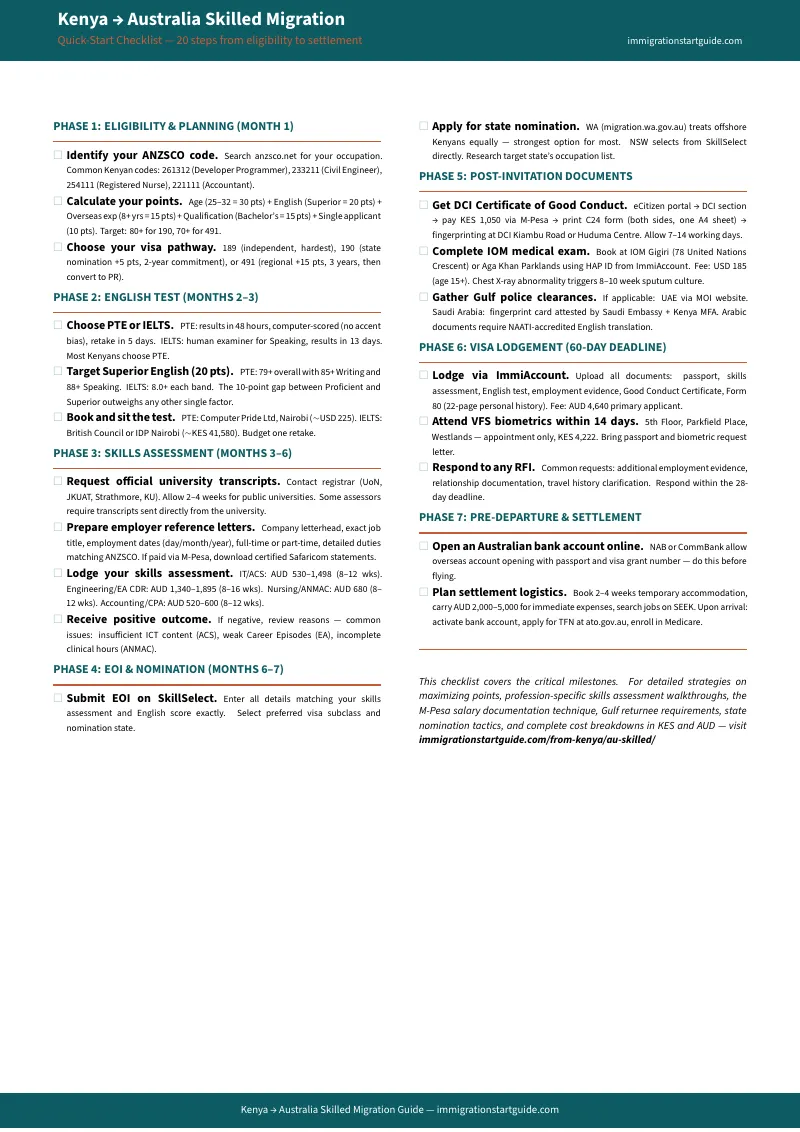
The free Quick-Start Checklist gives you the critical action items — documents to procure, agencies to contact, timelines to track. It is enough to calculate your current points score and see the full scope of what lies ahead.
The full guide gives you how: the PTE 88 Speaking protocol for Kenyan English speakers, the ACS two-year deduction workaround, the Gulf returnee verification playbook, the state nomination targeting strategy for NSW and WA, the M-Pesa salary documentation technique, the Nairobi logistics roadmap with every appointment sequenced, and the complete cost calculator in KES with real bank markup rates.
— Less Than 2% of What a MARA Agent Charges
A MARA-registered migration agent charges KES 300,000 to KES 600,000 for the same strategic intelligence this guide provides: points optimisation, skills assessment navigation, English test strategy, state nomination targeting, and application sequencing. The difference is that you execute the steps yourself — which you are going to do anyway, because even agents expect you to sit the English test, collect the DCI certificate, attend the IOM medical, and appear at VFS biometrics in person.
If the information in one chapter — the PTE Speaking protocol, the ACS deduction strategy, or the state nomination targeting — adds 5 points to your EOI, it is the difference between years in the queue and an invitation in the next round. That alone is worth more than the cost of this guide by orders of magnitude.
100% satisfaction guaranteed. If the guide does not meet your expectations, email [email protected] for a full refund.