
You Qualify for EU Citizenship in 2 Years. You Speak the Language. You Earn Enough. But Your Antecedentes Penales Expire in 90 Days, You Don't Know If You Need Homologación or Equivalencia, and Every Expat Guide You Find Was Written for Americans Who Don't Speak Spanish.
You ran the search: "visa de trabajo España para mexicanos." You got a law firm in Madrid quoting $800 to $2,000 USD for a full application. You got YouTube videos about Arraigo Social — a regularization path for people in irregular situations, which has nothing to do with you. You got an Etsy relocation guide written in English for British expats who need sworn translations for every document. And you got the consulate's website in Guadalajara, which lists requirements but does not tell you which ones to get first, which ones expire, or which ones will be rejected if you apostille them at the wrong government office.
Then you discover the real problems. Your Constancia de Antecedentes Penales Federales is valid for only 90 days. It must be apostilled by SEGOB — not your state government. If you get it apostilled too early, it expires before your consulate appointment. If you get it too late, SEGOB's 4-business-day processing window pushes you past your application deadline. Your birth certificate needs a state-level apostille from the Secretaría de Gobierno of the state where you were born — which may be different from the state where you live. And your cédula profesional, which you assumed was a straightforward credential, triggers an entirely different question: do you need Homologación (which takes 18 to 24 months and is required for regulated professions like medicine and law) or Equivalencia (which takes 3 to 6 months and is sufficient for business, tech, and most private-sector roles)? Choose the wrong path and you wait a year and a half for a recognition you never needed.
Meanwhile, the advantage that makes Spain uniquely valuable to you as a Mexican — the 2-year fast-track to EU citizenship through the Ibero-American provision — has a requirement that nobody emphasizes: "legal and continuous" residence with no absence exceeding three consecutive months. Miss a renewal deadline. Overstay a trip home for the holidays. Leave Spain for a 4-month project without understanding the absence rules. Any of these resets your clock to zero. Two years becomes four. Your EU passport slips further away because of an administrative error, not a qualification failure.
The Mexico → Spain Work Visa Guide is the Mexico-Spain Relocation System — built for the specific reality of navigating the Spanish immigration process from within the Mexican administrative system. This is not a translation of the consulate's checklist. This is not an English-language expat guide with a footnote about Latin Americans. This is the integrated system covering the document sequencing strategy that prevents your antecedentes penales from expiring before your consulate appointment, the SEGOB vs state apostille map so every document goes to the correct office the first time, the Homologación vs Equivalencia decision framework that saves non-regulated professionals 18 months of unnecessary waiting, the IMSS Convenio strategy that lets you keep your Mexican social security while living in Spain, the Beckham Law tax optimization for your first six years, the Digital Nomad Visa income proof templates using your SAT Constancia de Situación Fiscal, the 2-year citizenship timeline tracker with absence monitoring, and the complete cost breakdown from your first apostille to your CCSE exam.
What's Inside the Mexico-Spain Relocation System
A 40-page guide, a quick-start checklist, and 10 standalone printable worksheets and reference cards — 12 PDFs covering every step from your first apostille in Mexico to your citizenship application in Spain:
The Document Sequencing Strategy
This is where Mexican applicants sabotage their own applications without realizing it. You have six to eight documents that need apostilles, and each one has a different issuing authority, a different processing time, and a different expiration window. Your antecedentes penales expire in 90 days. Your apostille from SEGOB takes 4 business days. Your state-level apostille for your birth certificate takes 5 to 15 days depending on the state. Your equivalencia application has no expiration but takes 3 to 6 months to resolve. The guide provides the exact order to obtain, apostille, and submit every document so that nothing expires before your consulate appointment in CDMX, Guadalajara, or Monterrey. It includes the timing formula based on your target application date, the SEGOB vs state government apostille routing for every document type, and the digital apostille option with QR codes that Spanish immigration officers can verify instantly.
The Homologación vs Equivalencia Decision Framework
This decision alone can save you 18 months. Homologación is the process that grants your Mexican degree the exact legal standing of a specific Spanish título — and it is only required for regulated professions: medicine, nursing, dentistry, architecture, law, and certain engineering specialties. The processing time is 18 to 24 months. The fee is approximately 166 euros. For everyone else — business, marketing, tech, humanities, economics — the correct path is Equivalencia a Nivel Académico, which confirms that your Mexican licenciatura or maestría corresponds to a Spanish Grado or Máster. Processing time: 3 to 6 months. The guide includes the complete list of regulated professions that require homologación, the specific document requirements for each pathway, and the application process through the Ministry of Universities. If you are a software engineer, a marketing director, or a financial analyst, you need equivalencia. The guide ensures you never submit a homologación application for a profession that does not require one.
The IMSS Convenio Strategy
Mexico and Spain have a bilateral social security agreement that most guides never mention. If you are a digital nomad or a transferred worker, this agreement allows you to continue contributing to IMSS while living in Spain — saving you 300 to 500 euros per month in Spanish social security payments (RETA). You obtain a Certificado de Cobertura from IMSS, present it to Spanish authorities, and you are exempt from Spanish social security for up to two years. The trade-off: you must maintain private health insurance in Spain because the IMSS certificate does not grant you access to Spain's public healthcare system. The guide covers how to obtain the Certificado de Cobertura, the TA.300/ESP-MEX.1 form process, the insurance requirements (no copayments, no waiting periods, full coverage equivalent to the public system), and the decision framework for when IMSS continuation makes financial sense versus when enrolling in RETA is the better long-term strategy for your Spanish pension.
The Digital Nomad Visa (DNV) Income Proof System
The DNV requires you to demonstrate monthly income of approximately 200% of Spain's minimum wage — roughly 2,800 euros or $54,000 MXN per month for a single applicant. For families, the threshold increases by 75% for a spouse and 25% per child. Mexican applicants have two advantages here that no English-language guide explains: your documents are already in Spanish (saving hundreds of dollars in sworn translations), and your SAT Constancia de Situación Fiscal provides the income verification format that consulates expect. The guide includes the income proof template using your SAT documentation, the bank statement formatting requirements for Mexican banks, the freelancer income aggregation strategy for applicants with multiple clients, and the threshold calculations for families with dependents.
The Beckham Law Tax Optimization
Spanish income tax rates are progressive and can reach 47% at higher income levels. The Beckham Law — officially the Special Tax Regime for Displaced Workers — allows eligible new residents to be taxed as non-residents for their first six years in Spain: a flat 24% on Spanish-sourced income up to 600,000 euros. For a professional earning 80,000 euros, this translates to annual tax savings of 8,000 to 10,000 euros compared to the standard progressive regime. The guide covers the eligibility requirements (you must not have been a Spanish tax resident in the previous 5 years), the application timeline after obtaining your NIE, the interaction with the Mexico-Spain double taxation agreement, and the long-term planning considerations — because opting into the Beckham Law also affects your ability to claim certain deductions and your tax treatment of worldwide income.
The 2-Year Citizenship Timeline Tracker
The Ibero-American provision grants Mexican citizens the right to apply for Spanish citizenship after just 2 years of legal and continuous residence — compared to 10 years for most other nationalities. This is the single most powerful advantage of the Mexico-Spain corridor, and it is also the easiest to lose. "Continuous" means no absence exceeding three consecutive months. "Legal" means your residency permit must be valid and renewed on time — a lapsed permit resets your clock. The guide includes a month-by-month absence tracker, the renewal deadline calendar with buffer periods, the CCSE exam preparation roadmap (the only exam Mexican citizens must pass — you are exempt from the DELE language exam), and the complete citizenship application document checklist. Two years of precise administrative compliance earns you an EU passport and dual nationality with Mexico — you never have to renounce your Mexican citizenship.
The Arrival and Settlement Roadmap
Your first 30 days in Spain determine whether the next two years run smoothly or become a cycle of missed deadlines. The guide covers the empadronamiento (municipal registration) process — which you must complete within days of arrival because it starts your residency clock — the TIE card (Tarjeta de Identidad de Extranjero) application, the NIE number, opening a Spanish bank account as a new resident, and the cita previa system for scheduling appointments at the extranjería office. It includes the city comparison for Mexican professionals (Madrid vs Barcelona vs Valencia vs Málaga) with cost of living, professional networks, Mexican community presence, and quality of life factors.
Quick-Start Checklist (free download)
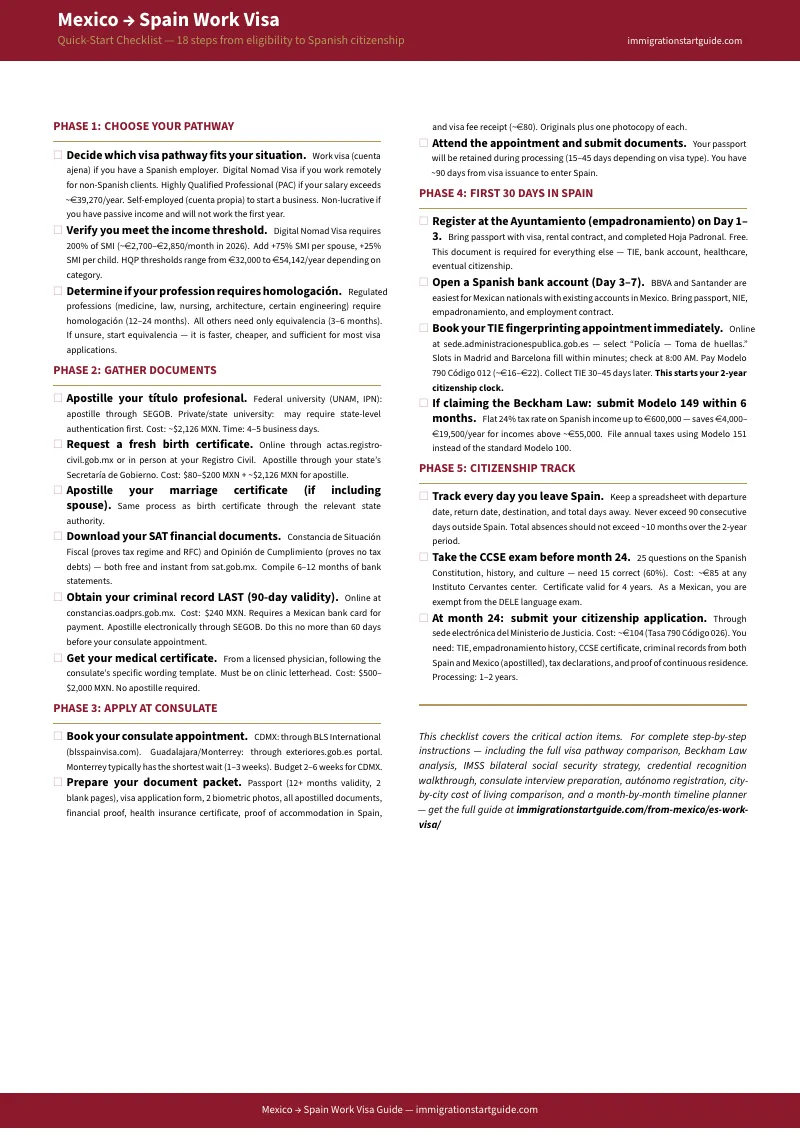
The critical steps distilled into a single action sheet organized by phase: visa pathway selection, document inventory with apostille routing, consulate appointment scheduling, and the first-week arrival tasks. Enough to confirm your visa eligibility tonight and identify whether the credential recognition path or the document sequencing is your primary obstacle.
Plus 10 standalone printable worksheets and reference cards:
- Visa Pathway Comparison — Side-by-side reference card comparing all 6 visa types (Work, DNV, PAC, Self-Employed, ICT, Non-Lucrative) with income thresholds, processing times, and Beckham Law eligibility
- Document Sequencing Worksheet — Apostille routing table, timing formula based on your consulate date, and a fillable document status tracker you bring to SEGOB
- Credential Recognition Decision — The regulated professions list and the Homologación vs Equivalencia decision framework on one printable sheet
- Financial Requirements Reference — Income thresholds by visa type in EUR and MXN, plus the freelancer income proof checklist and a fill-in income calculator
- Beckham Law Worksheet — Tax savings comparison table, the critical 6-month Modelo 149 deadline, application steps, and the Mexico-Spain double taxation treaty interaction
- IMSS vs RETA Comparison — Social security decision framework with cost comparison, Certificate of Coverage application steps, and insurance requirements
- Consulate Document Checklist — Universal and visa-type-specific document lists with checkboxes, consulate comparison table (CDMX, Guadalajara, Monterrey), and interview preparation tips
- First 30 Days Roadmap — Day-by-day arrival action plan from empadronamiento through TIE collection, with city-specific appointment notes and bank account options
- Citizenship Timeline Tracker — Fillable absence log, month-by-month milestone checklist from decision to EU passport, and the CCSE exam preparation roadmap
- Cost Breakdown — Every fee from your first apostille to your citizenship exam, grouped by phase, with fill-in fields for your actual costs
Who This Guide Is For
This guide is for Mexican professionals planning to live and work in Spain:
- Remote workers and digital nomads earning $54,000+ MXN monthly who want the Digital Nomad Visa as their entry point — you need the income proof system using SAT documentation, the IMSS Convenio decision, and the DNV-to-citizenship pathway that turns a nomad visa into an EU passport in two years.
- Corporate professionals receiving a transfer or job offer from a Spanish company — you need the Highly Qualified Professional visa pathway, the credential recognition decision (homologación vs equivalencia), and the Beckham Law tax optimization that saves you thousands of euros annually.
- Entrepreneurs and freelancers considering Spain's Startup Act visa — you need the business plan requirements, the self-employed (autónomo) registration process, and the RETA social security cost planning.
- Families relocating together — you need the dependent visa (reagrupación familiar) requirements, the income thresholds for families, the school enrollment process, and the healthcare options for each family member.
- Any Mexican professional who sees Spain as the fastest path to EU citizenship — you need the 2-year timeline tracker, the absence monitoring system, the CCSE exam preparation, and the dual nationality confirmation.
This guide is not for: people in irregular immigration situations seeking Arraigo Social (that is a different legal pathway), applicants from non-Ibero-American countries who do not qualify for the 2-year citizenship fast-track, or retirees seeking a non-lucrative visa without work authorization (see the Spain Non-Lucrative Visa Guide).
Why Not Free Resources?
Free information about moving to Spain is everywhere. Here is what it actually delivers for Mexican professionals:
- YouTube and social media are dominated by content about Arraigo Social — the regularization path for people who entered Spain without authorization and lived there for three years. This has nothing to do with your situation. You are a professional with a degree, a salary, and a legitimate visa pathway. The Arraigo Social content buries the information relevant to you: the Digital Nomad Visa, the Highly Qualified Professional pathway, and the IMSS Convenio. When you do find a video about the DNV, it is usually a 15-minute overview that does not explain how to prove income using your SAT Constancia or how to navigate the SEGOB apostille for your antecedentes penales.
- English-language expat guides (Etsy, relocation blogs) are written for Americans, Brits, and Canadians who need sworn translations for every document, have no path to citizenship in under 10 years, and cannot leverage the IMSS bilateral agreement. They are useful if you are a monolingual English speaker moving to Barcelona. They are useless if you are a Mexican professional who already speaks the language but needs to navigate the specific intersection of Mexican bureaucracy (SEGOB apostilles, SAT documentation, IMSS certificates) and Spanish immigration law.
- Immigration law firms charge $800 to $2,000 USD for a full residency application. For straightforward Digital Nomad Visa cases — where you meet the income threshold and your documents are in order — the lawyer handles the filing while you still have to navigate the Mexican side: getting apostilles in the right order, obtaining your antecedentes penales within the 90-day validity window, deciding between homologación and equivalencia for your degree. The most expensive mistakes happen on the Mexican administrative side, which no Spanish law firm manages for you.
This guide fills the gap between "I want to move to Spain" and "I have a TIE card and my 2-year citizenship clock is running" — the space where qualified Mexican professionals still fail because their antecedentes penales expired before the consulate appointment, they waited 18 months for a homologación they did not need, they missed the IMSS Convenio and paid 500 euros monthly in unnecessary RETA contributions, or they took a 4-month trip home and reset their citizenship clock without knowing it.
— Less Than One Hour of an Immigration Lawyer's Time
An immigration lawyer in Madrid charges $800 to $2,000 USD for a residency application. The consulate visa fee alone is approximately 80 euros — non-refundable whether you are approved or denied. A single apostille at SEGOB costs $2,126 MXN, and you need several. A denial does not just cost you the fees. It delays your arrival by months, pushes back your 2-year citizenship clock, and forces you to reassemble documents that may have expired during the wait.
This guide costs less than one apostille and covers every step, every document, every Mexican-specific administrative sequence, and every decision point between your first visit to SEGOB and your CCSE citizenship exam. The Homologación vs Equivalencia decision alone can save a non-regulated professional 18 months of unnecessary waiting. The IMSS Convenio strategy can save 300 to 500 euros per month in social security payments. The document sequencing strategy prevents the 90-day antecedentes penales expiration trap that derails applications every month at the consulates in CDMX, Guadalajara, and Monterrey.
You speak the language. You earn enough. You hold a degree from a Mexican university. You are a citizen of an Ibero-American country with a bilateral agreement that opens a path to EU citizenship in just two years — an advantage that citizens of the United States, Canada, the United Kingdom, and most of Asia will never have. What stands between you and that EU passport is not qualification. It is the gap between the Mexican credential system you navigated and the Spanish immigration system that will evaluate you. The apostille routing. The credential recognition path. The document timing. The absence rules. Every one of these is solvable. Every one of them, if solved wrong, adds months or years to a process that should take two.
Money-back guarantee, no time limit. If the document sequencing strategy, the Homologación vs Equivalencia decision framework, the IMSS Convenio walkthrough, and the 2-year citizenship timeline tracker do not make your Spain application stronger than anything you could assemble from YouTube videos, expat blogs, and Arraigo Social forums, you pay nothing.
Download the free Quick-Start Checklist to confirm your visa pathway, inventory your documents with the correct apostille routing, and identify the critical path items between today and your consulate appointment. When you are ready for the complete Mexico-Spain Relocation System — the full guide with the document sequencing strategy, the IMSS Convenio walkthrough, the Beckham Law tax planning, and the 2-year citizenship timeline tracker — the full guide is here.
Your advantage is structural — shared language, bilateral agreements, fast-track citizenship. But structural advantages only convert into an EU passport if the administrative execution is precise. Every month you spend piecing together advice from Arraigo Social forums and English-language expat guides is a month your 2-year clock could have been running. Start with the system built for Mexican professionals — the one that accounts for SEGOB, the SAT, the IMSS, and the consulate timeline that no generic guide covers.