
Spain Abolished the Golden Visa in April 2025. The Non-Lucrative Visa Is Now the Primary Route to Spanish Residency — and 40% of Rejections Come From Documentation Errors This Guide Eliminates.
You have the pension. You have the savings. You have the retirement plan that ends with a terrace overlooking the Mediterranean. You read the consulate website. It seemed manageable: prove financial means above 400% of the IPREM, get health insurance, submit documents, wait for approval. Then you got rejected because your insurance policy had the word "copago" buried in clause 14. Or because your bank statement was a downloaded PDF instead of a branch-stamped original. Or because you deposited your house sale proceeds two months before applying and the consulate flagged it as "unseasoned funds."
You go to Facebook groups. Someone in "Brits in Spain" says their Adeslas policy was accepted. Another member says theirs was rejected in January 2026 because it excluded pre-existing conditions for applicants over 65. A retiree asks whether their UK State Pension counts as passive income. Someone else warns that the Toronto consulate wants 12 months of bank history while the Miami consulate wants 6. Everyone has a different answer because everyone applied under different circumstances, at different consulates, with different case officers.
You research immigration lawyers. Balcells quotes €2,200. CostaLuz quotes €3,000 for full management. A gestor in Malaga offers to handle the paperwork for €1,500. These professionals handle the submission mechanics — but they are not in the business of explaining that your bank needs to produce a letter with specific phrasing about "recurring passive income," or that the medical certificate must reference the 2005 International Health Regulations by name, or that moving to Madrid instead of Valencia could save you tens of thousands in wealth tax over five years, or that the IPREM doubles at renewal and you need 800% to maintain your status in year two.
The Spain Non-Lucrative Visa Guide is a Consulate-Ready Documentation System — the structured framework that sits between the government's fragmented requirements and a lawyer's €2,000-€5,000 compliance retainer. It transforms scattered regulations, consular inconsistencies, 2026 IPREM thresholds, and regional tax variations into a precise, executable plan covering document preparation, financial proof formatting, insurance compliance, and post-arrival administration that eliminates the guesswork from every stage of your application.
What's Inside the Consulate-Ready Documentation System
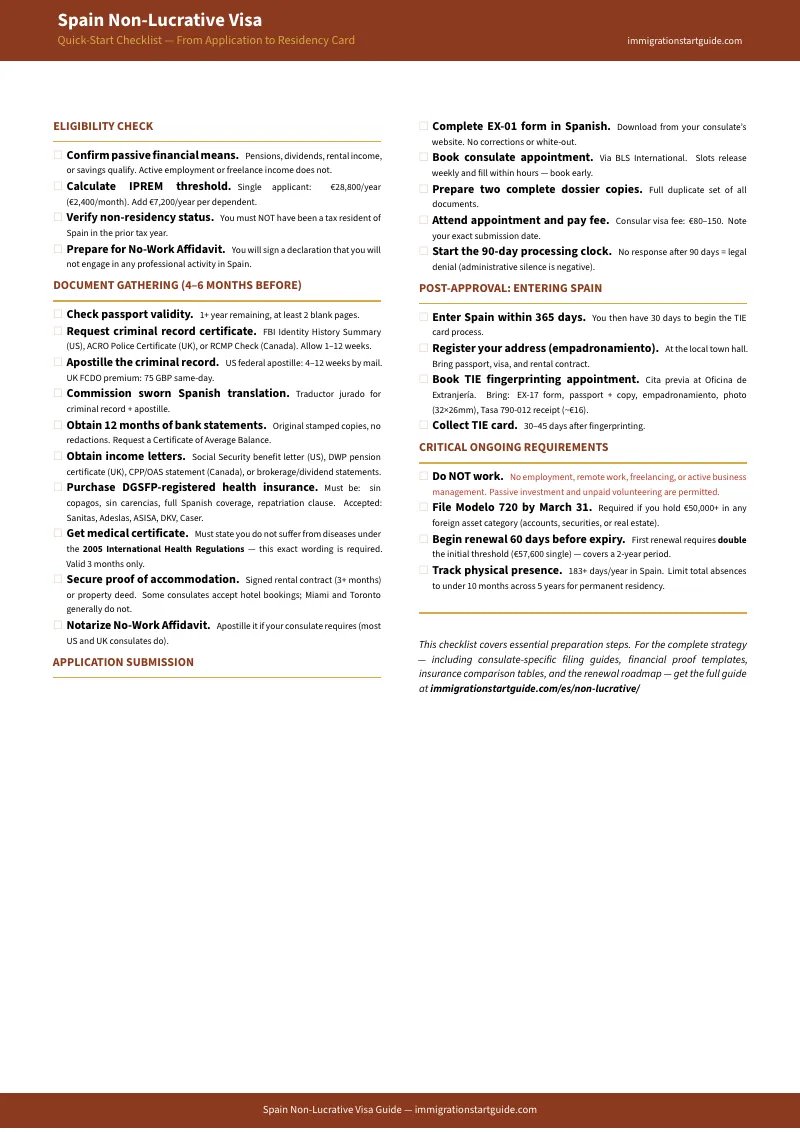
The complete kit includes 10 PDFs — the multi-chapter guide, the quick-start checklist, and eight standalone printable references you can bring to your bank, insurance broker, consulate appointment, and tax advisor. Everything you need to verify eligibility, prepare compliant documents, and navigate the five-year path to permanent Spanish residency.
The 2026 IPREM Financial Threshold Calculator — Spain pegs the Non-Lucrative Visa financial requirement to the Indicador Publico de Renta de Efectos Multiples (IPREM), which changes annually. For 2026, the monthly IPREM is €600, making the single applicant threshold 400% or €2,400/month (€28,800/year). Add a spouse: €3,000/month (€36,000/year). Add a child: €3,600/month (€43,200/year). The guide provides the exact calculation methodology, shows which income documentation each consulate actually accepts, and explains the critical distinction between demonstrating savings versus recurring passive income — because a €200,000 lump sum that appeared in your account two months ago will be flagged as "unseasoned" while that same amount with 12 months of deposit history sails through.
The "Sin Copagos" Insurance Compliance Module — health insurance is the single most common rejection trigger for Non-Lucrative Visa applications. The policy must be issued by a DGSFP-registered Spanish insurer, must include zero co-payments (sin copagos), zero waiting periods (sin carencias), no annual financial cap, repatriation of remains, and no exclusion of pre-existing conditions. Travel insurance is rejected. Medicare is rejected. International expat policies from non-Spanish entities are rejected. For applicants over 65, annual premiums range from €2,000 to €4,500 per person — and the consulate requires proof of full upfront payment. The module provides the exact coverage specifications to verify with your broker, the insurer comparison across Sanitas, Adeslas, Mapfre, and DKV, and the broker communication script that ensures your certificate of coverage contains the precise language consulates require.
The Complete Document Checklist with Freshness Windows and Consulate Variations — Spanish consulates enforce document age limits that vary by jurisdiction and are not published on any single government website. Criminal background checks (FBI for US, ACRO for UK, RCMP for Canada) expire at three to six months depending on your consulate and must be Apostilled. The medical certificate must reference the 2005 International Health Regulations — generic doctor's letters are rejected. Bank statements must be original stamped copies with no redactions, covering 12 months of history. The EX-01 application form must be completed in Spanish with no corrections. The checklist maps every document with its freshness window, legalization requirements, and the specific formatting that prevents rejection at each major consulate — because the Manchester consulate requires the Hague Apostille on medical reports while the Miami consulate requires notarized affidavits for the Work Cessation Rule even from retirees well past 70.
The Consulate-Specific Intelligence Briefs — a major gap in free resources is the assumption that all Spanish consulates operate identically. They do not. The Miami consulate enforces the Work Cessation Rule with notarized affidavits. The Toronto consulate scrutinizes 12-month average balances and rejects applicants showing high account volatility. The London consulate processes through BLS International with a rigid digital appointment system that has become a significant bottleneck. The Manchester consulate requires Apostilles on nearly every official certificate including medical reports. The guide maps the documented procedural variations for North American, UK, and European consulates so you know exactly what your specific office expects before you walk in.
The Renewal and Permanent Residency Roadmap — the initial visa is one year. The first renewal extends to two years, then another two years, then permanent residency at year five. But the financial threshold changes: renewal requires 800% of the IPREM (double the initial 400%), catching applicants who budgeted only for the first year's requirements. The 2026 Supreme Court ruling abolished the "six-month absence rule" for temporary residents — you can now leave Spain for extended periods without your permit being cancelled. But this ruling does not apply to permanent residency qualification: you still cannot be absent for more than 10 months total in the five-year period. The roadmap calculates the exact financial thresholds at each renewal stage and maps the absence tracking strategy that protects your path to permanent status.
The Tax Residency and Regional Planning Module — once you spend more than 183 days in Spain in a calendar year, you become a Spanish tax resident liable on worldwide income and assets. The Modelo 720 requires reporting all foreign assets (bank accounts, investments, real estate) where any category exceeds €50,000, filed by March 31st annually. Cryptocurrency on foreign exchanges requires separate reporting on Modelo 721. But Spain's tax burden varies dramatically by region: Madrid and Andalusia offer 100% wealth tax rebates (effective zero), while Catalonia and Valencia maintain higher rates with lower exemption thresholds. The module covers Modelo 720/721 filing requirements, the regional wealth tax comparison, inheritance tax implications, and why choosing Madrid or Andalusia over Barcelona or Valencia could save a high-net-worth retiree tens of thousands annually.
Common Rejection Mitigation Strategies — based on publicly reported denial patterns and immigration lawyer case studies, the guide maps the most frequent rejection reasons and their preventive solutions:
- Insurance with copayments or waiting periods — the policy must explicitly state sin copagos and sin carencias with full coverage from a DGSFP-registered Spanish insurer. The guide provides the exact certificate language to verify before submission
- "Unseasoned" financial deposits — large recent deposits (house sale proceeds, gifts, transfers) are flagged as potentially borrowed funds. The guide explains the seasoning timeline and documentation strategy that demonstrates financial stability
- Incomplete or incorrectly formatted bank statements — downloaded PDFs are rejected at most consulates. The guide specifies the branch-stamped originals requirement and the specific phrasing your bank letter must include
- Medical certificate without IHR 2005 reference — generic doctor's letters are rejected. The guide provides the exact wording your physician must include referencing the International Health Regulations
- Missing Apostille or incorrect legalization — which documents require Apostille, which require sworn translation, which require both, and how the requirements differ between UK, US, and Canadian documents
- EX-01 form errors — the form must be in Spanish with no corrections. The guide maps every field with the correct terminology
- Work Cessation documentation gaps — even fully retired applicants face this requirement at certain consulates. The guide provides the affidavit template and explains which consulates enforce it
Who This Guide Is For
- You are a retiree with a pension planning to move to Spain. You need to understand whether your State Pension, Social Security, or private pension qualifies as "recurring passive income," how to format your pension letters for the consulate, what happens to your healthcare coverage once you leave your home country, and how to structure the renewal so the 800% IPREM threshold does not catch you off guard in year two.
- You are financially independent (FIRE) and want a European base. You have investment income, dividends, or rental properties generating passive returns — but you need to prove these funds are "stable and recurring" rather than volatile capital gains. You also need to understand the strict no-work prohibition: remote work, freelancing, or even managing an active business disqualifies you from the NLV.
- You are a British citizen navigating post-Brexit residency. You are now classified as a third-country national and need the NLV to spend more than 90 days in 180 within the Schengen Area. You need to know which UK consulate processes fastest, whether the BLS International appointment bottleneck affects your timeline, and how to handle the ACRO criminal record check and Apostille process.
- You lost access to the Golden Visa route and need an alternative. The real estate investment pathway was abolished in April 2025. You have the financial means but need a different legal framework. The NLV is now the primary vehicle for financially self-sufficient non-EU nationals, and the guide maps exactly how your existing financial profile translates to NLV eligibility.
- You are choosing between Madrid, Andalusia, Valencia, or Catalonia. You know you want Spain, but regional tax differences — particularly wealth tax rebates in Madrid and Andalusia versus higher rates in Catalonia and Valencia — could change your effective tax burden by tens of thousands annually. The guide covers the regional comparison so your choice of city aligns with your financial planning.
- You are weighing the NLV against the Digital Nomad Visa. You have income but are unsure whether it qualifies as "passive" or "active." If your income comes from remote work for a foreign employer, you need the DNV, not the NLV — and submitting the wrong application wastes months. The guide maps the decision criteria so you apply under the correct framework.
This guide does not replace a lawyer for cases involving prior visa refusals, criminal record complications, or situations requiring in-person representation at a Spanish consulate. It gives you the consulate-ready documentation system that eliminates preventable rejections and positions you to either self-manage the process or hire a lawyer as an informed client who knows exactly what outcome to demand.
Why Not Free Resources?
- The Spanish government website lists the requirements. It does not explain that the Toronto consulate wants 12 months of bank history while the Miami consulate accepts 6. It does not warn that recent large deposits are flagged regardless of their legitimate source. It does not mention that the IPREM threshold doubles at renewal. It does not specify the exact medical certificate wording that prevents rejection. The system is designed to be applied through, not understood.
- Free blog posts (Balcells, SpainGuru, MySpainVisa) provide excellent general overviews but lack the actionable granular detail needed to handle consulate-specific requirements. They list "health insurance" as a requirement without specifying the exact sin copagos/sin carencias/DGSFP registration criteria that distinguish an accepted policy from a rejected one. They mention bank statements without explaining the seasoning trap that causes rejections for applicants who recently sold property.
- Facebook groups and Reddit contain thousands of anecdotal reports from applicants who filed at different consulates, under different circumstances, in different years. The poster who says "my travel insurance was fine" filed in 2023 before the crackdown. The one who says "you only need €25,000" is quoting last year's IPREM. Survivorship bias is structural — people who were rejected for a missing Apostille on their medical report do not post detailed breakdowns of what went wrong.
- Immigration lawyers charge €2,000 to €5,000 for NLV application management. They handle form submission and consular liaison. But the applicant still gathers 90% of the documents themselves — the bank statements, the criminal record check, the medical certificate, the insurance policy, the pension letters. A lawyer cannot go to your bank for you. The guide provides the same consulate-ready checklists at a fraction of the cost.
This guide fills the documentation gap — the space between "I technically meet the requirements" and "my application is structured to avoid every known failure point from initial submission through five-year permanent residency."
— Less Than the Consular Visa Application Fee
The Spanish consular visa fee alone is €80. Private health insurance for the NLV runs €600 to €4,500 per year depending on your age. Sworn translations cost €30 to €60 per page. A one-hour consultation with a Spanish immigration firm costs €100 to €300. Full application management runs €2,000 to €5,000. And the applicant still does the actual work — gathering Apostilled documents, securing sin copagos insurance, formatting bank letters, obtaining the correctly worded medical certificate, and navigating the post-arrival empadronamiento and TIE process.
Your total relocation costs will include consular fees, insurance premiums, translations, Apostilles, and months of preparation time. This guide represents a fraction of that investment — and it is the piece that determines whether your application is approved on first submission or triggers a rejection that costs you another three to six months of document gathering while your retirement timeline slips.
Money-back guarantee, no time limit. If the Consulate-Ready Documentation System does not clarify your path, you pay nothing.
Download the free Quick-Start Checklist to see the document requirements and verify your eligibility tonight. When you are ready for the complete Consulate-Ready Documentation System — the full guide with IPREM calculations, insurance compliance module, consulate-specific intelligence, renewal roadmap, and regional tax planning — the full kit is here.
The Golden Visa is gone. The Non-Lucrative Visa is how you get to Spain now. Make sure your application gets it right the first time.