
Your Application Was Rejected Because Your Health Insurance Had a Copayment Clause. This Guide Eliminates Every Hidden Failure Point Between You and a 5-Year Spanish Residency Permit.
You found out Spain launched a Digital Nomad Visa. You read the government website. It sounded straightforward: prove remote income above 200% of the minimum wage, get health insurance, submit documents. You assembled your paperwork. Then the UGE-CE issued a requerimiento asking for additional documentation you had never heard of. Or your consulate rejected the application because your employer letter did not include specific language confirming the company has no Spanish establishment. Or your insurance policy was denied because the word "copago" appeared somewhere in the fine print.
You go to Reddit. Someone says the Certificate of Coverage from the US is now accepted. Another poster says theirs was rejected in January 2026. A freelancer asks whether their Upwork contracts count as a "professional relationship of at least three months." Someone else warns that the Beckham Law deadline is six months from Social Security registration, not six months from visa approval. Everyone has a different answer because everyone applied under different circumstances, at different consulates, with different case officers.
You research immigration lawyers. Lexidy quotes €1,200. Balcells quotes €900 for the basic package, €2,200 for full management. Sinnott charges a flat €1,500. These firms handle the submission mechanics — but they are not in the business of explaining that the in-country UGE-CE path gives you three years immediately while the consular path gives you one, or that "positive administrative silence" means your application is legally approved if they fail to respond within 20 working days, or that updating your employer letter with one missing sentence could have prevented the requerimiento that delayed your approval by three months.
The Spain Digital Nomad Visa Guide is an Application Architecture System — the structured framework that sits between the government's fragmented requirements and a lawyer's €900-€2,200 compliance retainer. It transforms scattered regulations, consular inconsistencies, 2026 SMI thresholds, and Beckham Law deadlines into a precise, executable plan covering document preparation, path selection, timing strategy, and tax optimization that eliminates the guesswork from every stage of your application.
What's Inside the Application Architecture System
The complete kit includes 11 PDFs: the multi-chapter guide (72 pages), the quick-start checklist, and 9 standalone printable tools — reference cards, calculators, comparison sheets, and planning worksheets you can use independently without opening the main guide. Everything you need to select your optimal application path, prepare compliant documents, and navigate post-approval administration.
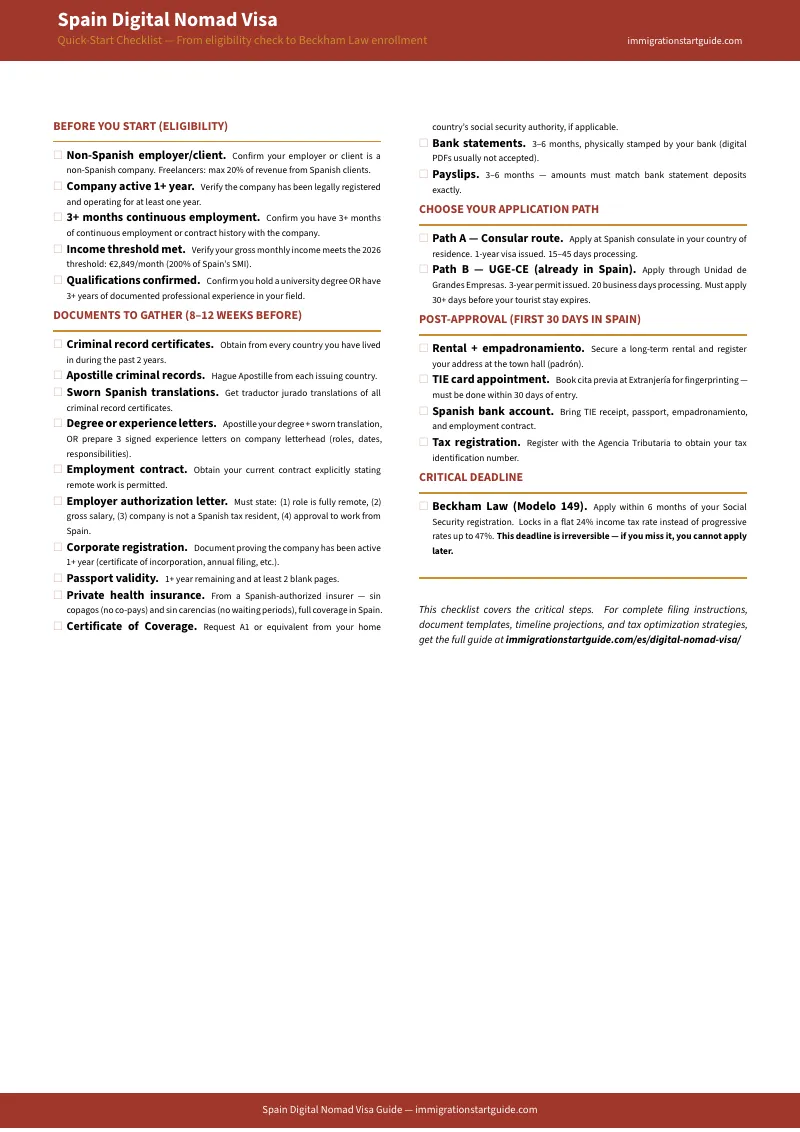
The Dual Path Decision Framework — the single most consequential decision in the Spanish DNV process is whether to apply from your home country (consular visa, 1-year permit) or from within Spain (UGE-CE residence authorization, 3-year permit). The guide maps the eligibility logic, processing timelines, and strategic tradeoffs for each path. The in-country route through the UGE-CE triggers "positive administrative silence" — if they do not respond within 20 working days, your application is legally approved. But you must submit at least 30 days before your 90-day Schengen tourist stay expires. Miss that window and you are locked into the consular route with a one-year initial permit. The framework calculates the optimal entry timing based on your document readiness and employment situation.
The 2026 Income Threshold Calculator — Spain pegs the financial requirement to the Salario Minimo Interprofesional, which changes every year. For 2026, the SMI increased to approximately €1,221/month (14 payments), pushing the single applicant threshold to approximately €2,850/month or €34,200/year. Add a spouse: €3,918/month. Add a child: €4,275/month. The guide provides the exact calculation methodology, shows which income documentation the UGE-CE actually accepts (bank-stamped statements, not digital PDFs), and explains why payslip amounts must precisely match bank deposit records — a mismatch is one of the top three rejection triggers.
The Complete Document Checklist with Freshness Windows — Spanish authorities enforce document age limits that are not published anywhere on the government website. Criminal background checks older than three months are rejected at some consulates. Apostilles must match specific formatting requirements depending on your country. Your employer letter requires explicit language confirming: (1) the work is performed remotely, (2) the company has no Spanish establishment, (3) the professional relationship predates the application by at least three months, and (4) the company has been operational for at least one year. Miss any one of these four elements and your application triggers a requerimiento. The checklist maps every document with its freshness window, legalization requirements, and the exact wording that prevents administrative delays.
The Beckham Law Tax Optimization Module — the Special Tax Regime for Displaced Workers caps your Spanish income tax at a flat 24% for six years, versus the standard progressive rates that reach 45-47% above €60,000. For a remote worker earning €100,000, the annual saving exceeds €13,000. But the application window is precisely six months from your Social Security registration date. Miss it by one day and you are permanently disqualified — there is no appeal, no extension, no second chance. The module covers the Modelo 149 filing process, the exact trigger date calculation, which income categories qualify, and the critical distinction between employees (eligible) and freelancers (eligible only with ENISA certification). It also addresses wealth tax exemption on foreign assets, Modelo 720 exemption, and the interaction with US FEIE/FTC for American applicants.
The US Certificate of Coverage Walkthrough — as of March 2026, Spain officially accepts the US CoC for Digital Nomad Visa applications. This resolved months of conflicting interpretations where some US applications were rejected because the 1986 Totalization Agreement was designed for employer-directed transfers, not voluntary remote work. The guide covers the current SSA application process, expected processing timelines, the specific form language that satisfies the UGE-CE, and the alternative "autónomo registration" path if your CoC is delayed or denied.
The Post-Approval Roadmap (NIE, Empadronamiento, TIE) — visa approval is the beginning, not the end. You have 30 days to apply for your TIE card, but the cita previa appointment system in Madrid and Barcelona is a digital lottery where slots disappear in seconds. The empadronamiento requires a long-term rental contract, but many landlords only offer 11-month "seasonal" leases that town halls reject. The guide provides the sequential dependency map: which steps unlock which, the workarounds for appointment scarcity (smaller towns, gestor services), and the exact documents needed at each administrative counter.
The Family Reunification Protocol — dependents receive permits of identical duration to the main applicant, and spouses gain the right to work for Spanish companies. The guide covers the income scaling calculation for each family member, dependent documentation requirements (marriage certificates, birth certificates, financial dependency proof), and the health insurance coverage that must match for every included person.
Common Rejection Mitigation Strategies — based on publicly reported denial patterns and immigration lawyer case studies, the guide maps the seven most frequent rejection reasons and their preventive solutions:
- Health insurance with copayments — the policy must explicitly state zero copago and full coverage (no travel-only or care-only policies). Accepted providers include Sanitas, Adeslas, and Mapfre
- Employer letter missing required elements — the four mandatory statements and the formatting that satisfies both consulates and the UGE-CE
- Payslip/bank statement mismatch — when net deposits differ from gross payslip amounts due to tax withholdings, benefit deductions, or currency conversion, the guide shows how to document the discrepancy
- Company age under one year — the UGE-CE verifies incorporation dates; the guide covers which corporate documents prove operational history
- Freelancer "disguised employment" — if your contract specifies fixed hours, paid leave, or company equipment, inspectors may classify it as a dependent employment relationship and reject the application
- Expired criminal background check — freshness windows vary by consulate; the guide maps the requirements for major consulates
- Missing apostille or sworn translation — which documents require apostille, which require sworn translation, and which require both
9 Standalone Printable Tools
Every standalone works as a self-contained reference — print it, pin it to your wall, or keep it open on your desk while you work through the application process:
- Document Checklist with Freshness Windows — every required document mapped with its expiration timeline, apostille chain, and the exact moment to request each one relative to your submission date
- Income Threshold Calculator — 2026 SMI thresholds with family size scaling and a currency buffer worksheet for non-euro earners
- Dual Path Comparison Sheet — consular visa vs. in-country UGE-CE side-by-side: eligibility, timelines, permit duration, and a decision checklist to pick your path
- Beckham Law Reference Card — tax savings table by income level, the critical six-month deadline, and the Modelo 149 filing steps on one sheet
- Post-Approval Roadmap — the NIE → empadronamiento → TIE sequential dependency map showing which steps unlock which
- Application Timeline Planner — 8-week pre-arrival countdown, arrival week actions, and post-submission tracking checklist
- Rejection Mitigation Card — the 8 most common rejection triggers with the specific preventive action for each
- Cost Breakdown Worksheet — government fees, document costs, insurance, professional services, and running totals
- Forms and Portals Reference Card — every form name, portal URL, and key terminology on one page
Who This Guide Is For
- You are a W-2 employee of a US company planning to relocate to Spain. You need to understand the Certificate of Coverage process, whether your employer needs to take any action, how the Beckham Law interacts with US citizenship-based taxation, and whether you should apply from the US consulate or fly to Spain on a tourist visa and apply in-country for the 3-year permit.
- You are a remote contractor earning above €35,000 from non-Spanish clients. You need to prove the professional relationship predates the application by three months, demonstrate that no more than 20% of income comes from Spanish sources, and decide whether to obtain a Certificate of Coverage or register as an autónomo in Spain.
- You want the Beckham Law but are confused about the deadline. You earn over €60,000 and the flat 24% rate would save you thousands annually — but you have read conflicting information about when the six-month window starts, whether freelancers qualify, and what happens to your foreign investment income once you opt in.
- You are relocating with your family. You need to calculate the combined income threshold for your household, understand which dependent documents require apostille and translation, and ensure every family member has compliant health insurance before the application is submitted.
- You are a Latin American national who wants EU citizenship in two years. You understand the Digital Nomad Visa is your entry point, but you need to know exactly how the two-year continuous residency requirement works, how much time abroad is tolerable, and what the CCSE citizenship exam involves.
- You are weighing Spain against Portugal's D8 or Germany's freelancer visa. You want a side-by-side comparison of the financial thresholds, tax regimes, processing times, and long-term residency paths — so you can choose the destination that matches your income level, tax situation, and lifestyle priorities.
This guide does not replace a lawyer for cases involving prior visa refusals, criminal record complications, or complex corporate structures. It gives you the application architecture that eliminates preventable rejections and positions you to either self-manage the process or hire a lawyer as an informed client who knows exactly what outcome to demand.
Why Not Free Resources?
- The Spanish government website lists the requirements. It does not explain that positive administrative silence means your in-country application is legally approved after 20 working days without a response. It does not warn that the UGE-CE rejects digital-only bank statements and requires physically stamped originals. It does not mention that the Beckham Law deadline runs from Social Security registration, not from visa approval or physical entry. The system is designed to be applied through, not understood.
- Etsy and Gumroad guides ($5-$30) were written in 2023 or early 2024. They reference pre-2026 SMI thresholds. They do not cover the March 2026 US Certificate of Coverage resolution. They mention the Beckham Law but do not map the exact Modelo 149 filing sequence or the irreversible six-month deadline. They provide a generic checklist but not the employer letter language that prevents requerimientos.
- Reddit and expat forums contain thousands of anecdotal reports from applicants who filed at different consulates, under different interpretations, in different years. The poster who says "I got approved without a CoC" filed in 2024 before the crackdown. The one who says "Beckham Law is automatic" has never actually filed a Modelo 149. Survivorship bias is structural — people who were rejected for missing one sentence in their employer letter do not post detailed breakdowns of what went wrong.
- Immigration lawyers charge €900 to €2,200 for application management. They handle form submission. They do not typically explain why the in-country path is strategically superior for your situation, or coach you through the Beckham Law application that happens months after the visa is granted, or map the post-approval TIE appointment strategy that prevents you from spending three months without a residency card.
This guide fills the architecture gap — the space between "I technically meet the requirements" and "my application is structured to avoid every known failure point from initial submission through post-approval administration."
— Less Than a Single Consultation With a Spanish Immigration Lawyer
A one-hour consultation with a Spanish immigration firm costs €100 to €300. Full application management runs €900 to €2,200. And the applicant still does the actual work — gathering apostilled documents, securing compliant health insurance, coordinating employer letters, calculating income thresholds, and navigating the post-approval bureaucratic sequence.
Your total relocation costs will include consular fees (€80-€150), health insurance (€600-€1,500/year), sworn translations (€30-€60 per page), and months of preparation time. This guide represents a fraction of that investment — and it is the piece that determines whether your application is approved on first submission or triggers a requerimiento that delays your move by months while your Schengen tourist visa ticks down.
Money-back guarantee, no time limit. If the Application Architecture System does not clarify your path, you pay nothing.
Download the free Quick-Start Checklist to see the document timeline and verify your eligibility tonight. When you are ready for the complete Application Architecture System — the full guide with dual-path framework, Beckham Law module, rejection mitigation strategies, and post-approval roadmap — the full kit is here.
Spain scored 99.67 on the Global Digital Nomad Visa Index. Your application should score just as high.