
Your Employer's Immigration Lawyer Serves the Company. This Guide Serves You. The Complete Playbook for Spain's Highly Skilled Professional Visa — From Contract Negotiation to TIE Card in Hand.
You have a job offer from a Spanish company. The salary looks right, the role is exciting, and someone in HR said the visa would take "about a month." They mentioned a unit called the UGE-CE. They said the company's lawyer would handle everything.
That last part is the problem.
The company's immigration lawyer works for the company. Their job is to get the authorization processed. They are not in the business of telling you that your contract's base salary is €1,000 below the Order PJC/44/2026 threshold because HR loaded the difference into a performance bonus that the UGE-CE does not count. They will not explain that choosing the EU Blue Card over the national HQP permit locks you out of the 2-year citizenship fast-track if you are Latin American. They will not warn you that the 30-day trial period termination clause means you could lose your residence permit before your first TIE appointment — and that in 2026, getting that appointment in Madrid, Barcelona, or Valencia has become something resembling a lottery.
You go to Google. Balcells has a blog post. Lexidy has a webinar. Duguech and Dip has a guide. All excellent general overviews, all designed to sell you €2,000 to €4,000 in legal services. They explain that the HQP permit exists. They do not explain which Telegram groups publish TIE appointment release windows in Barcelona. They do not tell you that the 0.8 reduction coefficient for under-30s means your 28-year-old data scientist colleague needs only €30,058 instead of €40,077. They do not walk you through filing Form 149 within six months of your Social Security start date to lock in the Beckham Law's 24% flat tax rate — or explain that missing that deadline means losing the benefit permanently, with no appeals process.
The Spain Highly Skilled Professional Visa Guide is The Employee's Immigration Playbook — the structured framework that puts you in control of a process your employer initiated but cannot explain. It covers every stage from contract verification against 2026 salary thresholds, through the UGE-CE authorization, the consular visa, the post-arrival registration sequence, and the TIE appointment crisis — all the way to the Beckham Law election and your long-term path to permanent residency or citizenship.
What's Inside The Employee's Immigration Playbook
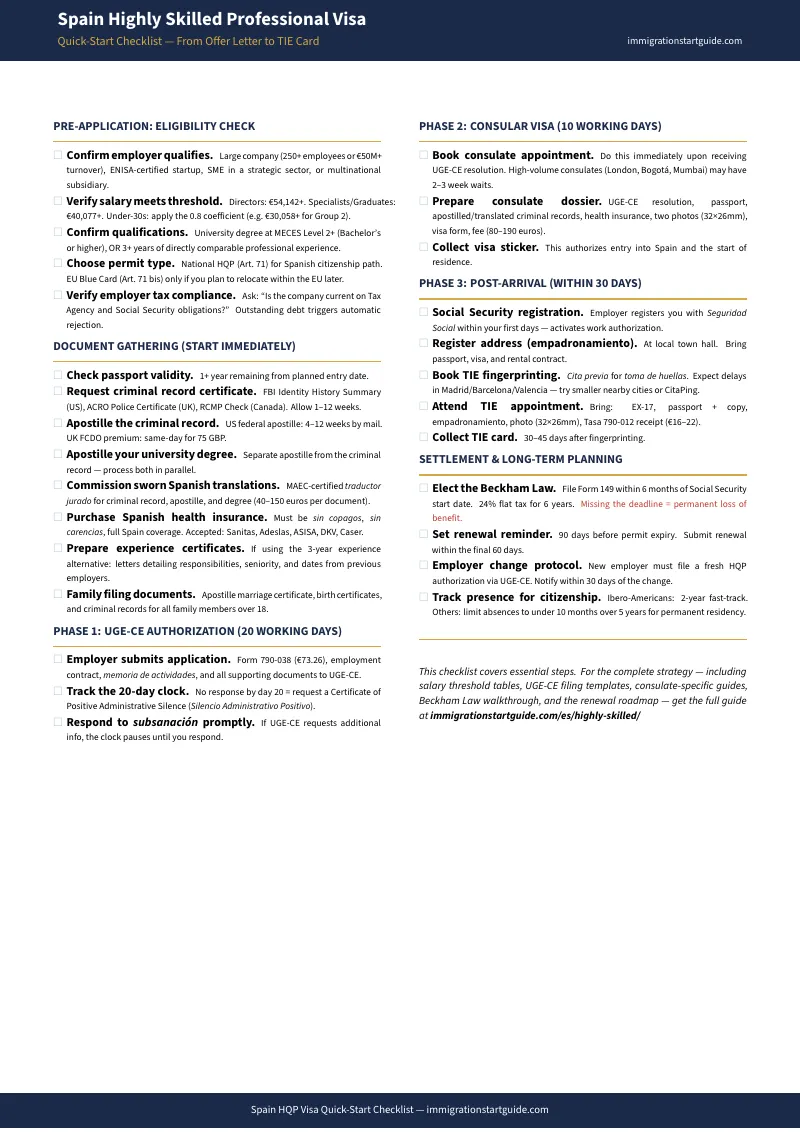
The complete kit includes the multi-chapter guide and the quick-start checklist covering every phase from pre-application eligibility through post-arrival settlement. Everything you need to verify your contract, prepare compliant documents, and navigate the bureaucratic sequence that turns a UGE-CE resolution into a physical residency card.
The HQP vs. EU Blue Card Decision Matrix — This is the choice your employer's HR department will not explain clearly, and the one you must make before a single document is filed. Both permits are processed through the same UGE-CE unit on the same 20-working-day timeline. But the national HQP (Article 71) accepts vocational qualifications and three years of experience in lieu of a degree, while the EU Blue Card (Article 71 bis) requires a minimum bachelor's degree and offers facilitated intra-EU mobility after 12 months. For a Latin American professional pursuing the 2-year citizenship fast-track, the Blue Card's mobility feature is a trap: transferring to a Berlin office after 18 months resets your Spanish residency clock. For an Indian or American professional who may want to work across the EU, the Blue Card is worth serious consideration. You cannot easily switch later — moving between permits requires a fresh UGE-CE filing. The matrix walks you through the decision based on your nationality, career plans, education level, and long-term residency goals.
The 2026 Salary Threshold Verification Tool — Salary is the quantitative gatekeeper, and a contract below threshold is a guaranteed rejection. For 2026, Order PJC/44/2026 sets minimum gross annual salaries at €54,142 to €61,000 for directors and senior managers, €40,077 to €44,000 for specialists and graduates, and €31,415 to €37,500 for ICT professionals in high-demand sectors. The UGE-CE counts only the fixed base salary and guaranteed prorated payments (the 13th and 14th month). Performance bonuses, stock options, RSUs, and variable commissions are excluded. In-kind remuneration cannot exceed 30% of total compensation. A contract stating €39,000 fixed salary for a Group 2 role will be rejected even if total compensation with bonuses exceeds €60,000. The tool shows you exactly how to verify your contract against the thresholds and how to negotiate with your employer to restructure the package — reduce the variable component, increase the fixed base — at zero additional cost to the company.
The Employer Eligibility Verification Checklist — The HQP authorization is a co-dependent permit: your qualifications are irrelevant if your employer does not meet the sponsorship criteria. The company must be a large enterprise (250+ employees or €50M+ turnover), an SME in a strategic sector with DGCI accreditation, an ENISA-certified innovative startup, or a subsidiary of a qualifying international group. Beyond category, the company must be current on all Tax Agency and Social Security obligations — any outstanding debt triggers automatic rejection. The checklist gives you the exact questions to ask HR before you accept an offer contingent on HQP sponsorship, including whether the company has successfully sponsored HQP permits before and whether they hold a current ENISA certification if they claim startup status.
The 2026 TIE Appointment Crisis Strategies — The UGE-CE authorization is a digital resolution. It is not the physical card that lets you open a bank account, travel within the EU, or prove your right to work. In 2026, the mass regularization program for approximately 500,000 undocumented migrants has flooded National Police offices with appointment requests. Getting a cita previa for TIE fingerprinting in Madrid, Barcelona, or Valencia can take weeks of daily refreshing. Criminal networks use bots to hoard slots and resell them for €200 or more. The guide covers battle-tested strategies: specific release windows (Barcelona often releases slots Tuesday and Friday mornings), monitoring services like CitaPing, smaller satellite cities near your metro area that process faster, and the pilot programs in L'Hospitalet de Llobregat and Girona that automatically assign appointments when UGE resolutions are issued.
The Beckham Law Tax Strategy — The Special Expatriate Tax Regime caps your income tax at a flat 24% for six years on Spanish employment income up to €600,000. On a salary of €80,000, the savings compared to standard progressive rates (which reach 45 to 47% for high earners) exceed €10,000 per year. To qualify, you must file Form 149 with the Agencia Tributaria within six months of your Social Security start date, and you must not have been a Spanish tax resident in the previous five years. The guide covers the exact filing procedure, the deadline calculation, common disqualifying scenarios, and why this is the single highest-value administrative task you will complete in your first year in Spain.
The Trial Period Contingency Plan — Spanish employment contracts for managers and technical staff allow trial periods of up to six months during which termination is immediate and without cause. If your employer terminates you during the trial period, you have a strict 30-business-day window to notify the UGE-CE of your change in status. Failure to notify can lead to permit revocation. Finding a new employer willing to take over an HQP permit is difficult — many companies refuse to engage with the paperwork. The contingency plan covers the UGE-CE communication procedure, how to modify your permit to continue with a new employer without leaving the country, and the requirements the new employer must meet to prove the role remains "highly qualified."
The Citizenship and Permanent Residency Roadmap — For nationals of Latin American countries, the Philippines, Equatorial Guinea, and Portugal, Spanish citizenship can be requested after just two years of continuous legal residence. "Continuous" is strict: absences must generally not exceed three months in a single year. For all other nationalities, permanent residency (Larga Duracion) arrives at five years, with citizenship at ten. The roadmap tracks the exact absence limits, the renewal timeline (your first permit renewal requires filing within the 60 days before expiry), and the documentation needed at each stage — because a missed renewal deadline or excess travel can reset the clock on a process you have been building for years.
Common Rejection Causes and Prevention — based on publicly reported denial patterns and immigration lawyer case analyses:
- Contract salary below threshold — the fixed base salary must independently clear the Order PJC/44/2026 minimum for your professional category. The guide provides the verification methodology and the restructuring conversation to have with your employer before signing
- Employer not current on tax or social security obligations — you cannot control this, but you can verify it. The guide provides the exact questions and the estar al corriente certificates to request
- Wrong permit type selected — filing for the EU Blue Card when you hold a vocational qualification (MECES Level 1) results in automatic rejection. Filing for the national HQP when you need EU mobility wastes months. The decision matrix prevents this
- Missing or improperly legalized documents — apostille requirements, MAEC-certified sworn translations, and the specific formatting that prevents subsanacion requests from the UGE-CE
- Missed Beckham Law deadline — Form 149 must be filed within six months of Social Security registration. There is no extension, no appeals process, and no second chance. The timeline calculator ensures you do not miss it
- TIE appointment delays causing legal limbo — without the physical card, you cannot prove residency status for banking, travel, or tax registration. The crisis strategies get you fingerprinted faster
Who This Guide Is For
- You have a job offer from a Spanish company and the visa process has started. HR says the lawyer is handling everything. You want to understand what is actually being filed, whether your contract clears the salary threshold, and what happens to your residency status if the job does not work out during the trial period.
- You are choosing between the national HQP and the EU Blue Card. Your employer's lawyer may default to whichever they file more frequently. You need to know which permit serves your long-term goals — Spanish citizenship, EU-wide mobility, or both — before the filing locks you in.
- You are a Latin American professional and Spain is your path to EU citizenship. The 2-year fast-track is the reason you chose Spain over Germany or the Netherlands. You need to understand the continuous residence requirement, the absence limits, and why the national HQP is almost always the better choice over the Blue Card for your specific situation.
- You are a senior professional with experience but no formal degree. You have led teams, shipped products, or managed divisions for a decade. You qualify under the 3-year experience alternative, but you need to understand what evidence the UGE-CE actually accepts — employment contracts, certificates of functions, social security history — and how to present it.
- You are under 30 and the salary in your offer seems low. The 0.8 reduction coefficient means a 28-year-old specialist needs roughly €30,058 instead of €40,077. But the coefficient only applies if your employer structures the filing correctly. The guide explains how to confirm that the reduction is being claimed and what documentation supports it.
- You want to lock in the Beckham Law before the deadline passes. The 24% flat tax for six years is the single largest financial benefit of your relocation. But the filing window is six months from Social Security registration, and the clock starts running whether you know about it or not.
This guide does not replace a lawyer for cases involving prior visa refusals, criminal record complications, or situations requiring in-person legal representation. It gives you the employee-side playbook that transforms you from a passive participant in your own immigration process into an informed professional who knows exactly what is being filed, what can go wrong, and what to do about it.
Why Not Free Resources?
- Your employer's HR department handles the logistics. They do not explain the HQP vs. Blue Card trade-off, the salary threshold calculation methodology, the Beckham Law filing deadline, or what happens to your residency status if you are terminated during the trial period. The process is employer-initiated, but the consequences are entirely yours.
- The company's immigration lawyer serves the company. They optimize for speed and compliance from the employer's perspective. They are not incentivized to explain that your contract's base salary is borderline, that you should restructure the variable-to-fixed ratio, or that the permit type they default to may not serve your citizenship timeline. Their fee is €2,000 to €4,000 — paid by the company, for the company.
- Free blog posts from Balcells, Lexidy, and Duguech and Dip provide excellent general summaries of the law. They are designed to demonstrate expertise and convert readers into paying legal clients. They list the salary thresholds without explaining the fixed-salary-only calculation. They mention the Beckham Law without detailing the Form 149 filing procedure. They describe the TIE card process without addressing the 2026 appointment crisis.
- Reddit and expat forums contain hundreds of anecdotal reports from professionals who filed under different circumstances, at different consulates, with different employers. The poster who says "my employer handled everything in three weeks" works at Telefonica. The one who says "I waited four months for my TIE" arrived during the mass regularization backlog. Survivorship bias is structural — people whose contracts were rejected for a salary threshold miscalculation do not post detailed breakdowns of what went wrong.
This guide fills the employee-side gap — the space between "my employer is filing the visa" and "I understand every decision being made about my immigration status, my tax position, and my long-term residency rights."
— Less Than One Hour With an Immigration Lawyer
A single consultation with a Spanish immigration firm costs €100 to €300 per hour. Full application management runs €2,000 to €4,000, paid by your employer to protect the company's compliance — not to optimize your personal outcome. Sworn translations cost €40 to €150 per document. The consular visa fee is €80 to €190. The TIE card fee is €16 to €22. Your total administrative costs will range from €1,000 to €1,800 before you step foot in Spain.
This guide represents a fraction of that investment — and it is the piece that determines whether your salary clears the threshold before you sign, whether you choose the right permit type before it is filed, whether you lock in the Beckham Law before the deadline passes, and whether you navigate the TIE appointment crisis without paying a bot operator €200 for something you could have booked yourself with the right strategy.
Money-back guarantee, no time limit. If The Employee's Immigration Playbook does not clarify your path, you pay nothing.
Download the free Quick-Start Checklist to verify your eligibility and map your document timeline tonight. When you are ready for the complete Employee's Immigration Playbook — the full guide with the HQP vs. Blue Card decision matrix, salary threshold verification, employer eligibility checks, TIE crisis strategies, Beckham Law filing procedure, trial period contingency plan, and citizenship roadmap — the full kit is here.
Your employer filed the visa. But your career, your tax rate, your residency status, and your path to citizenship are yours. Make sure you own the process.