
You Have the Job Offer. You Have the Degree. But Your Cédula Is Still in Trámite, the Job Title Says "Software Engineer," and the Consulate Interview Is in 5 Weeks. Every Free Resource You Find Was Written for Canadians.
You ran the search: "TN visa for Mexican citizens." You got the USMCA list of 63 professions, a few Reddit threads where someone from Toronto applied at the border in 20 minutes, and an attorney's website quoting $3,000 to $5,000 for representation. None of it matches your situation. You are not Canadian. You cannot walk up to a port of entry and ask for TN status. You need a visa stamp from the consulate in Monterrey or CDMX. You need an interview. You need your passport held for 5 to 10 business days while DHL delivers it back. And you need all of this done before your start date, which your employer set assuming you could begin in six weeks.
Then you discover the real problems. Your job title is "Software Engineer" — but the USMCA does not list Software Engineer. It lists "Engineer" (which now requires an engineering degree after the June 2025 policy shift) and "Computer Systems Analyst" (which requires your duties to emphasize systems analysis, not coding). Your licenciatura is in Ciencias de la Computación, not Ingeniería. If your employer's support letter describes your role as writing code, you will be denied — even with the right degree, the right experience, and a $185 MRV fee already paid. You found out about this from a Reddit comment posted three months ago by someone who was denied at Ciudad Juárez.
And the cédula. Your university graduated you in December, but the Dirección General de Profesiones is processing your e-Cédula through the new digital system. It should take 15 to 30 business days — but your university still uses a legacy paper system and has not uploaded your título to the SEP server. You are stuck in the "título en trámite" gap, where the consular officer may accept a university letter or may issue a 221(g) administrative processing delay that kills your start date. You do not know which consulate is more lenient. You do not know what supplementary evidence tips the decision in your favor. Nobody has written this down for Mexican applicants because every guide assumes you are Canadian.
The Mexico → US TN Visa (USMCA) Guide is the Mexican TN Playbook — built for the specific reality of navigating the TN process from within the Mexican administrative and consular system. This is not a translation of the CBP website. This is not a Canadian border-crossing guide with a footnote about Mexico. This is the integrated system covering the cédula profesional pipeline (digital e-Cédula, e.firma, título en trámite workarounds), the CSA vs Engineer category decision framework for IT professionals after the June 2025 policy shift, the employer support letter templates with an HR Champion one-pager that sells the TN visa to reluctant US hiring managers, the consular interview simulation for Monterrey and CDMX, the 4-year vs 12-month visa stamp decision, the complete cost breakdown and timeline planner, and the TN-to-Green-Card transition roadmap with three pathways for Mexican nationals.
What's Inside the Mexican TN Playbook
9 PDFs — the complete guide, a quick-start checklist, and 7 standalone printable tools — covering every step from your job offer through your first day at the US office:
The Cédula Profesional Pipeline
This is the single biggest procedural bottleneck for Mexican TN applicants — and the one no English-language resource explains. The consular officer needs to verify your cédula profesional before approving your visa. Since 2025, the SEP issues digital cédulas with QR codes that officers can verify in real-time. But the system only works if your university has uploaded your título and the DGP has processed it. For professionals whose university has not yet digitized their records, the processing time stretches from 15 days to months. The guide covers the exact steps to navigate the new e-Cédula portal, the e.firma (electronic signature) requirement and how to obtain it from SAT if you do not already have one, the título en trámite strategy — the specific supplementary documentation that has been accepted at Monterrey and CDMX consulates when the cédula is not yet issued, and the expedited processing request through your university's rectory. If your cédula is ready and verified, you skip this section. If it is not, this section determines whether you make your start date or lose the offer.
The CSA vs Engineer Category Decision Tool
This is where the most Mexican TN applications are denied in 2025-2026, and most applicants do not realize the trap until after the interview. The USMCA lists "Engineer" as an eligible category. It also lists "Computer Systems Analyst." Before June 2025, many IT professionals with a Licenciatura en Ciencias de la Computación applied under "Engineer" and were approved. That path is now effectively closed. USCIS and CBP now require an engineering degree — specifically a título de Ingeniero — for the Engineer category. If you hold a Licenciatura in Computer Science, Information Systems, or a related field, you must apply under Computer Systems Analyst. But here is the second trap: the CSA category requires that your job duties emphasize systems analysis, design, and architecture — not primarily coding. If your employer's support letter describes your role as "writing and maintaining software code," the consular officer will deny you because the duties do not match the CSA occupational definition. The guide provides the decision tree that maps your specific Mexican degree title and your actual job duties to the correct USMCA category, the duty description language that satisfies both the CSA requirements and your employer's honest description of the role, and the role-reframing strategy that emphasizes analytical and design components without misrepresenting the position. It includes the complete mapping of Licenciatura en Ciencias de la Computación, Ingeniería en Sistemas Computacionales, Ingeniería de Software, and eight other common Mexican degree titles to their correct USMCA categories.
Employer Support Letter Templates and the HR Champion One-Pager
The support letter is the most important document in your application, and it is written by someone who has probably never heard of the USMCA. Many US employers — especially small and mid-sized companies — confuse the TN visa with the H-1B, assume it requires a lottery, or believe it costs thousands of dollars in legal fees. Some refuse to write the letter because they do not understand what they are signing. The guide includes three employer support letter templates (for Engineer, Computer Systems Analyst, and Accountant categories) with the exact language that satisfies consular officers — the USMCA category affirmation, the DOL Occupational Outlook Handbook duty descriptions, the start and end dates, the salary statement, and the qualification linkage to your Mexican degree. It also includes the HR Champion One-Pager: a standalone document you send to your future manager or HR director that explains the TN visa in plain business English — no lottery, no Department of Labor certification, government fees under $600, the employee can start in weeks not months. This one-pager has converted hesitant employers into enthusiastic sponsors because it reframes the TN visa as the fastest and cheapest way to onboard Mexican talent.
The Consular Interview Simulation
Unlike Canadians, Mexican TN applicants must sit for a face-to-face interview at a US consulate. The officer's primary concern is non-immigrant intent — that you plan to work temporarily and return to Mexico when your status expires. This is a legal fiction for many applicants who hope to eventually transition to a Green Card, and the wrong answer can result in a denial under INA Section 214(b). The guide provides the 15 most commonly asked questions at the Monterrey and CDMX consulates, with recommended answers that demonstrate temporary intent without perjury. It covers the "ties to Mexico" evidence strategy — property, family, ongoing professional relationships — and the questions that seem routine but are actually traps (e.g., "How long do you plan to stay?"). It includes the 221(g) administrative processing scenario: what triggers it, what additional documents to bring preemptively, and the realistic timeline for resolution at each consulate.
The 4-Year vs 12-Month Visa Stamp Decision Framework
Mexican TN applicants can now choose between a 12-month visa stamp ($79 reciprocity fee) and a 48-month stamp ($357 reciprocity fee). The I-94 admission period is separate — it can be up to 3 years regardless of which stamp you choose. The decision is not simply "pick the longer one." The 4-year stamp eliminates the need for annual consular visits if you travel internationally, but it also means a higher upfront cost and a longer-validity document that some practitioners believe increases scrutiny on dual intent. The guide provides the decision framework based on your travel patterns, your employer's renewal timeline, and your long-term Green Card strategy. It includes the complete fee breakdown: MRV fee ($185), reciprocity fee ($79 or $357), SEVIS fee (if transitioning from F-1), and CAS biometrics appointment — every dollar you will spend, mapped to a timeline.
The TN to Green Card Transition Roadmap
The TN visa is legally a non-immigrant visa with no dual intent. Filing for a Green Card too early after entry can trigger a presumption of misrepresentation. But tens of thousands of Mexican TN holders have successfully transitioned to permanent residency — and Mexicans have a structural advantage because the EB-2 and EB-3 categories do not have the decade-long backlogs that Indian and Chinese nationals face. The guide maps three pathways: employer-sponsored PERM (the standard 24-to-36-month route with labor market testing), EB-2 National Interest Waiver for STEM professionals who can self-petition without employer sponsorship, and the H-1B bridge strategy where you work on TN while your employer enters the H-1B lottery to gain explicit dual intent protection. Each pathway includes the 90-day rule explanation, the travel restrictions during I-485 filing, and the realistic timeline and cost for Mexican nationals specifically.
The Complete 2026 Cost Breakdown and Timeline Planner
Every fee, every appointment, every waiting period — mapped from the day you receive your job offer to the day you enter the United States. The MRV fee ($185), the reciprocity fee ($79 or $357), the DS-160 filing, the CAS biometrics appointment, the consular interview, the passport delivery via DHL (5-10 business days), the port of entry admission. For professionals transitioning from F-1 OPT, the guide includes the cap-gap timing and the 60-day grace period strategy. For renewals, it covers the domestic renewal via USCIS (Form I-129) versus the consular renewal, with the cost and risk comparison for each.
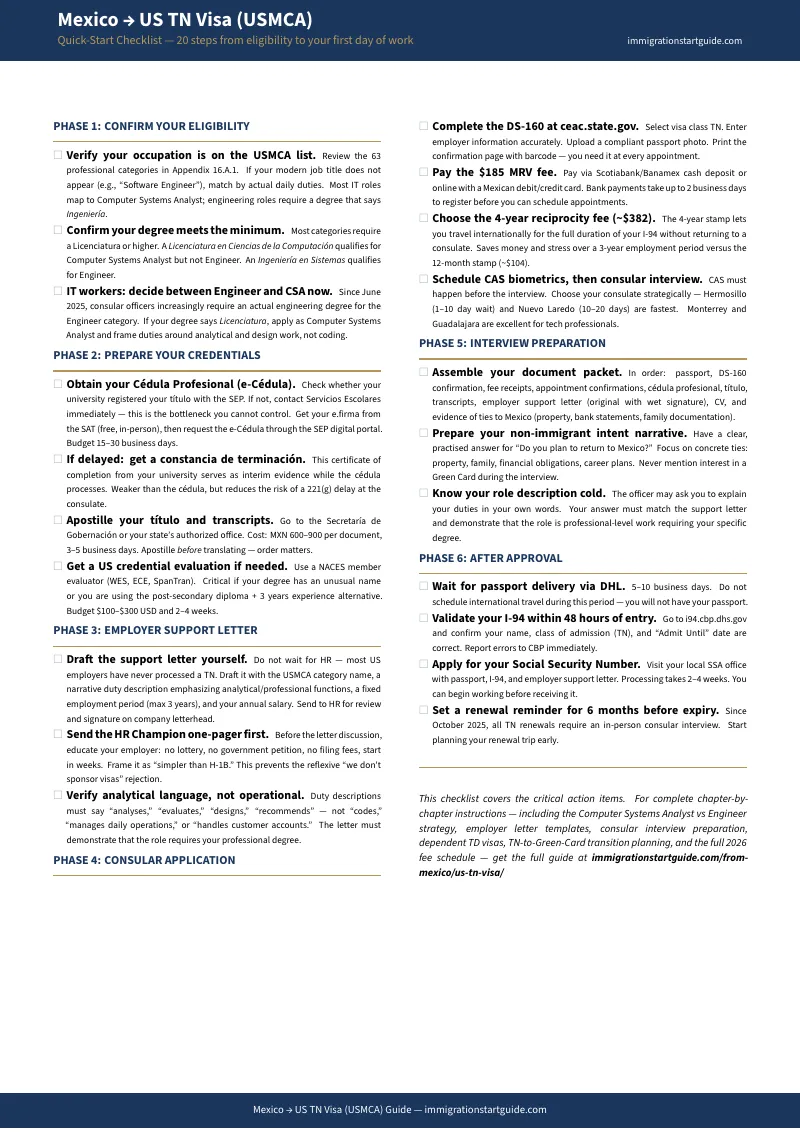
Quick-Start Checklist (free download)
The critical steps distilled into a single action sheet organized by phase: USMCA category verification, cédula profesional status check, employer support letter initiation, consular appointment scheduling, document assembly, and interview preparation. Enough to confirm your USMCA eligibility tonight and identify whether the cédula or the category classification is your primary obstacle.
Who This Guide Is For
This guide is for Mexican professionals applying for TN visa status at a US consulate:
- IT professionals — software developers, data engineers, systems architects — whose job title says "Software Engineer" but whose Licenciatura is in Ciencias de la Computación, Informática, or Sistemas Computacionales. You need the CSA vs Engineer category decision tool, the duty-reframing language for your support letter, and the degree-to-category mapping that prevents a denial based on a nomenclature mismatch that has nothing to do with your qualifications.
- Engineers with an Ingeniería degree who qualify under the Engineer category but need the correct duty description language to distinguish their role from a pure coding position, especially after the June 2025 policy tightening.
- Accountants, economists, and scientists whose Mexican cédula profesional maps directly to a USMCA category but who need the consular interview preparation, the support letter templates, and the timeline planner to coordinate their employer, the SEP, and the consulate within a tight start-date window.
- Professionals whose cédula profesional is still in trámite — you need the título en trámite strategy, the supplementary documentation approach, and the expedited processing path through the DGP digital system.
- Current TN holders applying for renewal — whether at the consulate or domestically via USCIS Form I-129 — who need the renewal comparison framework, the employer letter update strategy, and the Green Card transition timing.
- US HR managers and hiring managers who have extended an offer to a Mexican professional and need to understand what the TN visa requires from the employer's side — the HR Champion One-Pager is written for you.
This guide is not for: Canadian citizens applying for TN status at the border (you do not need a visa — see the US TN Visa (USMCA) Guide for the general pathway), applicants who do not have a job offer from a US employer (the TN visa requires one), or applicants seeking H-1B, L-1, or other non-USMCA work visas (see the relevant visa-specific guides).
Why Not Free Resources?
Free information about the TN visa is everywhere. Here is what it actually delivers for Mexican applicants:
- The USCIS and State Department websites list the requirements: USMCA profession, degree, job offer, consular interview. They do not explain the cédula profesional pipeline, the CSA vs Engineer category trap for IT professionals, or the título en trámite workaround. The government tells you what to submit. It does not tell you how to get a Mexican administrative system to produce those documents on a timeline that matches your start date.
- Reddit and Facebook groups are dominated by Canadian applicants who walk up to the border and get approved in 20 minutes. When a Mexican applicant asks a question, the answers assume the Canadian process. "Just bring your degree and the offer letter to the border" — advice that will get you turned away because Mexican citizens require a visa stamp. The Mexico-specific threads exist, but they are buried, contradictory, and months out of date on the June 2025 policy shift that changed the Engineer category eligibility.
- Immigration attorney websites provide excellent overviews of TN visa law — written for attorneys, not for the Mexican professional who needs to coordinate their cédula, their employer's support letter, and a consulate appointment within a six-week window. The information is accurate. The actionable steps are missing.
- Immigration attorneys themselves charge $1,000 to $5,000 for TN visa representation. This is money you do not yet have — your US salary has not started. And for most TN applications, the attorney handles the support letter and the filing. The hardest parts — getting the cédula on time, choosing the right USMCA category, preparing for the consular interview — are still on you.
This guide fills the gap between "I have a job offer from a US company" and "I have a TN visa stamp in my passport" — the space where qualified Mexican professionals still fail because they applied under the wrong USMCA category, their support letter described coding duties for a CSA application, their cédula was not ready and the consulate issued a 221(g), or they followed Canadian advice and showed up at the border without a visa.
— Less Than 3% of the Cheapest Immigration Attorney's Fee
An immigration attorney charges $1,000 to $5,000 for TN visa representation. The MRV fee alone is $185 — non-refundable whether you are approved or denied. A denial does not just cost you the fee. It costs you the job offer, because your employer is not going to hold the position open while you reapply with a corrected support letter, wait for a new consulate appointment, and hope the officer does not see the previous denial in the system. For IT professionals, one wrong word in the duty description — "develops software" instead of "analyzes and designs information systems" — is the difference between a visa stamp and a 214(b) denial. For professionals with a cédula in trámite, the difference between having the right supplementary documentation and not having it is the difference between an approval and a 221(g) that delays your entry by months.
This guide costs less than the reciprocity fee for a 12-month visa stamp and covers every step, every document, every Mexican-specific obstacle, and every category decision between your job offer and your first day at the US office. The CSA vs Engineer decision tool alone can save an IT professional their entire job offer. The HR Champion One-Pager can convert a reluctant employer into someone who actively supports the process. The consular interview simulation can prevent a denial that would follow you to every future visa application.
You have the degree. You have the job offer. You have the professional skills that a US company specifically chose to hire. What stands between you and that role is not qualification — it is the gap between the Mexican credential system you navigated and the US consular process that will evaluate you. The cédula pipeline. The USMCA category. The support letter language. The interview answers. Every one of these is solvable. Every one of them, if solved wrong, costs you the offer.
Money-back guarantee, no time limit. If the cédula profesional pipeline, the CSA vs Engineer category decision tool, the employer support letter templates, and the consular interview simulation do not make your TN application stronger than anything you could assemble from Reddit threads, Facebook groups, and Canadian-focused guides, you pay nothing.
Download the free Quick-Start Checklist to confirm your USMCA category eligibility, check your cédula profesional status, and identify the critical path items between your job offer and your consulate appointment. When you are ready for the complete Mexican TN Playbook — the full guide with the category decision tool, the employer templates, the interview simulation, and the Green Card transition roadmap — the full guide is here.
Your start date is set. Your employer is waiting. The consulate appointment calendar is filling up. Every week you spend piecing together advice from Canadian-focused forums is a week closer to the date your offer expires. Start with the process built for Mexican professionals — the one that accounts for the cédula, the consulate, and the category trap that no one else is talking about.