
Your Employer Just Handed You a Blank Letter. What You Write Next Decides Whether You Enter the US or Drive Back Across the Bridge.
You got the offer. $150,000 base, a team you're excited about, a start date in three weeks. The recruiter said TN status is "way simpler than H-1B — just show up at the border with a letter." So your employer's HR person sends you a template: "Can you draft something for us to sign?"
You open a blank document. You type "Software Engineer" and immediately realize that's not on the USMCA professions list. You search Reddit. One person says apply as "Computer Systems Analyst." Another says that only works if 80% of your duties are analysis, not coding — otherwise it's a denial. A third person says their CS degree got rejected for the Engineer category because the officer demanded "Engineering" in the degree title. It's 1 AM, you have conflicting advice from anonymous strangers, and a six-figure career starts in 19 days.
Here's the reality: the TN visa process takes 30 minutes at the border — if your letter is perfect. There is no lottery, no USCIS petition (for Canadians), no months of waiting. But the 63 professions on the USMCA list were written in 1994 and have never been updated. "Data Scientist" is not a listed profession. "UX Designer" is not a listed profession. "Product Manager" is not a listed profession. Every modern professional must translate their actual work into regulatory language that a CBP officer, trained on 30-year-old definitions, will recognize and approve in a 5-minute review.
The US TN Visa (USMCA) Guide is a Profession Mapping and Border Strategy System. Not a textbook explaining what the TN is — a structured workflow that maps your real job to the right USMCA category, produces an employer letter that satisfies 8 CFR 214.6, and prepares you for the exact questions the officer will ask. Updated for the June 2025 USCIS Policy Manual changes (PA-2025-05) that narrowed several profession definitions and tightened degree requirements.
What's Inside the Profession Mapping System
The complete guide, 5 standalone printable tools, and an 18-step quick-start checklist — everything from profession selection through border interview to green card transition:
The 63-Profession Eligibility Analysis
Every USMCA profession with its minimum education requirements, alternative credentials, and the current adjudication environment. Not just a list copied from the USCIS website — a decision framework that tells you which category matches your degree, your actual duties, and the post-June 2025 standards that officers are now applying.
The Duty-Mapping Framework for High-Scrutiny Categories
Computer Systems Analyst, Engineer, and Management Consultant account for the overwhelming majority of denials. For each, the guide provides "winning duties" and "losing duties" based on actual 2025 adjudication patterns, the 80/20 rule for letter construction, and the specific traps that trigger denials — like describing coding tasks in a CSA letter, holding a CS degree in the Engineer category, or structuring a Management Consultant role with W-2 benefits instead of project-based compensation.
The Employer Support Letter Blueprint
The TN support letter is not an offer letter. It is a legal memorandum that must satisfy five specific regulatory requirements under 8 CFR 214.6. The guide provides the structural blueprint, the required elements, and the common drafting errors that cause denials — vague duty descriptions, management-heavy language, inconsistent job titles, missing salary figures. Your employer's HR department probably has never seen a TN letter before. This chapter gives them exactly what to write.
Canadian Port-of-Entry Strategy with Tactical Site Selection
Where you apply matters. The Detroit-Windsor Tunnel handles tech and engineering roles more consistently than some East Coast bridges. Airport pre-clearance at Pearson or Vancouver gives you the ability to withdraw if a denial looms — without a border crossing on your record. The guide maps the major ports by profession type, volume patterns, and the strategic advantage of each location for your specific category.
Mexican Consular Process — DS-160 Through Visa Stamp
The step-by-step workflow for Mexican nationals: DS-160 filing, biometrics at the Applicant Service Center, the consular interview, Cedula Profesional documentation, and the post-June 2025 consistency requirements that trigger Section 221(g) administrative processing holds when any detail mismatches between forms, the letter, and your verbal responses.
Credential Evaluation Guidance
When you need an evaluation, which NACES/AICE agencies CBP officers accept, how to handle degrees from outside North America, the conferral-versus-ceremony distinction for recent graduates, and the transcript analysis technique for degrees whose title does not match the TN profession. Processing times, costs, and the difference between document-by-document and course-by-course evaluations.
Renewal Strategy and the Accumulating Scrutiny Pattern
The three renewal pathways (border, I-129, consular), the 240-day continued employment rule, employer changes and concurrent TNs, and the critical decision: when to renew at the border versus filing an I-129 petition to avoid a face-to-face denial. Each renewal after the second increases the officer's reason to question whether your stay is truly temporary.
The TN-to-Green Card Transition Strategy
The TN does not allow dual intent — which means openly pursuing a green card can get your TN denied. The guide covers the PERM-to-I-140-to-I-485 sequence, the 90-day rule for avoiding preconceived intent findings, the TN-to-H-1B bridge strategy for safe green card pursuit, and how to manage international travel during the transition without triggering a denial at re-entry.
Border Interview Preparation and Denial Recovery Protocol
What CBP officers evaluate in the 5-minute interview, the plain-language responses that satisfy each criterion, how to request a withdrawal before a formal denial hits your record, and the re-filing strategy when a denial has already occurred — including how to address specific deficiency findings in your second attempt.
Quick-Start Checklist (free download)
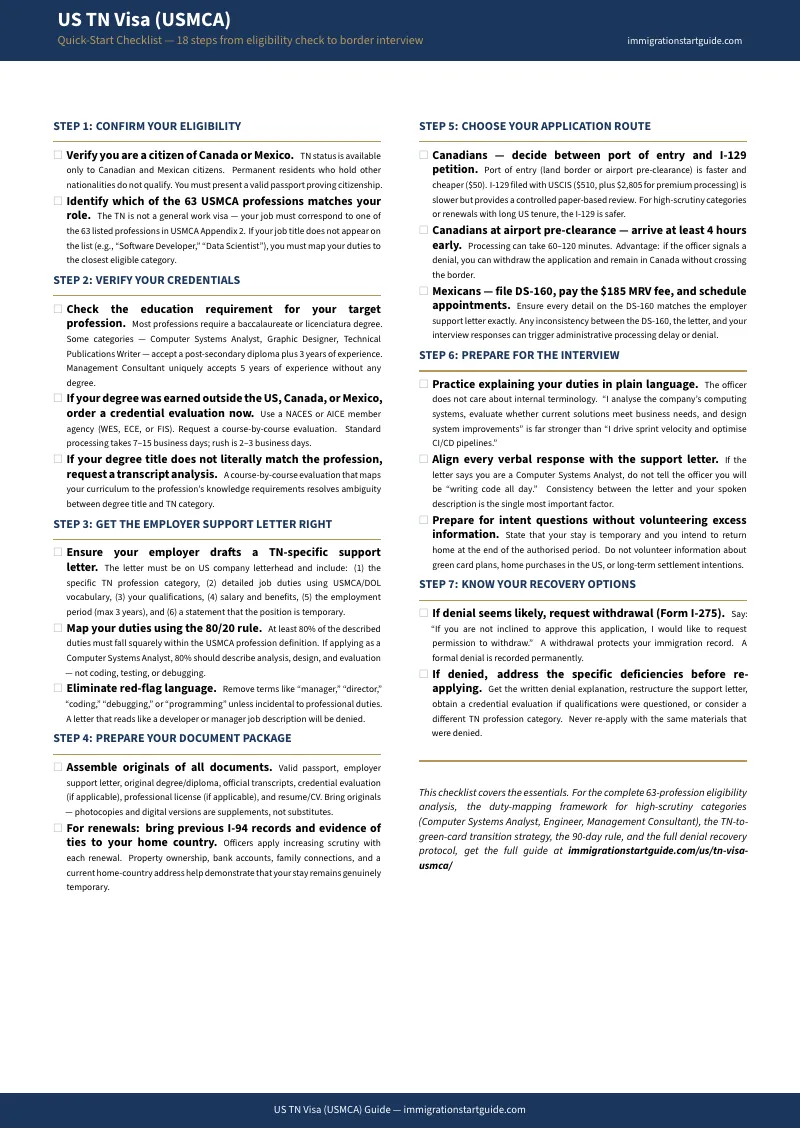
An 18-step action plan covering the critical decision points: eligibility confirmation, credential verification, support letter drafting, document assembly, route selection, interview preparation, and recovery options. Enough to start tonight.
5 Standalone Printable Tools
Print them, bring them to the border, hand them to HR. A document checklist for your appointment, the employer support letter blueprint with all five 8 CFR 214.6 requirements, an interview preparation card with the withdrawal protocol script, a fees and costs reference with total cost scenarios for all three routes, and a 63-profession quick reference with education requirements and high-scrutiny category warnings.
Who This Guide Is For
This guide is for Canadian and Mexican professionals with a US job offer who:
- Have a start date in weeks, not months, and need to understand the TN process from zero — what to prepare, where to apply, and what happens at the border or consulate
- Work in tech, engineering, or consulting and need to map a modern job title (Software Developer, Data Scientist, Product Manager) to one of the 63 USMCA professions without triggering a denial
- Are drafting the employer support letter themselves because HR has never sponsored a TN worker and asked them to "put something together for us to sign"
- Have been denied at the border or consulate and need a structured recovery strategy — not another Reddit thread saying "just try again at a different bridge"
- Are on their third or fourth renewal and worried that a CBP officer will question their temporary intent after years of US residence
- Want to understand the TN-to-green card transition without jeopardizing their current status — the 90-day rule, the H-1B bridge, and the I-140 timing
Why Not Free Resources?
Free information about the TN visa exists everywhere. Government websites, law firm blogs, Reddit threads, immigration forums — all free, all abundant. Here's what they actually deliver:
- USCIS.gov lists the 63 professions and the filing requirements. It will never tell you that applying as an Engineer with a Computer Science degree is now getting denied at multiple land ports, or that the 80/20 duty split is the difference between a CSA approval and a CSA denial. You get regulations, not strategy.
- Reddit (r/tnvisa) is where someone says "my friend got in as a Software Developer" — without mentioning their friend applied in 2022 under pre-PA-2025-05 standards that no longer exist. You're getting anecdotes from people with different degrees, different ports, and different officers, filtered through survivorship bias. The person who got denied doesn't post.
- Law firm blogs explain the TN requirements in careful, comprehensive detail — because their business model is to demonstrate enough complexity to justify a $1,500 to $5,000 consultation fee. They will never publish the specific duty-mapping framework that makes their letter-drafting service unnecessary.
- Amazon books on TN visas still reference NAFTA terminology and pre-2025 adjudication patterns. None incorporate the June 2025 Policy Manual changes that narrowed profession definitions and tightened degree requirements. Immigration law moves faster than the publishing cycle.
This guide fills the strategy gap — the space between "I know the TN exists" and "I can walk into secondary inspection with a letter that gets approved in 30 minutes." It gives you the profession-mapping logic, the letter construction framework, and the interview preparation that immigration attorneys build into $3,000 engagements.
— Less Than the I-94 Filing Fee
A mid-tier immigration attorney charges $1,500 to $5,000 for a standard TN application. A border denial costs you a missed start date, a rescinded offer, and a permanent entry in the CBP system that follows every future application. A credential evaluation alone runs $150 to $260.
This guide doesn't replace an attorney for complex cases involving prior denials, criminal history, or corporate restructuring. But for the straightforward professional who needs to get the letter right, choose the right profession category, and walk through the interview without contradicting their own documentation — it replaces the 40 hours of forum research and the $3,000 attorney engagement with a single afternoon of focused preparation.
Money-back guarantee, no time limit. If the profession-mapping framework and letter blueprint don't make your application stronger, you pay nothing.
Download the free Quick-Start Checklist to see the 18-step action plan. When you're ready for the duty-mapping framework, the employer letter blueprint, and the complete border strategy, the full guide is here.
The TN takes 30 minutes at the border. The letter you bring decides the outcome.