
Your Fiancé Is on the Other Side of the World, USCIS Processing Just Hit 10 Months, and the Attorney Wants $4,500 to Fill Out the Same Forms You Can Download for Free
You got engaged. You thought that was the difficult part. Then you downloaded the 13-page Form I-129F and discovered that bringing your fiancé to the United States requires a $675 USCIS filing fee, a $265 consular processing fee, a medical examination, police clearance certificates from every country your fiancé has lived in, proof that you've met in person within the past two years documented with flight records and passport stamps, a financial declaration proving you can support them, a consular interview where they'll be questioned alone about the specifics of your relationship, a 90-day window to get married after arrival with no extensions, and then a $2,330 Adjustment of Status filing to even begin the green card process.
You called an immigration attorney. The quote: $3,500 to $4,500 — on top of the government fees. You searched Reddit instead. One thread says to submit 600 pages of WhatsApp screenshots. The next says more than 50 pages looks desperate. A third thread from 2019 recommends a form that's been obsolete since 2023. At 2 AM you're deeper into VisaJourney than you've ever been, and every new thread makes you more anxious, not less.
Here's the reality: the K-1 fiancé visa process is not conceptually difficult. It is a sequence of petitions, evidence, and deadlines spread across USCIS, the National Visa Center, and a foreign consulate. But USCIS instructions tell you what to file without telling you how to build a case that survives sceptical adjudicators. Free forums mix 2016 advice with 2026 rules. And YouTube attorneys explain just enough complexity to justify their retainer — without ever handing you an actual filing strategy.
The US K-1 Fiancé Visa Guide is a Reunion Filing System — not a textbook explaining immigration law, but a structured process that produces the exact petition package, consular interview preparation, and post-arrival filing strategy that gets your fiancé from the other side of the world to your front door. It replaces 40 hours of panicked forum-scrolling with one linear roadmap you can follow from the I-129F petition through Adjustment of Status and conditional green card.
What's Inside the Reunion Filing System
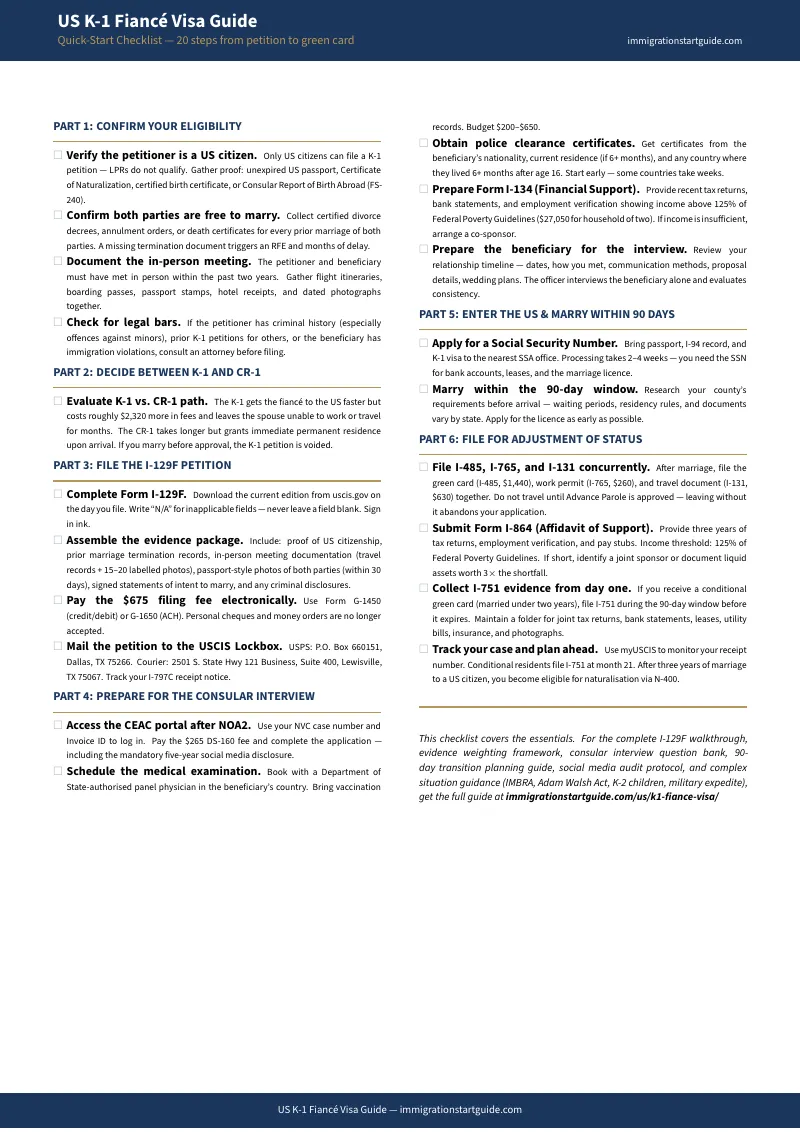
The complete 12-chapter guide and a Quick-Start Checklist — covering the full K-1 lifecycle from initial eligibility through green card, with every 2026 fee schedule, form edition, and regulatory citation current as of May 2026:
The K-1 vs CR-1 Decision Framework
The most expensive mistake in the fiancé visa process happens before you fill out a single form. The K-1 gets your fiancé to the US 5–6 months faster — but costs $2,320 more in government fees and leaves them unable to work or travel for months after arrival. The CR-1 spousal visa takes longer but grants immediate permanent residence and work authorisation the day they land. The guide provides a structured decision tree — not a vague list of pros and cons — that produces one definitive answer based on your financial situation, your timeline pressure, and whether your fiancé needs to work immediately. If you choose the K-1 and then marry before the visa is approved, the petition is voided and you start over. Getting this decision wrong costs you a year.
Line-by-Line I-129F Petition Walkthrough
Form I-129F is the petition that starts the entire process. The guide walks through every field — the most common Lockbox rejection triggers, why leaving a blank field instead of writing "N/A" gets your packet returned without review, the difference between the G-1450 and G-1650 payment forms, and the complete evidence package: proof of citizenship, proof all prior marriages are terminated, the in-person meeting documentation that satisfies sceptical adjudicators, and the IMBRA disclosures. Because a Lockbox rejection for a wrong form edition pushes your timeline back by weeks before an officer even looks at your case.
In-Person Meeting Evidence Strategy
The mandatory requirement that trips up more petitioners than any other: proving you've met your fiancé face-to-face within the past two years. The guide explains the internal consistency standard — your passport stamps must match your flight dates, your hotel receipts must cover the same period, your photos must show recognisable locations. It covers how many photos to include (15–20, labelled with dates), how to document an online relationship that started on a dating platform without triggering fraud flags, how to handle culturally arranged marriages where pre-marital contact was minimal, and the extreme hardship waiver for petitioners who genuinely cannot travel. This is the evidence gap every free resource ignores: USCIS demands proof but never tells you what a convincing package actually looks like.
Consular Interview Preparation
The beneficiary attends the consular interview alone — without the petitioner. The officer will ask specific questions about how you met, how often you communicate, what the petitioner does for a living, the names of the petitioner's parents, the details of the proposal, and your wedding plans. Vague answers raise suspicion. The guide provides the exact question categories, the medical examination requirements and vaccination list, the I-134 financial declaration with income thresholds, police clearance certificate requirements by country, and what the colour-coded refusal slips actually mean. A blue slip is a missing document you can fix in days. A white slip is a security clearance that can delay your case by months. Knowing the difference prevents panic.
The 90-Day Marriage Window and Post-Arrival Survival Guide
Your fiancé arrives and the 90-day countdown begins. No extensions. No exceptions. They cannot work. They cannot leave the country. They need a Social Security Number to open a bank account, but processing takes 2–4 weeks. State marriage licence requirements vary — some states have waiting periods, some require residency, and you need to research your county before they arrive. The guide covers the SSN logistics, state-by-state marriage licence considerations, how to plan a wedding around a visa approval date that's impossible to predict, and the emotional transition strategies that prevent the stress of compressed bureaucratic deadlines from overwhelming a brand-new life together.
Complete Adjustment of Status Filing Strategy
After the wedding, the fiancé must file Forms I-485 (green card, $1,440), I-765 (work permit, $260), and I-131 (travel document, $630) concurrently — a $2,330 filing on top of everything already spent. The guide covers the I-864 Affidavit of Support (which is now legally binding and remains in force until the immigrant becomes a citizen), the income threshold calculations, joint sponsor requirements, and the evidence strategy that shifts from romantic proof to financial and domestic commingling. It explains conditional residence, the I-751 removal process, and why you should start collecting I-751 evidence from the day your green card arrives — not 21 months later when the filing window opens.
2026 Social Media Vetting Compliance
As of March 2026, all K-1 applicants must disclose every social media platform used in the past five years on Form DS-160. Failure to disclose — including inactive accounts — constitutes a misrepresentation that can result in denial and permanent inadmissibility. The guide covers exactly what to list, how to handle accounts you forgot about, what consular officers actually look for in your social media history, and why deleting your accounts before the interview creates more suspicion than whatever you're trying to hide.
Complex Situations Chapter
IMBRA limitations on repeat petitioners, the Adam Walsh Act criminal bar, K-2 derivative visas for the beneficiary's children and the CSPA aging-out trap, military expedite protocols with the dedicated USCIS Military Help Line, applicants from high-scrutiny countries facing enhanced vetting, unlawful presence bars and the I-601 waiver, and VAWA protections. The guide identifies the exact scenarios where you should stop and hire a specialist — so you never fly blind in a case that genuinely requires legal representation, and never pay $4,500 for a case that doesn't.
Quick-Start Checklist (free download)
A 20-item action plan covering the essentials: confirm eligibility, evaluate K-1 vs CR-1, assemble the I-129F evidence package, prepare for the consular interview, execute the 90-day marriage window, and file for Adjustment of Status. Enough to start tonight — and enough to see whether the structured approach makes the process feel manageable for the first time.
7 Standalone Printable Tools
Every stage of the K-1 process has its own standalone PDF you can print and use independently — an I-129F Petition Checklist for assembling your filing package, a Meeting Evidence Checklist for organising your travel records and photos, a Consular Interview Prep sheet with question categories and document requirements, a Social Media Audit Worksheet for DS-160 compliance, a 90-Day Arrival Checklist for the marriage window logistics, an AOS Filing Checklist for the post-marriage Adjustment of Status, and a Cost Breakdown Reference card for tracking government fees across the full lifecycle. Nine PDFs total — not a textbook you read and shelve, but a toolkit you use at every milestone.
Who This Guide Is For
This guide is for US citizens bringing a foreign fiancé to the United States who:
- Just got engaged to someone in another country and are staring at the I-129F form instructions wondering how a 13-page government form requires a year of documentation they've never heard of — and whether they can actually do this without a lawyer
- Met their fiancé online through a dating platform and are anxious about how USCIS will evaluate the legitimacy of a relationship that started digitally — especially with the new social media screening requirements
- Consulted an immigration attorney, were quoted $3,500–$4,500 for a straightforward case with no criminal history, no prior deportations, and no IMBRA complications, and want the same level of strategic guidance without the four-figure fee
- Are already past petition approval and approaching the consular interview — the beneficiary will be questioned alone, and the VisaJourney horror stories about denied visas and 221(g) administrative processing holds are making the anxiety worse, not better
- Need to understand what happens after the fiancé arrives — the 90-day marriage requirement, the SSN logistics, the state marriage licence maze, and the $2,330 Adjustment of Status filing that most guides and templates completely ignore
- Have a complicated factor — a significant age gap, a previous K-1 petition, a fiancé from a high-scrutiny country, K-2 children approaching the CSPA age threshold, or a military deployment timeline — and need to know whether their case requires an attorney or whether the guide covers it
Why Not Free Resources?
Free information exists. Government pages, law firm blogs, immigration forums, YouTube attorneys — all free, all abundant. Here's what they actually deliver:
- USCIS.gov provides every form and its instruction booklet. It tells you to submit "evidence of a bona fide relationship" without ever specifying how many photos are enough, how to present WhatsApp logs spanning a two-year international relationship, or what evidence pattern triggers Requests for Evidence. You get forms, not strategy.
- VisaJourney and Reddit are invaluable for emotional support and processing time data. But a filing strategy that worked for a couple who met while studying abroad is fundamentally different from one involving an online relationship, a cultural arrangement, or a fiancé from a high-fraud post. You're building your case from contradictory anecdotes posted by strangers at 3 AM — and every new horror story about a denied visa or a months-long 221(g) hold makes you more anxious, not more prepared.
- YouTube immigration attorneys produce excellent, specific content about K-1 denial risks and interview pitfalls. Their business model is to demonstrate the terrifying complexity of your situation and then offer a $3,500+ consultation to resolve it. They explain why you need a lawyer. They never hand you the filing templates or evidence frameworks.
- RapidVisa and Boundless charge $700 for software that translates USCIS forms into questionnaires with an attorney review — and that's only for the I-129F petition phase. The Adjustment of Status after marriage is a separate service, a separate fee, and a separate anxiety spiral. All solid platforms, but the combined cost approaches $1,500 before you've paid a single government fee.
- Etsy templates ($8–$110) help you organise photos and chat logs into a neat evidence binder. They don't teach you how to fill out the I-129F, how to prepare for the consular interview, how to navigate the 90-day marriage window, or how to file for Adjustment of Status. They organise your evidence without telling you which evidence actually matters.
This guide fills the execution gap — the space between "I understand what forms to file" and "I can build a petition strategy, prepare for the consular interview, execute a 90-day marriage under bureaucratic pressure, and file for Adjustment of Status without an attorney." The same structured approach an experienced immigration paralegal would use internally, at a fraction of the cost of a single consultation hour.
— Less Than the Consular Medical Exam
The overseas medical examination alone costs $200–$650 depending on the country. An immigration attorney charges $3,500–$4,500 for the full K-1 lifecycle. The cumulative government fees from I-129F through Adjustment of Status total $3,270. A single error on the I-129F or a missing document triggers a Request for Evidence that adds 3–6 months of separation — another season of video calls, missed holidays, and a life stuck on hold.
This guide doesn't replace an attorney for cases involving the Adam Walsh Act, unlawful presence waivers, IMBRA complications, or prior deportations. But for the majority of K-1 cases that are procedurally straightforward, it provides the same strategic structure — at a cost lower than the medical exam your fiancé is already required to pay.
Money-back guarantee, no time limit. If the Reunion Filing System doesn't make your application stronger, you pay nothing.
Download the free Quick-Start Checklist to see the 20-point action plan. When you're ready for the complete I-129F walkthrough, consular interview preparation, 90-day survival guide, social media compliance protocol, and full Adjustment of Status filing strategy, the guide is here.
You found the person you want to spend your life with. Now build the case that brings them home.