
You Waited Years for Your Priority Date. The I-485 Filing Is Where a Single Strategic Mistake Can Erase All of It
You tracked the Visa Bulletin every month. You maintained status through employer changes, visa renewals, and administration shifts. Your priority date finally became current — or your spouse filed the I-130 and you're ready to adjust. Either way, the I-485 is the last step between you and your green card. It is also the step where the most applications fail.
Not because the form is hard. Because the strategy behind the form is invisible. The USCIS instructions for the I-485 are 40+ pages of cross-referenced legal jargon that explain the "what" without touching the "why." Reddit has 1,000 opinions on every question — most of them specific to someone else's service center, priority date, and filing category. Your employer's corporate attorney files the forms correctly but won't advise on whether to travel on Advance Parole or your H-1B stamp, won't help you evaluate AC21 portability when a competitor offers a 40 percent raise, and won't explain the marijuana trap before your medical exam.
Platforms like SimpleCitizen ($599–$1,299) and Boundless ($649–$1,500) offer guided form assembly — "TurboTax for immigration." But user reviews tell a consistent story: non-lawyer customer service agents who misinterpret inadmissibility rules, generic answers to complex questions, and clerical errors that trigger Requests for Evidence. They fill the boxes. They don't teach you the strategy behind each box.
Meanwhile, the financial stakes have never been higher. USCIS filing fees alone exceed $2,500 per person after the 2024 "unbundling" — EAD and Advance Parole are no longer included. A family of four faces $10,000+ in government fees before medical exams and attorney costs. A denial means re-filing fees, another 12 to 18 months of waiting, and — if you traveled on Advance Parole instead of maintaining your H-1B — no fallback status to keep you in the country.
The US I-485 Adjustment of Status Guide is an Adjudication Strategy System — not a form-filling manual, but the complete decision framework that covers every category, every filing trap, and every strategic choice between "I-485 received" and "card is being produced." It replaces the hundred hours of Reddit scrolling, the contradictory forum advice, and the corporate attorney's refusal to discuss your personal strategic decisions with one structured resource built for the applicant who needs to get this right the first time.
What's Inside the Adjudication Strategy System
A 12-chapter strategic guide, a 20-step Quick-Start Checklist, and 8 standalone printable tools — with every 2026 fee schedule, processing time, regulatory citation, and policy change current as of May 2026:
Eligibility Analysis and the Adjust-vs-Consular Decision
The three simultaneous requirements for adjustment (inspection/admission, visa availability, immigrant visa eligibility), who qualifies under each family and employment category, the INA §245(i) grandfather provision for applicants who entered without inspection, and the strategic comparison of adjustment versus consular processing based on your risk profile, timeline, and ability to remain in the US. Most applicants make this choice based on a blog post. The guide gives you the decision matrix that maps your specific situation to the path with the highest probability of approval.
Visa Bulletin Mastery
How the two-chart system works (Dates for Filing vs Final Action Dates), how USCIS decides each month which chart applies, how priority dates are established and retained across petitions, and how to identify narrow filing windows before they close. The Visa Bulletin is published on the 15th of every month. The guide teaches you how to read it like an adjudicator — not just checking whether your date is current, but understanding the implications of retrogression on pending filings and the timing calculations that determine whether concurrent filing is available to you.
Medical Examination Strategy (Form I-693)
The I-693 must now be submitted with your I-485 filing — no more "wait and see." The guide covers the civil surgeon process, current CDC vaccination requirements (including the Hepatitis B mandate for adults 18-59 and the multi-dose vaccine series that can delay your entire filing by 28+ days if you don't plan ahead), the Class A versus Class B condition distinction, and the marijuana disclosure trap. Under federal law, marijuana remains a Schedule I controlled substance regardless of state legalization. An admission of recreational use to your civil surgeon — even casual use in California or Colorado — can trigger a permanent inadmissibility bar under INA §212(a)(2). No conviction required. No waiver available unless it was a single possession of 30 grams or less. This section alone has saved applicants from a mistake they cannot undo.
AC21 Job Portability and Duty Mapping
Employment-based applicants can change employers after 180 days — but the definition of "same or similar" occupation is not a simple SOC code match. USCIS evaluates the "totality of circumstances": detailed job duties, required skills, education requirements, and salary levels. The guide provides the O*NET-based duty mapping method that demonstrates overlap through the "preponderance of evidence" standard, the Supplement J preparation instructions, managerial progression and promotion scenarios, and the portability timing analysis. Knowing when to move is worth a $20,000–$50,000 salary increase at a new employer. Knowing how to document the move is the difference between approval and a Notice of Intent to Deny.
Status Maintenance and the Travel Decision Tree
The critical difference between "authorized stay" and "lawful status" while the I-485 is pending. For H-1B and L-1 holders: traveling on Advance Parole changes your status to "parolee" upon re-entry. If the I-485 is later denied, a parolee is immediately deportable with no fallback. Re-entering on a valid H-1B visa stamp preserves your H-1B status as a safety net. The guide includes the Hybrid Maintenance Strategy — how to keep the H-1B active while simultaneously utilizing I-485 benefits — and the travel decision tree that maps your visa status, risk profile, and family situation to the safest re-entry method.
India and China Backlog Management
The EB-2/EB-3 downgrade strategy and inter-filing mechanics for applicants from backlogged countries. Cross-chargeability options if your spouse was born in a non-backlogged country. The Child Status Protection Act formula and the August 2025 policy change that restricts which Visa Bulletin chart can lock in a child's age — a change that caught families off guard and can mean the difference between your child receiving a green card and being forced to find their own visa status. And mandamus litigation for cases stuck beyond reasonable processing times.
Interview Preparation
What to expect at family-based interviews, how officers evaluate marriage bona fides, the Stokes Interview protocol for suspected fraud cases, and the standard officer questions with the framing that prevents misunderstandings. For employment-based applicants: how to determine whether your interview will be waived under current USCIS policy and what to prepare if it isn't.
RFE and NOID Response Framework
Common triggers for Requests for Evidence and Notices of Intent to Deny, the 87-day response deadline, the structured response format that converts a deficiency notice into an approval, and the appeal and motion-to-reopen options if your case is denied. An RFE adds 87 days to a process that already takes 10 to 18 months. The guide teaches you how to file a package that doesn't trigger one.
8 Standalone Printable Tools
Print-and-use tools extracted from the guide: a Document Assembly Checklist (every form and supporting document by category), a Medical Exam Preparation Sheet (vaccination table, marijuana disclosure warning — bring to your civil surgeon appointment), an Interview Preparation Sheet (evidence tiers, Stokes Interview questions, what-to-bring checklist), a Travel Decision Tree (Advance Parole vs visa stamp flowchart for H-1B holders), an AC21 Duty Mapping Worksheet (side-by-side duty comparison, SOC code reference, 180-day calculator), a Fee Calculator (2026 fee tables with personal cost worksheet), an RFE Response Checklist (87-day deadline tracker, five-step response framework), and an Employer EAD Letter (one-page auto-extension reference for your HR department citing 8 CFR §274a.13(d)).
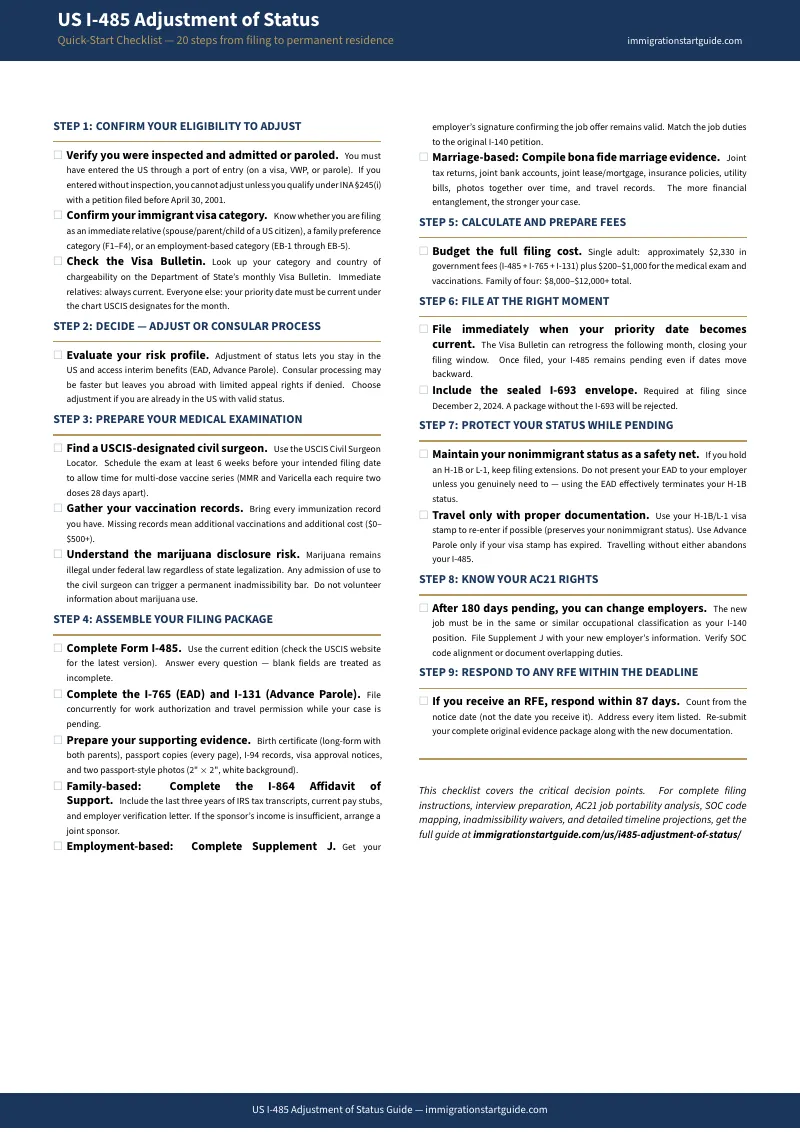
20-Step Quick-Start Checklist (free download)
The complete action sequence from eligibility verification through Visa Bulletin monitoring, civil surgeon scheduling, document assembly, fee calculation, filing, interview preparation, and post-approval next steps. Twenty steps. One linear path from "should I file?" to "card is being produced." Enough to start tonight — and enough to see whether the structured approach replaces the anxiety with a sequence you can actually follow.
Who This Guide Is For
This guide is for anyone filing Form I-485 to adjust status to permanent resident from inside the United States who:
- Has a priority date that just became current after years of waiting — and needs to file a complete, error-free package before the dates retrogress, because an RFE adds 87 days to a process that already takes 10 to 18 months and re-filing costs $1,440 in government fees alone
- Has a corporate law firm filing the I-140 but doesn't trust them to handle the I-485 strategically — they file forms, they don't advise on whether to travel on Advance Parole versus your H-1B stamp, don't help you evaluate AC21 portability, and don't explain the medical exam traps
- Is a family-based filer preparing for the I-485 interview — needs to compile a bona fide marriage evidence package that survives officer scrutiny, understand the Stokes Interview protocol, and know exactly what officers evaluate when they ask about your relationship
- Is considering changing jobs with an I-485 pending — AC21 says you can switch after 180 days, but "same or similar" occupation is not a simple SOC code match, and moving at day 175 instead of day 181 can collapse the entire green card process
- Has children who may age out before the I-485 is adjudicated — needs the exact CSPA formula, understands the August 2025 policy change on Chart A vs Chart B, and needs the planning strategies to prevent derivative eligibility from being lost
- Is filing without an attorney and needs the complete strategic framework — not 40 pages of USCIS legal jargon, not 100 Reddit threads, not a law firm blog that explains the problem at exactly the depth needed to sell a retainer
Why Not Free Resources?
Free information on the I-485 is abundant. Here's what it actually delivers:
- USCIS.gov publishes the forms, instructions, and Policy Manual (Volume 7, thousands of pages). It tells you what to file. It does not tell you when to file relative to the Visa Bulletin, which chart to use for CSPA age calculations, how to handle the medical exam disclosure risks, or how to map job duties for AC21 portability. You get the procedural requirements. You don't get the strategic framework.
- Reddit and VisaJourney provide real-time processing times, interview experiences, and timeline trackers. They also provide 1,000 different opinions on every topic — most of them specific to a different service center, filing category, and priority date than yours. An EB-2 India filer at the Texas Service Center faces an entirely different processing reality than a marriage-based filer at the NBC. Forum advice based on someone else's case is not a strategy.
- SimpleCitizen and Boundless offer guided form assembly with limited attorney review for $599–$1,500. User reviews consistently report non-lawyer customer service agents giving incorrect guidance on complex questions, clerical errors that trigger RFEs, and generic advice on admissibility issues that require case-specific analysis. They automate the 5% of the I-485 that is form-filling. The other 95% — the evidence strategy, the medical disclosures, the duty mapping, the status maintenance decisions — they don't touch.
- Immigration attorneys charge $3,000–$8,000 for a standard adjustment package — on top of $2,500+ in government fees. Some firms provide genuine strategic counsel. Many operate as "form factories" that delegate to junior paralegals, refuse to advise on personal career decisions, and charge by the hour to answer the questions that a structured guide answers once for a fraction of the cost.
This guide fills the strategy gap — the space between "I know the form exists" and "I have an eligibility analysis, a medical exam plan, a filing timeline, a portability framework, and an RFE prevention strategy built specifically for my category." The same strategic depth an experienced immigration attorney builds for each client, structured for the self-filer who refuses to leave the most important filing of their life to luck.
— Less Than 1% of What a Denial Costs You
A denial means re-filing fees of $1,440+, attorney fees of $3,000+, and another 12 to 18 months of waiting. If you traveled on Advance Parole instead of maintaining your H-1B, a denial means no fallback status — you must leave the country. For applicants from backlogged countries, a denial can mean re-entering a queue that stretches another decade.
The guide costs less than 1% of a single re-filing. Less than one hour of the immigration attorney fees it replaces. Less than 3 cents per day of waiting for an applicant who has spent a decade in line.
This guide does not replace an attorney for cases involving prior deportation orders, complex inadmissibility issues, or criminal history. But for the majority of I-485 filings — you have an approved petition, you need to file correctly, and you need to manage the strategic decisions that come after filing — it provides the same decision framework at a fraction of the cost.
Money-back guarantee, no time limit. If the Adjudication Strategy System doesn't make your filing stronger, you pay nothing.
Download the free 20-Step Quick-Start Checklist to see the complete action sequence. When you're ready for the medical exam strategy, the AC21 duty mapping framework, the travel decision tree, and the full filing playbook, the complete guide is here.
You didn't survive a decade of visa renewals and Bulletin watching to lose your green card on a filing mistake. Take control of the final mile.