
The 540-Day Safety Net Is Gone. Your EAD Expires in Months, Processing Takes 9, and One Filing Mistake Now Means Immediate Termination
On October 30, 2025, the Department of Homeland Security eliminated the automatic extension that allowed H-4 EAD renewal applicants to keep working while their application was pending. Before that date, you had up to 540 days of protection. After that date, the protection dropped to zero. The "Card Expires" date on your EAD is now a hard stop — miss it without an approved renewal in hand, and you walk out of the office that day.
You know you need to file. So you Googled "H4 EAD renewal 2026." Reddit gave you a thread from someone who filed last March and is still waiting. Your spouse's corporate attorney said they'd "handle it" — the same attorney who treats your case as a line item underneath your spouse's H-1B extension. You found a law firm blog that explains the elimination of auto-extensions in enough detail to terrify you, then ends with a $1,500 consultation link. At midnight you're cross-referencing processing times from three different USCIS service centers, and you still don't know whether premium processing on your I-765 alone actually speeds anything up when your I-539 is still pending separately.
Here's the reality: the I-765 is a seven-page form. The application is not conceptually difficult. What's difficult is the filing strategy — knowing exactly when to file, whether to bundle or file separately, which forms to premium-process and which to leave on standard, and how to prepare your employer for the possibility that your authorization expires before the renewal arrives. That's the gap where $80,000 salaries disappear. Not because the form was hard. Because the timing was wrong.
The US H-4 EAD Guide is a Career Continuity System — not a textbook on immigration law, but a structured filing strategy designed to eliminate the employment gap that the 2025 rule change created. It replaces the 20 hours of panicked Reddit scrolling, contradictory Facebook advice, and outdated blog posts with one linear process from eligibility verification through your next renewal cycle.
What's Inside the Career Continuity System
The complete guide, a Quick-Start Checklist, and step-by-step filing strategy — covering initial applications and renewals, with every 2026 fee schedule, form edition, premium processing cost, and regulatory citation current as of May 2026:
The 180-Day Filing Window Strategy
With automatic extensions eliminated, the 180-day pre-expiry filing window is no longer a recommendation — it's the entire margin between keeping your job and involuntary termination. The guide maps your personal filing countdown: when to start gathering documents (210 days out), when to file (exactly 180 days), and why filing even one day before the window opens risks a flat rejection that burns weeks off your timeline. This is the strategic gap that every free resource skips: USCIS tells you the window exists but never explains that filing outside it — even by one day — results in a returned packet, not a pending case.
Premium Processing ROI Analysis
Premium processing for the I-765 costs $1,780 as of March 2026. But premium-processing your EAD alone doesn't guarantee faster approval if the underlying I-539 (H-4 status extension) is sitting in the standard queue. The guide breaks down the full decision tree: when to premium-process only the I-129 ($2,965) and bundle, when to add I-539 premium ($2,075), when to add I-765 premium ($1,780), and when paying for all three is the only strategy that prevents a gap. The math depends on your specific expiration date, your service center's current processing speed, and whether the Edakunni settlement's bundled adjudication still applies to your case. This analysis alone can save you thousands in unnecessary fees — or prevent the gap that costs you your salary.
Line-by-Line I-765 Walkthrough
Every field of the I-765, with specific guidance on the traps that trigger rejections and Requests for Evidence. The eligibility category code must read (c)(26) exactly — not "c26" or "C26." The I-140 receipt number format must match the 13-character pattern starting with WAC, LIN, SRC, or EAC. Your mailing address must be stable for 6–10 months because a card returned as undeliverable creates a months-long replacement delay. The guide covers both online (myUSCIS) and paper filing paths, including the $50 fee difference and instant-receipt advantage of online submission.
Bundled Filing Strategy
After the Edakunni v. Mayorkas settlement expired in January 2025, USCIS is no longer legally required to adjudicate your H-4 EAD concurrently with the H-1B extension. But bundling still works at the agency's discretion — premium processing the I-129 often results in all three forms being adjudicated together within 15 business days. The guide explains exactly how to assemble and submit a bundled package (I-129 + I-539 + I-765), which service centers still process them together, and the specific scenarios where separate filing is actually the better strategy.
Employer Education Toolkit (included as a separate printable PDF)
Your biggest risk isn't USCIS — it's your own HR department. Many human resources professionals still believe the 540-day extension applies and may ask for a receipt notice that no longer confers work authorization. Others may panic and terminate you prematurely. The toolkit includes an employer notification letter template and an HR briefing document with specific citations from the USCIS Handbook for Employers (M-274), explaining the current I-9 reverification requirements for H-4 EAD holders. Print both pages and send them to HR 90 days before your expiration date. The difference between a smooth transition and a termination notice is whether your employer understands the rules — and the burden of educating them falls on you.
The Employment Gap Prevention Protocol
What happens when your EAD expires before the renewal arrives? The guide covers every option: expedite requests through USCIS (the specific criteria that qualify, including severe financial loss and employer-provided letters), congressional inquiries, Ombudsman requests, and when to pursue a Writ of Mandamus — the federal lawsuit that forces USCIS to decide your case. Including the timeline, cost, and specific conditions where mandamus has a realistic chance of success versus where it's a waste of legal fees.
18-Month Validity and the Renewal Treadmill
Since December 2025, USCIS caps H-4 EAD validity at 18 months. If you previously held a 3-year or 5-year card, you're now facing renewal every 12–18 months. Each cycle costs $470+ in filing fees (online), potentially thousands more in premium processing, and carries the same employment-gap risk. The guide builds a recurring cost model and a perpetual renewal calendar — so the next deadline never sneaks up on you.
H-4 EAD vs AOS EAD Comparison
If your family has already filed I-485 for Adjustment of Status, you may be eligible for an AOS-based EAD instead. But switching categories has hidden consequences: the December 2025 validity period reduction hit AOS EADs even harder, and abandoning H-4 status for AOS-pending status eliminates protections you may need later. The guide maps the trade-offs so you choose the category that gives you the strongest long-term position — not just the fastest card.
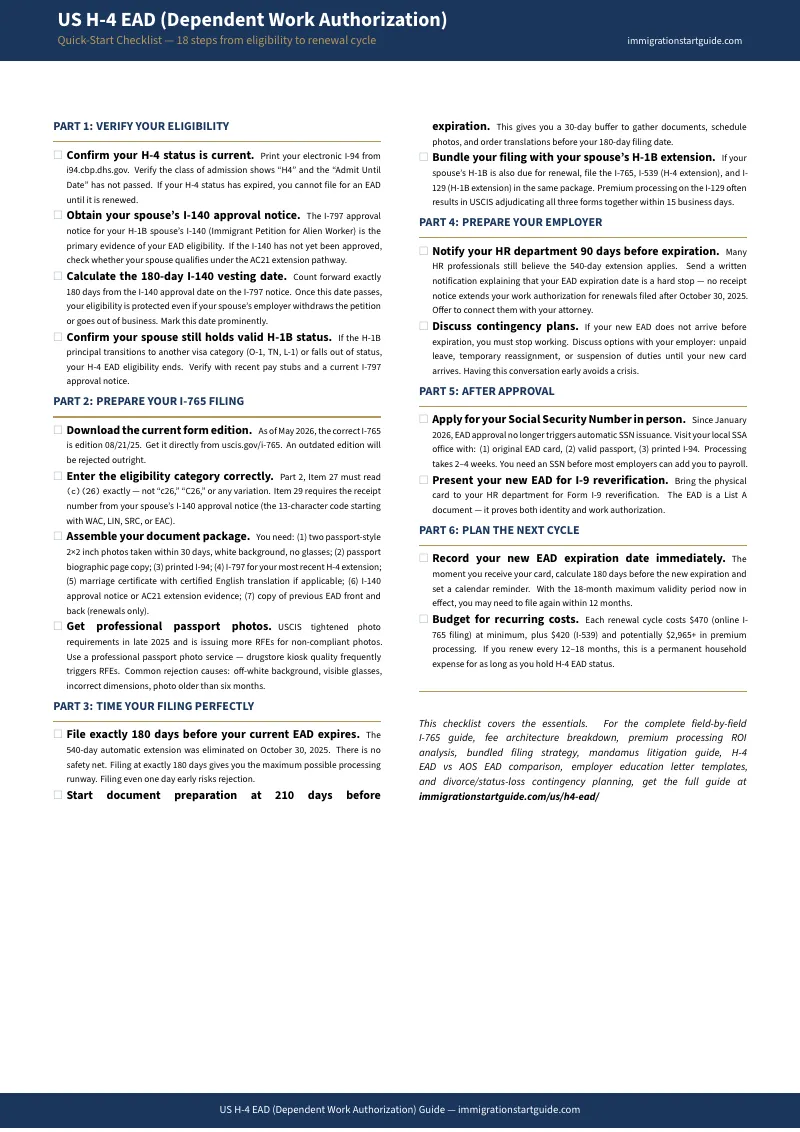
Quick-Start Checklist (free download)
An 18-point action plan covering the essentials: verify H-4 status, obtain the I-140 approval notice, calculate the 180-day vesting date, assemble the document package, time your filing within the 180-day window, and prepare your employer. Enough to start tonight — and enough to see whether the structured approach replaces the anxiety with a sequence you can actually follow.
Who This Guide Is For
This guide is for H-4 spouses of H-1B visa holders who:
- Have an approved I-140 (or AC21 extension) and are applying for their first H-4 EAD — and need to understand exactly which documents to submit, how to fill out the (c)(26) eligibility category, and how to avoid the photo and biometrics RFEs that USCIS is issuing more frequently in 2026
- Hold a current H-4 EAD that expires within the next 12 months and need to file a renewal in the post-auto-extension world — where the "Card Expires" date is a hard employment stop and not filing at exactly 180 days before expiry means risking your salary
- Are weighing premium processing and need to understand the actual math — whether paying $1,780 for I-765 alone accomplishes anything when the I-539 is still in the standard queue, and whether the $2,965 + $2,075 + $1,780 bundle is worth the investment for your specific timeline
- Have an HR department that doesn't understand the October 2025 rule change and may terminate their work authorization prematurely — or keep them on payroll based on a receipt notice that no longer confers work authorization, creating an I-9 compliance violation for the employer
- Are stuck in processing limbo — months past their filing date with no receipt notice, no biometrics appointment, and no case update — and need to know which escalation options actually produce results (expedite requests, Ombudsman, congressional inquiry, mandamus)
- Want to understand the long game — how the H-4 EAD fits into the broader green card journey, when to switch to an AOS-based EAD, and how to manage the recurring renewal cycle without losing their job every 18 months
Why Not Free Resources?
Free information exists. USCIS instructions, Reddit threads, Facebook groups, law firm blogs — all free, all abundant. Here's what they actually deliver:
- USCIS.gov publishes the I-765 form and its instructions. It tells you to file "up to 180 days before expiry" without explaining that filing one day before the 180-day window opens results in a flat rejection. It says to submit a passport-style photo without mentioning that the tightened 2025 specifications are generating RFEs for photos that passed two years ago. You get a form. You don't get a filing strategy.
- Reddit (r/h1b, r/immigration) is where you discover at 2 AM that someone filed their renewal eight months ago and still hasn't received a decision. These threads are emotionally raw and factually fragmented. The advice that worked for someone who filed before October 30, 2025 is dangerous for someone filing today — and most posters don't specify which rule regime they filed under. You spend 20 hours synthesising contradictory anecdotes and end up more anxious than when you started.
- Facebook and WhatsApp groups offer real-time emotional support from others going through the same process. But much of the tactical advice is still referencing the 540-day automatic extension as if it were active. In a community where everyone is anxious and information travels by screenshot, outdated guidance spreads faster than corrections.
- Law firm blogs (Murthy Law, Reddy & Neumann, Ahluwalia Law) provide authoritative updates on policy changes and processing times. Their purpose is to demonstrate complexity and convert readers into $500–$2,000 clients. They explain the problem at exactly the depth needed to convince you the problem is unsolvable without a retainer — then stop before giving you the templates and timelines that would let you file confidently yourself.
This guide fills the execution gap — the space between "I know the form exists" and "I have a filing strategy, a timeline, an employer letter, and escalation options ready before my card expires." The same structured approach an experienced immigration paralegal builds internally for their clients, at a fraction of the cost of a single consultation.
— Less Than One Hour of Your Future Salary
An immigration attorney charges $500–$2,000 to prepare an H-4 EAD filing. If your current EAD expires and the renewal hasn't arrived, you stop working immediately — a one-month gap at an $80,000 salary costs your household $6,600. Premium processing the wrong combination of forms wastes $1,780 to $6,820 without actually preventing the gap.
This guide doesn't replace an attorney for cases involving prior deportation orders, complex status changes, or criminal history. But for the majority of H-4 EAD filings that are procedurally straightforward — you have an approved I-140, you need to file or renew, and you need to do it without a gap — it provides the same filing strategy at a cost that amounts to less than one hour of the salary it's designed to protect.
Money-back guarantee, no time limit. If the Career Continuity System doesn't make your filing stronger, you pay nothing.
Download the free Quick-Start Checklist to see the 18-point action plan. When you're ready for the premium processing ROI analysis, employer education toolkit, and the complete gap prevention strategy, the full guide is here.
You didn't get an advanced degree to sit at home. Take control of your career back from the bureaucracy.