
Your Brazilian MBA Does Not Count as a Graduate Degree. NIW Approval Rates Just Crashed to 35.7%. The US Consulate in Rio Stopped Printing Green Cards on January 21. And You Still Think Free YouTube Videos Will Get You Through This.
You have the skills. You have the experience. You know that Brazilians hold the best position in the entire employment-based green card system — EB-2 is "Current" for Brazil, while Indian professionals wait 12 years for the same visa number. You have done the math. You have read the threads. You are ready to file.
What you are not ready for is the credential evaluation that will disqualify you before USCIS reads a single page of your petition.
The number one reason Brazilian EB-2 petitions fail is the "Lato Sensu Trap." Your Especialização, your MBA from FGV or Insper, your Pós-Graduação certificate — none of it counts. Not as a graduate degree. Not under US immigration law. USCIS requires a Stricto Sensu Mestrado or Doutorado for the EB-2 Advanced Degree category. A Lato Sensu program, regardless of prestige, duration, or institutional reputation, is evaluated by NACES agencies as a "professional certificate" — not a Master's degree. If you file EB-2 based on a Bacharelado plus an Especialização, your I-140 is denied. Full stop. And the denial goes on your immigration record.
Behind the credential trap sits a second problem that is rewriting the entire NIW landscape: USCIS is denying more petitions than it approves for the first time in recent history. The NIW approval rate dropped from 62.7% in FY2025 Q1 to 35.7% in Q4 — because the surge in templated, copy-paste petitions from unlicensed consultants finally triggered a crackdown. The era of easy NIW approvals is over. Generic "proposed endeavors" that worked in 2023 now generate Requests for Evidence or outright denials.
And behind the crackdown sits a third problem that no amount of preparation can bypass with paperwork alone: on January 21, 2026, the Department of State paused immigrant visa issuance for 75 countries — including Brazil. The US Consulate in Rio de Janeiro still conducts interviews. But if your case clears every other hurdle, the officer refuses the visa under INA Section 212(a)(4) and places it into indefinite administrative processing under Section 221(g). Your green card is approved on paper and frozen in practice. For Brazilian applicants pursuing consular processing, there is currently no end date.
The Brazil → US EB-2/EB-3 Green Card Guide is the EB-2/EB-3 Qualification Engine — built for the specific reality Brazilian professionals face in 2026: determining whether your Brazilian degree actually qualifies for EB-2 or must route through EB-3, building an NIW petition that survives the post-crackdown adjudication standards, navigating the consular visa pause through Adjustment of Status strategies, and assembling Brazilian documents with the cartório apostille timing that prevents expiration before your case is processed. This is not a translation of the USCIS website. This is the integrated system covering the EB-2 vs EB-3 decision framework with the Lato Sensu credential audit, the NIW self-petition playbook with Matter of Dhanasar strategies for Brazilian professionals, the PERM labor certification process for employer-sponsored routes, the complete Brazilian document procurement chain with cartório and apostille timing, the 2026 consular pause workaround through domestic Adjustment of Status, the cost breakdown and timeline planning, the US-Brazil tax transition, and the dual citizenship pathway.
What's Inside the EB-2/EB-3 Qualification Engine
The complete guide, a quick-start checklist, and standalone printable tools — covering every step from credential evaluation through green card approval:
The EB-2 vs EB-3 Decision Framework with Credential Audit
This is the decision that determines everything — and for Brazilians, it is more complex than for any other nationality because of the Lato Sensu distinction. The guide provides the complete mapping: Bacharelado (4-5 years) equals a US Bachelor's, qualifying for EB-3 Professional. Tecnólogo (2-3 years) equals an Associate's, requiring the EB-3 Skilled Worker route with two years of experience. Mestrado (Stricto Sensu) equals a US Master's, qualifying directly for EB-2 Advanced Degree. Especialização and Lato Sensu MBA equal a professional certificate — not a graduate degree, not EB-2 eligible on education alone. For the majority of Brazilian professionals who hold a Bacharelado without a Mestrado, the guide covers the "Bachelor's plus 5 years of progressive experience" pathway to EB-2, including how to document progressive responsibility through CTPS records, employer letters aligned with O*NET job descriptions, and the NACES credential evaluation strategy using WES, ECE, or Evaluation World. The credential audit tells you within 15 minutes whether you qualify for EB-2, must take the progressive experience route, or should file EB-3.
The NIW Self-Petition Playbook (Matter of Dhanasar)
The National Interest Waiver is the gold standard for Brazilian professionals because it eliminates the need for employer sponsorship and PERM labor certification entirely. But with approval rates crashing to 35.7%, a generic petition no longer works. The guide provides the three-prong Dhanasar framework adapted specifically for Brazilian professionals: how to define a "proposed endeavor" with genuine national importance aligned with the Critical and Emerging Technologies list, how to prove you are "well-positioned" using MEC-recognized credentials, CREA or OAB or CRM certifications, CTPS employment history from firms like Petrobras or Embraer, and publications or patents, and how to argue that waiving the labor certification benefits the United States — with field-specific strategies for healthcare (addressing shortages in underserved areas), engineering (infrastructure modernization under the Bipartisan Infrastructure Law), financial services (fintech and SME access to capital), and technology (AI, cybersecurity, clean energy). The guide includes the premium processing strategy ($2,805 for a 45-business-day decision) and the evidence architecture that distinguishes an approval-caliber petition from the templated filings USCIS is now denying.
The PERM Labor Certification Process
For EB-3 applicants and EB-2 professionals who do not qualify for NIW, the employer-sponsored PERM route is mandatory. The guide covers the full timeline: Prevailing Wage Determination (6-10 months), recruitment phase (2-3 months with two Sunday newspaper ads, State Workforce Agency job order, and additional advertisements), ETA-9089 filing with the Department of Labor (6-18 months for adjudication), and the audit response strategy. For Brazilian applicants, the critical detail is ensuring the job requirements reflect the actual complexity of the role — because if a qualified US worker applies and meets the minimum qualifications, the certification is denied. The guide covers how to articulate job duties that map to your Brazilian experience without triggering a DOL audit for unduly restrictive requirements, and how to align your MEC-recognized degree with SOC codes and O*NET descriptions.
Brazilian Document Procurement and Apostille Timing
Every Brazilian document submitted to USCIS or the NVC must be apostilled through the cartório system and translated by a Tradutor Juramentado. But apostilled documents have validity windows — the Certidão de Antecedentes Criminais from the Polícia Federal expires in 90 days, birth certificates must be in "inteiro teor" format, and state-level police certificates must come from the Secretaria de Segurança Pública of every state where you have lived for six months or more. The guide maps the exact timing sequence: when to order federal and state criminal clearances, when to request the Certidão de Inteiro Teor from the Cartório de Registro Civil, when to get the CTPS employment history from the Digital CTPS app and supplement it with employer letters on company letterhead, when to apostille through a CNJ-authorized cartório, and how to synchronize the 90-day criminal clearance window with NVC processing timelines. It covers the IRPF tax returns needed to demonstrate income and professional trajectory, the military service certificate for male applicants aged 18-45, and the CPF validation that underpins the entire documentation chain.
The 2026 Consular Pause Strategy
Since January 21, 2026, the US Consulate in Rio de Janeiro has been refusing immigrant visas for Brazilian nationals under the public charge provision — even when the applicant is fully qualified. The visa is placed into indefinite 221(g) administrative processing with no announced end date. The guide covers the two strategic responses: first, for applicants already in the US on H-1B, L-1, or other dual-intent visas, the Adjustment of Status pathway through I-485 concurrent filing, which is unaffected by the consular pause and provides an Employment Authorization Document (EAD) and Advance Parole within 6-9 months. Second, for applicants in Brazil, the strategy for entering the US on a dual-intent non-immigrant visa to enable domestic adjustment, the documentary perfection standard that positions your case for immediate processing when the pause lifts, and the 221(g) monitoring protocol for tracking case status through the CEAC system.
Cost Breakdown and Timeline Planning
The guide provides the complete cost structure: I-140 filing fee ($715), premium processing ($2,805 optional), I-485 Adjustment of Status ($1,440), USCIS Immigrant Fee ($235), medical examination ($200-$500 at approved panel physicians in Rio, São Paulo, Brasília, or Belo Horizonte), NACES credential evaluation ($200-$400), cartório apostille fees, and sworn translation costs. The NIW self-petition timeline runs 12-18 months from filing to interview under normal conditions. The PERM employer-sponsored timeline runs 26-30 months minimum. Both timelines include buffer calculations for the current consular pause. The guide compares these costs against the $15,000-$25,000 that US immigration attorneys charge for full EB-2 representation — and shows exactly which steps require an attorney and which you can execute yourself.
US-Brazil Tax Transition
The United States and Brazil do not have an income tax treaty — which means double taxation is a real and immediate risk for every Brazilian moving to the US. The guide covers the Comunicação de Saída Definitiva do País to the Receita Federal, the timing considerations (declare too early and you lose access to Brazilian financial products; declare too late and both countries tax you as resident), the 25% withholding on Brazilian-source income after the exit declaration, and the IRPF filing requirements in the transition year. It addresses the green card holder's obligation to report worldwide income to the IRS, the FBAR and FATCA reporting requirements for Brazilian bank accounts maintained after the move, and the 2026 Brazilian VAT reform implications for PJ holders transitioning their business structures.
Dual Citizenship and Long-Term Strategy
Since Brazil's 2023 constitutional amendment, dual citizenship is fully permitted. A Brazilian who naturalizes as a US citizen retains their Brazilian passport, property rights, and the right to live and work in Brazil. The guide covers the naturalization timeline (3-5 years after green card), the English and civics requirements, the continuous residence rules, and why the dual citizenship guarantee makes the US green card a "Plan B" strategy — permanent access to the US labor market and social infrastructure while maintaining full rights in Brazil.
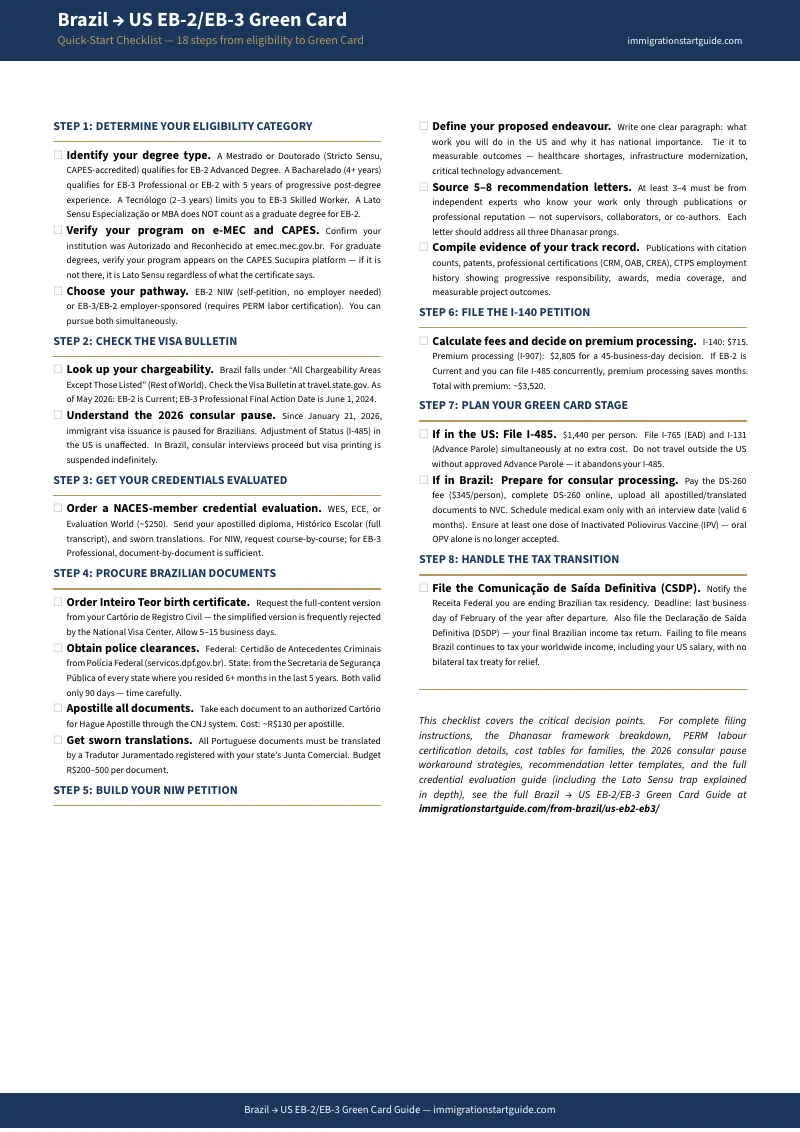
Quick-Start Checklist (free download)
The critical steps distilled into a single action sheet organized by phase: EB-2 vs EB-3 qualification check, credential evaluation preparation, NIW vs PERM pathway selection, Brazilian document procurement order, consular processing vs Adjustment of Status decision, and first steps after green card approval. Enough to determine your visa category tonight and identify whether your Brazilian degree qualifies for EB-2, requires the progressive experience bridge, or routes through EB-3.
Standalone Printable Tools
Every major decision point and planning stage extracted as its own printable worksheet — fill them in, bring them to your attorney consultation, use them to track your case. The EB-2 vs EB-3 Decision Worksheet, Credential Evaluation Checklist, NIW Evidence Inventory, PERM Timeline Planner, Brazilian Document Checklist with Apostille Tracker, Cost Breakdown Worksheet, and Government Portals Reference Card.
Who This Guide Is For
This guide is for Brazilian professionals pursuing US permanent residency through the EB-2 or EB-3 employment-based categories:
- Mid-career professionals with a Bacharelado and 5+ years of progressive experience in engineering, technology, healthcare, finance, or aviation — you meet the EB-2 threshold through education plus experience but need to know how to document "progressive responsibility" using CTPS records and employer letters that satisfy USCIS standards, and whether your specific field supports a viable NIW petition under the post-crackdown adjudication climate.
- Researchers, physicians, and specialists with a Mestrado or Doutorado — you qualify directly for EB-2 Advanced Degree and want to self-petition through NIW, but need the Dhanasar three-prong strategy adapted to your field, the premium processing timeline, and the evidence architecture that separates an approval from the templated petitions USCIS is now denying at 64.3%.
- Professionals with a Lato Sensu MBA or Especialização who assumed they qualified for EB-2 — the guide tells you exactly why you do not, what your actual options are (progressive experience bridge to EB-2, or EB-3 Professional), and how to avoid the credential evaluation denial that would go on your record.
- Brazilian professionals currently in the US on H-1B, L-1, or J-1 visas — you can file I-140 and I-485 concurrently because EB-2 is Current for Brazil, bypassing the consular visa pause entirely, and the guide covers the concurrent filing strategy, EAD processing, and Advance Parole.
- Employer-sponsored applicants whose company will file PERM on their behalf — you need to understand the prevailing wage determination, the recruitment advertising requirements, the DOL audit triggers, and how to ensure your Brazilian degree and CTPS employment history are documented in a way that survives the labor certification process.
- PJ holders and entrepreneurs weighing NIW — the guide covers the self-employment NIW argument (the "impossibility of self-sponsorship" rationale), how to present PJ income as evidence of professional accomplishment, and the proposed endeavor framing for startup founders and independent consultants.
This guide is not for: applicants seeking family-based green cards (different process entirely), EB-1 Extraordinary Ability or Outstanding Researcher petitions (see the US EB-1 Green Card Guide), EB-5 investor visas (see the US EB-5 Investor Visa Guide), or non-Brazilian applicants (see the general US EB-2 Green Card Guide or US EB-3 Green Card Guide).
Why Not Free Resources?
Free information about US green cards for Brazilians is everywhere. Here is what it actually delivers:
- The USCIS website lists the requirements: advanced degree or exceptional ability for EB-2, bachelor's degree for EB-3 Professional, two years of experience for EB-3 Skilled Worker. It does not explain that a Brazilian Especialização is not an advanced degree, that a Tecnólogo is not a bachelor's equivalent, or that the "5 years of progressive experience" pathway requires employer letters with O*NET-aligned duty descriptions — not just a CTPS printout showing job titles and dates. The government tells you what to file. It does not tell you whether your Brazilian credentials actually qualify.
- Reddit and Brazilian WhatsApp groups give you real-time anecdotes. One person approved with NIW in 45 days through premium processing. Another denied because their Lato Sensu MBA was evaluated as a professional certificate. A third whose PERM was audited because the job requirements were considered unduly restrictive. Each story is real. None tells you which scenario applies to your specific degree, your specific field, or your specific employer's willingness to navigate DOL recruitment advertising.
- YouTube and Brazilian immigration influencers built their audiences during the 2022-2024 period when NIW approval rates exceeded 90% and templated petitions sailed through. Their advice — "just file NIW, it's easy for Brazilians" — was accurate then. In 2026, with approval rates at 35.7% and USCIS explicitly targeting generic petitions, that same advice sends your filing into a denial. A video from 2023 does not account for the consular visa pause, the approval rate crash, or the tightened evidence standards.
- US immigration attorneys charge $15,000 to $25,000 for full EB-2 representation. They handle the legal filing. They do not teach you how to determine whether your Brazilian degree qualifies for EB-2 before you pay the retainer, how to build the CTPS-to-employer-letter evidence chain, how to time the cartório apostille sequence so your Certidão de Antecedentes does not expire before NVC processing, or how to evaluate whether NIW or PERM is the stronger route for your specific profile. And the majority of Brazilian attorneys offering "immigration assessoria" are not licensed to practice US immigration law.
This guide fills the gap between "I know I want a US green card" and "My I-140 is approved, my documents are at NVC, and I know exactly what happens next" — the space where qualified Brazilian professionals still fail because they filed EB-2 with a Lato Sensu degree, submitted a templated NIW petition that worked in 2023 but triggers denial in 2026, missed the Adjustment of Status window that bypasses the consular freeze, or discovered their criminal clearance expired three weeks before NVC processed their documents.
— Less Than One Hour of a US Immigration Attorney's Time
A US immigration attorney charges $15,000 to $25,000 for full EB-2 representation. A NACES credential evaluation costs $200 to $400. A denied I-140 petition costs you the $715 filing fee, the months of preparation, and a denial on your immigration record that every future petition must disclose. The wrong category — filing EB-2 when your degree evaluates as a bachelor's, or NIW when your proposed endeavor does not meet the post-crackdown standard — costs you a year and thousands of dollars that cannot be recovered.
This guide costs less than one hour of a US immigration attorney's billing rate and covers every step, every credential evaluation pathway, every NIW strategy, every PERM timeline, every Brazilian document with apostille timing, and every Adjustment of Status maneuver between your first credential check and your green card approval. The EB-2 vs EB-3 decision framework alone can save you from the single most common and most expensive mistake Brazilian applicants make — filing in the wrong category based on a degree that does not mean what you think it means under US immigration law.
You have the skills. You have the experience. You have the "no retrogression" advantage that Indian and Chinese professionals would trade a decade of waiting to have. What stands between you and a green card is not qualification — it is execution. The Lato Sensu trap catches applicants who assumed their MBA was enough. The NIW crackdown catches applicants who filed templated petitions. The consular pause catches applicants who did not know that Adjustment of Status bypasses the freeze. Every one of these is avoidable with the right preparation.
Money-back guarantee, no time limit. If the credential audit, the NIW playbook, the PERM timeline, the apostille timing chain, and the consular pause strategy do not make your application stronger than anything you could assemble from Reddit threads and pre-crackdown YouTube videos, you pay nothing.
Download the free Quick-Start Checklist to determine your visa category, verify whether your Brazilian degree qualifies for EB-2, and identify the first step in your credential evaluation. When you are ready for the complete EB-2/EB-3 Qualification Engine — the full guide with the NIW playbook, the PERM process, the Brazilian document procurement chain, the consular pause strategy, the tax transition planning, and the dual citizenship pathway — the full guide is here.
EB-2 is Current for Brazil. The window is open. Now build the petition that gets approved — in a system that is denying more applications than it approves for the first time in years.