
Nearly Half of All EB-1A Petitions Filed Last Quarter Were Denied. Yours Doesn't Have to Be.
You've spent six years building a career that looks extraordinary on paper. Lead architect on a platform serving 40 million users. Three patents. A dozen peer-reviewed publications. Your H-1B is ticking toward its six-year limit, your EB-2 priority date sits in 2019 with a projected 15-year wait, and every immigration attorney you've consulted has said the same thing: "You should consider EB-1A."
Then they quoted $15,000 to $20,000 in legal fees — and explained that the retainer covers filing the forms and drafting the petition brief. It does not cover the 12 months of strategic profile-building you need to actually produce a winnable case. The attorney assembles whatever evidence you hand them. They do not tell you which conferences to target for judging credentials, how to secure media coverage that satisfies USCIS's "major media" standard, or whether your 200 citations are enough in your specific subfield. That $15,000 buys a filing service, not a strategy.
Meanwhile, USCIS is denying EB-1A petitions at an accelerating rate. The Q4 2025 approval rate plummeted to 53.4% — meaning adjudicators rejected nearly half of all self-petitions that quarter. Not because the applicants were unqualified. Because their evidence portfolios failed the Kazarian Step Two Final Merits Determination — the subjective, totality-of-evidence analysis where volume of documentation means nothing and strategic quality means everything.
The US EB-1 Extraordinary Ability Green Card Guide is an Evidence Architecture System. It covers all three EB-1 subcategories — EB-1A self-petition, EB-1B outstanding professors and researchers, and EB-1C multinational managers — with the strategic frameworks, field-specific benchmarks, and evidence-building timelines that transform a pile of career achievements into a petition built to survive the most hostile adjudication environment in a decade.
What's Inside the Evidence Architecture System
12 chapters covering every pathway from eligibility assessment through green card approval, plus a printable 20-step quick-start checklist:
The Kazarian Defence Framework (Chapter 3)
The single biggest reason EB-1A petitions fail is not weak credentials. It is the applicant's inability to survive the two-step adjudicatory framework established in Kazarian v. USCIS. Step One is mechanical — you count whether you meet three of the ten evidentiary criteria. Step Two is where petitions die. The Final Merits Determination requires the adjudicator to evaluate whether your evidence collectively proves "sustained national or international acclaim" — and submitting 500 pages of generic reference letters, marginal conference presentations, and uncontextualised citation counts fails catastrophically at this stage. This chapter deconstructs the exact analytical framework USCIS applies, shows you how to structure evidence that passes the "totality" test, and explains how the 2026 Mukherji v. Miller ruling creates a new litigation tool for challenging arbitrary denials.
The Ten Criteria Decoded (Chapter 2)
Every free resource lists the ten EB-1A evidentiary criteria. None of them tell you what actually passes and what fails under current adjudication standards. This chapter provides criterion-by-criterion breakdowns with specific examples of evidence that works (IEEE Fellow membership, NSF grant review panels, feature profiles in MIT Technology Review) versus evidence that triggers denials (Employee of the Year awards, standard professional memberships, passing mentions in employer press releases). For each criterion, you get the exact documentation checklist — what to include, what to leave out, and how to contextualise achievements so the adjudicator understands significance without needing to be an expert in your field.
12-to-24 Month Evidence-Building Roadmap (Chapter 6)
Your attorney expects you to hand them a complete evidence portfolio. They do not tell you how to build one. This chapter provides the proactive strategy: how to secure peer review invitations at high-impact journals, which media pitch strategies generate coverage that satisfies USCIS's "major media" standard, how to cultivate 5-8 recommendation letters from independent experts who know your work only through its published impact (not co-authors or supervisors), and how to document your compensation against BLS O*NET percentile data. Because the difference between a successful EB-1A and a denial is almost never credentials — it is whether those credentials were strategically documented 12 months before filing.
Field-Specific Citation Benchmarks (Chapter 12)
"How many citations do I need?" is the most common EB-1A question on every immigration forum, and the answers are dangerously wrong. Forum wisdom claims you need thousands, but 2025 approval data from specialised legal platforms shows EB-1A approvals for commercial AI engineers with as few as 46 citations — provided the commercial impact was heavily documented through enterprise implementation and high remuneration. An academic biologist may need 1,000+. A startup founder may need zero citations but extensive evidence of market disruption. This chapter provides field-segmented benchmarks for technology, academia, business, and the arts — replacing anecdotal guesswork with data.
EB-1B Outstanding Professors and Researchers (Chapter 4)
The six evidentiary criteria, the three-year experience requirement, the employer sponsorship rules that catch private-sector researchers off guard, and the critical difference between academic peer review and the immigration evidentiary standard for recommendation letters. EB-1B carries a 97.5% approval rate — but only if you understand why generic praise from former academic mentors gets flagged during adjudication while structured, criterion-targeted letters from independent experts sail through.
EB-1C Multinational Manager Strategy (Chapter 5)
The L-1A to EB-1C pipeline is the most common corporate green card path for multinational executives — and the job description consistency trap is the most common reason it fails. If your L-1A petition emphasised hands-on technical expertise to secure rapid approval, using that same description for the EB-1C petition will trigger a fatal RFE. This chapter provides the "function manager" vs. "personnel manager" statutory definitions from Matter of Z-A- and Matter of G-, side-by-side examples of fatal vs. winning job descriptions, and the organisational chart framework that proves managerial authority. Because a 96.5% approval rate only applies to petitions that don't contradict themselves.
I-140 Filing and Premium Processing Strategy (Chapter 7)
Filing fees ($715 base + $300/$600 Asylum Program Fee), premium processing mechanics ($2,965 for 15-day guaranteed action on EB-1A/EB-1B), priority date strategy, and when premium processing is an advantage versus a liability. For H-1B holders approaching the six-year limit, standard processing that pends for 365+ days can unlock H-1B extensions beyond year six — a strategic benefit that premium processing eliminates.
Visa Bulletin and Backlog Strategy (Chapter 9)
Reading the monthly Visa Bulletin is straightforward. Using it strategically is not. This chapter covers cross-chargeability through a spouse born in a Rest of World country, the EB-2 NIW hedge filing strategy (lock in a priority date via the lower-bar NIW while building your EB-1A profile), priority date porting across categories, and the tactical approach for Indian and Chinese nationals facing a 3+ year EB-1 backlog on top of a decade-long EB-2 wait.
RFE and Denial Recovery (Chapter 10)
You have 87 days to respond to a Request for Evidence. The wrong response structure — burying adjudicators under hundreds of disorganised pages — is worse than no response at all. This chapter provides structured response frameworks for the most common EB-1A RFE triggers (Original Contributions, Final Merits insufficiency, high salary documentation) and the denial recovery decision tree: appeal to the AAO, motion to reopen, refile with new evidence, or pivot to EB-2 NIW. Because panic is not a strategy.
EB-1A vs. EB-2 NIW Decision Framework (Chapter 9)
The most expensive mistake in employment-based immigration is spending 12 months building a profile for the wrong category. EB-1A rewards documented past achievements and independent recognition. EB-2 NIW rewards the future national importance of a proposed endeavour under the Dhanasar test. Different legal standards, different evidence requirements, different filing strategies. The guide provides the structured decision tree to choose the right pathway — or execute both concurrently.
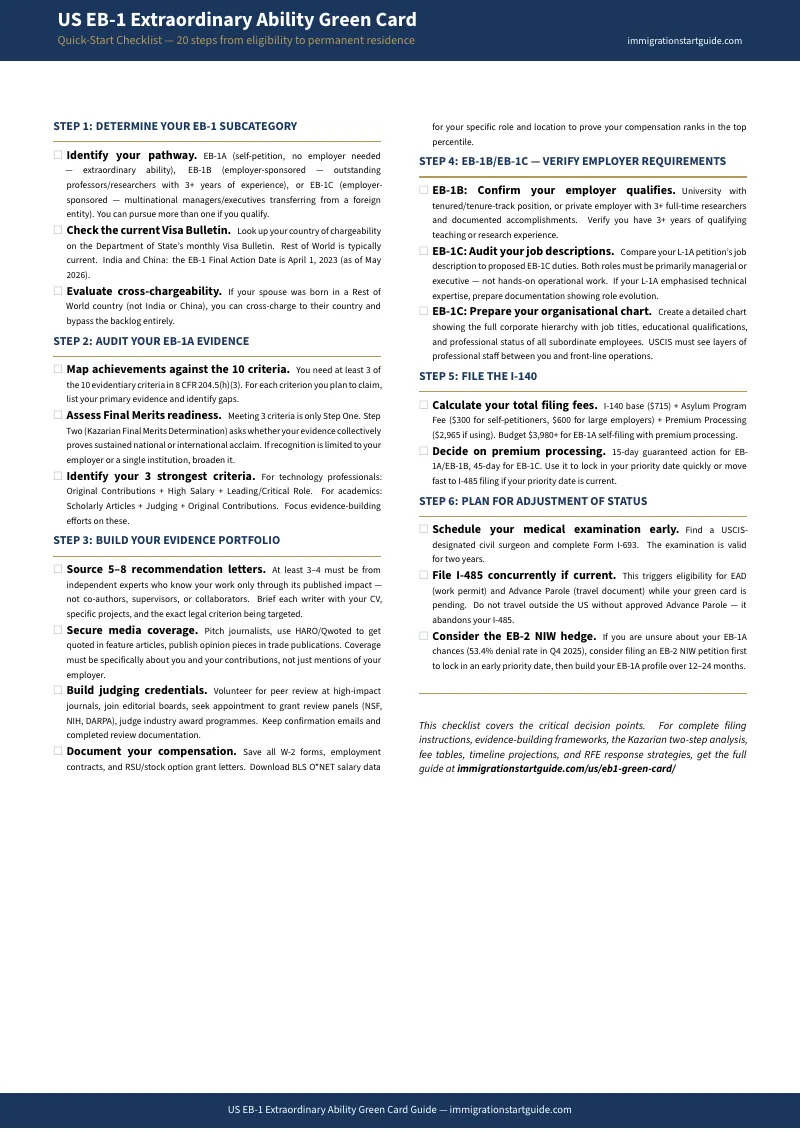
20-Step Quick-Start Checklist (free download)
The critical decision points distilled into a single action sheet: identify your subcategory, audit your evidence against the ten criteria, assess Final Merits readiness, source recommendation letters, and file the I-140. Enough to take your first strategic step tonight.
8 Standalone Printable Tools
Print-and-use worksheets and reference cards you can bring to your attorney meeting, give to your recommendation letter writers, or pin to your desk during the 12-24 month evidence-building process:
- Evidence Criteria Scorecard — Fillable worksheet to map your achievements against all 10 EB-1A evidentiary criteria with strength ratings and documentation tracking
- Recommendation Letter Briefing Template — Give this to each letter writer: the 4-part letter structure, dependent vs. independent distinction, and a tracking table for all 5-8 letters
- Evidence-Building Roadmap — 12-to-24 month phased action plan with checkboxes for media outreach, judging credentials, association applications, and compensation documentation
- EB-1A vs. EB-2 NIW Decision Tree — Side-by-side pathway comparison, the 4-step dual filing strategy, and legal standard cheat sheet (Kazarian vs. Dhanasar)
- EB-1C Job Description Audit — L-1A to EB-1C consistency checklist with side-by-side comparison tables, organisational chart audit, and 50% time allocation worksheet
- RFE Response Framework — The 5 common RFE triggers, 4-step response structure, 87-day timeline planner, and post-denial decision matrix
- Fee & Timeline Reference Card — Every filing fee, total cost estimate by pathway, realistic processing timelines, and approval rates on a compact 2-page card
- Visa Bulletin Quick Reference — How to read Chart A vs. Chart B, the May 2026 snapshot table, cross-chargeability rules, and a monthly checklist
Who This Guide Is For
This guide is for professionals with extraordinary careers who need a strategic framework to prove it to USCIS:
- You're a senior software engineer, AI researcher, or tech lead at a major company with patents, publications, and high compensation — and you've been told you "probably qualify" for EB-1A but nobody has shown you how to structure the evidence to survive the Kazarian Final Merits Determination
- You're trapped in the EB-2 India or China backlog with a priority date that won't be current for a decade, and the EB-1 category is the only realistic escape — but the 53.4% denial rate terrifies you because you can't afford to waste your one shot
- You're an outstanding professor or researcher whose university HR department is "handling" the EB-1B petition, and you have no visibility into whether your recommendation letters and evidence documentation meet the standard that produces a 97.5% approval rate or the standard that produces an RFE
- You're an L-1A intracompany transferee whose seven-year visa clock is ticking, and you need the EB-1C job description consistency framework to ensure your petition doesn't contradict your original L-1A application
- You consulted an immigration attorney who quoted $15,000 to $20,000 — and you want to ensure that before you hand them your evidence portfolio, it contains the quality and strategic structure that actually wins cases rather than the bulk documentation that triggers RFEs
- You're 6-12 months away from filing and you need the proactive evidence-building roadmap — which journals to target for peer review, which media strategies generate qualifying coverage, how to secure independent recommendation letters — that no attorney provides because it's not billable legal work
Why Not Free Resources?
Free information on the EB-1 process is everywhere. Here's what it actually delivers:
- USCIS Policy Manual (Volume 6, Part F) provides the statutory requirements in dense bureaucratic legalese. You'll learn that you need "original contributions of major significance." You won't learn how to frame a proprietary software architecture deployed across enterprise clients as meeting that standard — or why a patent that's been granted but never licensed will fail.
- Law firm blogs (WeGreened, Manifest Law, Alma) publish detailed case analyses and impressive approval statistics — because their business model is to demonstrate overwhelming complexity and then offer a $5,000 to $10,000 retainer. They explain why approval rates are plummeting. They never provide the evidence-building frameworks that would let you construct a winning case without them.
- Reddit (r/immigration, r/eb1a), Trackitt, VisaJourney are flooded with "chance me" posts from anonymous users whose specific field, country of chargeability, filing date, and individual adjudicator assignment you don't know. One user insists you need 2,000+ citations. Another was approved with 46. The signal-to-noise ratio is so low that reading these forums actively increases anxiety without improving outcomes.
- High-ticket courses (Smart Green Card, Immigration Jason) charge $5,000 to $40,000 for cohort-based consulting and profile-building programs. Documented complaints include deteriorating communication, sluggish document review, and unmet promises as the process drags on for months. The strategic frameworks these programs teach — media pitching, peer review cultivation, recommendation letter sourcing — are not proprietary. They're in this guide.
This guide fills the strategy gap. It doesn't compete with free information — it organises, verifies, and sequences it into an executable system that covers all three EB-1 subcategories. It provides the evidence-building frameworks and field-specific benchmarks that attorneys don't offer and courses charge thousands for, at a fraction of the cost of a single hour of legal consultation.
— Less Than One Hour of Attorney Billable Time
A mid-tier immigration attorney charges $300 to $500 per hour. Full-service EB-1A representation runs $10,000 to $20,000. High-ticket profile-building programs charge $5,000 to $40,000. Premium processing alone costs $2,965 in government fees. The total cost of the EB-1 journey easily exceeds $15,000.
The guide doesn't replace an attorney for complex legal appeals or RFE responses that require case-specific legal analysis. But it gives you the evidence architecture and strategic frameworks that prevent the filing mistakes triggering those RFEs in the first place. If you're self-filing EB-1A, it's your complete blueprint. If you're hiring counsel, it transforms you from a confused client handing over raw materials into a prepared partner who delivers a curated portfolio that maximises your attorney's effectiveness and cuts billable hours.
Money-back guarantee, no time limit. If the frameworks don't make your petition strategy stronger, you pay nothing.
Download the free Quick-Start Checklist to see the 20 critical decision points across all three EB-1 subcategories. When you're ready for the Kazarian Defence Framework, the evidence-building roadmap, and the complete field-specific benchmarks, the full guide is here.
Your career has already produced extraordinary results. This guide ensures USCIS sees it that way too.