
Your Attorney Works for the Company. This Guide Works for You.
Your employer agreed to sponsor your EB-3 green card. The attorney filed the PERM. And now you're waiting — in the dark — while your career, your spouse's work authorisation, and your family's future in the United States depend on decisions being made by people who don't report to you.
Here's the part nobody explained at the start: if you're from India, the EB-3 backlog exceeds twelve years. During that wait, every career move you make carries real risk. Accept a better offer at the wrong stage and you lose your priority date. Get laid off before your I-140 has been approved for 180 days and your years of waiting vanish. Your spouse's H-4 EAD — the work authorisation that may represent half your household income — lives or dies based on your I-140 status. Nobody told you any of this when you signed the engagement letter.
Your employer's immigration attorney handles corporate compliance. They file the PERM correctly and get the I-140 approved. They will not call you when the Visa Bulletin jumps and say: "You should file a second I-140 in the EB-2 category to hedge your position." They will not map your SOC codes to prove you can safely accept a competitor's offer. That is not what the company pays them to do.
The US EB-3 Skilled Worker Green Card Guide is an Employee-Side Strategic Playbook — the counterweight to your employer's legal counsel. It covers the PERM-to-green-card pipeline from the beneficiary's perspective: the career decisions, the layoff contingencies, the category strategy, and the job portability frameworks that corporate counsel is neither incentivised nor permitted to advise you on.
What's Inside the Employee-Side Strategic Playbook
12 chapters covering every stage from PERM through green card approval, plus a printable 20-step quick-start checklist:
PERM From the Employee's Perspective (Chapter 3)
The PERM labour certification is controlled entirely by your employer and their attorney — you're the beneficiary, but you have zero visibility into the process that determines your immigration future. This chapter gives you the intelligence to protect yourself: what SOC code the attorney should select and why the wrong one will restrict your ability to change jobs under AC21 five years from now, how to gather experience letters from former managers before they become unreachable, the audit triggers your employer must avoid during structured recruitment, and how to assess whether your employer's financial health can survive the ability-to-pay scrutiny at the I-140 stage. The PERM takes 12 to 18 months. What you do during those months — and what you fail to do — echoes through the rest of your case.
I-140 Priority Date Protection (Chapter 4)
Your priority date is the single most valuable number in your immigration journey. This chapter covers the 180-day protection threshold after which your priority date belongs to you permanently — even if your employer withdraws the petition, lays you off, or goes bankrupt. It includes the ability-to-pay financial analysis for small companies and startups, premium processing decision calculus ($2,965), and the multiple I-140 strategy that lets you hold positions in both the EB-2 and EB-3 queues simultaneously. Because losing your priority date after years of waiting is the worst outcome in this process, and it is entirely preventable.
Visa Bulletin Reading Framework (Chapter 5)
Tracking the Visa Bulletin is easy. Making decisions based on it is not. This chapter explains Final Action Dates versus Dates for Filing, when USCIS authorises the DFF chart for early I-485 filing, spillover mechanics from higher preference categories, and the monthly analysis process that determines whether you should act or wait. It includes the EB-2/EB-3 downgrade decision matrix — a structured framework for deciding when filing a second I-140 in the alternate category justifies the $2,965 premium processing investment, factoring in retrogression risk, timing windows, and whether you can capture concurrent filing eligibility before the dates move backward again.
AC21 Job Portability With SOC Code Crosswalk (Chapter 8)
Changing employers during a pending green card is the single most consequential career decision most EB-3 applicants face — and the one that causes the most paralysis. The 180-day rule, the "same or similar" occupational classification standard, and the question of whether your promotion from Software Developer to Engineering Manager qualifies are all answered here. The SOC code crosswalk methodology shows you how to map career progression across different occupational classifications using O*NET data, compare job duties between the original PERM position and the new role, and file the Supplement J that makes the transfer official. This is the chapter that turns a decade of career stagnation into career mobility.
The Stage-Specific Layoff Survival Matrix (Chapter 9)
If your company announces layoffs, the consequences for your green card process depend entirely on which stage you're in — and the rules change drastically at each threshold. During PERM: the entire process terminates. After I-140 filing but before 180 days of approval: your priority date can be permanently destroyed. After 180 days of I-140 approval: your priority date is locked forever, but you need a new PERM. After 180 days of pending I-485: you have full AC21 portability. The layoff survival matrix gives you the exact contingency plan for each stage, including the 60-day H-1B grace period strategy, severance negotiation tactics to prevent I-140 withdrawal, and the evidence documentation you need to start assembling before layoff rumours become reality.
Dependent Protection and H-4 EAD Strategy (Chapter 10)
Your immigration status controls more than your own career. Your spouse's H-4 EAD — the work authorisation that may account for $50,000 to $150,000 in annual household income — depends directly on the status of your I-140 approval. If the I-140 is revoked or withdrawn, that income disappears. The guide covers how to protect your spouse's work authorisation through corporate transitions, the Child Status Protection Act calculations for children approaching the age-21 threshold, cross-chargeability through a spouse born in a Rest of World country, and the family-level contingency planning that treats your green card process as what it actually is: a household financial decision, not just an HR filing.
India and China Backlog Management (Chapter 10)
For Indian nationals facing a 12+ year EB-3 wait, standard linear advice is useless. This chapter covers realistic wait-time projections, the multiple I-140 strategy (maintaining approved petitions in both EB-2 and EB-3 to capture whichever advances first), cross-chargeability mechanics, decade-long H-1B status maintenance beyond the six-year limit, and the EB-1 "escape valve" analysis for applicants who develop extraordinary-ability or multinational-executive qualifications during the wait. Because the strategy you adopt in year one determines whether the process takes eight years or fifteen.
Industry-Specific EB-3 Strategies (Chapter 11)
IT and software (SOC code selection pitfalls for developers vs. programmers), healthcare (Schedule A exemptions for nurses and physical therapists that bypass PERM entirely), skilled trades, and the EB-3C "Other Workers" pathway for positions requiring less than two years of experience. Each industry has unique filing considerations that generic guides ignore.
Adjustment of Status and Consular Processing (Chapters 6-7)
I-485 concurrent filing strategy, EAD and Advance Parole interim benefits, medical examination timing, interview preparation, the travel rules that can abandon your application, DS-260 preparation for consular processing, NVC document assembly, panel physician requirements, and embassy interview guidance.
Complete 2026 Fee Architecture (Chapter 12)
Every filing fee, premium processing cost ($2,965), Asylum Program Fee surcharge, biometrics fee, and medical exam cost mapped across every pathway combination. Realistic total-cost calculations updated for the March 2026 fee schedule.
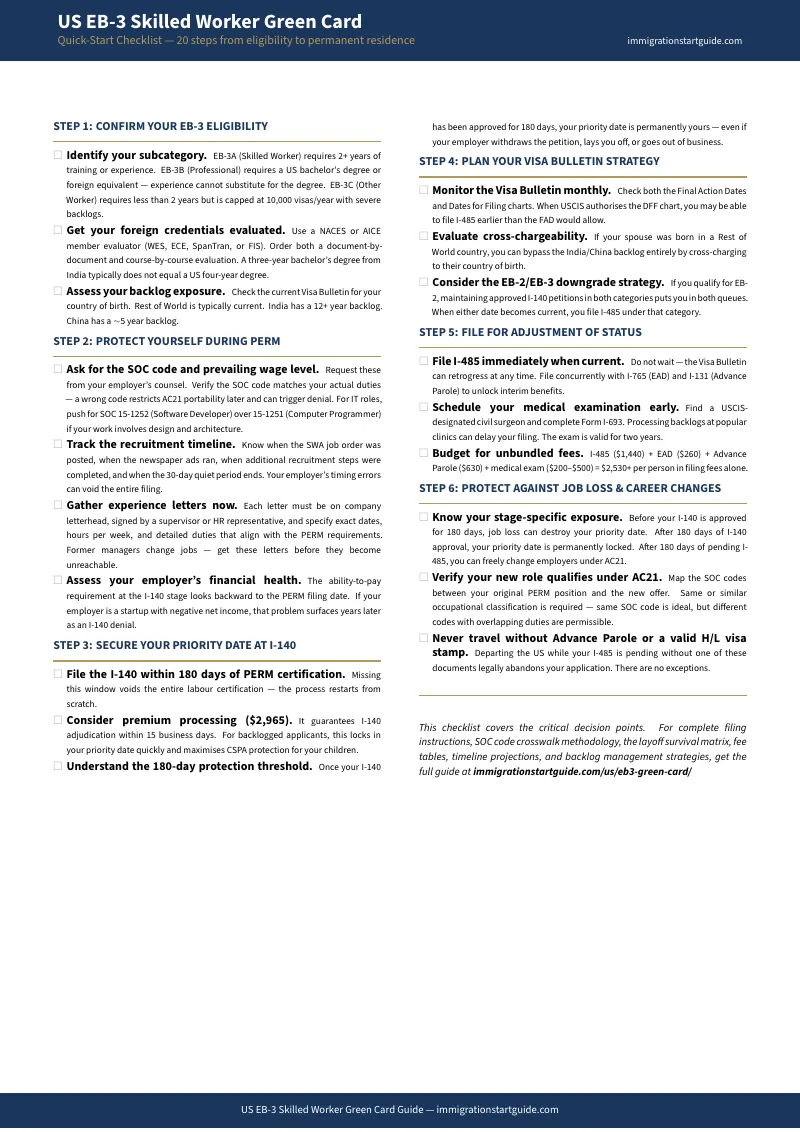
20-Step Quick-Start Checklist (free download)
The critical decision points distilled into a single action sheet: confirm EB-3 eligibility, protect yourself during PERM, secure your priority date, plan your Visa Bulletin strategy, file for adjustment of status, and prepare for job loss and career changes. Enough to take your first strategic step tonight.
8 Standalone Printable Worksheets and Reference Cards
Every strategic framework from the guide extracted as a standalone tool you can print and use immediately — the Layoff Survival Matrix for crisis planning, the AC21 SOC Code Crosswalk Worksheet for evaluating job changes, the EB-2/EB-3 Downgrade Decision Matrix for category strategy, the Priority Date Protection Timeline for tracking your milestones, the I-485 Document Checklist for your AOS filing, the PERM Employee Audit Checklist for protecting yourself during the labour certification, the Fee Reference Card with every 2026 cost mapped, and the Visa Bulletin Quick Reference for monthly tracking.
Who This Guide Is For
This guide is for skilled workers, professionals, and other workers whose employers are sponsoring (or planning to sponsor) an EB-3 green card — and who refuse to spend a decade waiting passively while someone else controls their case:
- Your employer just agreed to start the green card process and the attorney sent you a questionnaire about your job duties and work history — but nobody explained how what you write on that form constrains your career mobility for the next decade
- Your PERM has been pending for months with no status updates, and you don't know whether this is normal, whether an audit is coming, or what you should be doing to protect yourself
- You received a significantly better job offer but your I-485 has been pending for less than 180 days — and you are terrified that switching employers will void years of waiting
- Your company just announced layoffs and you need to know tonight whether your priority date survives termination at your specific stage of the process
- You're from India staring at a 12+ year backlog and trying to decide whether the EB-2/EB-3 downgrade strategy or a second I-140 petition is worth the $2,965 premium processing fee
- Your spouse works on an H-4 EAD and you need to understand exactly how your I-140 status controls their work authorisation — and what happens if the petition is withdrawn
- You're a nurse, physical therapist, or healthcare worker and want to know whether the Schedule A exemption applies to your role and eliminates the PERM requirement entirely
Why Not Free Resources?
Free information on the EB-3 process is abundant. Here's what it actually gives you:
- USCIS.gov and the Policy Manual explain the statutory requirements in bureaucratic prose that makes no distinction between what the employer must do and what you, the beneficiary, should be doing to protect yourself. You'll learn that the employer must file a labour certification. You won't learn how to verify that the SOC code they filed under won't trap you in career stagnation for a decade.
- Law firm blogs (Murthy, BAL, Ogletree Deakins) publish accurate legal analysis of Visa Bulletin movements and PERM processing times — because their business model is to demonstrate complexity and then offer representation at $6,000 to $15,000. They explain what AC21 portability means. They never provide the SOC code crosswalk framework that would let you evaluate a job change without paying for a consultation.
- Reddit, Trackitt, and Blind are repositories of anecdotal data from anonymous users with different countries of chargeability, filing dates, and case facts. One commenter says you can safely switch from Software Developer to Engineering Manager. Another says you'll get denied. Neither cites the USCIS policy memorandum. You're betting a decade of waiting on upvote counts.
- Prediction tools (AM22Tech, RedBus2US) track Visa Bulletin dates and estimate when your priority date becomes current. They tell you when something might happen. They cannot tell you how to manoeuvre when circumstances change — how to evaluate a downgrade, how to survive a layoff, or how to protect your spouse's work authorisation during a corporate transition.
This guide fills the strategy gap. It doesn't compete with free information — it organises, verifies, and sequences it into an actionable playbook built for the person whose name is actually on the petition. It provides the employee-side frameworks that corporate counsel is neither incentivised nor permitted to give you.
— Less Than One Hour of Attorney Billable Time
A single consultation with an immigration attorney to discuss AC21 portability or layoff contingencies costs $100 to $600 per hour. Full EB-3 representation runs $6,000 to $15,000 — paid by the employer, serving the employer. Premium processing alone costs $2,965 in government fees. A botched priority date strategy can add years to a wait that already exceeds a decade.
The guide doesn't replace an attorney for complex legal disputes. But it gives you the strategic frameworks that prevent the filing mistakes, missed timing windows, and career paralysis that cost thousands in attorney consultations and years in unnecessary waiting. It transforms you from a passive beneficiary into a prepared strategist who understands every stage of their own case.
Money-back guarantee, no time limit. If the frameworks don't give you clearer strategic control over your EB-3 process, you pay nothing.
Download the free Quick-Start Checklist to see the 20 critical decision points. When you're ready for the PERM employee playbook, AC21 SOC code crosswalk methodology, layoff survival matrix, and the complete EB-2/EB-3 strategy framework, the full guide is here.
Your priority date is your most valuable asset. Every month without a strategy is a month you can't get back.