Your Attorney Expects You to Write the Job Description. Give Them a Masterpiece.
You won the H-1B lottery. You called your parents. You posted on LinkedIn. And then your employer's immigration attorney sent you a blank questionnaire: "Please describe your job duties and explain how your degree relates to the position."
You stare at it for an hour. You write "develop software applications" and immediately wonder if that's too vague. You search Reddit. One person says their generic description sailed through. The next person says the same wording triggered a Request for Evidence that nearly ended their career in the US. At 2 AM, you're reading a third contradictory thread, and you're more confused than when you started.
Here's what nobody tells you: the attorney represents your employer, not you. Their job is to file compliant paperwork. But the raw material that determines whether your petition gets approved or triggers an RFE — your job description, your degree-to-duty mapping, your evidence organization — that burden falls entirely on you. And with employers now facing a $100,000 petition fee on top of standard filing costs, their tolerance for a weak submission is zero.
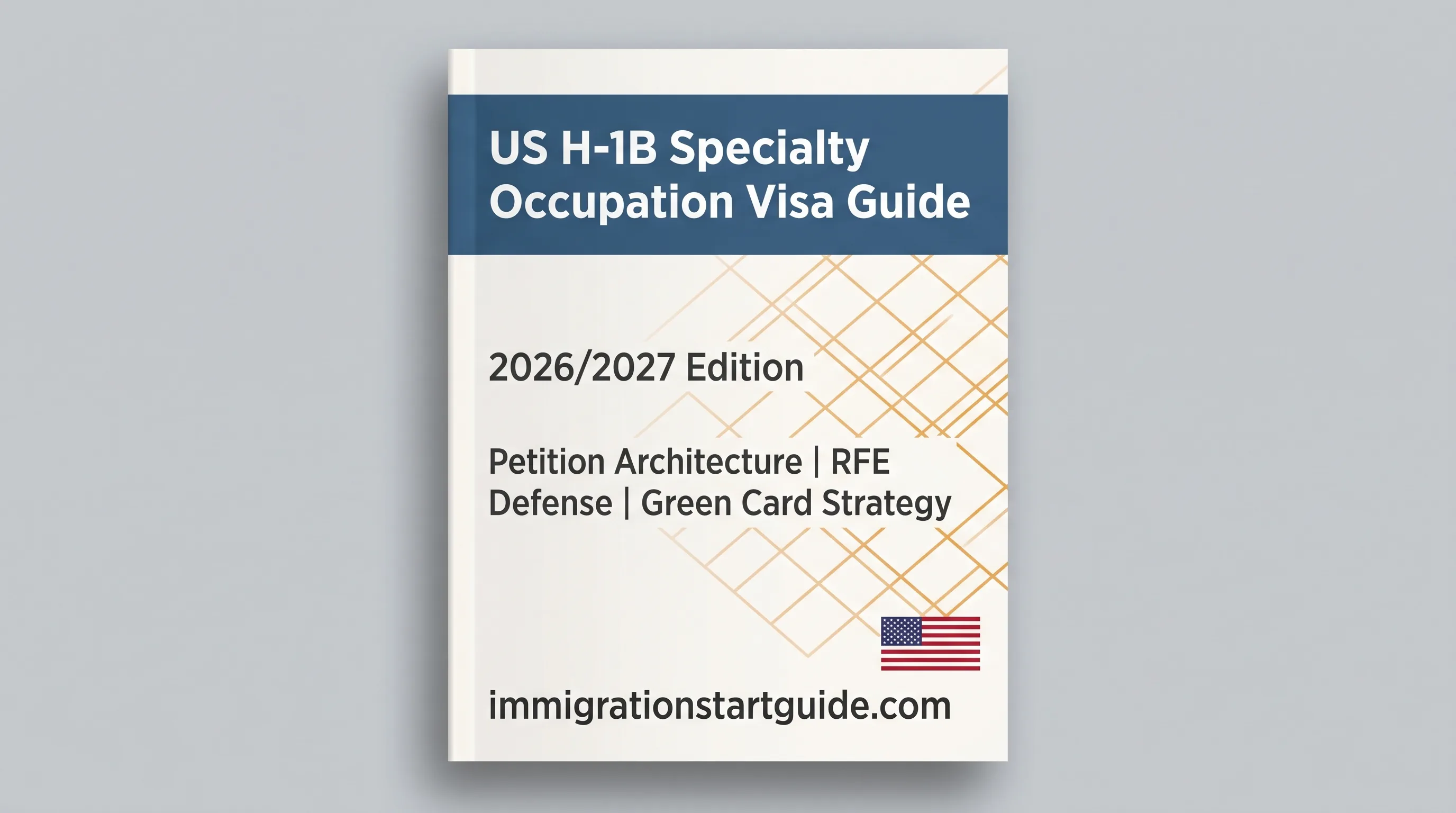
The US H-1B Specialty Occupation Visa Guide is a Petition Architecture System. Not a textbook explaining what the law says — a structured build process that produces the exact evidence USCIS adjudicators need to approve your petition. It replaces 40 hours of anxious forum scrolling with a step-by-step workflow you can complete in an afternoon.
What's Inside the Petition Architecture System
9 PDFs — the complete guide plus 7 standalone printable tools you can bring to your desk, hand to your employer, or take to your consular interview:
The Coursework-to-Duty Matrix Builder
The single most important document in any H-1B petition. A fillable framework that maps each specific job duty (with percentage-of-time allocations) to the exact university courses from your transcript — proving the "directly related" degree nexus required under the 2025 Modernization Rule. This is why Business Administration graduates get denied while Computer Science graduates with identical roles get approved: the matrix makes the connection explicit. When USCIS sees a coursework grid instead of a paragraph, they see evidence, not an argument.
RFE Response Frameworks by Category (Chapter 7)
If you receive a Request for Evidence, you have 87 days before your career in the US ends. The guide provides structured response templates for the three most common RFE types — Specialty Occupation, Beneficiary Qualifications, and Employer-Employee Relationship. Each framework includes a cover letter template, exhibit labeling structure, and a professional table of contents. Because an RFE response that buries the adjudicator in 50 unorganized pages is worse than no response at all.
Expert Opinion Letter Brief Template
When your degree doesn't obviously match your role — Mechanical Engineering working as a Data Scientist, or Business Administration in a Financial Analyst position — you need a university professor or credential evaluator to write a letter explaining why your education qualifies you. The problem: most professors have never written one and don't know what USCIS requires. The brief template tells them exactly what to state, in what order, citing which regulatory standards. You hand it to the professor, they fill in the specifics, and USCIS gets the precise analysis they're looking for.
Complete Annual Timeline and Filing Calendar
Every critical date mapped from March registration through October 1 start date: LCA filing periods, I-129 submission windows, premium processing decision points, cap-gap extension triggers, and the consular stamping timeline. Because missing a filing deadline by one day has the same outcome as never filing at all.
Prevailing Wage and Fee Worksheets
Level I through Level IV wage determination walkthroughs, total employer cost calculations for small companies (approximately $1,925) and large employers (approximately $3,280), plus the $100,000 Proclamation fee analysis — including which categories are exempt. A startup CEO can look at one page and understand exactly what sponsoring you costs.
Petition Assembly Checklist
Form I-129 preparation with every required supporting document, filing fee breakdown, and the evidence organization structure that corporate immigration attorneys use internally. The difference between a strong petition and a weak one isn't the evidence — it's how the evidence is organized, labeled, and cross-referenced.
Consular Processing and Interview Preparation
DS-160 preparation, the questions consular officers actually ask (and the answers that trigger Section 221(g) administrative processing holds), which documents to bring and which to leave at home, and the strategy for handling delays when your visa is placed in administrative processing for weeks or months.
Job Portability and Six-Year Clock Management
How to transfer your H-1B to a new employer without re-entering the lottery, concurrent employment rules, the 60-day grace period after termination, time recapture for days spent abroad, and AC21 extensions beyond six years while your green card is pending. Your career isn't static — neither should your understanding of your visa flexibility.
Green Card Transition Strategy
PERM labor certification timing, I-140 filing tactics, priority date backlogs by country of birth, and the EB-2/EB-3 downgrade strategy for Indian-born applicants facing 12+ year queues. Every month you delay PERM filing pushes your permanent residence back by the same amount — understanding when to push your employer to start is worth more than any single filing tip.
H-4 Dependent and Spousal EAD Guidance
Filing timelines, the post-October 2025 rules that eliminated automatic 540-day EAD extensions, and contingency planning for gaps in your spouse's work authorization. If your family's second income depends on the H-4 EAD, this chapter prevents the surprise that leaves your household budget in crisis.
Quick-Start Checklist (free download)
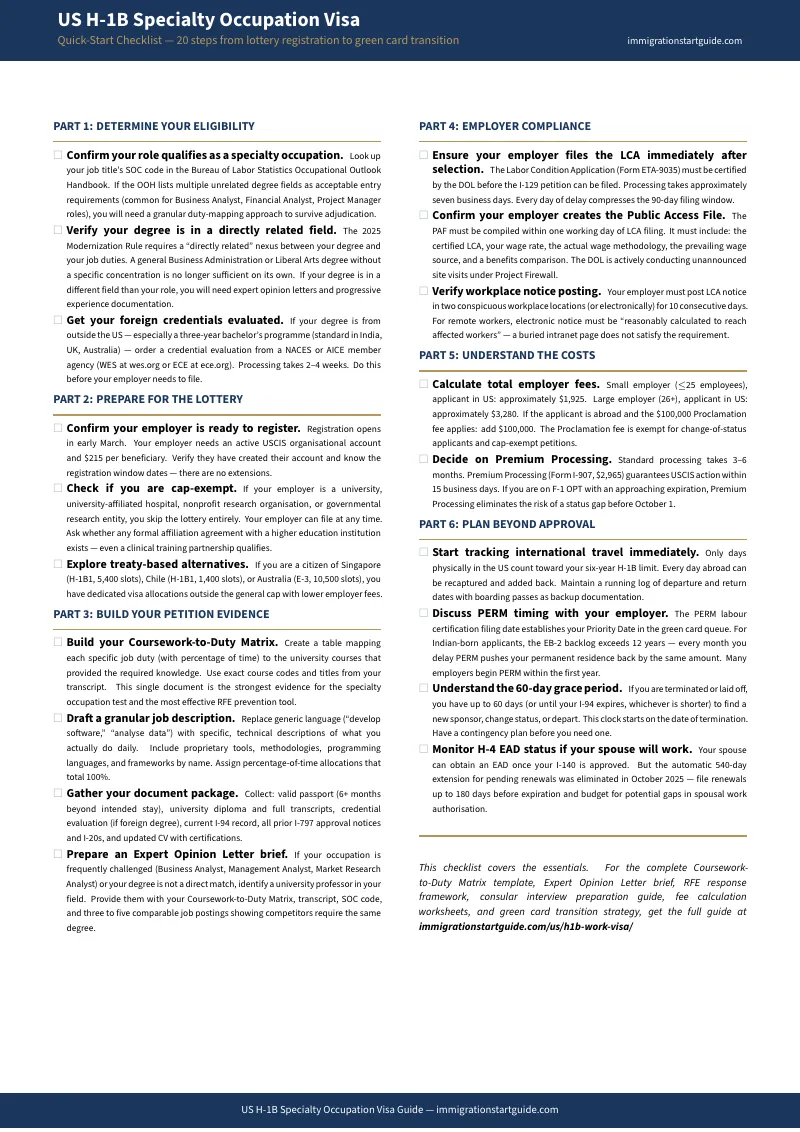
A 20-item action plan covering the essentials: confirm your specialty occupation eligibility, verify your degree nexus, check cap-exempt status, build your document package, and understand employer fees. Enough to start tonight.
Who This Guide Is For
This guide is for skilled professionals sponsored by US employers who:
- Were selected in the H-1B lottery and need to assemble a petition that survives USCIS adjudication — not just one that technically gets filed
- Are on F-1 OPT with an expiration approaching, and the H-1B is the only path to staying in the US and keeping a career worth $90,000 to $200,000+
- Work at a startup or small company with no immigration legal department, and need a resource they can hand to their CEO that explains the entire process in plain language
- Received a Request for Evidence and need a structured response framework — not another contradictory Reddit thread
- Have a degree in a different field than their current role and know USCIS will challenge the nexus
- Want to understand portability, green card timing, and long-term career strategy on H-1B status
Why Not Free Resources?
Free information exists. Government pages, law firm blogs, Reddit threads — all free, all abundant. Here's what they actually deliver:
- USCIS.gov provides the Form I-129 and its instructions. It will never provide a framework for proving why your Business Administration degree qualifies you for a Financial Analyst role. You get forms, not strategy.
- Law firm blogs (Fragomen, Murthy, Cyrus Mehta) publish excellent legal analysis — because their business model is to demonstrate overwhelming complexity and then offer a $5,000 consultation to resolve it. They explain why RFE rates fluctuate. They never provide a free template for responding to one.
- Reddit and Trackitt are where a data scientist gets told that listing "develop machine learning models" worked for someone in 2019 — without mentioning that the 2025 Modernization Rule now requires a "directly related" degree nexus that makes that same description a denial trigger in 2026. You're getting survivorship bias from strangers with different circumstances, filed under different rules.
- The Nolo book (US Immigration Made Easy, $35) covers every immigration category in 700 pages. The H-1B section is a single chapter that explains the statute. It has no fillable templates, no coursework matrices, and can't react to the $100,000 fee implementation or the latest USCIS policy memos.
This guide fills the execution gap — the space between "I understand the law" and "I can produce the evidence." It gives you the same document frameworks that corporate attorneys build internally, at a fraction of the cost of a single billable hour.
— About 9 Minutes of Attorney Billable Time
A mid-tier immigration attorney charges $300 to $500 per hour. A standard H-1B petition costs $3,000 to $7,000 in legal fees. An RFE response adds another $1,500 to $3,000 on top of that.
This guide doesn't replace an attorney for complex legal appeals. But it gives you the structured evidence and document frameworks that prevent the most common filing mistakes — the ones that trigger RFEs in the first place. If it prevents a single Request for Evidence, it saves your employer thousands and your career months of uncertainty.
Money-back guarantee, no time limit. If the frameworks don't make your petition stronger, you pay nothing.
Download the free Quick-Start Checklist to see the 20-point action plan. When you're ready for the Coursework-to-Duty Matrix builder, RFE response frameworks, and the complete petition architecture, the full guide is here.
You won the lottery. Now build a petition that deserves the approval.