
You Won the DV Lottery. Half of All Winners Never Get the Visa. The Difference Is What Happens in the Next 120 Days.
You checked the Entrant Status Check in May. Your name is there. Case number, region code, the whole thing. For a few minutes, it feels like the biggest break of your life — one of 55,000 immigrant visas, selected from nearly 20 million entries.
Then the questions start. What is the DS-260? When do you file it? You need police certificates from every country you've lived in since age 16 — but you left that country five years ago and the embassy takes eight weeks to process requests. The medical exam requires vaccinations you've never had. You need financial evidence to prove you won't become a public charge, but the consular officer's standard is vague. And everything — every form, every document, every appointment — must be complete before September 30 or your visa dies. No extensions. No exceptions.
Roughly half of all selectees never receive their visa. Not because they were ineligible. Because they missed a deadline, filed the DS-260 with an inconsistency that triggered administrative processing, submitted an expired police certificate, or simply ran out of calendar days before the fiscal year ended.
The US Diversity Visa Lottery Guide is a Post-Selection Survival System. Not a summary of the rules you can find on travel.state.gov — a structured operational playbook that takes you from selection notification through green card in hand, with every deadline mapped, every document sequenced, and every trap identified before you fall into it. Updated for the DV-2027 cycle, including the $1 registration fee, the passport upload requirement, and current Visa Bulletin cut-off patterns.
What's Inside the Post-Selection Survival System
A 12-chapter guide, a 20-step quick-start checklist, two standalone printable reference sheets, and the document sequencing strategy that keeps you ahead of the September 30 deadline:
The DV Program Mechanics and Why Over-Selection Creates a Race
The Department of State selects roughly 130,000 entries for 55,000 available visas. That's deliberate — they expect half of selectees to fail. The guide explains the statutory framework under INA §203(c), the regional allocation formula, the legislative offsets that reduce the actual visa count below 55,000, and how your case number determines your position in the queue. Understanding the system isn't optional — it's how you estimate your interview window and build a timeline that doesn't collapse in August.
Eligibility Analysis and Cross-Chargeability
Eligibility is based on country of birth, not citizenship. Born in an ineligible country but married to someone born in an eligible one? Cross-chargeability may save your case. The guide covers the education requirement (GED does not qualify), the work experience alternative using O*NET Job Zone 4-5 classifications, and the consistently ineligible countries versus those that fluctuate by cycle.
Registration Strategy for the DV-2027 Cycle and Beyond
The entry window is 35 days. One entry per person, verified by facial recognition. The guide covers the $1 fee, the passport upload requirement, the spousal double-entry strategy that legally doubles your household's chances, and why your confirmation number is irreplaceable — the Department of State cannot recover it. For future cycle entrants: the photo compliance chapter alone prevents the most common cause of automatic disqualification.
Photo Compliance That Survives Automated Screening
600×600 to 1200×1200 pixels, JPEG, 240 KB maximum, plain white background, no eyeglasses, neutral expression, taken within the last 6 months. These are the published specs. The guide goes deeper: the head positioning and eye-level calculations that pass the Department of State's automated validator, the six-month recency enforcement, and how to verify your photo before submission so a $1 entry doesn't get discarded because of a shadow on the background.
The Post-Selection Action Sequence — DS-260 Through KCC Processing
This is where most selectees lose their visa. The DS-260 requires complete address, employment, and family history — and every field must be consistent with your supporting documents. An address you listed on the DS-260 but didn't provide a police certificate for? That's a 221(g) administrative processing hold. A family member you forgot to list? Automatic denial at the interview, no waiver available. The guide walks through each section of the DS-260, flags the fields that trigger scrutiny, and gives you the consistency checks to run before you hit submit.
Country-by-Country Police Certificate Procurement Map
You need certificates from every country where you've lived for six months or more since age 16. For the country you're in now, that's straightforward. For the country you left three years ago, it's a logistical operation involving embassy requests, processing queues, and validity periods that can expire before your interview date. The guide maps procurement for high-volume countries — Nigerian POSSAP (2-4 weeks, requires NIN registration and in-person biometrics), Ethiopian clearances (2-4 weeks minimum), and the "third country" challenge for applicants with multinational residence histories.
Medical Exam Timing and the TB Delay Risk
High-volume embassy posts like Lagos, Addis Ababa, and Kathmandu book out weeks in advance during DV season. A positive TB screening triggers a sputum culture that takes 6-8 weeks — which can push a July or August selectee past the September 30 deadline. The guide covers vaccination requirements (MMR, polio, Tdap, varicella, Hepatitis B, seasonal influenza), when to schedule relative to your interview, and why a private pre-screening is the cheapest insurance against a timeline-destroying delay.
Financial Evidence and the Public Charge Rule
The distinction between Form I-134 (Declaration of Financial Support used at the consulate) and Form I-864 (Affidavit of Support for other categories) confuses even experienced immigration researchers. The guide explains what consular officers actually evaluate under the totality-of-circumstances standard, the strongest evidence combinations (bank statements + US sponsor + job offer), and how to structure a financial case when you don't have a US sponsor or formal employment offer.
Consular Interview Preparation and 221(g) Administrative Processing
The interview is the final gate — and for DV applicants, administrative processing under Section 221(g) is uniquely dangerous. Other visa categories survive a processing delay. DV applicants don't. If your case is placed on hold and the hold outlasts September 30, your visa is gone permanently. The guide covers the document checklist, the most common denial reasons (education fraud, DS-260 inconsistencies, undisclosed family members), the questions officers ask, and the "front-loading" strategy that minimizes the chance of a 221(g) hold.
Adjustment of Status for US-Based Selectees
If you're in the US on an F-1, H-1B, or J-1 and you win the lottery, you can adjust status through USCIS instead of consular processing. But there's no premium processing for DV-based I-485 applications, you can't file until your rank number is current in the Visa Bulletin, and you still owe the $330 DV processing fee to the Department of State. The guide maps the AOS timeline, the "Dates for Filing" versus "Final Action Dates" distinction, and the decision framework for choosing between AOS and consular processing.
Special Situations — CSPA, Derivative Beneficiaries, and Political Risk
The Child Status Protection Act formula for children approaching age 21, what happens when marital status changes after selection, derivative beneficiary procedures, and the political proposals to eliminate the DV program entirely — context that helps you understand why acting quickly on each cycle matters more than it did five years ago.
Scam Identification and Full Cost Breakdown
The Department of State never contacts winners by email, mail, or phone. Every notification comes through the Entrant Status Check. The guide covers the broker scam patterns in high-volume countries, the "confirmation number ransom" scheme, and the complete fee breakdown from the $1 registration through the $220 USCIS Immigrant Fee — so you know exactly what legitimate costs to expect at every stage.
Police Certificate Procurement Map (standalone printable)
Country-by-country reference card with processing times, validity periods, and ordering steps for high-volume DV countries — Nigeria (POSSAP), Ethiopia, Nepal, Ghana, Kenya, Bangladesh, and Uzbekistan. Includes a fillable tracking table so you can record when you ordered each certificate, when you expect it, and when it expires. Print it and work from it as you sequence your documents.
Consular Interview Checklist (standalone printable)
The complete document checklist for interview day, the seven most common interview questions with what each one actually tests, the top denial triggers, and the Section 221(g) front-loading prevention strategy. Print this and review it the night before your appointment.
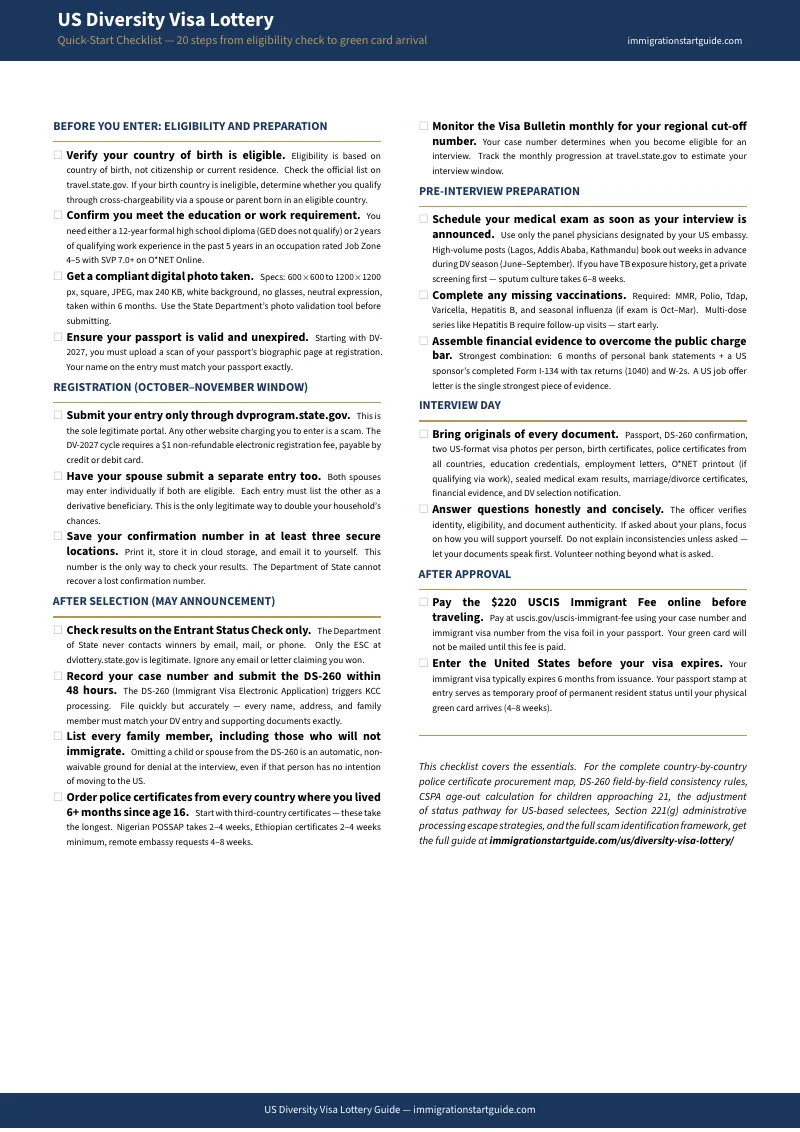
Quick-Start Checklist (free download)
A 20-step action plan covering eligibility verification, registration, post-selection document sequencing, and interview preparation. Enough to start tonight.
Who This Guide Is For
This guide is for DV lottery entrants and selectees from eligible countries who:
- Have been selected in the DV lottery and need a structured plan to convert that selection into a green card before the September 30 deadline — not fragments of advice from forum threads written by people with different case numbers and different embassies
- Are entering the DV lottery for the first time and want to avoid the technical errors (photo non-compliance, duplicate entries, incorrect biographical data) that disqualify entries before the drawing even happens
- Need police certificates from multiple countries — including countries where they no longer live — and don't know how long each one takes or when the validity period starts ticking
- Are in the United States on a student or work visa and need the adjustment of status roadmap — Visa Bulletin tracking, I-485 filing timing, and the decision between AOS and consular processing
- Want to understand the financial evidence requirements without paying $2,000-$5,000 for an immigration attorney to tell them the same information this guide contains
- Have a high case number and need to know whether their number is likely to become current — or whether consular processing will move fast enough to beat September 30
Why Not Free Resources?
Free information about the DV lottery exists in enormous quantities. Government websites, community forums, immigration attorney blogs, YouTube explainers — all free, all available right now. Here's what they actually deliver:
- Travel.state.gov publishes the official instructions, the eligible country list, and the DS-260 form. What it won't tell you: which DS-260 fields trigger administrative processing holds, how to sequence third-country police certificates so they don't expire before your interview, or why submitting the DS-260 fast but inaccurately is worse than submitting it carefully a week later. You get rules, not strategy.
- BritSimonSays and community forums are the best free resource in the DV space — genuinely helpful, staffed by people who understand the system. But they are unstructured. Finding the answer to your specific question means reading through hundreds of threads, sorting contradictory advice from different fiscal years, and hoping the person who answered shares your regional conditions. The person who got denied rarely posts their story.
- Immigration attorney blogs explain the DV process in careful, qualified detail — because their business model is to demonstrate enough complexity to justify a $2,000-$5,000 consultation. They will never publish the document sequencing timeline or the DS-260 consistency framework that makes their filing service unnecessary.
- YouTube channels in Amharic, Nepali, French, and Arabic provide accessible overviews — but "accessible" means general. They cover what documents you need, not the procurement map that tells you exactly how long each one takes in your country and when to start so validity periods don't expire.
This guide fills the structure gap — the space between "I know I was selected" and "every document is sequenced, every deadline is mapped, and my interview is prepared." It gives you the operational playbook that immigration attorneys charge thousands to walk clients through verbally.
— Less Than One Police Certificate
An immigration attorney charges $2,000 to $5,000 for DV lottery case management. A single police certificate in Nigeria can cost up to ₦40,000 through expedited processing. The consular interview fee alone is $330 — and if you're denied because of a document gap, that money is gone along with your once-in-a-lifetime opportunity.
This guide doesn't replace an attorney for complex cases involving criminal history, prior visa denials, or removal proceedings. But for the selectee who needs to convert a winning lottery number into a green card — with every document in the right order, every deadline tracked, and every trap identified in advance — it replaces the 50 hours of forum research and the $3,000 attorney engagement with a structured system you can follow from selection day to arrival in the US.
Money-back guarantee, no time limit. If the Post-Selection Survival System doesn't make your DV process clearer and more manageable, you pay nothing.
Download the free Quick-Start Checklist to see the 20-step action plan covering eligibility through interview day. When you're ready for the DS-260 consistency framework, the police certificate procurement map, and the complete post-selection timeline, the full guide is here.
55,000 visas. 130,000 selectees. The lottery chose you — the next 120 days decide whether you keep it.