
You Invested $200,000 in a US Degree. One Wrong Move on OPT Can Erase It All in 90 Days.
You did everything right. Got accepted to a strong program. Passed the visa interview. Maintained full-time enrollment for two years. Graduated. Filed for OPT. And now you are staring at the 90-day unemployment clock, wondering whether the unpaid research gig your professor offered actually counts, whether your employer is on E-Verify, whether 12 months of full-time CPT during your co-op permanently killed your OPT eligibility, and whether the $100,000 H-1B fee everyone is panicking about on WhatsApp actually applies to you.
So you search Reddit. One person says unpaid work stops the unemployment clock. The next says it doesn't count unless you are on payroll. A third says the $100,000 fee only applies to consular processing, but someone else says it affects everyone. Your DSO takes two weeks to answer emails and manages 800 students. Your friends who graduated last year tell you what worked for them, except the H-1B lottery switched to beneficiary-centric selection in FY2025, the wage-weighted system starts in FY2027, and premium processing fees jumped to $2,965. What worked for your seniors is legally obsolete.
Here is the structural problem: the F-1 to H-1B pathway is not one process. It is a pipeline with six stages, five agencies, a dozen forms, and a handful of traps where a single procedural error terminates your SEVIS record, ends your work authorization, and forces you to leave the country. Your university teaches you none of this. Your DSO handles compliance paperwork, not career strategy. Reddit gives you fragments from people in different situations at different times under different rules. And immigration lawyers charge $350 an hour for consultations that tell you what to file but not when, in what sequence, or how to negotiate H-1B sponsorship from a position of strength.
The US F-1 Student Visa + OPT Pathway Guide is built around the Full Pipeline Strategy — a unified, stage-by-stage framework that connects your academic choices to your CPT usage to your OPT start date to your STEM extension to your H-1B lottery odds to your backup options if the lottery fails. This is not a summary of immigration rules you can find on USCIS.gov. This is the strategic playbook that shows you how to use every rule to your advantage: how to freeze the 90-day unemployment clock with qualifying unpaid work, how to avoid the full-time CPT trap that permanently kills OPT eligibility, how to align your OPT timeline with the H-1B filing season, how to negotiate sponsorship before accepting an offer, and how to build an O-1 evidence portfolio as a fallback starting from day one of your program.
What's Inside
The complete 18-chapter guide plus 5 standalone printable tools — covering every stage from university selection through the H-1B transition and beyond:
The Full Pipeline Strategy
The guide's core framework. Instead of treating the F-1 visa, CPT, OPT, STEM OPT, and H-1B as separate processes you figure out one at a time, the Full Pipeline Strategy maps every stage as a connected sequence where decisions at each point constrain or expand your options at the next. A master timeline from program start through H-1B activation shows exactly when each milestone must be completed, what forms to file, and how the stages synchronize. You make decisions with full visibility into their downstream consequences — not in isolation, not in panic.
The 90-Day Unemployment Survival Plan
The single most dangerous clock in the F-1 system. Once your OPT start date arrives, you have 90 days of total unemployment before your SEVIS record is terminated. Most students do not know that unpaid internships, volunteer work in their field, self-employment through an LLC, and freelance consulting all legally stop the clock — as long as the work is related to your major and involves at least 20 hours per week. Students routinely waste 60 to 70 unemployment days waiting for paid offers because no one told them unpaid qualifying work freezes the timer. The guide walks through every option that counts, how to document it, and the specific Department of Labor guidelines you must follow for unpaid internships.
The CPT Trap Detector
If you accumulate 12 months or more of full-time Curricular Practical Training, you permanently lose OPT eligibility. No waiver, no exception, no appeal. Many students discover this only when they try to apply for OPT and their DSO tells them they are ineligible. The guide explains exactly how full-time versus part-time CPT is counted, why students doing co-op rotations are at highest risk, the 11-month safety ceiling strategy, and the separate risk analysis for Day 1 CPT programs — including how USCIS scrutinizes Day 1 CPT during later H-1B and green card adjudications.
The H-1B Lottery Playbook
The FY2026 lottery selected roughly 35% of applicants. Starting FY2027, selection is weighted by wage level — Level I (entry-level) workers face approximately 15% odds, while Level IV (senior) workers see roughly 61%. The guide covers the beneficiary-centric registration system, how wage levels are determined by occupation and metro area, the specific salary thresholds you need to cross to reach Level II or III, and the geographic arbitrage strategy where the same job title may qualify as Level II in a smaller metro but only Level I in San Francisco.
The $100,000 Fee Decoder
The September 2025 presidential proclamation sent every international student WhatsApp group into panic. The guide breaks down exactly who the fee applies to (beneficiaries outside the US requiring consular processing), the critical exemption for anyone in valid F-1/OPT status inside the US whose employer files as a Change of Status, and why maintaining unbroken legal status until H-1B approval has never been more consequential. If your status lapses and you leave the country, your employer faces a $100,000 fee that will almost certainly kill your petition.
The STEM OPT Extension Framework
STEM graduates get 36 months of work authorization and up to three H-1B lottery attempts instead of one. But the extension requires your employer to be on E-Verify, demands a completed I-983 Training Plan with specific learning objectives and employer-signed evaluations, bans self-employment, and subjects you to potential unannounced ICE site visits. The guide covers eligibility verification, E-Verify enrollment checks, the I-983 preparation process, the 180-day automatic extension while USCIS processes your application, and the critical filing deadline you cannot miss.
Alternative Visa Decision Trees
For the 65% of applicants who are not selected in the H-1B lottery: the guide maps every viable alternative pathway — cap-exempt H-1B positions at universities and research institutions, the O-1A extraordinary ability visa with a portfolio-building strategy you start during your studies, the L-1 intracompany transfer through an employer's overseas office, the EB-2 National Interest Waiver self-petition for researchers and PhD graduates, and the E-2 treaty investor visa for students who start businesses. Each pathway includes eligibility criteria, timeline, costs, and a structured decision tree that helps you identify the strongest option for your specific situation.
Complete Fee Reference, Forms Guide, and Filing Checklists
Every fee you pay as a student ($350 SEVIS, $185 DS-160, $470 I-765 online, $1,780 premium processing) and every fee your employer pays for H-1B sponsorship ($2,010 to $3,595 in mandatory filing costs plus $2,965 optional premium processing). Filing checklists for the OPT application package, the STEM OPT extension package, and the H-1B sponsorship conversation with your employer. A forms quick reference for all 12 critical forms. And a complete directory of government URLs, sponsorship research tools, and tax resources for nonresident aliens.
Who This Guide Is For
- International students preparing to apply for F-1 visas — the guide covers university selection with immigration strategy in mind (SEVP certification, STEM CIP codes, DSO quality), the DS-160 filing, the 214(b) visa interview strategy, and port-of-entry procedures
- Current F-1 students planning their post-graduation pathway — the Full Pipeline Strategy, CPT tracking, OPT application timeline with the 30-day and 60-day filing deadlines, and the unemployment clock survival plan
- STEM graduates who need the 24-month extension — E-Verify verification, I-983 Training Plan preparation, the automatic 180-day extension, and the stricter rules around self-employment and site visits
- OPT workers preparing for the H-1B lottery — wage-level strategy under the new weighted system, employer sponsorship negotiation, cap-gap bridge mechanics, and the $100,000 fee exemption for Change of Status filers
- Students who lost the H-1B lottery and need a backup plan — the alternative visa decision trees covering O-1A, cap-exempt H-1B, L-1, EB-2 NIW, and Day 1 CPT risk analysis
Why Not Free Resources?
- USCIS.gov tells you what the law requires. It does not tell you how to choose your OPT start date strategically, how to freeze the unemployment clock with qualifying unpaid work, or how to negotiate H-1B sponsorship during the interview process. You get rules, not a plan.
- Reddit and Trackitt give you crowdsourced anecdotes from people who filed under different rules, at different times, with different degree types. The person who says "OPT was easy" had a STEM degree and a job offer on graduation day. The person who says "I got terminated" did not know unpaid internships stop the clock. Without understanding which variables drive your specific outcome, other people's stories create panic, not clarity.
- Your DSO manages 800+ students, is legally required to protect the university's compliance rather than optimize your career, and provides procedural forms — not strategic advice on salary negotiation, lottery odds, or alternative visa pathways. When you make a mistake, the DSO's mandate is to terminate your SEVIS record, not advocate for you.
- Immigration lawyers charge $200 to $350 for a 30-minute to 60-minute consultation and $2,500 to $5,000 to file an H-1B petition. They are essential for execution — but at those rates, they are too expensive for the multi-year strategic planning that starts when you pick your major and ends when your H-1B is approved. The Full Pipeline Strategy provides the strategic architecture that lawyers structurally cannot deliver at a price students can afford.
- Amazon books on F-1 visas are published once and frozen in time. Books from 2023 or 2024 miss the beneficiary-centric lottery change (FY2025), the wage-weighted selection system (FY2027), the $2,965 premium processing fee increase, and the $100,000 H-1B fee proclamation. In a regulatory environment that changes every six months, a printed book is not just incomplete — it is potentially dangerous.
This guide fills the strategy gap — the space between knowing that OPT exists and having a connected, stage-by-stage plan that maximizes your work authorization runway, optimizes your H-1B lottery odds, and ensures you have a viable backup if the lottery fails. It provides the same multi-year pipeline planning that boutique immigration firms build for corporate clients, focused entirely on international students navigating the system independently.
— 15% of One Lawyer Consultation
A single 30-minute immigration lawyer consultation costs $200 to $350. An H-1B filing runs $2,500 to $5,000 in legal fees alone. Premium processing for your OPT EAD is $1,780. And your US education — the investment this entire pathway is designed to monetize — cost $50,000 to $200,000 or more.
This guide does not replace legal counsel for complex RFEs, SEVIS reinstatement, or removal proceedings. But it gives you the Full Pipeline Strategy, the unemployment survival plan, the CPT trap detector, the H-1B lottery playbook, and the alternative visa decision trees that prevent the procedural errors and strategic blind spots that derail international students every year.
If it prevents a single wasted unemployment day, a single missed filing deadline, or a single avoidable SEVIS termination, it pays for itself before you finish reading the first chapter.
Money-back guarantee, no time limit. If the guide does not make your immigration pathway clearer, you pay nothing.
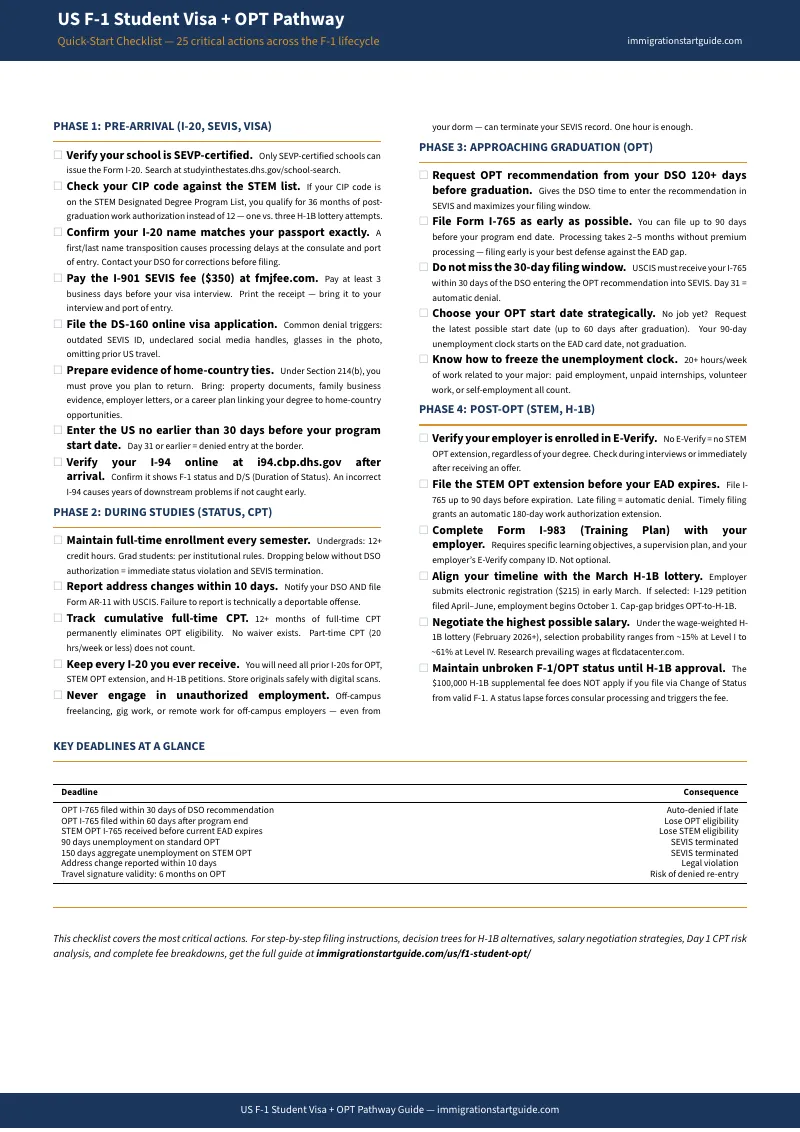
Download the free Quick-Start Checklist to see the 25 most critical action items across the F-1 lifecycle and identify where you stand right now. When you are ready for the complete Full Pipeline Strategy, the unemployment survival plan, the H-1B lottery playbook, and the 18-chapter execution framework, the guide is here.
Your degree is the investment. This is the plan that makes it pay off.