
You're About to Wire $100,000+ Into a US Business Before Anyone Tells You Whether Your Visa Will Be Approved. The Attorney Filing Your Petition Expects You to Show Up With the Business Already Chosen.
You've spent weeks reading about the E-2 Treaty Investor Visa. You've scrolled through law firm blogs that all say the same thing: "The investment must be substantial. It depends on the circumstances." You've searched Reddit threads where one person claims $50,000 is enough and another insists on $200,000 minimum. You've had a free consultation with an immigration attorney who quoted $7,000 to $15,000 in legal fees and then asked what business you're planning to invest in.
And that's where it falls apart. Because the attorney expects you to arrive with a business model, an investment amount, and a corporate structure already decided. The business plan writer expects you to hand them financial assumptions. The franchise broker is pushing brands that pay the highest commission — often 40% to 50% of the franchise fee — not the brands with the highest E-2 approval probability. And every dollar you spend on leases, equipment, and franchise fees is irrevocably committed before the consular officer decides whether your visa is approved or denied.
The US E-2 Treaty Investor Visa Guide is a Proportionality Strategy System — the foundational business and immigration architecture you need before the attorney billable hours begin. It covers the exact Proportionality Test thresholds for quantifying "substantial" capital, the Marginality Test that causes more E-2 denials than any other factor, consulate-specific filing playbooks for London, Paris, Toronto, and Tokyo, the escrow mechanism that protects your capital against denial, franchise evaluation mechanics, corporate structuring for future green card transitions, and the complete cost breakdown — giving you the strategic clarity to structure your investment correctly before committing a single dollar to an attorney or business plan writer.
What's Inside the Proportionality Strategy System
12 chapters covering every decision from treaty eligibility verification through green card transition architecture, a printable 18-step quick-start checklist, and 6 standalone printable tools you can bring to attorney consultations, franchise evaluations, and financial planning meetings:
The Proportionality Test Decoded (Chapter 2)
Every free resource answers "How much do I need to invest?" with "It depends." This chapter provides the actual answer. The Proportionality Test under 9 FAM 402.9-6(D) uses an inverted sliding scale: low-cost enterprises ($50K-$150K) require 90-100% personal investment; mid-range ($200K-$500K) require 50-75%; high-cost ($1M+) require 25-40%. The chapter walks through concrete dollar thresholds at each level, explains why loans secured against the business assets do not count as personal at-risk capital (the distinction that triggers more denials than any other financial error), and covers the escrow mechanism under 9 FAM 402.9-6(B) that protects your largest expenditure against a visa denial while still satisfying the irrevocable commitment standard.
The Marginality Test — Why Your Business Plan Is the Real Visa Application (Chapter 3)
Marginality is the leading cause of E-2 denial. A marginal enterprise generates enough income to cover the investor's living costs and nothing more — no broader economic impact, no US job creation. This chapter explains the five-year window for demonstrating non-marginality, why you do not need employees on day one (a persistent myth), what GAAP-compliant financial projections must demonstrate, and how to structure a hiring plan that satisfies the consular officer's scrutiny. Because a $1,500 business plan formatted on premium paper cannot rescue a business model that was structurally marginal from the start.
Source of Funds Documentation (Chapter 4)
Two simultaneous burdens: prove where your capital came from and trace every dollar through every intermediary account, currency conversion, and wire transfer into the US enterprise. This chapter provides documentation frameworks for salary accumulation, real estate proceeds, business profits, inheritance, and personal loans — plus the specific gaps that trigger fraud inquiries. A single unexplained bank deposit can derail an otherwise strong application. The chapter shows how to build a clean, unbroken chain of evidence before you ever wire funds to the US.
Franchise Evaluation Mechanics (Chapter 6)
Franchises have the highest E-2 approval rates — proven models, standardised financials, and built-in job creation. But selecting the wrong franchise guarantees a denial. This chapter covers which franchise sectors are structurally E-2 friendly (home services, senior care, B2B services), which models fail the "develop and direct" requirement (fully automated, absentee-ownership concepts), how to independently evaluate Franchise Disclosure Documents (Item 19 financial performance, Item 7 total investment, Item 5 franchise fee), and why you should never rely solely on a franchise broker whose compensation is a 40-50% commission from the franchisor.
Consulate-Specific Filing Playbooks (Chapter 7)
An E-2 binder formatted for Tokyo will be rejected in London. London mandates pre-registration with the E-Visa Unit, imposes a strict 50-page limit, and now uses a rotating pool of 14 general officers rather than dedicated E-visa specialists. Paris requires a single PDF with tabs A through L and a separate 50-page cap. Toronto requires registration through eVisaCanada with a 50-page/20MB limit. Tokyo demands A4 paper with lettered tabs A through I. This chapter provides post-specific formatting requirements, document curation strategies, and interview preparation for each major consular post — because non-compliant formatting results in rejection before substantive review even begins.
Green Card Transition Architecture (Chapter 11)
The E-2 has no direct path to permanent residency. But the business you build on it does — if you structure the corporate entity correctly from day one. This chapter covers the EB-1C Multinational Executive/Manager pathway (structure the US entity as a subsidiary of your foreign company to qualify), the EB-2 National Interest Waiver for advanced-degree entrepreneurs, and the EB-5 upgrade path when retained earnings reach $800,000. The single structural decision you make at incorporation — forming the entity as a personal LLC versus a corporate subsidiary — permanently determines which green card pathways remain open in years two through five.
Complete Cost Breakdown (Chapter 12)
The all-in cost of an E-2 application extends far beyond the investment itself. This chapter itemises every fee: corporate formation ($500-$2,000), business investment ($50,000-$500,000+), immigration attorney ($4,000-$15,000), business plan writer ($1,500-$3,500), MRV consular fee ($315), USCIS I-129 filing ($510-$1,015), premium processing ($2,965), reciprocity fees (varying by nationality), and ongoing renewal costs. A consolidated budget table shows the true total so you can plan capital allocation before committing to any single expenditure.
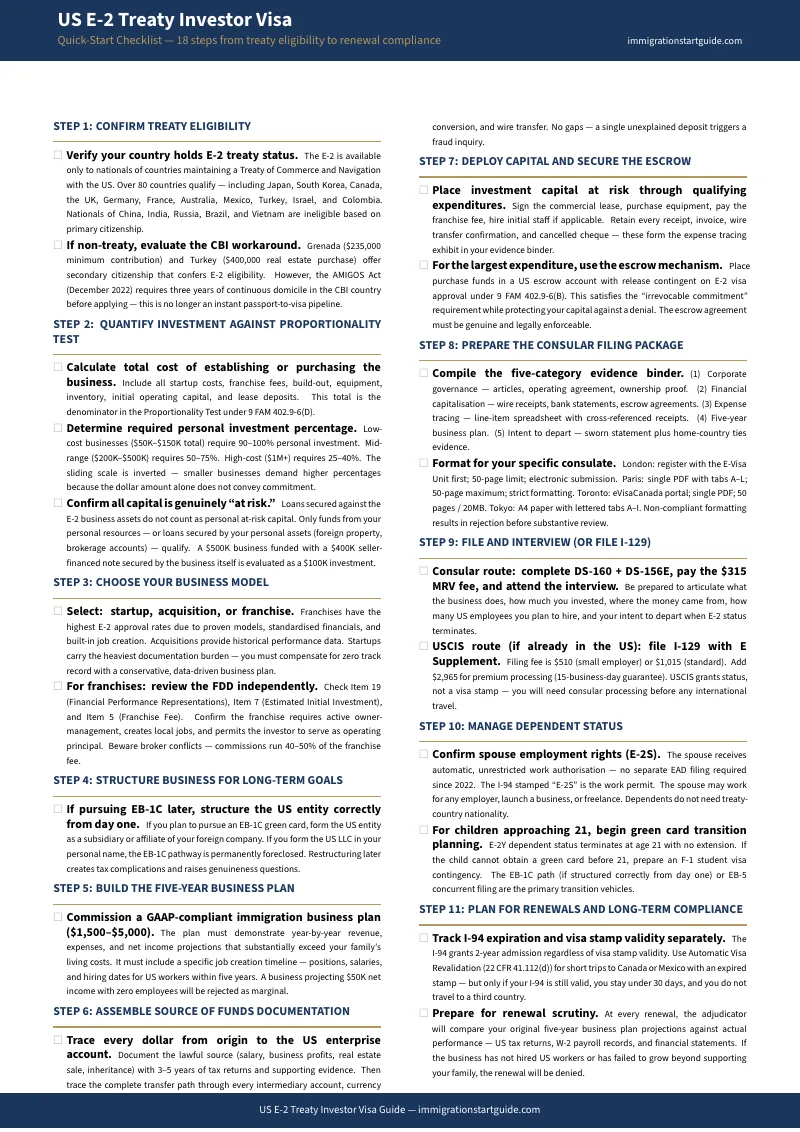
18-Step Quick-Start Checklist (free download)
The critical decision points distilled into a single action sheet: verify treaty eligibility, calculate your proportionality threshold, choose your business model, structure the entity for green card optionality, build the business plan, assemble source of funds documentation, and format your consular binder. Enough to take your first strategic step tonight.
6 Standalone Printable Tools
Extracted from the guide for quick reference in meetings, attorney consultations, and franchise evaluations:
- Proportionality Test Reference Card — the inverted sliding scale with dollar thresholds, at-risk capital rules, and the escrow mechanism on one page
- Source of Funds Documentation Checklist — every required document by source type (salary, real estate, business profits, inheritance, loans) with common pitfalls
- Franchise Evaluation Worksheet — FDD review framework (Items 5, 7, 19), E-2 viability scorecard, and broker conflict warnings
- Consulate Filing Playbooks — post-specific requirements for London, Paris, Toronto, and Tokyo with page limits, tab structures, and registration procedures
- Green Card Transition Planner — EB-1C, EB-5, and EB-2 NIW pathway comparison, the day-one corporate structuring decision, and the dependent age-out urgency table
- Cost Breakdown Budget Worksheet — every fee itemised with a fillable budget planner for your specific scenario
Who This Guide Is For
This guide is for treaty-country nationals who refuse to commit $100,000+ in irrevocable capital based on fragmented Reddit advice, vague attorney consultations, and commission-driven broker recommendations:
- You've had a free consultation with an immigration attorney — and left with a fee quote but no guidance on whether your business idea will actually pass the Proportionality Test or survive the Marginality analysis
- You're evaluating franchises and every broker is recommending a different brand, each conveniently paying a high commission — and you need an objective framework to evaluate FDDs against E-2 requirements independently
- You're planning to transition from H-1B or L-1 employer-dependent status to E-2 entrepreneurship — and you need to understand how to structure the enterprise so your future green card options remain open
- You're a national of a high-volume treaty country (Japan, South Korea, Canada, UK, Germany, France, Australia, Mexico) and you want to understand exactly how the consulate in your jurisdiction processes E-2 applications — including post-specific formatting rules that no blog post covers
- You've been told the E-2 is a "dead end" with no green card path — and you want to understand the EB-1C, EB-2 NIW, and EB-5 transition strategies that make permanent residency achievable within three to five years
- You're from a non-treaty country and exploring the Citizenship by Investment workaround — and you need the full picture on the AMIGOS Act three-year domicile requirement, updated 2026 costs, and realistic timelines before committing $235,000+ to Grenada or $400,000 to Turkey
Why Not Free Resources?
Free information on the E-2 visa is abundant. Here's what it actually delivers:
- The Foreign Affairs Manual (9 FAM 402.9) is the regulatory source that consular officers use to adjudicate your application. It is also written in impenetrable statutory language for government officials, not entrepreneurs. You'll learn that your investment must be "substantial." You won't learn that a $500,000 franchise funded with a $400,000 seller-financed note secured against the business is evaluated as a $100,000 investment — because the business is collateralising itself, not you.
- Law firm blogs are SEO content designed to capture top-of-funnel traffic and generate consultations. Every article explains what the E-2 requirements are. None provide the operational thresholds, proportionality percentages, or consulate-specific formatting rules required to actually structure the business and prepare the filing. They answer "What is the E-2 visa?" twenty different ways. They never answer "How much is enough?" with a number.
- Reddit (r/e2visa, r/immigration, r/entrepreneur) provides unfiltered peer experiences — and rampant misinformation. One user was told by an attorney that he needed an office and two US employees before applying (he didn't — he needed a credible five-year hiring plan). Another asked whether a denied E-2 means losing the investment money (it depends entirely on whether an escrow mechanism was used). The signal-to-noise ratio makes Reddit dangerous when $100,000+ is at stake.
- Franchise brokers and consultants charge $5,000 to $9,000 in upfront consulting fees to access their curated franchise list — then earn 40-50% commissions from the franchisors they recommend. The structural conflict of interest is not subtle. It is the documented business model of the franchise consulting industry.
- Business plan writers charge $1,500 to $3,500 to format the financial projections you provide. They operate on a "garbage in, garbage out" paradigm. If your underlying business model fails the marginality test or your investment allocation doesn't meet the proportionality threshold, a beautifully formatted plan will still result in a 214(b) denial.
This guide fills the strategic gap. It provides the proportionality calculations, marginality frameworks, consulate-specific playbooks, franchise evaluation criteria, and green card transition architecture that no entity in the ecosystem has a financial incentive to provide — because attorneys, brokers, and plan writers all profit from your engagement, not from your education.
— Less Than 0.1% of Your Capital at Risk
An immigration attorney charges $7,000 to $15,000 for E-2 petition preparation. A business plan writer charges $1,500 to $3,500. A franchise consultant charges $5,000 to $9,000 in upfront fees — before commissions. The total professional advisory cost easily exceeds $15,000 before a single dollar is deployed into the enterprise.
This guide doesn't replace legal counsel for filing mechanics or consular representation. But it ensures you understand the proportionality threshold for your investment level, structure the business to survive the marginality analysis, format the binder for your specific consulate, and preserve future green card pathways — before you pay an attorney $7,000 to file on a business model that was structurally flawed from inception. If a single insight prevents you from choosing a business that fails the marginality test, misstructuring the corporate entity in a way that forecloses the EB-1C pathway, or formatting a London binder at 80 pages when the limit is 50, the return on investment is the preservation of your entire capital deployment.
Money-back guarantee, no time limit. If the proportionality frameworks and consular playbooks don't make your investment strategy sharper, you pay nothing.
Download the free Quick-Start Checklist to see the 18 critical decision points from treaty eligibility through consular filing. When you're ready for the full proportionality calculations, marginality test frameworks, and consulate-specific filing playbooks, the complete guide is here.
The entities billing you $15,000+ should not be your only source of education about the process they're billing you for.