
Your Spouse Is 8,000 Miles Away, USCIS Processing Times Just Hit 17 Months, and the Attorney Wants $6,500 to Fill Out the Same Forms You Can Download for Free
You got married. It was supposed to be the hard part. Then you Googled "marriage green card application" and discovered that reuniting with your own spouse requires a $2,100+ government filing fee, a medical examination, a financial affidavit proving you earn enough to support them, a bona fide marriage evidence package that would satisfy a federal fraud investigator, and an in-person interview where one wrong answer can escalate into a Stokes interrogation with both of you in separate rooms.
You consulted an immigration attorney. The quote: $5,000 to $8,000 — on top of the government fees. You searched Reddit instead. One thread says to file I-130 and I-485 concurrently. The next thread says concurrent filing triggers a fraud flag if your spouse entered on a tourist visa less than 90 days ago. At 2 AM you're reading a third contradictory thread from 2019, and you're more confused than before you started.
Here's the reality: the marriage-based green card process is not conceptually difficult. It is a sequence of forms, evidence, and deadlines. But USCIS instructions tell you what to file without telling you how to build a case that survives scrutiny. Free forums are full of outdated advice from people who applied under different rules. And YouTube attorneys explain just enough danger to justify their $5,000 retainer — without ever giving you the actual filing templates.
The US Green Card Through Marriage Guide is an Evidence Weighting System — not a textbook explaining immigration law, but a structured filing strategy that produces the exact evidence package and case organisation a USCIS adjudicator needs to approve your petition. It replaces 40 hours of panicked forum-scrolling with one linear process you can follow from first eligibility check through I-751 conditions removal.
What's Inside the Evidence Weighting System
The complete 62-page guide, a Quick-Start Checklist, and 6 printable standalone worksheets — 8 PDFs covering both Adjustment of Status and Consular Processing paths, with every 2026 fee schedule, form edition, and regulatory citation current as of May 2026:
The Evidence Weighting Hierarchy
The strategic framework that transforms a random pile of documents into a persuasive case. Tier 1 evidence (joint tax returns, shared mortgage, commingled bank accounts) carries exponentially more weight with adjudicators than Tier 3 evidence (photographs and travel receipts). The guide explains exactly why submitting fifty photos without a single joint financial account is the pattern that triggers Requests for Evidence — and what a minimally viable evidence package looks like when you've only been married a few months. This is the gap every free resource ignores: USCIS tells you what to submit but never explains how officers actually rank it.
The Path Selection Decision Framework
Adjustment of Status or Consular Processing? This is the first decision every couple faces, and making the wrong choice wastes months and thousands of dollars. The guide provides a structured decision tree — not a list of pros and cons — that produces one definitive answer based on your specific visa status, how the beneficiary entered the country, whether there's any unlawful presence, and your timeline constraints. If your spouse entered on a B-2 tourist visa, the 90-day rule analysis alone can save your entire application.
Line-by-Line I-130 Petition Walkthrough
Form I-130 is the petition that establishes your qualifying relationship. The guide walks through every field — both online (myUSCIS) and paper submission — covering the most common Lockbox rejection triggers, the critical difference between the $625 electronic and $675 paper filing fees, and the concurrent filing strategy that lets US citizen petitioners submit I-130, I-485, I-765, and I-131 in a single packet. Because a Lockbox rejection for a wrong form edition or incorrect payment format isn't a denial — it's a returned packet that pushes your timeline back by weeks before an officer even sees your case.
Affidavit of Support (I-864) Decoded
The legally binding income requirement that trips up more applicants than any other form. The guide covers household size calculation (which is not as simple as counting people in your home), the 125% Federal Poverty Guideline thresholds for 2026, how to use assets when your income falls short, when you need a joint sponsor and the exact requirements they must meet, and the specific documentation errors that cause I-864 rejections even when the petitioner clearly qualifies. If your household income is anywhere near the threshold, this chapter prevents the RFE that adds four months to your wait.
Interview Preparation and Stokes Defence
The exact categories of questions USCIS officers ask, how to handle memory lapses without appearing deceptive, preemptive strategies for common red flags (significant age gaps, brief courtships, lack of cohabitation), and detailed preparation for the Stokes fraud interview — where spouses are separated into different rooms and questioned independently about intimate relationship details. The difference between a couple that passes a Stokes interview and one that doesn't isn't the quality of their marriage. It's whether they prepared for the specific comparison methodology the officer uses.
The RFE Response Protocol
A Request for Evidence is not a denial — but the panicked response most applicants send (dumping every document they can find into an envelope) often turns a recoverable situation into a real denial. The guide provides a step-by-step framework: how to organise the response packet, how to index supplementary evidence corresponding to each deficiency point, how to draft a professional cover letter, and the 87-day deadline mechanics. Because the structure of your RFE response matters more than the volume of paper you send.
Conditional Residence and I-751 Removal
If your marriage is less than two years old when the green card is approved, you receive a conditional card that expires after two years. The I-751 petition must be filed during a specific 90-day window — filing early or late means rejection. The guide covers what evidence to collect from day one of conditional residence, the joint filing requirement, and the waiver options available if your marriage ends before the two-year mark. Planning for I-751 starts the day your green card arrives, not 21 months later.
Complex Situations Chapter
Unlawful presence bars (3-year and 10-year), the I-601A provisional waiver for spouses of US citizens, Section 245(i) grandfathering, prior deportation orders, J-1 home residency requirements, and Adam Walsh Act criminal bars. The guide identifies the exact scenarios where you should stop and hire a specialist — so you never fly blind in a case that genuinely requires legal representation, and never pay $6,500 for a case that doesn't.
2026 Cost Breakdown and Timeline Tracker
Every government fee, medical examination cost, document translation expense, and realistic processing timeline for both AOS and Consular Processing. Plus the tracking system using myUSCIS receipt numbers and CEAC case numbers — so you always know where your application is in the pipeline without refreshing the status page twenty times a day.
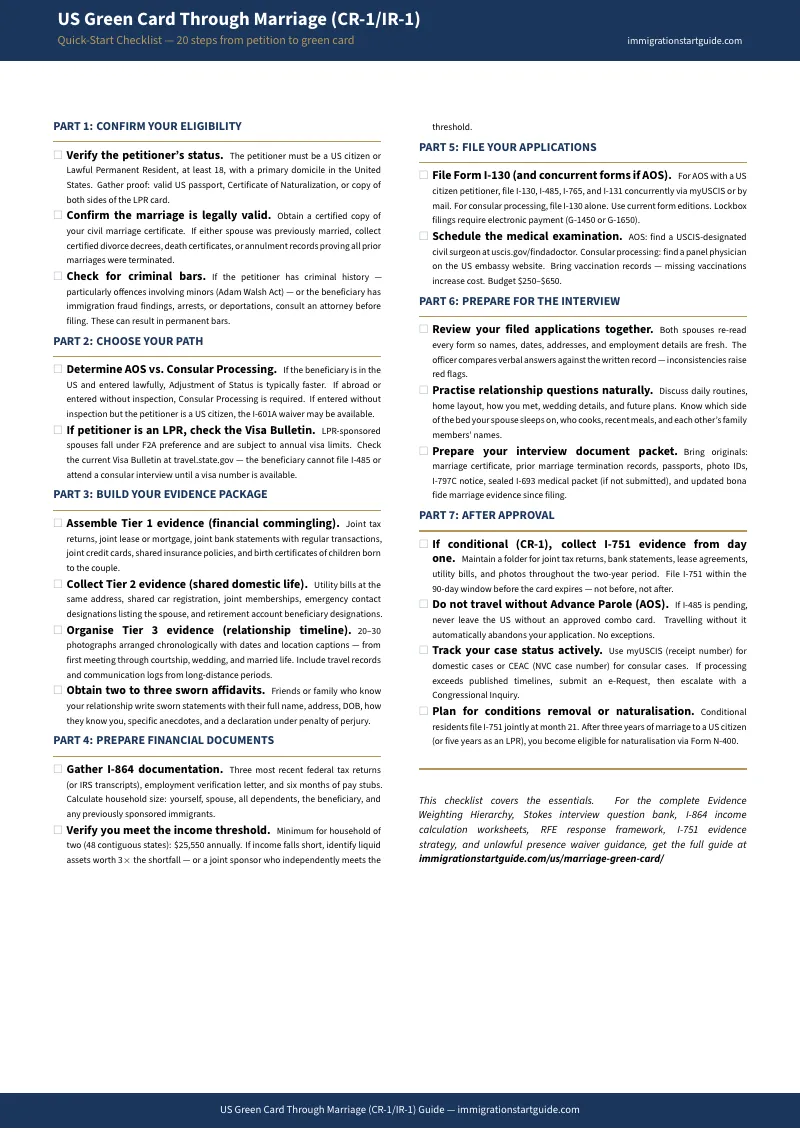
Quick-Start Checklist (free download)
A 20-item action plan covering the essentials: verify petitioner eligibility, choose your filing path, assemble tiered evidence, prepare financial documents, and build your interview packet. Enough to start tonight — and enough to see whether the structured approach makes the process feel manageable for the first time.
Who This Guide Is For
This guide is for US citizens and permanent residents sponsoring a spouse for a green card who:
- Married their partner abroad and need to bring them to the United States via Consular Processing — and need to understand realistic NVC timelines, DS-260 preparation, and what happens at the embassy interview
- Have a spouse in the US on a tourist visa or other nonimmigrant status and want to file Adjustment of Status before the visa expires — but are terrified of the 90-day rule and unsure whether filing "too soon" after entry triggers a fraud finding
- Attended a consultation with an immigration attorney, were quoted $5,000–$8,000 for a straightforward case with no criminal history or prior deportations, and want the same level of strategic guidance organised into a sequence they can follow without a law degree
- Already filed on their own and received a Request for Evidence — USCIS is asking for additional proof and they need a systematic response framework, not a Reddit thread telling them to "just send more photos"
- Have a petitioner who is a Lawful Permanent Resident (not a US citizen) and need to understand F2A preference category wait times, priority dates, and whether the petitioner upgrading to citizenship changes the timeline
- Are preparing for the green card interview and the horror stories on VisaJourney and Reddit — Stokes interviews, denied for forgetting an anniversary date, officers requesting text message histories — are making the anxiety worse, not better
Why Not Free Resources?
Free information exists. Government pages, law firm blogs, immigration forums, YouTube attorneys — all free, all abundant. Here's what they actually deliver:
- USCIS.gov provides every form and its instruction booklet. It tells you to "submit evidence of a bona fide marriage" without ever explaining that a joint lease carries exponentially more weight than a photograph — or that fifty photos without a single financial document is the evidence pattern that triggers RFEs. You get forms, not strategy.
- VisaJourney and Reddit are invaluable for emotional support and real-time processing time reports. But a strategy that worked for a European tech worker filing AOS may trigger a fraud finding for a beneficiary who entered on a B-2 tourist visa 60 days ago. You're building your family's legal case from contradictory anecdotes written by strangers at 2 AM, and every thread increases your anxiety instead of reducing it.
- YouTube immigration attorneys (Jim Hacking, Brad Bernstein, Moumita Rahman) produce excellent, specific content. Their business model is to demonstrate the overwhelming complexity of your situation and then offer a $5,000+ consultation to resolve it. They explain the dangers of filing without an attorney. They never provide the actual filing templates or evidence frameworks.
- Boundless Immigration charges $750–$1,500 for a software interface that translates USCIS forms into plain-English questionnaires with an independent attorney review. SimpleCitizen starts at $529. RapidVisa starts at $629. All solid services — but all still a significant financial burden on top of $2,100+ in mandatory government fees, for couples whose cases are procedurally straightforward.
This guide fills the execution gap — the space between "I understand what forms to file" and "I can build an evidence package and case strategy that an adjudicator approves." The same structured approach an experienced immigration paralegal would use internally, at a fraction of the cost of a single consultation hour.
— Less Than the Civil Surgeon Medical Exam
A USCIS-designated civil surgeon charges $250–$650 for the mandatory I-693 medical examination. An immigration attorney charges $300–$500 per hour, or $5,000–$8,000 for the full case. A single mischeck on your I-864 or a missing document triggers a Request for Evidence that adds 4–8 months of separation and $1,440+ in potential refiling fees if you need to start over.
This guide doesn't replace an attorney for cases involving criminal history, unlawful presence waivers, or prior deportations. But for the majority of marriage-based cases that are procedurally straightforward, it provides the same strategic organisation — at a cost lower than the medical exam you're already required to pay.
Money-back guarantee, no time limit. If the Evidence Weighting System doesn't make your application stronger, you pay nothing.
Download the free Quick-Start Checklist to see the 20-point action plan. When you're ready for the Evidence Weighting Hierarchy, RFE response protocol, and the complete filing strategy, the full guide is here.
You married the person you love. Now build the case that brings them home.