
You Survived the Green Card Process. The N-400 Is Where a Single Miscalculation Turns Decades of Lawful Presence into a Denial — or Removal Proceedings
You waited years for your green card. You maintained status through visa renewals, employer changes, and administration shifts. Now you are ready to naturalize — the final step, the one you control. But the N-400 is not a ceremonial filing. It is an audit of your entire immigration history, and USCIS treats it that way.
Denial rates have climbed to 10.5% under the current administration — nearly 9,000 additional denials per year compared to two years ago. The causes are not dramatic. They are technical: a physical presence count that falls one day short. A trip abroad that hit 181 days and created a rebuttable presumption of broken continuous residence. A failure to register for Selective Service between ages 18 and 26 that the applicant never knew about. An admission of marijuana use in a state where it is legal — which remains a federal crime and a bar to good moral character under USCIS policy, regardless of state law.
The USCIS website gives you the form instructions. Reddit gives you 1,000 anecdotes — most of them from a different field office, a different filing track, and a different year's civics test. CitizenPath ($159) checks your form for errors. SimpleCitizen ($599–$1,299) and Boundless ($950+) assemble your application with limited attorney review. They fill the boxes. They do not teach you that filing one day before your 90-day early window triggers automatic rejection and loss of a $710 fee. They do not walk you through the physical presence math that determines whether you are eligible or 12 days short. They do not explain why volunteering information about a 15-year-old dismissed charge can reopen an immigration file that was closed.
The US Naturalization (N-400) Citizenship Guide is an Eligibility Strategy System — not a form-filling checklist, but the complete decision framework for the applicant who needs to calculate their filing date down to the exact day, navigate the good moral character standard without triggering a problem that does not exist, prepare for the 2025 civics test (128 questions, 20 asked, 12 correct to pass), and walk into the USCIS interview knowing exactly what the officer will ask and why. It replaces the hundred hours of scattered research with one structured resource built for the stakes of this particular filing.
What's Inside the Eligibility Strategy System
A 9-chapter strategic guide, a 20-step Quick-Start Checklist, and 6 standalone printable tools — 8 PDFs total, with every fee schedule, processing time, regulatory citation, and policy change current as of May 2026:
Eligibility Analysis and Filing Date Calculation
The six simultaneous requirements for naturalization, the distinction between the five-year general track (INA §316) and the three-year spousal track (INA §319), and the 90-day early filing window calculation that must be exact to the day. Most applicants estimate. This guide gives you the formula — because filing one day early forfeits your $710 fee and puts you back at the end of a 6-to-18-month processing queue.
Physical Presence and Continuous Residence Math
How to count your days present (913 minimum for the five-year track, 548 for spousal), how individual trips are categorized by length, the 180-day rebuttable presumption trigger, the one-year automatic break, and how to recover from a broken continuity period using Form N-470. You will build a complete travel log cross-referenced against passport stamps and I-94 records — the same audit USCIS performs, done before the officer does it for you.
Good Moral Character — The Holistic Standard
The August 2025 "holistic" GMC policy shift, permanent and conditional bars, the Selective Service registration trap (males 18-26), the cannabis danger zone (federal Schedule I regardless of state law), tax compliance documentation, child support obligations, and voter registration — the "gotcha" that catches applicants who were unknowingly registered at the DMV. A "yes" to having registered to vote as a non-citizen can trigger denial and removal proceedings. The guide maps every GMC risk factor so you can assess your exposure and address it before USCIS discovers it at the interview.
2025 Civics Test Mastery (128-Question Bank)
The expanded test pool (128 questions, up from 100), the new format (20 questions asked, 12 correct required), the critical-thinking style that rewards understanding over memorization, the reading and writing vocabulary lists that are published by USCIS and guarantee those points, the age-based exemptions (50/20, 55/15, 65/20 rules), and the "current officials" strategy — check the President, VP, governor, representative, and both senators 24 hours before your interview, because these change and wrong answers count.
N-400 Application Strategy
Online versus paper filing (online saves $50 and gives you an immediate receipt with a 24-month green card extension), the 18 parts of the form, the supporting documents by category, and the strategic decisions embedded in seemingly routine questions. Questions about prior addresses, employment dates, and marital history are not just data collection — the officer compares your answers against every previous immigration form you have ever filed. A discrepancy is a "fraud or willful misrepresentation" finding. The guide teaches you how to prepare your N-400 answers alongside your prior filings so nothing contradicts.
Interview Preparation and Tactical Approach
What happens at the field office from check-in to decision, how the officer evaluates your English through the N-400 review conversation, the civics test protocol, the application review section where most denials actually originate, and the one rule that prevents tactical mistakes: answer only what is asked. The guide covers the most dangerous interview questions, the voter registration trap, and what happens if you fail the civics test (you get one retake in 60-90 days — a second failure is a full denial).
Post-Interview Actions and Oath Ceremony
The three possible outcomes (approved, continued, denied), the Oath of Allegiance ceremony logistics, same-day oath versus scheduled ceremony, and the 30-day post-citizenship action plan: passport application (routine 4-6 weeks, expedited 2-3 weeks), Social Security update (wait 10 days after oath), family sponsorship upgrades (your pending F2A spouse petition immediately converts to Immediate Relative — skipping a 3-to-5-year backlog), and dual citizenship rules for your country of origin.
Special Situations
Military naturalization (expedited processing, physical presence waivers), derivative citizenship for children (automatic under INA §320 in many cases), fee waivers and reduced fees for low-income applicants, the N-336 hearing process for denied applications, and name changes during naturalization — a one-time opportunity to legally change your name as part of the oath ceremony without a separate court petition.
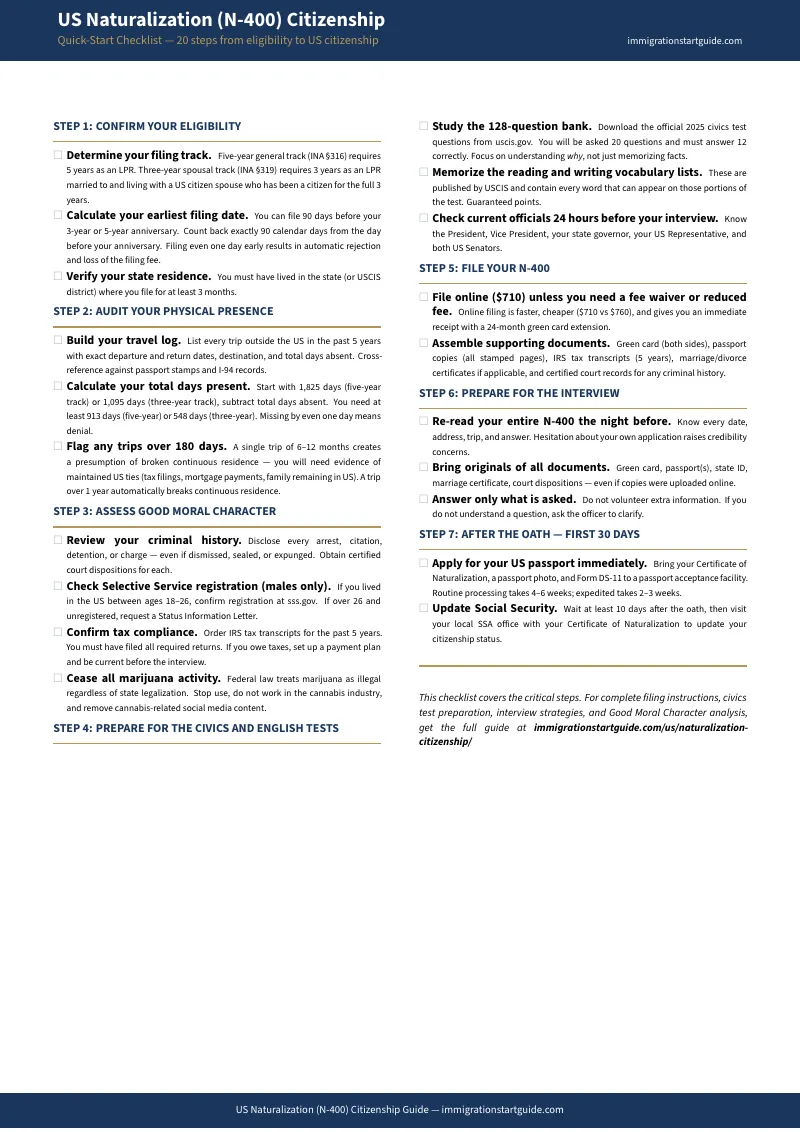
20-Step Quick-Start Checklist (free download)
The complete action sequence from eligibility verification through physical presence math, GMC assessment, civics test prep, N-400 filing, interview preparation, and post-oath actions. Twenty steps. One linear path from "am I eligible?" to "I have my US passport." Enough to start tonight — and enough to see whether a structured approach replaces the anxiety of scattered research with a sequence you can actually follow.
6 Standalone Printable Tools
Extracted from the guide for quick reference and real-world use — print them, fill them in, bring them to your preparation sessions:
- Physical Presence Calculator — fillable worksheet to count your exact days on US soil and verify you meet the 913-day (or 548-day) threshold before filing
- Travel Log Worksheet — structured log for every trip outside the US during your statutory period, with columns for departure/return dates, duration, and purpose
- GMC Assessment Checklist — self-assessment covering every Good Moral Character risk factor: Selective Service, tax compliance, cannabis, voter registration, arrests, and child support
- Document Checklist — the complete list of documents to gather for your N-400 filing, organized by category so nothing is missing when you submit
- Interview Prep Sheet — the key questions the officer will ask, the dangerous topics to prepare for, and the tactical reminders to review the night before your appointment
- Post-Citizenship Action Plan — the 30-day checklist of actions after your Oath Ceremony: passport application, Social Security update, family sponsorship upgrades, and dual citizenship verification
Who This Guide Is For
This guide is for any green card holder preparing to file Form N-400 for US citizenship who:
- Has been an LPR for 4+ years and wants to calculate the exact earliest filing date, audit physical presence, and file a complete package that does not trigger an RFE or denial — because a rejected N-400 costs $710+ in forfeited fees and another 6 to 18 months of processing time
- Obtained their green card through marriage and needs to understand the three-year spousal track requirements — continuous marital union, spouse's citizenship duration, and the evidence package that proves the marriage is genuine
- Has traveled extensively during the statutory period and needs to calculate physical presence down to the day, assess whether any trip triggered the 180-day presumption, and prepare evidence to rebut a continuity break
- Has a potential GMC issue — a dismissed arrest, an unpaid tax year, a period without Selective Service registration, or past marijuana use in a legal state — and needs to assess whether it is a bar, how to address it proactively, and what not to volunteer at the interview
- Is preparing for the 2025 civics test and needs a study strategy for 128 questions, not just a flashcard deck — understanding the critical-thinking format, the reading/writing vocabulary lists, and the age-based exemptions
- Is filing without an attorney and needs the complete strategic framework — not USCIS form instructions, not Reddit threads, not a law firm blog that explains the problem at exactly the depth needed to sell a $1,500 retainer
Why Not Free Resources?
Free information on naturalization is abundant. Here's what it actually delivers:
- USCIS.gov publishes the N-400 form, instructions, and the 12-volume Policy Manual. It tells you the requirements. It does not help you calculate physical presence, does not explain the 180-day presumption recovery process, does not warn you about the Selective Service or voter registration traps, and does not provide interview tactics. You get the statute. You do not get the strategy.
- Reddit and immigration forums provide processing timelines, interview experiences, and civics test tips. They also provide conflicting advice from applicants at different field offices (Cleveland averages 5.5 months; Charleston averages 13+), different filing tracks, and different administration eras. Forum advice calibrated to a 2023 adjudicative climate does not account for the 10.5% denial rate under the current policy posture.
- CitizenPath ($159) and SimpleCitizen ($599–$1,299) offer software-based form assembly with error checking. CitizenPath guarantees USCIS acceptance of the form. Neither teaches you the strategy behind the form — when to file relative to your travel, how to document GMC issues before the interview, or how to handle the 2025 civics test's critical-thinking format. They prevent clerical rejections. They do not prevent substantive denials.
- Immigration attorneys charge $700–$2,500 for standard N-400 representation, and $3,000–$5,000 for cases with criminal history, travel complications, or GMC issues. Some provide genuine strategic counsel. Many delegate to junior staff, file the form without discussing the interview traps, and charge hourly for the follow-up questions this guide answers comprehensively.
This guide fills the strategy gap — the space between "I know the form exists" and "I have an eligibility analysis, a physical presence audit, a GMC assessment, a civics test strategy, an interview preparation plan, and a post-oath action sequence built for the stakes of this particular filing." The same strategic depth an experienced naturalization attorney builds for each client, structured for the self-filer who refuses to leave the last step of their immigration journey to luck.
— A Fraction of What One Mistake Costs
A denied N-400 means a forfeited $710 filing fee, another 6 to 18 months in the processing queue, and — in cases where the denial exposes a prior immigration issue — potential removal proceedings. For applicants with family sponsorship pending, every month of delay extends the wait for your spouse or parents by the same amount.
The guide costs less than one hour of the immigration attorney fees it replaces. Less than 10% of even the cheapest form-assembly platform. Less than 1% of the re-filing costs, attorney fees, and lost time that a single strategic mistake generates.
This guide does not replace an attorney for cases involving serious criminal history, prior deportation orders, or complex inadmissibility issues. But for the majority of N-400 filings — you have your green card, you meet the basic requirements, and you need to calculate, prepare, and file correctly — it provides the same decision framework at a fraction of the cost.
Money-back guarantee, no time limit. If the Eligibility Strategy System does not make your naturalization filing stronger, you pay nothing.
Download the free 20-Step Quick-Start Checklist to see the complete action sequence. When you're ready for the physical presence math, the GMC assessment framework, the 2025 civics test strategy, and the full interview playbook, the complete guide is here.
You did not endure years of visa renewals and green card processing to lose your citizenship on a filing technicality. Take control of the final step.