
Your Company Is Transferring You to the United States. The L-1 Has a 92% Approval Rate — But a 25% RFE Rate That Adds Months of Delay, Thousands in Legal Fees, and Enough Uncertainty to Stall Your Entire Relocation. The Difference Is How the Petition Is Built.
You have been selected for an intracompany transfer to your company's US office. Or you are the HR director responsible for getting an executive, a manager, or a specialized knowledge worker into the country on time and on budget. Either way, you just discovered that the L-1 visa — which looked straightforward a week ago — is a maze of definitions that USCIS adjudicators interpret aggressively.
If you are the transferee, your employer's law firm sent you a questionnaire and told you to wait. You have questions they are not answering: What exactly is "specialized knowledge" and does your role qualify? What happens if you get a Request for Evidence and your start date slips by four months? What are your rights if you are laid off while on L-1 status? How does this lead to a green card? You searched online and found the USCIS Policy Manual written in dense legalese, law firm blogs that list the top five denial reasons and then end with "Contact us for a consultation," and Reddit threads where anonymous users argue about whether your specific situation counts — none of them accountable if their advice is wrong.
If you are the HR professional or global mobility manager, the stakes are operational. A single L-1 transfer costs your company $13,000 to $45,000 in government fees and legal bills. Your external law firm charges $5,000 to $8,000 per petition, files boilerplate support letters that read like they were copied from the last case, and bills another $2,000 when the inevitable RFE arrives. You know the approval rate is high, but you also know that one in four petitions triggers an RFE — and an RFE means a delayed start date, an anxious employee sitting in a foreign office unable to begin the project they were hired for, and an impatient US hiring manager asking you why the person they need is still not here.
Here is the structural problem no one explains clearly: the L-1 approval rate of 92% is not because the process is easy. It is because the petitions that get approved are built correctly from the start — with job descriptions drafted to the legal standard, qualifying relationship evidence that adjudicators can verify in minutes, and specialized knowledge claims backed by quantifiable proof. The petitions that fail are filed by HR teams submitting generic job descriptions that sound like any posting on LinkedIn, founders who perform operational tasks during their New Office year and then cannot prove managerial capacity at extension time, and companies that default to expensive Individual filings when a Blanket L program would cut their costs and processing time in half.
The US L-1 Intracompany Transfer Visa Guide is built around one principle: the Petition Intelligence System. This is a complete filing playbook that covers both sides of the L-1 — the corporate petition strategy that HR teams need, and the personal preparation that transferees need — in a single resource. It synthesizes the legal standards, the precedent AAO decisions, the RFE prevention protocols, and the long-term green card alignment strategy that law firm blogs deliberately withhold because explaining it would reduce your dependency on their billable hours.
What's Inside
12 PDFs — the complete guide, a quick-start checklist, and 10 standalone worksheets and reference cards covering every stage from qualification assessment through petition filing, approval, compliance, extensions, and the transition to permanent residency:
L-1A vs. L-1B Classification — The Decision That Shapes Everything
The L-1A (executives and managers) and L-1B (specialized knowledge workers) share the same visa category but operate under fundamentally different legal standards, maximum stay durations, and green card pathways. The L-1A allows up to seven years and leads directly to the EB-1C green card without PERM labor certification. The L-1B allows up to five years and requires a separate, more complex green card strategy. Choosing the wrong classification — or allowing your law firm to default to L-1B because it seems easier to prove — can cost you years of immigration progress. The guide maps the exact criteria for each classification with practical examples so you know which one fits your role before the petition is drafted.
Specialized Knowledge — How to Prove What Adjudicators Actually Want
Approximately 41% of all L-1B denials are attributed to insufficient specialized knowledge claims. The legal standard requires demonstrating that your knowledge is either "special" (distinct from common industry knowledge) or "advanced" (highly developed regarding your specific company's processes, products, or operations). Most petitions fail this test because the support letter reads like a standard job description. The guide synthesizes the landmark Fogo De Chao v. DHS decision and current AAO precedent into a practical drafting framework. It teaches you how to quantify the "economic inconvenience" — the tangible cost and time burden your company would face to train a US worker to your level — which is the single most persuasive piece of evidence for specialized knowledge claims.
The New Office Extension Trap
When a foreign company opens its first US branch, the initial L-1 visa is granted for only one year. At the end of that year, the company must file an extension proving the US entity is viable and the L-1A beneficiary is functioning in a genuinely managerial or executive capacity. This is where founders and early executives get destroyed. You spent the first year doing everything — hiring, selling, setting up operations, handling customer issues. That operational involvement is exactly what USCIS uses to deny the extension, arguing you are performing the duties of a first-line worker rather than directing subordinate professionals. The guide provides the first-year evidence construction protocol: the organizational chart that demonstrates delegation from day one, the W-2 payroll records showing subordinate hires, the commercial leases, the client contracts, and the financial statements that prove business viability — all structured to protect your managerial status at extension time.
Blanket L vs. Individual L — The Strategy Decision That Saves Tens of Thousands
If your company files more than a handful of L-1 petitions per year, you may be leaving enormous amounts of money and time on the table by filing Individual petitions through USCIS. An approved Blanket L certification lets subsequent transferees skip USCIS adjudication entirely and apply directly at a US consulate using Form I-129S — or, for Canadian citizens, at a port of entry. The time savings are dramatic: weeks instead of months. The cost savings compound with every transfer. But most HR teams never pursue it because the eligibility requirements seem complex, and their law firm has no incentive to recommend a process that reduces future billing. The guide provides a clear decision matrix with the exact revenue, headcount, and operational thresholds your company needs to qualify, plus the complete application framework.
Qualifying Relationship Documentation
Every L-1 petition requires proof that the US and foreign entities share a qualifying corporate relationship — parent, branch, subsidiary, or affiliate — with common ownership and control. This sounds administrative until your petition is returned because the capitalization table was ambiguous, the share registry was in a foreign language without certified translation, or the articles of incorporation did not clearly demonstrate the parent company's controlling interest. The guide provides the definitive documentation checklist: the exact combination of corporate filings, ownership certificates, board resolutions, and financial statements that constitute bulletproof qualifying relationship evidence for each entity structure.
RFE Prevention and Response
One in four L-1 petitions triggers a Request for Evidence. Each RFE adds months of processing delay, requires a response drafted to the exact deficiency the adjudicator identified, and costs thousands in additional legal fees if your law firm handles the response. The guide covers the most common RFE triggers — vague specialized knowledge claims, insufficient managerial evidence for L-1A, incomplete qualifying relationship documentation, inadequate New Office business plans — and provides the structural countermeasures that prevent each one. If you do receive an RFE, the response framework shows you how to address the specific concern rather than restating what was already rejected.
The L-1A to EB-1C Green Card Pathway
The L-1A is not just a temporary work visa. It is the fastest employer-sponsored path to permanent US residency. The EB-1C Multinational Manager category mirrors the L-1A requirements and — critically — does not require the PERM labor certification process that delays other green card categories by years. But there is a trap: USCIS cross-references your L-1A petition with your EB-1C application. If your original L-1A support letter described you as a first-line supervisor rather than a true executive or functional manager, it structurally compromises your green card case years later. The guide teaches you to align your L-1A narrative with EB-1C requirements from the very first filing, incorporating the precedent set by Matter of Z-A- and Matter of G- on functional management in modern corporate structures.
Post-Approval Compliance and Site Visits
Approval is not the finish line. L-1 holders and their employers face ongoing obligations regarding worksite locations, material changes that require amended petitions, and the possibility of unannounced site visits by the Fraud Detection and National Security Directorate. A site visit that reveals the beneficiary is not performing the duties described in the petition can trigger revocation proceedings. The guide covers the compliance framework that keeps your status secure after approval.
Every Fee and Timeline
The $1,385 base I-129 filing fee, the $600 Asylum Program fee, the $500 Fraud Prevention fee, the $2,805 or $2,965 Premium Processing fee (15 business days), standard processing timelines at each service center, law firm fee ranges of $3,000 to $8,000 per petition, and total transfer costs of $13,000 to $45,000+. No surprises, no hidden charges discovered halfway through the process.
Who This Guide Is For
- Corporate HR directors and global mobility managers — you manage the transfer pipeline and carry the operational risk when petitions are delayed or denied. The guide gives you the strategic knowledge to draft stronger internal job descriptions, prepare more complete evidence packages, evaluate whether your company qualifies for a Blanket L program, and manage your external law firm as an informed client instead of a passive one. Stop paying $500-per-hour billable rates for basic procedural education you can master in an afternoon.
- Executives and managers being transferred on L-1A — your company controls the petition, but you are the one whose career, family relocation, and immigration timeline depend on the outcome. The guide explains the exact legal standard of "managerial capacity" so you can provide your employer with the documentation that proves it, prepare for consular interviews with precision, and protect your future EB-1C green card eligibility from day one.
- Specialized knowledge workers on L-1B — the "specialized knowledge" standard is the most subjective and most challenged classification in the L-1 category. The guide teaches you how to articulate what makes your knowledge special or advanced, quantify the economic inconvenience of replacing you, and provide the kind of concrete, company-specific evidence that prevents your petition from joining the 25% that trigger RFEs.
- Foreign founders opening a US office — the New Office L-1 gives you one year to prove your business is viable and your role is truly managerial. If you spend that year doing operational work (and you will), you need a first-year evidence strategy that documents the progressive delegation of duties, the hiring of subordinate staff, and the establishment of a genuine organizational hierarchy. The guide builds that strategy from day one so you are not scrambling at extension time.
- Immigration paralegals and in-house counsel — the guide provides the complete documentation framework, precedent case analysis, and RFE prevention protocols that supplement your firm's internal practice resources. Use it as a reference for training junior staff, standardizing evidence packages, and ensuring consistency between L-1A filings and future EB-1C applications.
- L-2 dependent spouses planning to work — following the Shergill v. Mayorkas settlement, L-2 spouses receive work authorization incident to status — no EAD application required. The guide covers the L-2S class of admission code, immediate work authorization upon arrival, and the critical steps to maintain L-2 status during the primary beneficiary's extensions and status changes.
Why Not Free Resources?
- The USCIS Policy Manual (Volume 2, Part L) defines the legal thresholds but does not explain how to satisfy them. It states that an L-1B applicant must possess "specialized knowledge" but provides no templates for structuring an employer support letter, no examples of how to quantify economic inconvenience, and no guidance on the specific evidence that survives adjudicator scrutiny in your industry. Knowing the legal standard is the easy part. Translating your actual job into language that meets it — that is where petitions succeed or fail.
- Law firm blogs are lead-generation content. Fragomen, BAL, and every boutique practice publishes articles listing common L-1 pitfalls, then ends with "Contact us for a consultation." They deliberately withhold the actionable frameworks — the specialized knowledge drafting protocols, the New Office evidence construction checklists, the Blanket L eligibility matrices — that they charge $5,000 to $8,000 to execute on your behalf. Their business model depends on you not knowing how to do this yourself.
- Reddit and immigration forums are repositories of anxiety and anecdote. Users routinely conflate L-1A requirements with L-1B standards, share experiences from different service centers under different adjudicators in different years, and provide advice that is legally imprecise at best and dangerously wrong at worst. A cautionary tale about someone's denied petition teaches you what went wrong for them, not what will go right for you.
- Legal tech platforms like Docketwise and Bridge US automate form-filling and case tracking. They are software tools, not strategic knowledge. An HR director using Docketwise still needs to know how to articulate a parent-subsidiary qualifying relationship, draft a functional manager job description that aligns with AAO precedent, or determine whether an Individual or Blanket filing is the right choice. The technology facilitates the process. It does not replace the strategic foundation.
- AILA and SHRM professional resources are priced for institutional budgets and written for licensed attorneys. AILA subscriptions range from $275 to $1,095. Individual toolkits cost $499 to $799. The content is dense legal analysis — invaluable for practitioners, impenetrable for an HR coordinator or a transferee employee trying to understand the mechanics of their own case.
— A Rounding Error Against the $13,000 to $45,000 Cost of a Single Transfer
The government fees alone total $1,385 for the base I-129 filing, plus $600 for the Asylum Program fee, $500 for the Fraud Prevention fee, and $2,805 or $2,965 if you need Premium Processing. Your law firm adds $5,000 to $8,000. A single RFE adds months of delay and thousands more in billable hours for the response. A denial does not come with a refund — USCIS keeps every filing fee, your company loses the legal costs, and the employee's relocation timeline is destroyed.
This guide does not replace an immigration attorney for complex legal situations. But it covers the strategic petition layer — the classification decision framework, the specialized knowledge drafting protocols, the New Office first-year evidence construction, the Blanket L eligibility matrix, the qualifying relationship documentation checklist, the RFE prevention architecture, and the L-1A to EB-1C green card alignment strategy — that determines whether a petition gets approved cleanly or returned with a Request for Evidence.
If it prevents one RFE, catches one boilerplate support letter before filing, saves your company from one unnecessary Individual filing when a Blanket L was available, or aligns one L-1A narrative correctly with the EB-1C standard from the start, it pays for itself before you finish the second chapter.
Money-back guarantee, no time limit. If the guide does not make your L-1 petition strategy clearer, you pay nothing.
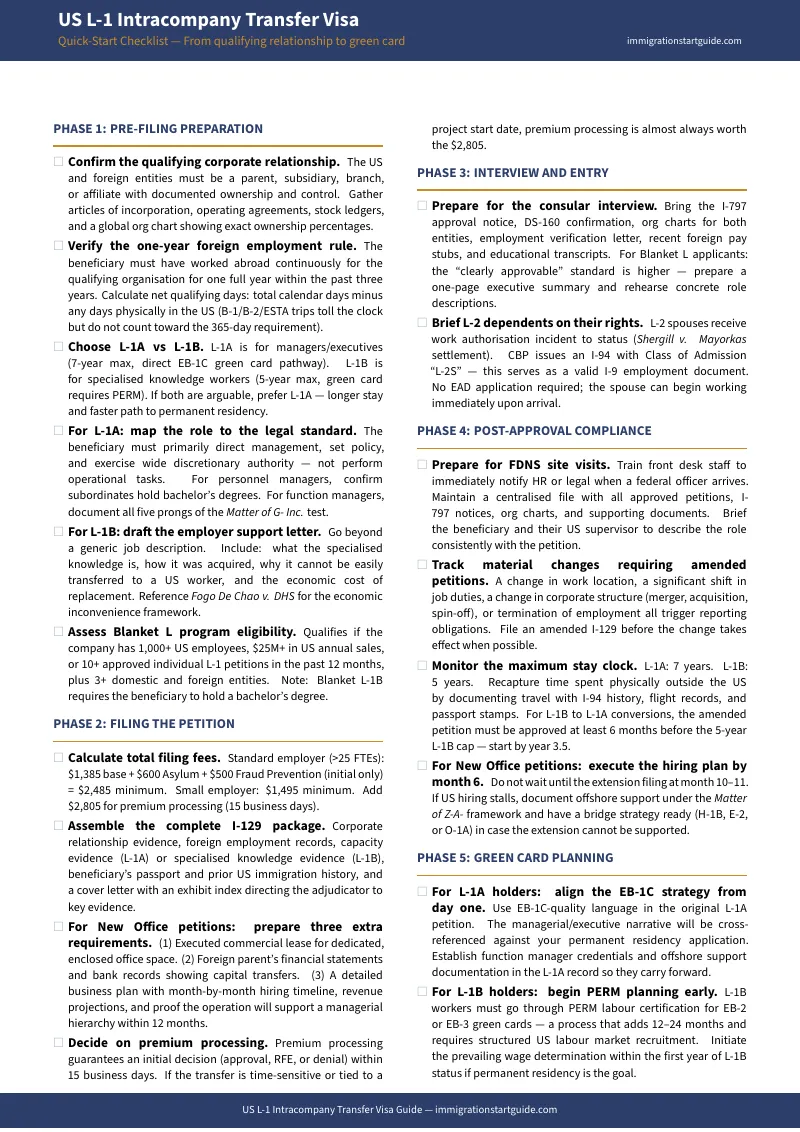
Download the free Quick-Start Checklist to see the critical document and evidence requirements across the entire L-1 transfer process — from qualifying relationship proof through petition filing, RFE prevention, and post-approval compliance. When you are ready for the complete Petition Intelligence System with specialized knowledge drafting frameworks, New Office extension protocols, Blanket L decision matrices, and the EB-1C green card alignment strategy, the full guide is here.
The L-1 has a 92% approval rate. But 1 in 4 petitions still triggers a Request for Evidence that adds months of delay, thousands in legal fees, and enough uncertainty to derail a corporate expansion. The difference between the petitions that sail through and the ones that stall is not the qualifications of the transferee. It is the quality of the evidence package. This guide builds that package.