
You're About to Wire $800,000 Into a Foreign Commercial Enterprise. The Entity Selling You the Investment Is Also Your Only Source of Information About It.
You've spent months researching the EB-5 Immigrant Investor Program. You've attended webinars hosted by Regional Centers showcasing glossy renderings of mixed-use developments and projected IRR charts. You've sat through consultations with migration agents who assured you their recommended project is "fully approved by USCIS." You've read the USCIS Policy Manual — 200 pages of bureaucratic legalese that explains what the rules are but never tells you how to navigate them strategically.
And now you're stuck. Because every entity in the EB-5 ecosystem — the Regional Center collecting $60,000 to $80,000 in administrative fees, the migration agent earning $30,000 to $50,000 in undisclosed syndication commissions, the immigration attorney operating within a referral network tied to specific developers — has a massive financial stake in which project you select. Not whether you select wisely. Which project you select.
Meanwhile, the September 30, 2026 grandfathering deadline is four months away. File your I-526E before that date and you receive permanent statutory protection — USCIS must process your petition even if the Regional Center Program lapses. Miss it, and your petition has no safety net. With source of funds documentation routinely taking three to six months to assemble, the practical window for new investors is closing fast.
The US EB-5 Investor Visa Guide is a Capital Protection Framework — the only independent resource in the market with zero financial stake in where you invest. It covers the complete post-RIA investment landscape: Regional Center due diligence, source of funds documentation strategies, TEA set-aside visa queue analysis, concurrent filing mechanics, CSPA child protection, pre-immigration tax planning, and the I-829 removal of conditions — giving you the knowledge to evaluate projects, advisors, and timelines like an institutional investor rather than a captive buyer.
What's Inside the Capital Protection Framework
12 chapters covering every decision from investment model selection through unconditional green card approval, plus 4 printable standalone tools (Regional Center Due Diligence Scorecard, Cost Breakdown Worksheet, Pre-Immigration Tax Planning Timeline, CSPA Age Calculator) and a 20-step quick-start checklist:
Regional Center Due Diligence Scorecard (Chapter 3)
USCIS designation means a Regional Center has permission to sponsor EB-5 projects. It does not mean USCIS has evaluated the project's financial viability, the developer's track record, or the safety of your capital. This chapter provides a six-category evaluation framework covering capital stack analysis (developer cash equity vs. inflated land contributions, confirmed senior debt, EB-5 share of total costs), job creation buffer assessment (construction-derived vs. speculative operational revenue jobs), fund administration independence verification, I-829 completion history, and securities compliance checks. Because conflating USCIS designation with USCIS endorsement is the most expensive mistake an EB-5 investor can make.
Source of Funds Documentation Frameworks (Chapter 4)
Source of funds is the leading cause of I-526E Requests for Evidence and the primary driver of outright denials. Two simultaneous burdens apply: proving the lawful origin of your capital and tracing every dollar through every intermediary account into the NCE escrow — with zero gaps. This chapter provides documentation frameworks for salary accumulation, real estate proceeds, corporate dividends, gifts, and unsecured loans, plus country-specific strategies for Chinese investors navigating SAFE currency controls and $50,000-per-person annual limits, and Indian investors coordinating LRS transfers across family members while managing the 20% TCS liability that pushes the true liquidity requirement to $960,000+ for an $800,000 investment.
TEA Set-Aside Visa Queue Analysis (Chapter 5)
Your TEA category selection determines which visa queue you enter — and in the post-RIA landscape, the queue matters more than the money. This chapter provides the mathematical reality of each set-aside: Rural (20% of visas, USCIS priority processing, currently no backlog for any country), High Unemployment (10% of visas, 8,500+ pending petitions, severe retrogression projected within 1-2 years), and Unreserved (68% of visas, China backlogged to September 2016, India to May 2022). For China-born investors, the difference between rural and unreserved is a 12-month timeline versus a 10-year wait. This is not a marginal consideration — it is the single most consequential strategic decision in the entire EB-5 process.
Concurrent Filing and Adjustment of Status (Chapter 7)
If you are physically present in the US on lawful non-immigrant status and your visa category is "Current," you can file I-485 simultaneously with I-526E — immediately triggering eligibility for an Employment Authorization Document (typically issued within 3-4 months) and Advance Parole travel documents. For H-1B holders, this means liberation from employer dependency. For E-2 Treaty Investors, this means a bridge to permanent residency — provided you navigate the preconceived intent investigation that USCIS triggers when non-immigrant visa holders file immigrant petitions too soon after entry.
Pre-Immigration Tax Planning (Chapter 9)
Upon receiving your green card, you become a US tax resident on worldwide income. If you hold appreciated assets, non-US mutual funds classified as Passive Foreign Investment Companies, controlling interests in foreign corporations, or offshore trust structures — and you fail to restructure before your residency start date — the tax liability can exceed the value of your EB-5 investment itself. This chapter covers the step-up in basis strategy, PFIC liquidation timing, CFC ownership restructuring, foreign trust "throwback rule" exposure, and FBAR/FATCA reporting requirements. Because immigration attorneys and Regional Centers are not tax advisors, and this is the chapter nobody else in the ecosystem has an incentive to write.
The I-829 Removal of Conditions (Chapter 10)
The conditional green card is valid for two years. The I-829 petition to remove conditions requires proof that the investment remained at risk and the project created at least 10 full-time jobs per investor. This chapter covers the post-RIA two-year sustainment period (a critical departure from the legacy regime where capital was locked for 5-7 years), the redeployment rules when projects repay early, the "reasonable time" exception for construction delays, and the updated economic impact report requirements. The I-829 is where the due diligence you conducted — or failed to conduct — before investing determines whether you receive an unconditional green card or a deportation notice.
Complete Cost Breakdown (Chapter 11)
The true all-in cost of a TEA Regional Center investment is $885,000 to $955,000+ — not the $800,000 advertised in marketing materials. This chapter itemises every expense: capital investment, Regional Center administrative fees ($50,000 to $80,000+), USCIS filing fees (currently at reduced post-litigation rates), Integrity Fund contribution, immigration attorney fees, tax advisory costs, and derivative family member fees. Because the Regional Center's $60,000 "administrative fee" is not a government requirement — it is a negotiable syndication charge, and understanding the fee structure gives you leverage most investors never exercise.
Special Situations (Chapter 12)
The E-2 to EB-5 bridge strategy for treaty country nationals who want rapid US entry while organising their EB-5 investment. The dual-track filing approach for Indian and Chinese professionals stuck in EB-2/EB-3 backlogs stretching 10+ years. The Subparagraph M good-faith investor protections that now shield innocent investors when a Regional Center is terminated. And the 180-day emergency transfer protocol for responding to a Notice of Intent to Terminate. Because "what happens if things go wrong" is the section every Regional Center brochure conveniently omits.
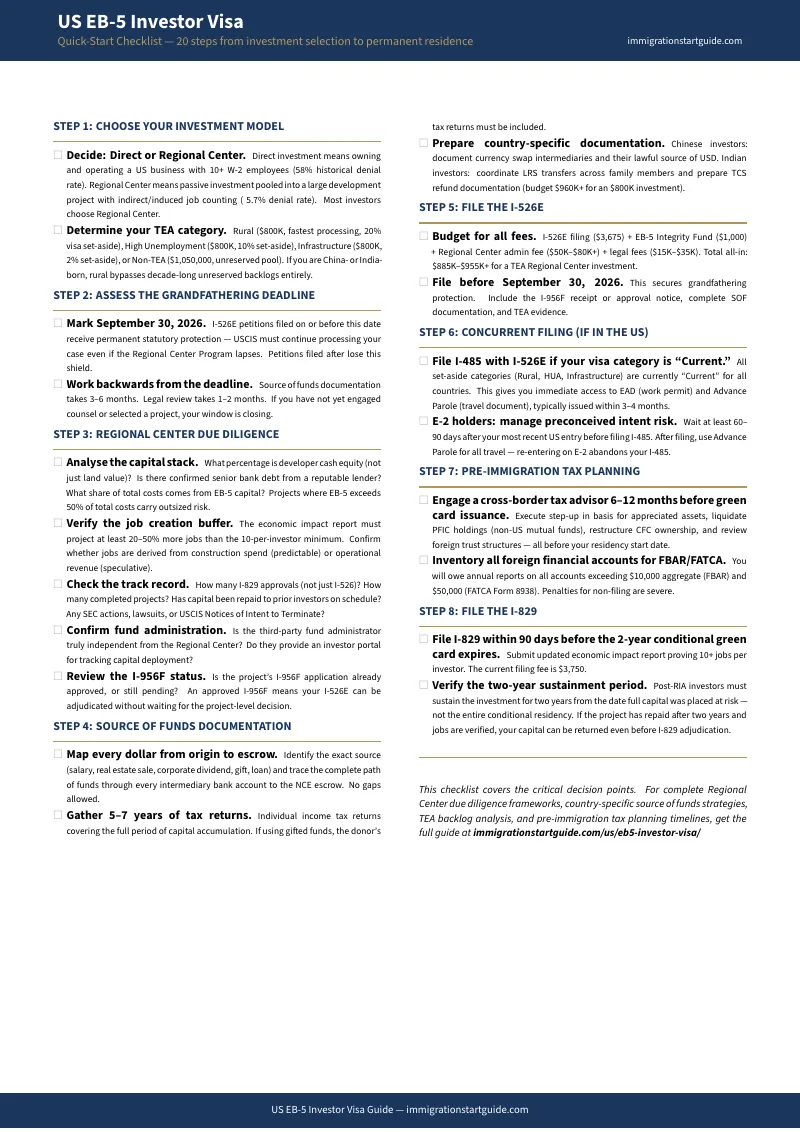
20-Step Quick-Start Checklist (free download)
The critical decision points distilled into a single action sheet: choose your investment model, assess the grandfathering deadline, conduct Regional Center due diligence, assemble source of funds documentation, budget for all fees, evaluate concurrent filing eligibility, and plan pre-immigration tax restructuring. Enough to take your first strategic step tonight.
Who This Guide Is For
This guide is for high-net-worth individuals who refuse to deploy $800,000+ based solely on the assurances of the entities profiting from the deployment:
- You've attended Regional Center webinars and spoken with migration agents — and you've noticed that every "educational" presentation ends with a pitch for a specific project, and the agent's recommendation always seems to be whichever developer is offering the highest commission
- You're a Chinese investor navigating SAFE currency controls and you need a source of funds strategy that doesn't rely on "smurfing" family remittances — a practice Chinese banks and USCIS have both cracked down on aggressively
- You're an Indian professional whose H-1B uncertainty or EB-2/EB-3 backlog has pushed you toward EB-5 — and you need to understand the LRS coordination, TCS liquidity requirement, and NRE/NRO account staging before committing capital
- You're already in the US on E-2, H-1B, F-1, or L-1 status and you want to understand the concurrent filing mechanics, EAD/Advance Parole timeline, and preconceived intent risks before filing I-485 alongside I-526E
- You have children approaching 21 and need to understand the Child Status Protection Act age formula, the August 2025 Final Action Date policy change, and why rural TEA priority processing is not just about speed — it directly affects whether your child ages out
- You've retained an immigration attorney — and you want to ensure that before you wire $800,000 into a project they recommended, you can independently evaluate the capital stack, job creation buffer, fund administration independence, and developer I-829 track record
Why Not Free Resources?
Free information on the EB-5 program is abundant. Here's what it actually delivers:
- USCIS Policy Manual (Volume 6, Part G) provides the statutory requirements in dense bureaucratic legalese. You'll learn that source of funds must be "lawful." You won't learn how to construct a fully traceable path of funds when your capital sits in Chinese RMB subject to $50,000-per-person annual exchange limits — or how to stage Indian LRS transfers across family members while managing the 20% TCS upfront liability.
- Regional Center marketing materials — webinars, migration expo brochures, YouTube channels — are sales pitches disguised as education. They highlight projected returns and past successes while obscuring subordinate debt positions in the capital stack, speculative job creation methodologies based on operational revenue rather than construction spend, and the absence of any I-829 completion history. They explain why EB-5 is a great programme. They never explain how to evaluate whether their specific project is safe.
- EB5investors.com is the largest industry forum, providing direct Q&A access to professionals. It also functions as a lead-generation engine for the attorneys and Regional Centers who sponsor it. You'll find hundreds of fragmented answers across dozens of unstructured threads. You won't find a chronological decision-making framework that sequences due diligence, source of funds, TEA selection, filing strategy, and tax planning into an executable process.
- Reddit (r/EB5, r/immigration) is valuable for uncovering worst-case scenarios — ghosting by developers, stalled processing, missing tax documents at the I-829 stage. But the signal-to-noise ratio is catastrophic. One user reports USCIS adjudicates only "5 to 8 cases on a best day." Another claims rural processing takes 6 months. Neither provides the data to evaluate their claim or apply it to your situation.
- Migration agents and consultants charge $10,000 to $50,000 in upfront fees — while generating the bulk of their revenue through $30,000 to $50,000 commissions paid by the Regional Centers they recommend. The structural conflict of interest is not a conspiracy theory. It is the documented business model of the industry.
This guide fills the independence gap. It provides the due diligence frameworks, source of funds documentation strategies, TEA queue analysis, and pre-immigration tax planning that no entity in the ecosystem has a financial incentive to provide — because everyone else profits from your ignorance, not your knowledge.
— A 0.018% Insurance Premium on Your Capital
A migration agent charges $10,000 to $50,000 in consulting fees — on top of the undisclosed commission. An immigration attorney charges $15,000 to $35,000 for petition preparation. A securities attorney charges $5,000 to $15,000 for PPM review. Pre-immigration tax advisory runs $5,000 to $15,000. The total professional advisory cost easily exceeds $50,000 before a single dollar is wired to the NCE escrow.
The guide doesn't replace legal counsel for filing mechanics or securities review. But it gives you the independent evaluation framework to assess projects before you pay an attorney to file on one, to understand source of funds requirements before you pay $500-per-hour to have them explained, and to identify pre-immigration tax exposure before a cross-border CPA bills you to discover it. If a single insight prevents you from selecting a project with an inadequate job creation buffer, an undercapitalised developer, or a non-independent fund administrator, the return on investment is the preservation of $800,000 and years of your family's life.
Money-back guarantee, no time limit. If the due diligence framework doesn't make your project evaluation sharper, you pay nothing.
Download the free Quick-Start Checklist to see the 20 critical decision points from investment model selection through I-829 filing. When you're ready for the Regional Center due diligence scorecard, country-specific source of funds strategies, and pre-immigration tax planning timelines, the full guide is here.
The entities selling you the investment should not be your only source of education about it.