
The H-1B Lottery Gave You a 35% Chance. The O-1 Has a 94.6% Approval Rate, No Cap, and No Lottery. The Only Thing Standing Between You and Approval Is an Evidence Strategy.
You have been through the H-1B cycle. You registered, waited, refreshed your portal, and got the rejection that 65% of applicants receive every year. Or maybe you are watching the FY2027 wage-weighted lottery cut Level I and Level II selection probabilities nearly in half, and you are calculating that your startup equity compensation or early-career salary puts you on the wrong side of those numbers. Or your OPT is running out, your employer just got acquired, your 60-day grace period is ticking, and every immigration attorney you have called wants $10,000 before they will even review your file.
So you searched "O-1 visa" and hit a wall. The USCIS website lists eight criteria and demands proof of "extraordinary ability" and "sustained national or international acclaim." You read those words and thought: I am good at what I do, but I am not a Nobel Laureate. An immigration attorney confirmed the criteria in a free consultation, told you it would cost $5,000 to $15,000 for full representation, and scheduled a follow-up you are not sure you can afford. Reddit has 400 contradictory threads from people in different fields, different years, under different adjudicators, all arguing about whether your type of evidence counts. You are stuck between imposter syndrome and a ticking clock.
Here is what nobody is explaining clearly: the O-1 does not require fame. It requires meeting three of eight specific evidentiary criteria with properly structured documentation. The 94.6% approval rate is not because only superstars apply. It is because the people who get approved understand how to translate their existing career achievements into the precise legal language that USCIS adjudicators expect. The people who get denied almost always had the qualifications. They just did not know how to present them.
The US O-1 Extraordinary Ability Visa Guide is built around one principle: the Evidence Strategy System. This is a complete petition-building playbook that treats your O-1 as a strategic evidence project, not a bureaucratic form-filling exercise. It maps the eight O-1A criteria and six O-1B criteria with field-specific examples for STEM professionals, startup founders, artists, athletes, and researchers. It provides the expert opinion letter framework that adjudicators expect, the agent sponsorship mechanics that let freelancers and founders file without a single employer, the I-129 filing architecture for organizing 300 to 700 pages of documentation, the 2026 AI-detection countermeasures that prevent your petition from being flagged, and the complete pathway from O-1 approval to a permanent green card.
What's Inside
A 14-chapter guide, a quick-start checklist, and 5 standalone printable tools covering every stage from self-assessment through petition filing, approval, and the transition to permanent residency:
The Eight O-1A Criteria — With Practical, Field-Specific Evidence Examples
Not a restatement of the USCIS Policy Manual. A criterion-by-criterion breakdown of what actually satisfies each standard in practice. Awards: not just Pulitzers and Oscars, but industry-specific recognition that adjudicators accept (design awards, hackathon prizes, best paper citations, startup competition wins). Published material: not just The New York Times, but trade publications, podcast features, tech blog profiles, and academic journal citations. Judging: not just Nobel Prize committees, but peer review panels, grant evaluation boards, conference program committees, and startup accelerator selection panels. Every criterion mapped to the evidence that works in your specific field.
Field-Specific Evidence Strategies for STEM, Business, Arts, and Athletics
"Extraordinary" looks completely different depending on your industry. A software engineer relies on patents, open-source adoption metrics, and technical conference invitations. A startup founder documents venture capital raised, revenue milestones, and advisory board invitations as proof of critical capacity. A visual artist demonstrates gallery exhibitions, critical reviews, and high remuneration relative to peers. A researcher points to citation counts, editorial board memberships, and grant funding. The guide does not give you a generic checklist. It gives you the evidence translation strategy for your field.
The Comparable Evidence Provision
The legal safety valve that USCIS updated in 2025 for professionals in non-traditional fields. If you are a UX designer, product manager, esports player, content creator, or anyone whose work does not map neatly to the standard eight criteria, the comparable evidence clause lets you substitute equivalent proof. The guide explains when to invoke it, how to structure the argument, and the documentation standards that prevent adjudicators from dismissing it.
Expert Opinion Letters — The Qualitative Core of Your Petition
Procuring 5 to 8 expert letters is universally recognized as the hardest part of the O-1 process. The guide covers who to ask (independent industry experts who know your work through its published impact, not your direct manager), who never to ask (co-authors, business partners, anyone with a financial interest), the four-part letter structure adjudicators expect (expert credentials, how they know your work, detailed analysis of a specific contribution, conclusion about your standing), the specific language that triggers rejection ("promising," "talented," "great potential" — USCIS requires proof of current standing, not future trajectory), and practical strategies for getting busy experts to actually write these letters.
The Agent Sponsorship Path for Freelancers and Founders
If you do not have a single US employer willing to petition for you, you are not disqualified. The O-1 uniquely permits an agent petitioner to file on behalf of professionals who work for multiple clients. The guide breaks down the agent petition structure, the strict itinerary requirements, deal memo templates, agent contracts, and the self-owned entity path for founders. This mechanism is deeply misunderstood on public forums, and getting it wrong can result in a denial that was entirely preventable.
I-129 Filing Architecture
How to organize 300 to 700 pages of evidence so an adjudicator who reviews dozens of petitions per day can follow your narrative. The petitioner support letter structure, the advisory opinion letter requirement (when it is mandatory and when it is not), the evidence tabbing system, and the exhibit index that lets an officer verify your claims without hunting through a stack of unorganized documents.
The 2026 AI-Detection Risk
USCIS is deploying AI-detection tools in 2026 to flag expert letters and petition materials that appear formulaic, generic, or machine-generated. Officers are issuing Requests for Evidence specifically targeting documents that read like ChatGPT output. The guide provides authentic, human-centric drafting frameworks that emphasize verifiable, case-specific details over the hyperbolic, AI-style prose that triggers these flags. If you are using AI to help draft any part of your petition, this chapter prevents you from walking into a trap that did not exist a year ago.
RFE Prevention and Response
The most common triggers for Requests for Evidence, the 84-day response deadline, and how to structure a rebuttal that actually resolves the adjudicator's concerns rather than restating what they already rejected. Including the Kazarian two-step framework that explains why meeting three criteria is necessary but not sufficient — the final merits determination that catches applicants who thought clearing the evidentiary threshold guaranteed approval.
Consular Processing
Petition approval is the domestic step. If you are outside the US, you still need to navigate the DS-160 application, the consular interview, embassy-specific wait times (which vary from 1 month to 7+ months depending on location in 2026), and the risk of 221(g) administrative processing delays. The guide covers interview preparation, document organization for the embassy appointment, and strategies for expedited appointments when your timeline is tight.
The O-1 to Green Card Pathway
The O-1 is not a dead end. It is a stepping stone to permanent residency via the EB-1A (Extraordinary Ability green card) or the EB-2 NIW (National Interest Waiver). The guide maps the evidence overlap between O-1 and EB-1A, the critical trap where O-1 holders assume their existing approval guarantees a green card (it does not — the EB-1A standard is higher), and the timeline planning that lets you build your green card case while maintaining O-1 status.
Every Fee and Timeline
The $1,055 base filing fee, the $600 Asylum Program fee, the $2,965 Premium Processing fee, legal representation ranges from $5,000 to $15,000, third-party costs for translations, expert letter procurement, and credential evaluations. Standard processing timelines (3 to 6 months) versus Premium Processing (15 business days). No surprises.
Plus 5 Standalone Printable Tools
Separate PDFs you can print and use independently during your petition process: an Evidence Mapping Worksheet for inventorying your evidence against all eight criteria, a Criteria Quick Reference cheat sheet with what works and what does not for every O-1A and O-1B criterion, an Expert Letter Guide you can share directly with your recommenders so they know exactly what to write, a Fee Quick Reference with every cost scenario on one page, and a Filing Checklist tracking every step from pre-filing through post-approval.
Who This Guide Is For
- H-1B lottery casualties looking for a viable alternative — you were not selected in a system that rejects 65% of applicants by random chance. The O-1 has no lottery, no annual cap, and no wage-weighted selection. The guide shows you how to translate the same career achievements that qualified you for the H-1B into the evidentiary framework that satisfies the O-1. Many H-1B candidates already meet three criteria without realizing it.
- OPT and STEM OPT holders running out of time — your 12-to-36-month window is closing and you need a classification that does not require re-enrollment in a degree program. The guide maps the fastest path from self-assessment through filing, including the Premium Processing option that delivers a decision in 15 business days.
- Startup founders and freelancers without a single US employer — the H-1B requires a specific employer-employee relationship. The O-1 agent petition lets you work for multiple clients, run your own company, and structure your own itinerary. The guide provides the agent sponsorship framework, itinerary requirements, and deal memo structures that make this work.
- Tech professionals, researchers, and engineers — you have patents, citations, conference presentations, and high compensation, but you do not know how to translate those into USCIS evidentiary categories. The guide provides field-specific evidence strategies for STEM professionals, including how to document open-source contributions, proprietary code impact, and venture-backed innovation.
- Artists, musicians, filmmakers, and performers — the O-1B has a different evidentiary standard ("distinction" for arts, "extraordinary achievement" for motion picture and television). The guide covers the six O-1B criteria with specific examples for visual artists, recording artists, actors, directors, and performing artists, including how to document exhibitions, critical reviews, box office performance, and high remuneration relative to peers in your field.
- Anyone preparing to hire an immigration attorney — the guide turns you into an informed client who can audit your attorney's work, provide pre-structured evidence portfolios, and direct the narrative of your petition. Many attorneys are generalists who charge premium rates but rely on templates. The guide ensures your case gets the field-specific strategy it requires, whether you file yourself or manage outside counsel.
Why Not Free Resources?
- The USCIS Policy Manual tells you the law. It does not tell you how to satisfy the law. It lists "published material about the applicant" as Criterion 3 but provides zero guidance on whether a trade publication profile, a podcast interview transcript, or a tech blog feature article qualifies in your field. It defines "original contributions of major significance" but does not explain how to document that your open-source library was adopted by 200 companies. Knowing the eight criteria is the easy part. Knowing how to build an evidence package around them that survives adjudication — that is the hard part, and no government resource covers it.
- Law firm blogs are lead-generation content designed to get you to book a paid consultation. They recite the criteria, add a few surface-level tips, and end with a call-to-action to schedule a $300 consultation. They deliberately withhold the strategic execution details — the evidence mapping, the letter structures, the filing architecture — that they charge $10,000 to deploy on your behalf.
- Reddit and immigration forums are echo chambers of anxiety. A biotech researcher's success story might convince a graphic designer to pursue the same evidentiary strategy, leading to a denial. A thread about RFEs amplifies fear without providing replicable solutions to prevent them. The advice is anecdotal, frequently outdated, and impossible to verify. One user's experience under one adjudicator in one service center does not generalize to your case.
- YouTube immigration channels provide excellent news coverage on policy changes, travel bans, and processing pauses. But video is a poor medium for the work that actually matters: mapping evidence to criteria, structuring 5 to 8 expert letters, organizing a 300-to-700-page petition, and drafting rebuttals to RFEs. You cannot build an evidence portfolio from a 12-minute video.
- ChatGPT and AI tools will generate impressive-sounding expert letters and petition narratives that trigger the exact AI-detection flags USCIS deployed in 2026. The guide teaches you how to write authentically — with verifiable, case-specific details that no AI tool can generate from a generic prompt.
— Less Than the Filing Fee USCIS Will Keep if Your Petition Is Denied
The mandatory government fees alone total $1,055 for the base I-129 filing, plus $2,965 if you need Premium Processing. An immigration attorney quotes $5,000 to $15,000 for full representation. A denied petition does not come with a refund — USCIS keeps every dollar. A Request for Evidence adds months of delay and requires a response that addresses the exact deficiency the adjudicator identified. A denial can trigger consequences that cascade through your entire immigration timeline: lost time, expired work authorization, forfeited filing fees, and potentially a gap in status that affects future applications.
This guide does not replace an immigration attorney for complex legal situations. But it covers the strategic evidence layer — the self-assessment framework, the criterion-by-criterion evidence mapping, the expert letter architecture, the agent sponsorship mechanics, the I-129 filing organization, the 2026 AI-detection countermeasures, and the RFE prevention strategy — that determines whether your petition gets approved or returned with a Request for Evidence. The people who get denied are rarely unqualified. They are unprepared.
If it prevents one weak criterion from triggering an RFE, saves you from one AI-flagged expert letter, or ensures your 300-page evidence package is organized in the narrative structure that adjudicators expect, it pays for itself before you finish the first chapter.
Money-back guarantee, no time limit. If the guide does not make your O-1 petition strategy clearer, you pay nothing.
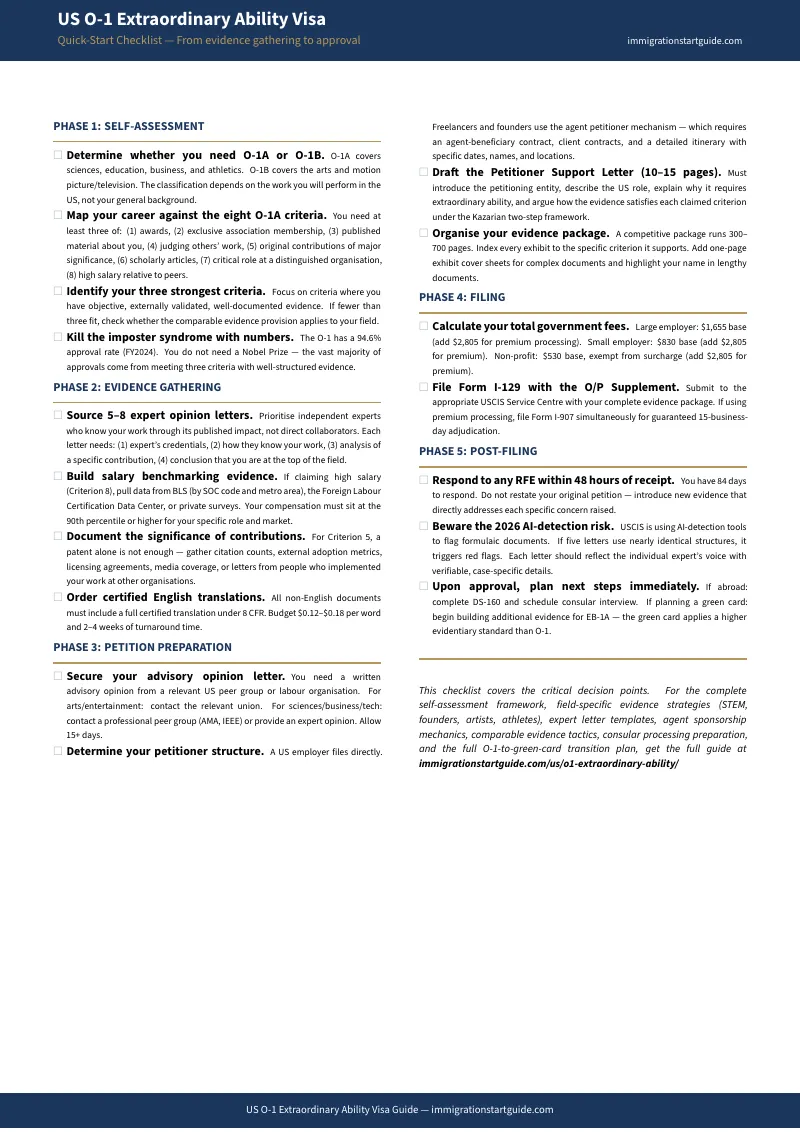
Download the free Quick-Start Checklist to see the 18 highest-stakes action items across the entire O-1 petition process — from self-assessment through evidence gathering, expert letters, filing, and the transition to a green card. When you are ready for the complete Evidence Strategy System with field-specific evidence maps, expert letter frameworks, agent sponsorship mechanics, and the 2026 AI-detection countermeasures, the full guide is here.
The O-1 has a 94.6% approval rate, no annual cap, no lottery, no degree requirement, and no maximum duration. It is the most powerful work visa in the US immigration system. The only thing it requires is an evidence strategy that proves you belong. This guide builds that strategy.