
The Rule Your Sponsor Won't Explain Could Block Your H-1B, Your Green Card, and Your Career in the US — For Two Full Years.
You accepted the J-1 program. You got your DS-2019, paid the SEVIS fee, passed the consular interview. Your sponsor explained the program dates, the reporting requirements, the insurance rules. Everything felt clear.
What nobody explained is Section 212(e) — the two-year home residency requirement buried in the Immigration and Nationality Act. If you're subject to it, you cannot change to H-1B status, cannot apply for an L-1 or K-1 visa, and cannot pursue a green card until you either return to your home country for two full years or successfully obtain a waiver. Your sponsor knows this rule exists. They are compliance officers, not immigration strategists — most are legally or policy-restricted from explaining your waiver options or helping you plan a transition to permanent status.
On December 9, 2024, the Department of State published a completely overhauled Exchange Visitor Skills List — the first major update since 2009. Thirty-seven countries were removed retroactively, including India, China, Brazil, South Korea, Turkey, and Nigeria. If your country was removed, you may no longer be subject to 212(e) based on the Skills List — but most online resources, forum advice, and even some attorneys still reference the 2009 list. Following outdated guidance could mean filing an unnecessary waiver application, spending $1,500–$7,000 on attorney fees for a problem that no longer exists, or worse — missing a transition window because you thought you were trapped when you weren't.
The US J-1 Exchange Visitor Visa Guide is a 212(e) Navigation System — a strategic framework that covers all 15 J-1 categories, the three triggers that activate the two-year requirement, all five waiver pathways with step-by-step filing instructions, the December 2024 Skills List changes and their retroactive impact, and the complete transition playbook from J-1 to H-1B and permanent residency. Updated for the rules in force as of May 2026.
What's Inside the 212(e) Navigation System
A 10-chapter strategic guide, a 20-step quick-start checklist, and the waiver decision framework that prevents you from spending months on the wrong pathway:
The J-1 Statutory Framework and the Sponsor Gap
The J-1 is governed by the Department of State, not DHS — which means different regulations (22 CFR Part 62), a different institutional philosophy, and a critical distinction from H-1B dual intent that shapes every transition decision. The guide explains the Fulbright-Hays Act, the sponsor system, SEVIS tracking, and why your sponsor's compliance mandate creates an information gap that leaves you strategically blind.
All 15 J-1 Categories — Eligibility, Duration, and Regulatory Exposure
Au Pair, EduCare, Intern, Trainee, Research Scholar, Professor, Alien Physician, Teacher, Camp Counselor, Government Visitor, International Visitor, Short-Term Scholar, Specialist, Summer Work Travel, Student — each with different maximum durations, work limitations, extension rules, and 212(e) risk profiles. A mismatch between your category and your actual activities is a status violation.
The DS-2019 Lifecycle — From Sponsor Selection Through the Grace Period
How sponsors generate the form through SEVIS, the I-901 fee structure ($220 for most categories, $35 for Au Pair and Summer Work Travel), the DS-160 application, how consular officers evaluate nonimmigrant intent, the 30-day advance entry window, and the 30-day post-program grace period during which you cannot work, cannot travel outside the US, and cannot re-enter on J-1 status.
Section 212(e) Deep Dive — The Three Triggers and the 2024 Skills List Overhaul
This is the strategic core. The three independent triggers (government funding, the Exchange Visitor Skills List, and graduate medical education), how to determine your actual subjectivity status, the Advisory Opinion process for challenging an incorrect DS-2019 notation, and a complete analysis of the December 2024 Skills List update — which countries were removed, which remain, and what retroactive relief means for participants who thought they were permanently trapped.
All Five Waiver Pathways — Decision Tree and Step-by-Step Filing
No Objection Statement (4–6 months, requires embassy cooperation), Interested Government Agency (4–8 months, requires a federal sponsor), Conrad 30 for physicians (6–10 months, 30 slots per state with October 1 deadlines), Exceptional Hardship (12–24 months, US citizen or permanent resident spouse/child required), and Persecution (12–24 months). Each pathway includes filing instructions, evidence requirements, processing timelines, and the specific conditions that make it stronger or weaker for your situation. The decision tree prevents you from spending months pursuing a waiver that was never your strongest option.
Conrad 30 State-by-State Strategy for Physicians
Physicians receiving graduate medical education are automatically subject to 212(e) — no exceptions. The guide covers the competitive dynamics of the 50-state system, why states like California and Texas exhaust all 30 slots within days of October 1, how "Flex 10" slots allow physicians to practice in urban areas while fulfilling waiver obligations, the three-year service contract structure, and why your contract must be signed months before the application window opens.
J-2 Dependents — Status, Employment Authorization, and Backlog Mitigation
J-2 spouses have the right to work anywhere in the US — if they have an EAD. But with USCIS backlogs pushing processing to 6–9 months, an incorrectly filed I-765 can cost your family $40,000 or more in lost wages. The guide covers the application process, error-prevention strategies that avoid Requests for Evidence, expedite request criteria for "severe financial loss," and how 212(e) affects your dependent's immigration options.
Health Insurance Compliance Under 22 CFR 62.14
$100,000 medical benefits, $50,000 evacuation, $25,000 repatriation, $500 maximum deductible, A.M. Best "A-" rated underwriter. A single day without compliant coverage can result in program termination and immediate loss of status. The guide explains the dollar thresholds, how to verify policy compliance, and the gap coverage strategies for transitions between plans.
Employment Rules, Academic Training, and the STEM PhD Extension
Category-specific work authorization, the Academic Training benefit for J-1 students (18 months standard, 36 months for STEM PhDs), the prohibition on fully remote AT positions, the moonlighting prohibition for physicians and researchers, and the critical distinction between authorized and unauthorized employment that protects your status.
The J-1 to H-1B and Green Card Transition Playbook
The timing relationship between 212(e) waivers and change-of-status applications, cap-exempt versus cap-subject H-1B employers, why filing for a green card while on J-1 status creates a dual-intent conflict that can result in visa denial, and the strategic sequence — 212(e) waiver first, then H-1B, then green card — that immigration attorneys charge $5,000+ to explain.
Program Management — Extensions, Transfers, and Repeat Bars
The extension process for each category, transfer procedures between sponsors, program termination and its consequences, the 12-month and 24-month repeat participation bars for Research Scholars and Professors, address reporting requirements, and the complete fee schedule for every government filing in the J-1 process.
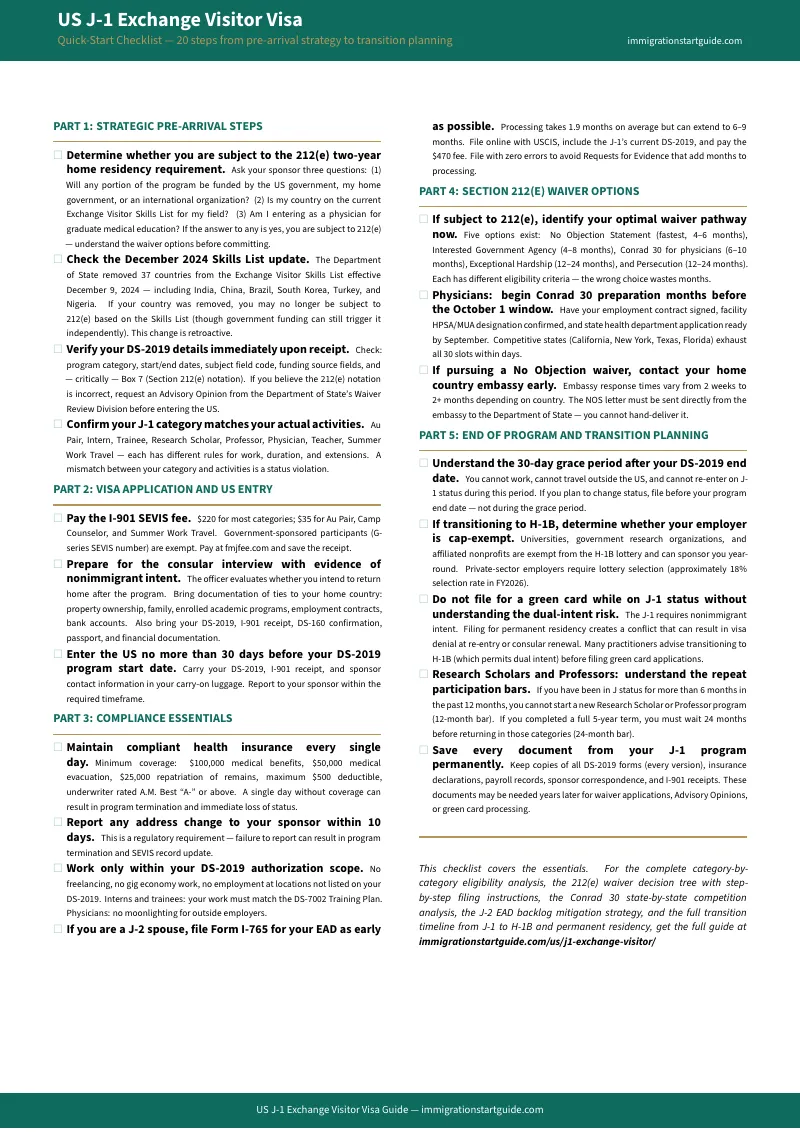
Quick-Start Checklist (free download)
A 20-step action plan covering pre-arrival 212(e) assessment, DS-2019 verification, compliance essentials, waiver pathway selection, and transition planning. Enough to start tonight.
Six Standalone Reference Tools (print and use independently)
Waiver Decision Tree — a one-page flowchart to identify your strongest 212(e) waiver pathway. Waiver Pathway Comparison — side-by-side analysis of all five pathways with evidence checklists for filing. Fee Schedule — every government fee from SEVIS I-901 through I-485. Insurance Compliance Checklist — verify your policy meets 22 CFR 62.14 thresholds. J-1 Category Summary — all 15 categories on one page with duration, work rules, and 212(e) risk. Transition Timeline Planner — fillable worksheet mapping the J-1 → H-1B → green card sequence with key deadlines.
Who This Guide Is For
This guide is for J-1 exchange visitors, their dependents, and prospective participants who:
- Are about to accept a J-1 program and want to understand whether 212(e) applies to them before signing a DS-2019 — not after they've spent two years building a life in the US
- Are from one of the 37 countries removed from the Skills List in December 2024 — including India, China, Brazil, South Korea, and Turkey — and need to know whether they are retroactively freed from the two-year requirement
- Are J-1 physicians preparing for Conrad 30 waiver applications and need the state-by-state competition analysis, Flex 10 slot strategy, and contract preparation timeline
- Discovered that their DS-2019 has the 212(e) box checked incorrectly and need to understand the Advisory Opinion process before it blocks their career transition
- Are J-2 spouses who need to file for an EAD without errors that trigger Requests for Evidence and add months to an already 6–9 month backlog
- Plan to transition from J-1 to H-1B or permanent residency and need the strategic sequence — when to file the waiver, when to apply for change of status, and how to avoid the dual-intent trap
Why Not Free Resources?
Free information about the J-1 visa exists everywhere. Government websites, Reddit threads, sponsor FAQ pages, YouTube explainers. Here's what they actually deliver:
- Travel.state.gov publishes the regulations, the Skills List, and the waiver application process. What it won't tell you: which waiver pathway is strongest for your specific situation, how to handle an embassy that takes three months to issue a No Objection Statement, or whether the December 2024 Skills List update means you no longer need a waiver at all. You get rules, not strategy.
- Reddit r/immigration is where J-1 participants go to panic. Users regularly receive contradictory advice — told they are "definitely subject" to 212(e) when they may not be, or told to pursue an NOS waiver when a hardship waiver would be stronger. The December 2024 Skills List update has made most pre-2025 forum advice dangerously outdated.
- J-1 sponsor organizations explain your program compliance obligations. They are legally or policy-restricted from advising on 212(e) waivers, transition strategies, or how to stay in the US permanently. Their mandate ends where your long-term immigration strategy begins.
- Immigration attorney consultations start at $250–$500 per hour. A No Objection waiver engagement runs $1,500–$3,000. A hardship or Conrad 30 case can exceed $7,000 — before government filing fees. Attorneys provide personalized representation, but many do not specialize in the J-1 niche and give generic advice that doesn't account for the 2024 Skills List changes.
This guide fills the strategy gap — the space between "I'm on a J-1 visa" and "I understand exactly how 212(e) applies to me, which waiver is my strongest option, and how to sequence my transition without losing years." It gives you the decision framework that immigration attorneys charge thousands to walk clients through verbally.
— Less Than One Hour of Attorney Time
An immigration attorney charges $250–$500 per hour for a J-1 consultation. A No Objection waiver engagement costs $1,500–$3,000. A hardship or Conrad 30 case runs $5,000–$7,000+. An incorrectly filed J-2 EAD application — just one Request for Evidence — can cost your family months of lost wages while processing restarts from scratch.
This guide doesn't replace an attorney for complex cases involving removal proceedings, criminal inadmissibility, or contested persecution claims. But for the exchange visitor who needs to understand their 212(e) status, choose the right waiver pathway, file without errors, and plan a transition to H-1B or permanent residency — it replaces dozens of hours of contradictory forum research and the initial $1,500+ attorney engagement with a structured system you can follow from pre-arrival through transition.
Money-back guarantee, no time limit. If the 212(e) Navigation System doesn't make your J-1 strategy clearer and more actionable, you pay nothing.
Download the free Quick-Start Checklist to see the 20-step action plan covering pre-arrival 212(e) assessment through transition planning. When you're ready for the waiver decision tree, the Conrad 30 state strategy, and the complete J-1 to H-1B playbook, the full guide is here.
316,000 J-1 visas issued annually. The two-year rule catches most participants after it's too late to plan. This guide makes sure you plan before it catches you.