
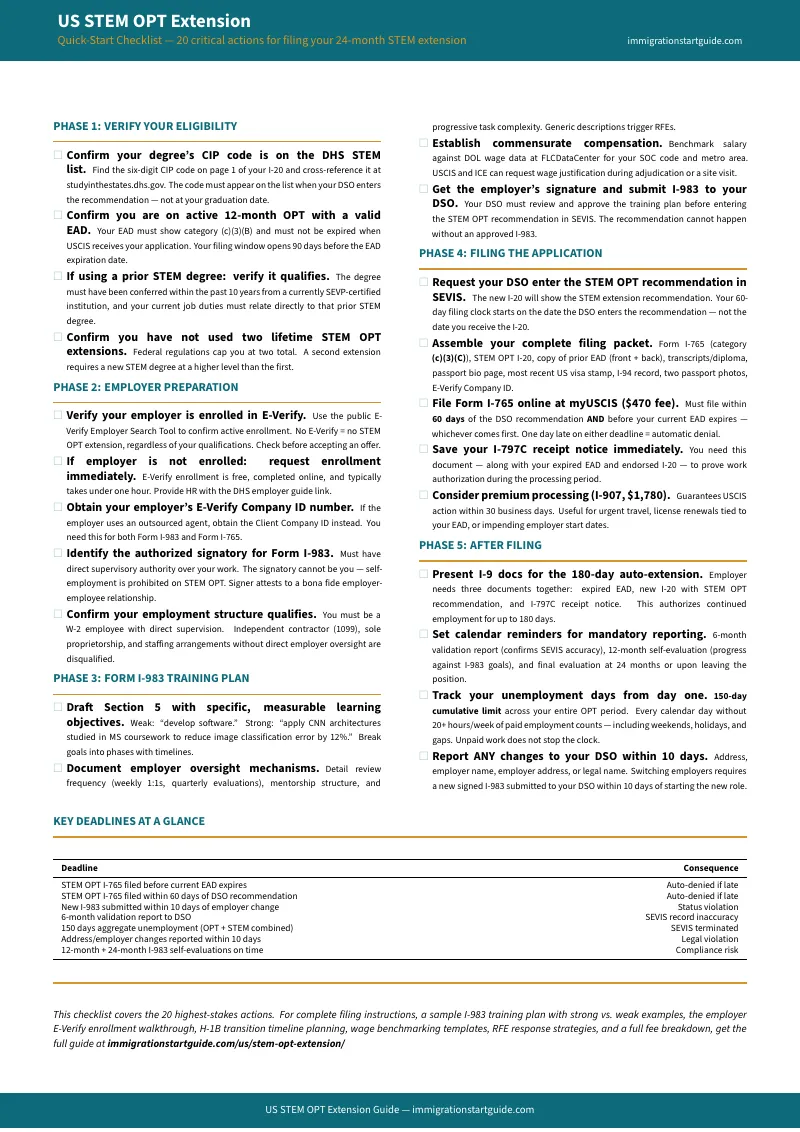
Your I-983 Is the Only Part Your Attorney Cannot Write for You. That Is Also the Part Where Applications Get Denied.
You already know the basics. File Form I-765. Get a new I-20. Have your employer on E-Verify. You have read the USCIS website, sat through your DSO's workshop, and bookmarked six Reddit threads that each say something different about the unemployment limit.
But none of that helps with the actual hard part: sitting down with your engineering manager and writing a Form I-983 Training Plan that convinces USCIS your job is structured educational training — not just employment. Your manager stares at Section 5 and asks what "specific and measurable learning objectives directly related to your qualifying STEM degree" means in plain English. You have a Computer Science degree and you write software. How do you describe "writing code" in a way that satisfies federal compliance officers who have never seen a codebase? Your DSO processed 400 extensions last semester and cannot write it for you. Your company's immigration lawyer files the I-765 but tells you the I-983 learning objectives are between you and your supervisor. Reddit has twelve different examples, none from your field, all from anonymous accounts who may or may not have been approved.
Meanwhile, the clock is running. Your DSO must enter the STEM OPT recommendation in SEVIS. You must file within 60 days of that recommendation. Your current EAD expires in 11 weeks. If any of these deadlines pass, the application is automatically denied with no appeal. And this is before you have figured out whether your startup's HR department even knows what E-Verify is, or how to explain to your VP of Engineering that signing the I-983 does not expose the company to an audit.
The US STEM OPT Extension Guide is built around the I-983 Execution System — five complete, field-specific sample training plans, a section-by-section I-983 walkthrough, and ready-to-send employer communication templates that handle every friction point between you, your manager, your HR department, and your DSO. This is not a summary of regulations you have already read. This is the execution layer that transforms "I know I need to file" into "I have filed, my training plan is airtight, my employer signed without hesitation, and my 180-day automatic extension is active."
What's Inside
The complete 12-chapter guide plus a 20-item quick-start checklist — covering every stage from eligibility verification through maintaining status for the full 24 months and positioning yourself for the H-1B transition:
Eligibility Verification and CIP Code Lookup
How to confirm your degree qualifies, the six-digit CIP code check against the DHS STEM Designated Degree Program List, using a prior STEM degree when your most recent degree is non-STEM (the 10-year window and job-duties test), and the second lifetime extension rules. You verify eligibility before you start the employer conversation — not after.
Employer Requirements Deep Dive
The E-Verify enrollment requirement, the bona fide employer-employee relationship test and why it matters, the self-employment prohibition (no freelancing, no 1099 work, no founding your own startup on STEM OPT), how staffing agencies and consulting firms qualify — or do not qualify — and the specific risks of multi-client contract work. Read this chapter before you accept a job offer.
The I-983 Section-by-Section Walkthrough
Every section of Form I-983, explained in plain language. What "structured learning objectives" actually means. How to articulate the relationship between your degree and your daily work when your CS degree says "algorithms and data structures" and your job says "fix bugs in the payment service." The commensurate compensation benchmarking process using DOL wage data. Material change triggers that require a new I-983. The difference between a training plan that gets approved and one that triggers a Request for Evidence.
Five Field-Specific Sample I-983 Training Plans
Complete, annotated training plans for Software Engineers, Data Scientists, Mechanical Engineers, Electrical and Computer Hardware Engineers, and Biotech Researchers. Not vague templates — copy-ready learning objectives, mentorship structures, phased training progressions, and evaluation criteria written in the compliance language USCIS expects to see. Your manager reads the sample, sees that the learning objectives map directly to your actual work, and signs. This is the chapter that saves you 15 hours of anxious drafting and three rounds of revisions with your DSO.
Step-by-Step Filing Sequence
The exact order of operations: when to request the DSO recommendation, the 60-day filing window, the 90-day pre-expiration window, required documents for online filing ($470) versus paper filing ($520), how to file Form I-765 at myUSCIS, and when premium processing ($1,780 via Form I-907) is worth it. The sequence matters — filing before the DSO enters the SEVIS recommendation wastes your application fee. Filing after your EAD expires gets you an automatic denial.
The 180-Day Automatic Extension
How the automatic work authorization extension works, the three documents you must present to your employer for I-9 verification (expired EAD + new I-20 + I-797C receipt notice), common I-9 errors that cause employer panic, and what happens if USCIS does not adjudicate within 180 days.
Maintaining Status for 24 Months
The 150-day cumulative unemployment limit across your entire OPT period (weekends and holidays count), mandatory 6-month validation reports, the 12-month self-evaluation, the final 24-month evaluation, material change reporting within 10 days, and what to expect during an unannounced SEVP site visit. A missed reporting deadline does not generate a warning — it generates a SEVIS violation.
Employer Communication Templates
Ready-to-send email scripts for every hard conversation: requesting E-Verify enrollment from HR departments that have never heard of it, coordinating I-983 completion with your direct manager, escalating when HR ignores your requests, onboarding a new employer mid-extension (new I-983 + updated I-20 + 10-day reporting window), and requesting your DSO recommendation when they are managing hundreds of cases. You stop improvising emails at midnight and start sending tested scripts that have gotten employers to sign.
The 2026 H-1B Transition Strategy
The STEM OPT extension gives you up to three shots at the H-1B lottery. This chapter maps each lottery attempt against your STEM OPT timeline, covers the wage-weighted selection system effective FY2027 (Level I workers face roughly 15% odds, Level IV workers see approximately 61%), strategic salary positioning to reach Level II or III, the beneficiary-centric registration model, cap-gap relief mechanics, and alternative pathways — O-1A, cap-exempt H-1B, EB-2 NIW — if the lottery fails three times.
Special Situations
Layoffs during the extension (the unemployment clock starts immediately, weekends included), corporate restructuring that changes your employer's legal entity, remote work and worksite reporting, changing employers while your STEM OPT application is still pending (the I-9 sequencing nightmare), and switching between STEM fields during the extension.
Common Pitfalls and a Complete Fee Breakdown
The mistakes that cause denials, RFEs, and status violations — including the ones you will not find on Reddit because the people who made them left the country. Plus a full financial planning table with every fee from the $470 I-765 to the $1,780 premium processing to the immigration attorney rates you might need if something goes wrong.
Plus Four Standalone Tools
In addition to the guide and checklist, your download includes standalone printable PDFs you can use independently — field-specific I-983 sample training plans to bring to your manager meeting, ready-to-send employer email templates to open alongside your inbox, a fillable unemployment day tracker for the 150-day limit, and a filing timeline reference card for your desk.
Who This Guide Is For
- F-1 STEM graduates whose initial 12-month OPT is expiring — the 90-day filing window is open or approaching and you need to execute the extension process from start to finish without a procedural error that triggers a denial
- Students whose managers or HR departments have never completed an I-983 — you need the field-specific sample training plans and the employer communication templates to walk them through it without creating legal anxiety
- Employees at startups or mid-sized companies not enrolled in E-Verify — you need the exact enrollment request scripts and the framing that makes E-Verify sound like the 30-minute, zero-risk formality it actually is
- Workers who did not get selected in the H-1B lottery — the STEM OPT extension is your path to two more lottery attempts and you need the filing executed without delays that eat into your remaining work authorization
- Anyone changing employers during STEM OPT or while an application is pending — the new I-983, the updated I-20, the I-9 verification sequencing, and the 10-day reporting requirement create a bureaucratic obstacle course where the order of operations determines whether you maintain status
Why Not Free Resources?
- Your DSO processes the SEVIS recommendation and answers basic compliance questions. They do not write your I-983 learning objectives, draft emails to convince your HR department to enroll in E-Verify, or help you benchmark your salary against DOL wage data for the commensurate compensation requirement. They manage hundreds of students and their mandate is institutional compliance, not your individual career strategy.
- USCIS.gov and Study in the States tell you that a training plan is required and list the sections of Form I-983. They do not show you a completed, field-specific example. They do not explain the difference between learning objectives that get approved and learning objectives that trigger a Request for Evidence. You get the what, never the how.
- Reddit and Trackitt give you 30 contradictory answers from anonymous accounts at different universities, working at different companies, under different DSOs. The person who says "my manager signed the I-983 in five minutes" works at Google where immigration teams do this weekly. The person whose extension was denied had a DSO who forgot to enter the SEVIS recommendation. Without knowing which variables drove the outcome, other people's stories create confusion, not confidence.
- Immigration attorneys file the Form I-765 and review your I-983 for basic compliance. They charge $1,500 to $3,000 for the filing and cannot write your training plan's technical learning objectives — your manager has to describe what a Software Engineer or Data Scientist actually does day-to-day. The attorney handles the legal filing mechanics. The hardest part of the process — the I-983 content — is still entirely on you.
This guide fills the execution gap — the space between knowing the STEM OPT extension exists and having the field-specific training plans, employer scripts, and filing sequences that get the application approved without an RFE, without a panicked HR department, and without a DSO delay that pushes you past the deadline.
— Less Than 2% of Your Filing Costs
The I-765 filing fee alone is $470. Premium processing is $1,780. An immigration attorney charges $1,500 to $3,000 for filing assistance — and still cannot write your I-983. If a weak training plan triggers a Request for Evidence, attorney intervention for an RFE response starts at $4,000. And if a missed deadline or a procedural error causes denial, the financial cost is not just the lost filing fees — it is the $6,000 to $12,000 per month in salary you forfeit while you cannot legally work.
This guide does not replace an immigration attorney for complex legal situations, SEVIS reinstatement, or removal proceedings. But it provides the I-983 Execution System — the field-specific sample training plans, the employer communication templates, and the step-by-step filing sequence — that prevents the procedural errors and weak training plans that cause RFEs and denials in the first place.
If it saves you one round of I-983 revisions, one week of chasing your HR department for an E-Verify number, or one RFE that would have cost $4,000 to resolve, it pays for itself before you finish Chapter 4.
Money-back guarantee, no time limit. If the guide does not make your STEM OPT extension process clearer, you pay nothing.
Download the free Quick-Start Checklist to see the 20 highest-stakes action items across the five filing phases — eligibility verification, employer preparation, I-983 drafting, application filing, and post-filing compliance. When you are ready for the complete I-983 Execution System, the field-specific sample training plans, and the employer communication templates, the guide is here.
Your STEM degree opens the door. This is the filing system that makes sure it stays open.