Your Employer Filed the PERM. Your Attorney Works for Them, Not You.
Your company's immigration attorney just sent a status update: "The PERM is progressing normally." That's all you got. No details on the SOC code they chose, no explanation of the prevailing wage level, no mention of whether the recruitment phase was structured to withstand a DOL audit. You are the beneficiary — your entire career trajectory depends on this petition — and you have less visibility into it than an intern has into the quarterly revenue report.
Meanwhile, your company is a three-year-old startup running at a loss. Nobody told you that USCIS requires employers to prove continuous "ability to pay" the proffered wage from the priority date onward — and that a cash-burning startup with negative net income faces an I-140 denial that invalidates years of waiting. You won't discover this until after the denial, after the priority date is gone, after the damage is irreversible.
Or maybe you're on the other track. You're building your own NIW petition because the attorneys you consulted quoted $5,000 to $10,000, and you know your credentials are strong enough to self-file. You've read the Matter of Dhanasar standard. You understand the three prongs. But the gap between understanding the legal test and producing a 20-to-30 page petition narrative that maps your career evidence to each prong in the format adjudicators expect — that gap is where petitions die. Especially now: NIW approval rates collapsed from 95.7% in FY 2022 to 55.2% in FY 2025, with Q4 hitting 35.7%. The era of rubber-stamped approvals is over.
The US EB-2 Employment-Based Green Card Guide is a Dual-Track Strategic Playbook. It covers both the employer-sponsored PERM pathway and the self-petitioned National Interest Waiver in a single document — with the audit frameworks, evidence-mapping blueprints, and decade-long backlog strategy that no free resource, forum thread, or $35 Amazon book provides. It replaces hundreds of hours of contradictory research with a verified, systematic framework you can execute in days.
What's Inside the Dual-Track Strategic Playbook
12 chapters plus 4 appendices covering both pathways from eligibility verification through green card approval, plus a printable 20-step quick-start checklist:
PERM Audit Framework (Chapter 3)
The employer-sponsored PERM process is controlled entirely by corporate counsel — which means you're blind to the exact mechanics that determine whether your case succeeds or fails. This chapter gives you the defensive intelligence to audit what your employer is doing: prevailing wage determination verification (is the SOC code right? Is the wage level defensible?), structured recruitment timeline tracking (when do the 30-day job order, newspaper ads, and three additional steps need to complete?), and the "ability to pay" financial analysis that catches startup-sponsored cases headed for denial before you've wasted years in the queue. Because corporate counsel represents the company's legal interests, not your life trajectory.
Dhanasar Evidence-Mapping Blueprint (Chapters 5-6)
The National Interest Waiver requires you to satisfy three prongs: substantial merit and national importance, that you are well-positioned to advance the endeavour, and that it benefits the US to waive the job offer requirement. Every free resource explains what these prongs mean. None of them show you how to construct the argument. The blueprint provides prong-by-prong evidence-mapping frameworks for STEM researchers, healthcare professionals, entrepreneurs, and industry experts — the exact structural architecture that boutique documentation agencies charge $1,500+ to produce. You map your publications, patents, citations, and career impact into the narrative structure that adjudicators expect. This is the difference between a petition that reads like a CV and one that reads like a legal argument.
NIW Cover Letter Architecture (Chapter 6)
The 20-to-30 page petition narrative is where most self-filers fail. Not because their credentials are weak, but because they don't know how to structure the document. This chapter provides the complete organizational framework: section-by-section flow, exhibit referencing conventions, the recommended balance of narrative vs. evidence, and the recommendation letter sourcing strategy — including why you need at least 3-4 independent experts (not co-authors or supervisors) and exactly what each letter should address. Designed for the 2026 adjudication environment where 39% of NIW filings receive an RFE or NOID.
I-140 Filing Strategy (Chapter 4)
Premium processing decisions, Asylum Program Fee calculations ($300 for self-petitioners, $600 for large employers), priority date retention rules when employers revoke petitions after you leave, and the filing mechanics for both employer-sponsored and self-petitioned cases. For Indian and Chinese applicants, premium processing isn't about speed — it's about locking in your priority date before you change employers. One chapter, both pathways, every fee mapped.
Visa Bulletin Tactical Playbook (Chapter 9)
Reading the monthly Visa Bulletin is straightforward. Making strategic decisions based on it is not. This chapter covers the Dates for Filing vs. Final Action Dates distinction, EB-2/EB-3 downgrade timing (when EB-3 moves faster than EB-2 for Indian nationals), cross-chargeability through a spouse born in a Rest of World country, EB-1 upgrade assessment with priority date porting, and the interfiling mechanics that can shave years off a decade-long wait. Because tracking your priority date without a strategy for accelerating it is just watching a clock you can't control.
India and China Backlog Strategy (Chapter 10)
If you're from India, your EB-2 wait is 12 to 18 years. If you're from China, 5 to 7. Generic guides treat the EB-2 process as a linear sequence ending with I-140 approval. For backlogged nationals, the I-140 approval is the beginning of a decade-long strategic exercise. This chapter covers dual-filing mechanics (concurrent EB-2 and EB-3 to capture whichever advances faster), priority date porting across categories, decade-long nonimmigrant status maintenance, the EAGLE Act and per-country cap reform prospects, and the psychological framework for managing a multi-year wait without career paralysis.
AC21 Job Portability (Chapter 7)
Changing employers during a pending green card process is the single most terrifying decision most applicants face. This chapter covers when it's legally safe to invoke AC21 portability (180 days after I-485 filing), what "same or similar" occupational classification actually means, how to preserve your priority date across employers, what happens if your original employer revokes the I-140, and the documentation you need to execute a transfer without destroying your case. Corporate counsel has no incentive to explain this until you're already leaving.
RFE Response Framework (Chapter 11)
You have 87 days to respond to a Request for Evidence. The framework provides structured response architecture for the most common RFE categories — ability to pay, national interest articulation, well-positioned evidence gaps, and credential equivalency challenges. Each framework includes organizational structure, exhibit referencing, and the specific types of supplemental evidence that resolve the adjudicator's concern. Because a panicked response that buries USCIS under 100 disorganized pages is worse than a targeted 30-page rebuttal.
Adjustment of Status and Consular Processing (Chapters 7-8)
I-485 concurrent filing strategy, EAD and Advance Parole interim benefits, civil surgeon medical exam timing, interview preparation, DS-260 preparation for consular processing, NVC document assembly, panel physician requirements, and embassy interview strategies. Whether you're adjusting status from within the US or processing through a consulate abroad, every step is mapped.
Complete 2026 Fee Architecture (Chapter 12)
Every filing fee, premium processing cost ($2,965), Asylum Program Fee surcharge, biometrics fee, and medical exam cost mapped across both PERM and NIW pathways. Total cost calculations for every pathway combination. A self-filed NIW with premium processing approaches $4,000 in government fees alone — know exactly what you're committing to before you file.
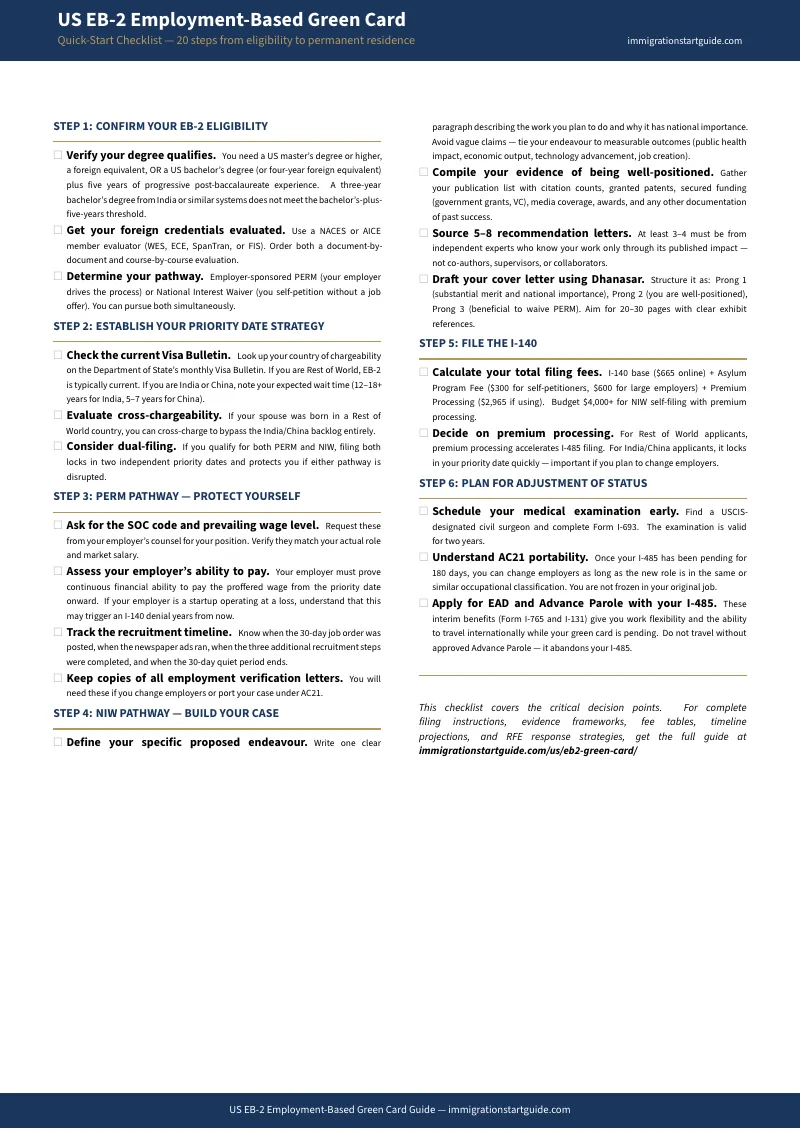
20-Step Quick-Start Checklist (free download)
The critical decision points distilled into a single action sheet: confirm EB-2 eligibility, choose your pathway, audit your employer's PERM process, compile NIW evidence, file the I-140, and plan for adjustment of status. Enough to take your first strategic step tonight.
6 Standalone Printable Tools
Print-ready reference cards and checklists you can bring to attorney meetings, filing sessions, and employer conversations: PERM Document Checklist, NIW Self-Petition Document Checklist, I-485 Adjustment of Status Checklist, Fee and Timeline Reference Card (PERM vs. NIW comparison), NIW National Importance Evidence Mapper (Dhanasar Prong 1 worksheet), and Employer Ability-to-Pay Reference Card. Each is a standalone one-page PDF — no need to flip through the full guide when you're sitting across from your HR department or assembling your petition.
Who This Guide Is For
This guide is for skilled professionals with advanced degrees or exceptional ability who need strategic control over their EB-2 green card process:
- You're on an H-1B and your employer started the PERM process, but corporate counsel treats your case as one file among hundreds — you have no visibility into the prevailing wage determination, recruitment phase, or whether your employer can survive the ability-to-pay test
- You're a researcher, physician, engineer, or entrepreneur building your own NIW petition and you need the structural framework to map your evidence to the Dhanasar prongs — not another blog post explaining what the test is
- You consulted an immigration attorney who quoted $5,000 to $10,000 for NIW representation, and you know you can produce a strong petition if you had the architectural blueprint — the guide costs less than 20 minutes of attorney billable time
- You're from India or China facing a decade-plus backlog, and you need a long-term strategy covering dual-filing, priority date porting, and EB-1 upgrade assessment — not just instructions for the next form to file
- Your H-1B six-year limit is approaching and you need your employer to file PERM before the end of year five to qualify for extensions — you need to know the exact timeline and what to push for
- You received an RFE and the 87-day clock is running — you need a structured response framework, not contradictory advice from anonymous forum users with different case facts
Why Not Free Resources?
Free information on the EB-2 process is abundant. Here's what it actually delivers:
- USCIS.gov and the Policy Manual provide the statutory requirements — dense, bureaucratic, and deliberately silent on strategy. You'll learn that the employer must demonstrate ability to pay the proffered wage. You won't learn how to assess whether your specific employer's financials can survive that test, or what to do if they can't.
- Law firm blogs (WeGreened, Chen Immigration, Raju Law) publish detailed legal analyses of the Dhanasar standard and PERM requirements — because their business model is to demonstrate overwhelming complexity and then offer a $5,000 retainer to resolve it. They explain why NIW approval rates are collapsing. They never provide the petition framework that would let you file successfully without them.
- Reddit, Trackitt, and VisaJourney are repositories of anecdotal data from anonymous users whose country of chargeability, filing date, credentials, and individual case facts you don't know. A strategy that worked for a Rest of World applicant in 2023 is irrelevant for an Indian national filing under 2026 scrutiny. You're building a career-defining legal petition on survivorship bias from strangers.
- DIY courses (Oscar's Green Card, $269) cover the NIW pathway exclusively — leaving the massive segment of PERM-sponsored employees with no guidance on auditing their employer's process, understanding AC21 portability, or navigating the decade-long backlog.
This guide fills the execution gap. It doesn't compete with free information — it organizes, verifies, and sequences it into an actionable playbook that covers both pathways. It provides the structural frameworks that boutique agencies charge $1,500 and attorneys charge $5,000+ to produce, at a fraction of the cost.
— Less Than 20 Minutes of Attorney Billable Time
A mid-tier immigration attorney charges $300 to $500 per hour. Full-service NIW representation runs $5,000 to $10,000. Boutique petition narrative services start at $1,500. Premium processing alone costs $2,965 in government fees.
The guide doesn't replace an attorney for complex legal appeals. But it gives you the strategic frameworks and evidence architecture that prevent the filing mistakes that trigger RFEs — the ones that cost thousands in additional legal fees and months of uncertainty. If you're self-filing, it's your complete blueprint. If you're hiring counsel, it transforms you from a confused client into a prepared partner who cuts billable hours and produces a stronger petition.
Money-back guarantee, no time limit. If the frameworks don't make your petition stronger, you pay nothing.
Download the free Quick-Start Checklist to see the 20 critical decision points. When you're ready for the PERM audit framework, Dhanasar evidence-mapping blueprint, and the complete dual-track playbook, the full guide is here.
Your priority date is your most valuable asset. Protect it with a strategy that matches the stakes.