
You Qualify for Australian PR. But Between You and the Invitation Is the ACS Year Deduction, a POSSAP Biometric Queue, and a Transcript From UNILAG That Has Not Left the Registry in Six Weeks.
You ran the numbers. Age: 30 points. English: 20 points. Experience: six years of software development, so 15 points. That puts you at 75 before state nomination. Competitive. You started telling people.
Then you discovered that the ACS deducts two years from your experience before counting it. Your six years became four claimable years. Your 15 experience points dropped to 5. Your 75 became 65 — the bare minimum to enter the pool, and about 25 points below what actually gets invited for a 189 visa. Nobody in the Nairaland thread mentioned this.
And that was just the points. Then came the reference letter. Your HR department at the Lagos office wrote a one-paragraph confirmation: "[Name] was employed as a Software Developer from 2019 to present." ACS wants six specific elements: exact duties, percentage time per duty, technologies used, employment dates to the day, full-time/part-time status, and the signatory's direct contact details. Your HR manager said "we don't do that here." You are not alone. Nigerian HR departments write for Nigerian purposes. Australian skills assessors evaluate for Australian standards. The gap between those two realities is where applications die.
Then the transcript. You paid Remita. You visited the registry at your university. They said two weeks. It has been six. The department has not sent your scores to the registry. You are calling every other day and nobody is picking up. Meanwhile, the state nomination window for South Australia opens in July and you need a positive skills assessment before you can submit your EOI, and you need a transcript before you can submit your skills assessment. Every week the transcript stalls is a week closer to missing the annual intake.
You are not short on qualifications. You are short on a bridge between what Nigerian institutions give you by default and what Australian authorities demand by policy.
The Nigerian-Australian Migration Blueprint
This is the operational bridge. Not a generic explainer of the 189/190/491 visa system — you can get that from the Department of Home Affairs website. This is the Nigeria-specific manual for every step where the Australian process collides with the Nigerian institutional reality: the ACS year deduction calculator that tells you your real points score before you pay the assessment fee. The reference letter template that satisfies ACS format requirements while being realistic for a Nigerian employer to actually sign. The transcript procurement strategy for universities where "two weeks" means two months. The POSSAP police certificate walkthrough — because the portal says NGN 30,000 and 72 hours but Alagbon Close says NGN 60,000 to NGN 100,000 and come back next Tuesday. The state nomination strategy that shows you why South Australia's Offshore Stream, not the 189, is the realistic pathway for most Nigerian professionals applying from within Nigeria.
Immigration consultants in Lagos charge NGN 500,000 to NGN 2,000,000 for Australian skilled migration cases. Some know the system well. Many focus on Canada and the UK because those systems are simpler, and they push study visas because those are easier to sell. What you need is not a consultant to submit your EOI. You need the technical playbook for navigating skills assessment bodies that apply deductions your consultant never warned you about, document procurement from institutions that operate on their own timeline, and a points optimization strategy that accounts for the real invitation thresholds — not the published minimums.
What Is Inside
ACS Skills Assessment Walkthrough
The ACS year deduction is the single most misunderstood part of the Australian migration process for Nigerian IT professionals. A "closely related" ICT Major degree from an NUC-accredited university means a 2-year deduction. A "not closely related" ICT Major means 4 years gone. An ICT Minor means 5 years. A non-ICT degree means 6 years deducted — and if you have fewer than 6 years of total experience, the RPL pathway is your only option. The guide breaks down exactly how the ACS evaluates Nigerian degrees (they assess your actual transcript subjects, not the degree title), which ANZSCO codes map to which Nigerian job titles, and how to calculate your claimable experience before you spend AUD 530-1,450 on an assessment that might leave you with fewer points than you expected.
Reference Letter Templates and Negotiation Strategy
ACS, Engineers Australia, ANMAC, and CPA Australia each have specific format requirements for employment reference letters — and Nigerian employers do not produce these by default. The guide includes the exact template format that satisfies each assessor: detailed duties, percentage time allocation, technologies used, full employment dates, and signatory contact details. It also covers what to do when your employer refuses or cannot provide the required level of detail: the statutory declaration pathway, the supporting evidence package (payslips, tax records, offer letters, org charts), and how to present NYSC primary assignment experience when the work was genuinely professional-level.
Engineers Australia CDR Writing Framework
Most Nigerian engineers are assessed through the Competency Demonstration Report pathway because COREN's Washington Accord full signatory status is still pending. The CDR requires three Career Episodes of 1,000+ words each, a Summary Statement cross-referencing 16 competency elements, and a CPD listing. The guide provides the structural framework for each Career Episode (introduction, background, personal engineering activity, summary), explains the difference between describing what your team did and what you did (Engineers Australia rejects team narratives), and shows how to map your episodes to the Summary Statement matrix so every competency element is covered.
ANMAC Assessment for Nigerian Nurses
Nigerian nurses face a unique bottleneck: the NMCN Certificate of Good Standing. ANMAC requires this sent directly from the Nursing and Midwifery Council of Nigeria to Canberra — you cannot submit it yourself. Processing takes months. The guide covers how to initiate this with NMCN headquarters in Abuja, the follow-up strategy that prevents your verification from sitting in a pile, the supplementary "Clinical Hours Breakdown" letter that ANMAC requires when Nigerian transcripts show credit units instead of hours, and the Modified Plus pathway for nurses who already have AHPRA in-principle approval.
CPA Australia Assessment for Nigerian Accountants
Nigerian accounting degrees cover most of CPA Australia's 12 Core Knowledge Areas — but almost certainly not Australian Taxation Law and Australian Business Law. These two gaps will produce a "negative" result for those subjects. The guide explains the "Provisional" assessment outcome that lets you proceed with your EOI despite the gap, the approved online bridging courses that satisfy the requirement, and how your ICAN membership (ACA or FCA) fits into the picture. You do not need to complete bridging courses before applying — but you need to know the pathway before committing to the assessment fee.
Nigerian Document Procurement Playbook
Every document in your application must be genuine, verifiable, and formatted to Australian standards. In Nigeria, that means fighting institutional timelines that have nothing to do with your migration schedule. The guide covers the university transcript process step by step — Remita payment, registry processing, departmental score retrieval, Registrar dispatch — with realistic timelines for each stage and the proxy agent option for graduates who are abroad or in a different state. It covers the ESS Digital Portal and the 16-digit Verification Token that can bypass slow registrar-to-assessor communication. It covers POSSAP police certificates with the Alagbon Close fast-track route and the state SIB alternative. It covers MFA and FME document legalization in Abuja, WAEC/NECO verification, and the cost breakdown for each step in Naira.
State Nomination Strategy
The Subclass 189 requires 90-95 points for an invitation in IT and engineering occupations. Most Nigerian offshore applicants score 65-75 without state nomination. The 190 adds 5 points. The 491 adds 15 points. The guide profiles every state that realistically nominates offshore applicants — South Australia's Offshore Stream (the most accessible for Nigerians who have never been to Australia), Victoria's ROI system, Tasmania's growing program, and Western Australia's regional pathway — with their occupation lists, financial capacity requirements, and annual intake timelines. It also explains why "regional" Australia is not the outback: Perth, Adelaide, Gold Coast, Hobart, and Canberra are all classified as regional for the 491 visa.
Financial Planning in Naira and AUD
The realistic total cost for a single Nigerian applicant is AUD 7,000 to AUD 10,000. For a family of four, AUD 16,000 to AUD 22,000. The guide breaks down every line item — skills assessment, English test, visa application fee (AUD 4,910 primary, AUD 2,455 spouse, AUD 1,230 per child), medicals, police certificates, legalization, transcripts, biometrics, and flights — in both AUD and NGN. It covers the domiciliary account strategy for holding migration funds in USD rather than Naira, the payment method for the AUD 4,910 visa fee when Nigerian Naira cards have USD 20-50 monthly limits, the 20% buffer rule for proof of funds, and the source-of-funds documentation that prevents "lump sum deposit" scrutiny from the Department of Home Affairs.
English Test Strategy
Superior English (PTE 79+ or IELTS 8.0+) is worth 20 points — the single highest-value item you can control. The guide covers why PTE Academic has become the dominant choice for Nigerian applicants targeting Australia (AI scoring eliminates accent bias concerns, results in 48 hours, approximately NGN 65,000-80,000 versus NGN 279,500-300,000 for IELTS), the specific PTE tasks that disproportionately affect your score (Read Aloud, Repeat Sentence, Summarize Written Text), booking logistics for Lagos and Abuja test centers, and the retake strategy if your first attempt falls short.
The 12-24 Month Roadmap
Australian skilled migration from Nigeria is a project with a defined timeline. The guide maps it across three phases: Documentation Sprint (months 1-4 — transcripts, English test, reference letters, domiciliary account), Assessment and EOI (months 5-10 — skills assessment, SkillSelect submission, state nomination), and Visa Application (months 11-18 — ITA response, medicals, biometrics, visa grant). Each phase has specific milestones, parallel tasks that should run simultaneously, and the common delays at each stage.
Settlement Planning — The First 90 Days
The visa grant is the starting point, not the finish. The guide covers what to ship versus sell in Nigeria (short answer: sell everything heavy), administrative setup in Week 1 (TFN, Medicare enrollment, bank account, SIM card), housing and employment search strategy in Weeks 2-4, and the Nigerian diaspora networks in every major Australian city — CoNAPA, state-based associations, and the WhatsApp and Facebook groups that provide housing leads, job referrals, and the practical settlement advice that only comes from Nigerians who arrived before you.
Profession-Specific Guidance
IT Professionals (ACS)
ACS year deduction calculator, ANZSCO code mapping for Nigerian job titles, reference letter template with the six required elements, statutory declaration fallback, and NYSC experience eligibility criteria.
Engineers (Engineers Australia)
CDR Career Episode writing framework, Summary Statement competency matrix, COREN registration as supporting evidence, and the Washington Accord status update for Nigerian degrees.
Nurses (ANMAC)
NMCN Certificate of Good Standing initiation strategy, Clinical Hours Breakdown letter template, OET versus IELTS score requirements (7.0 or OET "B" across all bands), and the Modified Plus pathway.
Accountants (CPA Australia)
Core Knowledge Area gap analysis, Provisional assessment explanation, approved bridging courses for Australian Taxation Law and Business Law, and ICAN membership documentation.
Who This Is For
- Nigerian IT professionals — software developers, systems administrators, data analysts, cybersecurity specialists — navigating the ACS assessment, the year deduction, and the reference letter format that Nigerian employers do not produce by default
- Nigerian engineers — civil, mechanical, electrical, chemical — who need to write a Competency Demonstration Report because their Nigerian degree is assessed through the non-accredited pathway until COREN's Washington Accord full signatory status is finalized
- Nigerian nurses and midwives — facing the NMCN verification bottleneck, the clinical hours breakdown requirement, and the high English threshold that ANMAC demands
- Nigerian accountants — ICAN members whose degrees cover ten of twelve CPA Australia Core Knowledge Areas but need a bridging strategy for Australian Taxation Law and Business Law
- Professionals with a spouse in a skilled occupation — couples who can claim 10 partner skills points but need both assessments and both English tests to be strategic about the investment
- Anyone currently holding migration funds in Naira — and losing purchasing power every month they delay converting to a domiciliary USD account
Why Not Nairaland, YouTube, or a Lagos Travel Agent?
Nairaland threads are the largest source of Australian migration information for Nigerians — and they are dominated by survivor bias. The person posting "I got my 189 invitation with 85 points" does not mention the ACS year deduction that almost sank their application, the three rejected reference letters before the fourth one worked, or the six months their transcript took to arrive. The threads from 2023 describe a points landscape that no longer exists in 2026. And the advice is contradictory: one poster says "just apply for 189," another says "491 only," and neither knows your specific points breakdown, your occupation's state nomination availability, or your financial situation.
YouTube "Japa" content gives you the highlight reel. A ten-minute video cannot walk you through the ACS year deduction mechanism, the reference letter template, the POSSAP biometric logistics, the domiciliary account strategy, and the state-by-state nomination analysis. The comments section is recycled advice from viewers who applied under different rules. And the creator is monetizing views, not outcomes — their success metric is watch time, not whether you received an invitation.
Travel agents in Lagos and Abuja focus on Canada and the UK because those systems are simpler and the commissions are faster. Most do not understand the ACS year deduction. Many push study visas because those are easier to sell than a 12-24 month skilled migration project. The ones who do handle Australian cases charge NGN 500,000 to NGN 2,000,000 — and their value is form-filling and lodgement, not the technical skills assessment strategy that determines whether your profile scores 65 points or 85. If you can submit an EOI yourself through SkillSelect, what you need is the playbook, not the middleman.
Printable Tools
The guide includes standalone tools designed to be printed and used throughout your migration process:
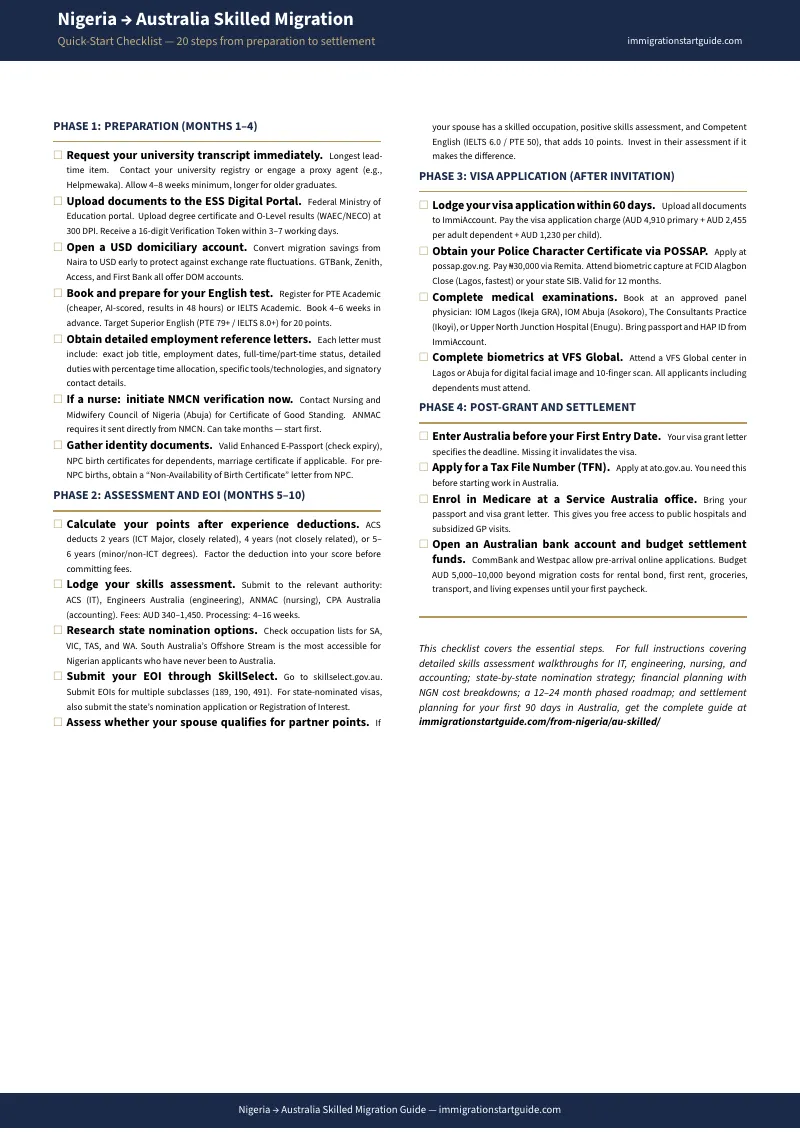
- Quick-Start Checklist — every step from transcript request to settlement, with realistic Nigerian processing times and the parallel task structure that prevents sequential bottlenecks
- Points Calculator Worksheet — calculate your actual score after ACS/EA/ANMAC/CPA deductions, English points, partner skills, and state nomination bonus to see where you stand before committing fees
- True Cost Calculator — every fee in both AUD and NGN for single applicants and families, with the domiciliary account conversion timeline
- Document Tracker — status tracking for every document with issuing agency, expected timeline, and the common error at each step that causes rejection or delay
The Free Checklist vs. The Full Guide
The free Quick-Start Checklist gives you the critical action items — every step you need to take, the agencies involved, and the order to tackle them. It is enough to see the full scope of what stands between you and a visa invitation, and to identify the long-lead-time items (transcripts, NMCN verification) that need to start moving immediately.
The full guide gives you how: the ACS year deduction calculator, the reference letter template, the CDR writing framework, the POSSAP walkthrough with Alagbon fast-track, the transcript procurement strategy for unresponsive registries, the state nomination analysis with financial capacity thresholds, the domiciliary account strategy, the 12-24 month phased roadmap with parallel tasks, and the settlement plan for your first 90 days in Australia.
— Less Than the POSSAP "Facilitation Fee" at Alagbon
The total cost of skilled migration from Nigeria to Australia — skills assessment, English test, visa application, medicals, police certificates, legalization, transcripts, biometrics, flights — exceeds NGN 8 million for a single applicant. For a family of four, it passes NGN 20 million. That does not count the months of preparation, the trips to university registries, the visits to Alagbon or Abuja, the time off work, or the opportunity cost of a rejected skills assessment that wastes the AUD 1,450 fee because your reference letters were in the wrong format.
If the information in one chapter — the year deduction calculator that prevents a nasty points surprise, the reference letter template that avoids ACS rejection, the domiciliary account strategy that saves you 15% of your migration fund against Naira devaluation, or the state nomination analysis that directs you toward the 491 pathway instead of waiting indefinitely in the 189 pool — prevents a single wasted fee or a single missed nomination window, the guide has paid for itself before you finish the first section.
100% satisfaction guaranteed. If the guide does not meet your expectations, email [email protected] for a full refund.