
You Hit 75 Points. Australia Needs 85. Your Agent Wants ₱300,000 to Close the Gap.
You ran the numbers. Age 30, Bachelor's degree, 5 years of experience, Competent English. That's 65 points — technically enough to lodge an Expression of Interest. But SkillSelect hasn't invited anyone below 85 points for your occupation in six months. You need 20 more points. And every strategy you find online assumes you already know how the system works.
You're a nurse in Riyadh scrolling through PinoyAU at 2am, trying to figure out whether you need AHPRA registration or ANMAC assessment first — and whether the "OBA pathway" everyone mentions is the same thing as the "competency-based assessment" on the AHPRA website. (It is. Nobody explains this.) You found a 2024 Reddit thread saying OSCE slots in Adelaide book out within minutes. You don't know if that's still true. You don't know if Melbourne has slots. You don't know what the 10 OSCE stations actually test, or why Filipino nurses fail not because they lack clinical skill but because they didn't verbalize a hand hygiene check to the standardized patient.
Or you're a software engineer in Makati with a CS degree from DLSU. You applied for an ACS skills assessment and listed "Developer Programmer" as your ANZSCO code. ACS came back with a "Skill Met Date" that deducted 4 years of your work experience — because your transcript didn't include unit descriptions proving that 33% of your coursework was ICT-professional content. Your degree was classified as "ICT Minor" instead of "ICT Major." That single classification cost you 3 years of claimable experience and the 15 points that would have put you over the 85-point wall. The ₱20,000 assessment fee is gone. The 12 weeks of processing time are gone. And nobody in the Facebook groups mentioned that you needed to submit a detailed syllabus alongside your transcript.
Meanwhile, you need your PRC license verified for the skills assessment. You're abroad, so you need someone in the Philippines to bring a wet-signed authorization letter to a PRC branch — because PRC banned electronic signatures on authorization documents in July 2024. If your representative doesn't hold a PRC license themselves, they need a notarized, DFA-Apostilled Special Power of Attorney. Getting that SPA from Riyadh requires a Philippine Embassy appointment, which takes weeks. Nobody in the 50,000-member Filipino Australia Migration Facebook group mentioned this rule change, because most of them verified their licenses in 2023.
The Philippines → Australia Skilled Migration Guide is the Decision-Ready Migration System — the procedural strategy playbook that sits between your points calculation and the forensic reality of satisfying AHPRA, ACS, ANMAC, and the Department of Home Affairs when your documents come from the Philippines and the Gulf. It covers the AHPRA OBA nursing pathway that most guides describe in two paragraphs and takes twelve chapters to actually execute. The ACS "ICT Major vs Minor" classification trap that silently costs Filipino IT professionals 3 years of claimable experience. The PRC wet-signature mandate that has been catching OFWs since July 2024. The state nomination strategies — including the Adelaide Edge, where healthcare workers are seeing visa grants in 25-35 days — that turn an 85-point problem into a 70-point solution. And the GCC verification layer for OFWs whose DataFlow records, Statements of Service, and contract verification documents need to satisfy both Gulf employer HR departments and Australian assessing authorities simultaneously.
What's Inside the Decision-Ready Migration System
AHPRA OBA Nursing Pathway — Stream B Walkthrough (Chapters 1-3)
Most Filipino BSN graduates are classified into Stream B — a category that requires passing both the NCLEX-RN and a 10-station OSCE before AHPRA grants registration. This isn't a single exam. It's a 90/120/180-day countdown sequence where missing one deadline expires your entire case and wastes every fee you've paid. These chapters walk through the complete OBA timeline: the Phase 2 portfolio audit (where identity discrepancies between your maiden name on your BSN degree and your married name on your passport trigger rejections), the NCLEX-RN at Pearson VUE, and the OSCE itself — station by station. The OSCE isn't a clinical knowledge test. It's a behavioral exam where Filipino nurses fail because they perform an aseptic technique correctly but don't announce each step to the examiner. The guide covers the APIE sequence (Assessment, Planning, Implementation, Evaluation), the Safety Critical stations where a single breach is an automatic fail, and the Adelaide vs. Melbourne booking strategy. It also covers the 800-hour clinical placement minimum that Philippine transcripts often obscure under a single "RLE" line item — and the "Detailed Course Breakdown" request from your university registrar that prevents ANMAC from stalling your application with a 6-8 week Request for Information.
ACS ICT Skills Assessment — The Classification Trap (Chapter 4)
For Filipino IT professionals, the ACS assessment is a forensic audit of your degree and employment history. The single highest-risk decision is how ACS classifies your qualification. An "ICT Major" (33% or more ICT-professional units) means a 2-year experience deduction. An "ICT Minor" means a 5-year deduction. A non-ICT degree means 6 years plus a Recognition of Prior Learning report that ACS cross-checks with plagiarism detection software. This chapter provides the unit-mapping methodology for Philippine "Big 4" degrees (UP, Ateneo, DLSU, UST) — how to extract and present course descriptions so ACS counts your electives and thesis toward the 33% threshold. It covers the ANZSCO code selection trap: why choosing ICT Manager (135111) when your reference letter only lists coding duties results in a "Not Closely Related" outcome and a 4-year deduction. The "Skill Met Date" calculation that determines which years of experience count for points. And the reference letter forensics — how to ensure your BPO employer's HR department provides duty descriptions that satisfy ACS without triggering the plagiarism filter that flags applicants who copy-paste ANZSCO task lists into their letters.
English Test Strategy — PTE vs IELTS in the Post-2025 Scoring Era (Chapter 5)
Superior English is worth 20 points — the single largest controllable factor in your points test. But in late 2025, PTE raised the Superior threshold significantly: Speaking now requires 88 out of 90, Writing requires 85. These scores are punishingly close to the maximum. Meanwhile, IELTS now accepts the One Skill Retake — if you hit 8.0 in three bands but got 7.5 in Writing, you can retake only Writing within 60 days instead of sitting the entire exam again. This chapter covers the Filipino-specific diagnostic: which test suits your profile based on the L1 transfer patterns that hold Filipino speakers at Band 6.5-7.0 (TH sounds, final consonant clusters, formal register circumlocution in Writing). The "clubbing" rules that let you combine results from two sittings within 12 months. And the strategic decision framework for whether Superior English (20 points) or Proficient English plus a state nomination (10 points plus regional advantages) gives you a faster path to PR.
Philippine Document Procurement — PSA, NBI, DFA eApostille, PRC (Chapter 6)
Australia's visa system is fully digital. The Philippine bureaucracy is still transitioning from the Red Ribbon era. This chapter covers the complete document procurement workflow for applicants in the Philippines and abroad. The PSA eApostille through PSAHelpline — which documents qualify for fully digital processing and which still require physical DFA appointments. The NBI clearance for applicants already in Australia — the blank Form 5 from the Philippine Consulate in Sydney or Melbourne, fingerprints taken at an Australian police station, authentication by the Consulate, and courier to Manila's Mailed Clearance Section. The PRC wet-signature mandate since July 2024 — no electronic signatures on authorization letters, period. If your representative is a PRC license holder, a handwritten authorization is sufficient. If not, they need a notarized, DFA-Apostilled Special Power of Attorney. And the identity document forensics — why a 600 dpi color scan matters, why mobile phone scanning apps trigger "Possible Alterations" flags that add 4 months to processing, and how to handle naming discrepancies between your BSN degree, marriage certificate, and passport with an Apostilled "Affidavit of One and the Same Person."
The OFW Chapter — Gulf Verification and GCC Document Standards (Chapter 7)
For Filipino OFWs in Saudi Arabia and the UAE, verifying Gulf work experience for an Australian skills assessment requires navigating multiple layers of international verification. ANMAC and ACS require Primary Source Verification — the DataFlow Group contacts your employer directly to confirm clinical roles or technical duties. This takes up to 60 days. Middle Eastern employers frequently provide Statements of Service that lack the granular details Australian assessors require: total clinical hours, specific specialty duties, technical project descriptions. This chapter provides the GCC-compliant Statement of Service templates that satisfy both Gulf employer HR policies and ANMAC/ACS assessment standards. It covers the UAE Contract Verification Centers operated by VFS Global in Dubai and Abu Dhabi. The Saudi exit visa logistics for nurses who need to travel to Adelaide for their OSCE without alerting an unsupportive employer. And the Philippine Overseas Employment Certificate requirements that must be met before legal travel from the UAE to Australia.
State Nomination Strategy — The Adelaide Edge, WA, and NSW (Chapter 8)
If your points score sits between 70 and 85, state nomination is your most viable path to PR. South Australia's 2026 strategy has been aggressive — SA Migration Services is directly inviting offshore healthcare professionals from the SkillSelect pool, bypassing the requirement for existing Australian work experience. Healthcare workers received the largest share of SA invitations in early 2026 (69 out of 344), with median visa grant times of 25-35 days for "Decision-Ready" applications. This chapter covers the Adelaide Edge in detail: which occupations SA is targeting, the Priority Three protocol (Care Economy, Infrastructure, Digital/Cyber/Net Zero), and why Adelaide is now competing with Canada and the UK for Filipino nursing talent. It also covers WA's three-stream nomination program (Schedule 1 Healthcare, Schedule 2 IT/Engineering, Graduate Stream), the WASMOL occupation list, and the NSW 5-Day Rule — the requirement that all supporting documents must have at least 5 days of validity remaining after nomination submission. Filipino applicants with long document procurement timelines are at particular risk of English tests or skills assessments expiring mid-process.
Points Strategy — The 85-Point Wall, Age Cliff, and Power Couple Approach (Chapter 9)
Meeting the technical minimum of 65 points is no longer a guarantee of an invitation. This chapter maps the realistic points landscape for Filipino professionals in 2026. The age cliff at 33 — crossing this birthday costs 5-10 points overnight and can invalidate an EOI in a competitive occupation. The partner points paradox — single applicants receive a flat 10 points, but a married applicant whose spouse lacks professional skills loses that advantage entirely. The "Power Couple" strategy — if the primary applicant is a software engineer and their spouse is a registered nurse, claiming 10 additional partner points (5 for skills assessment, 5 for competent English) creates a "Double Priority" profile that addresses two state shortages simultaneously and gets invited within weeks. And the counterintuitive recommendation: in many Filipino couples, the primary breadwinner (the IT lead) should step aside as the secondary applicant to let the nurse spouse take the lead, because healthcare processing times are significantly faster.
Financial Planning — Total Cost of Migration (Chapter 10)
A single Filipino professional must budget for a series of high-cost milestones over 12-18 months: English test ($410-$495 AUD), skills assessment ($530-$1,450 AUD), visa application ($4,910 AUD for Subclass 189 — non-refundable), dependent partner ($2,455 AUD), medical and biometrics ($300-$600 AUD). Total: approximately ₱370,000+ excluding airfare and settlement buffer. This chapter provides the complete PHP cost breakdown mapped to a realistic timeline, so you're not scrambling for visa fees and exam registrations in the same month. It covers the TSMIT threshold ($79,499 AUD from July 2026) — the minimum salary an employer must pay a sponsored worker. If your nominated role's market salary in Australia falls below this threshold, the employer-sponsored path is closed and GSM (points-based) is your only option. And the $6,000 AUD settlement buffer that successful applicants recommend for the first six months, particularly given Australia's current housing market.
The NEC Code Trap and EOI Integrity (Chapter 11)
A nurse may work in ICU and claim a Critical Care specialty code on their Expression of Interest. But if ANMAC issued an NEC (Not Elsewhere Classified) code on their Determination Letter because the Statement of Service lacked specialized ICU hours, the codes don't match. The Department of Home Affairs is checklist-driven — there is no room for explanation. Under Public Interest Criterion 4020, claiming a specialty code that doesn't match your assessment letter can result in a 10-year application ban for "Fraudulent Information." This chapter covers the AHPRA-ANMAC disconnect, how to ensure your ANMAC code aligns with your EOI nomination, and the documentation strategy that prevents an NEC default.
8 Standalone Printable PDFs
Points Calculator Worksheet (fillable points test with 189/190/491 comparison). Philippine Document Procurement Checklist (organized by agency — PSA, DFA, NBI, PRC, CHED — with OFW-specific requirements). OSCE Station Reference Card (10-station breakdown, Safety Critical triggers, Adelaide vs. Melbourne comparison). Migration Cost Planner (milestone-by-milestone AUD and PHP estimates with fillable "Your Actual Cost" column). 18-Month Timeline Planner (fillable target and actual dates for every milestone, with the overlap strategy). State Nomination Comparison Card (SA, WA, NSW, and Regional 491 side-by-side). Document Validity Tracker (issue dates, expiry dates, and renewal alerts for every document in your application). ANZSCO Code Reference Card (18 common Filipino occupation codes, color-coded by assessing authority).
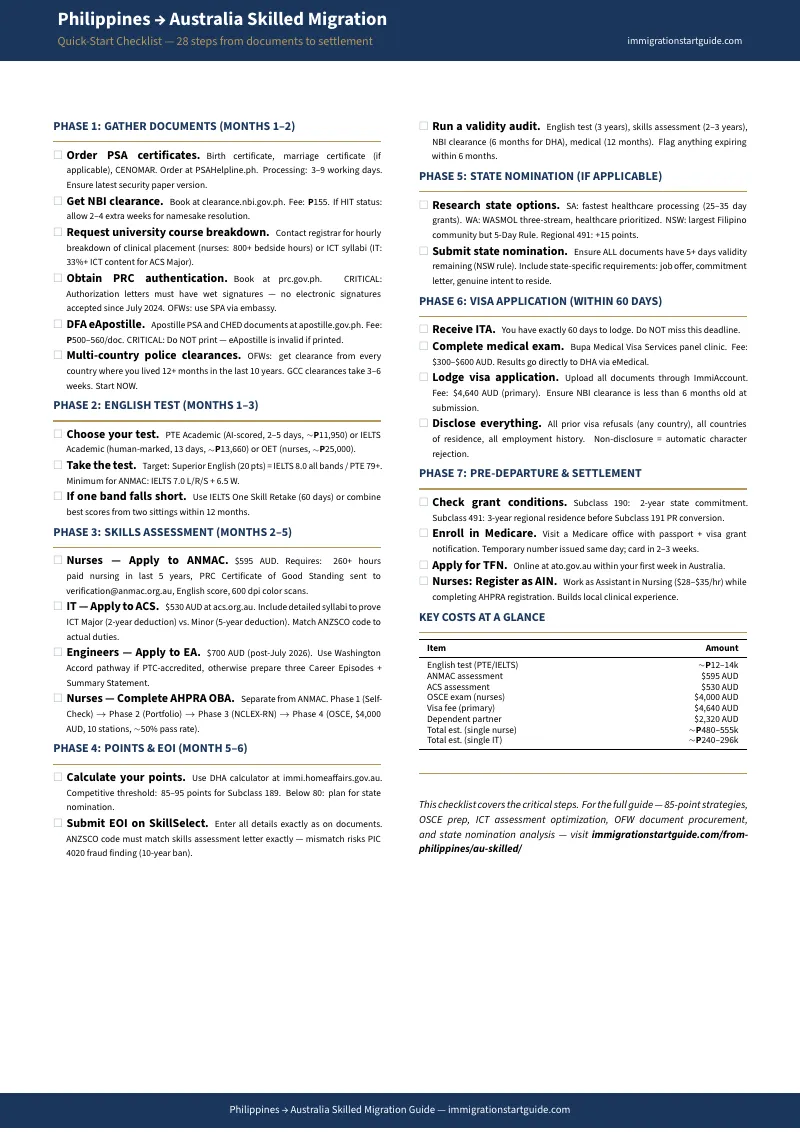
Quick-Start Document Checklist (free download)
Every Philippines-specific document you need for your Australian skilled visa application, distilled into a single printable checklist: PSA documents, DFA eApostille requirements, PRC license verification, NBI clearance, skills assessment documents (ANMAC for nurses, ACS for IT), English test requirements, points calculation framework, and state nomination prerequisites. Enough to start gathering documents tonight.
Who This Guide Is For
This guide is for Filipino professionals navigating Australia's skilled migration system — whether you're a nurse building your AHPRA file, an IT professional fighting the ACS experience deduction, or an OFW planning your exit from the Gulf:
- You're a registered nurse in Saudi Arabia or the UAE and you know Australia is short 20,000+ nurses — but you have no idea whether to start with AHPRA or ANMAC, whether your BSN qualifies as Stream A or Stream B, or how to get your PRC license verified when electronic signatures have been banned since July 2024
- You're an IT professional with a CS degree from a Big 4 university and ACS classified your qualification as "ICT Minor" instead of "ICT Major" — costing you 3 years of claimable experience and the points that would have cleared the 85-point wall. You need to know whether to appeal, resubmit with a detailed syllabus, or pivot to a different ANZSCO code entirely
- You scored IELTS 7.0 across three bands but got 6.5 in Writing — and you're not sure whether the One Skill Retake, PTE Academic, or OET gives you the best shot at Superior English and the 20 points that would change everything
- You're working in a Riyadh hospital and you need to fly to Adelaide for your OSCE — but your employer controls your exit visa and you don't know how to frame the trip without jeopardizing your contract
- You're a couple — one nurse, one engineer — and you can't figure out who should be the primary applicant, whether partner points help or hurt, or how to structure a "Power Couple" profile that gets invited in weeks instead of months
- You're turning 33 in eight months and you know the age cliff drops your points by 5-10 overnight — but you haven't started your skills assessment and you don't know how to run AHPRA, NBI clearance, and English testing in parallel instead of sequence
- You're a career switcher with a non-IT degree working in a BPO and the ACS RPL pathway requires two project reports — but you've heard that AI-generated or plagiarized reports result in immediate, non-appealable rejections
Why Not Free Resources?
Free information about skilled migration to Australia is everywhere. Here's what it actually gives you:
- Facebook groups (PinoyAU, Filipino Nurses in Australia, OFW to Australia) have tens of thousands of members posting timelines, agent recommendations, and exam tips. The problem: most active advice-givers lodged their applications in 2023 or 2024. They'll tell you PTE is easier than IELTS — without mentioning the late 2025 scoring changes that pushed the Superior Speaking threshold to 88 out of 90. They'll share reference letter templates that worked for them — templates that now trigger the ACS plagiarism filter. And a single wrong ANZSCO code recommendation means a ₱20,000 assessment fee wasted and 12 weeks lost.
- Reddit threads (r/phmigrate, r/AusVisa) are excellent for real applicant timelines and emotional support. They deliver information in fragments that don't build into a procurement strategy. A nurse in the UAE needs to coordinate AHPRA registration, ANMAC assessment, PRC verification, DataFlow PSV, NBI clearance, English testing, and state nomination across four countries and eight agencies simultaneously. No comment thread does this.
- Migration agents charge ₱150,000-₱400,000 for a single applicant, ₱600,000+ for couples. Many are volume processors who handle Filipino cases the same way they handle Indian or British cases — they don't know the PRC wet-signature mandate, the NBI Mailed Clearance Section process for applicants in Australia, or the GCC Statement of Service format that satisfies both Gulf HR departments and ANMAC assessors. You're paying for case management and portal submissions. Whether you're paying for the Filipino-specific documentation strategy is a different question.
- Generic skilled migration guides explain the points test and SkillSelect for applicants from any country. They don't know what PSAHelpline is. They've never navigated a PRC wet-signature authorization from abroad. They think skills assessment is a single step, not a forensic audit of your university transcript, employment references, and clinical hours. They have no concept of the DataFlow PSV timeline or the Saudi exit visa logistics for a nurse who needs to fly to Adelaide for an OSCE.
- Government websites (immi.homeaffairs.gov.au, ahpra.gov.au, acs.org.au) list requirements without explaining how to fulfill them from the Philippines or as an OFW. AHPRA says "provide evidence of 800 clinical hours." It doesn't tell you that most Philippine transcripts list these hours under a single "RLE" line item that assessors can't verify, and that you need a specific "Detailed Course Breakdown" from your university registrar. ACS says "provide reference letters." It doesn't tell you that BPO HR departments routinely issue generic Certificates of Employment that lack the duty descriptions ACS requires, and that you need a Statutory Declaration from a direct manager plus BIR Form 2316 as third-party evidence.
This guide fills the Philippine documentation gap. It doesn't replace a Registered Migration Agent — it handles the entire Filipino-specific procurement and strategy layer that generic guides ignore and agents charge ₱150,000-₱400,000 to manage. The AHPRA OBA timeline sequence, the ACS unit-mapping methodology for Philippine degrees, the PRC wet-signature workaround, the GCC document standards, and the state nomination strategy that only matter when you're filing from the Philippines or as a Filipino OFW.
— Less Than a Single Skills Assessment Fee
An ANMAC Full Skills Assessment costs $595 AUD. An ACS assessment costs $530 AUD. Nominating the wrong ANZSCO code means paying again, waiting another 12 weeks, and watching your age tick past the next points penalty threshold. A PRC authorization letter with an electronic signature — banned since July 2024 — means your skills assessment stalls for weeks while you arrange a wet-signed replacement from abroad. A mismatched ANMAC code and EOI nomination can trigger a 10-year application ban under PIC 4020.
The guide doesn't replace a migration agent. It handles the Filipino-specific procedural strategy that sits between your points calculation and an approved visa. It turns months of fragmented Facebook advice and outdated Reddit threads into a structured protocol built for Philippine government agencies, Gulf verification requirements, and the 2026 assessment and nomination rules that most resources still haven't caught up with.
Money-back guarantee, no time limit. If the guide doesn't give you clearer control over the Philippine documentation and strategic planning side of your skilled visa application, you pay nothing.
Download the free Quick-Start Checklist to see every Philippines-specific document you need for your Australian skilled visa. When you're ready for the AHPRA OBA walkthrough, the ACS classification strategy, the PRC wet-signature workaround, the GCC document templates, and the state nomination roadmap, the full guide is here.
Australia needs your skills. Your points score gets you into the pool. Your Philippine documents — assessed correctly, verified properly, procured from the right agencies in the right order — determine whether you get out of it.