
40 Free Zones. 200 Setup Agencies. Every One of Them Wants to Pick Your Jurisdiction for You. This Guide Lets You Pick It Yourself.
You decided to go freelance in the UAE. You started researching free zones. And within 48 hours, you were drowning. GoFreelance in Dubai Media City costs AED 14,120 but restricts you to media activities. SHAMS in Sharjah costs AED 5,750 but your bank application will probably be rejected because legacy banks view it as "minimal presence." Ajman NuVentures costs AED 4,888 but nobody on Reddit can confirm whether the license actually gets you a business bank account. IFZA costs AED 14,900 and promises "ease of setup" but charges AED 7,350 for a No Objection Certificate if you ever want to leave. Meydan costs AED 12,500 and gives you a Dubai address, but the flexi-desk approval rate at Emirates NBD is 30 to 40 percent. Meanwhile, a setup agency just quoted you AED 25,000 "all-in" for a Fujairah Creative City license that the free zone itself advertises for AED 15,900. The AED 9,100 difference is their commission, but they did not mention that part.
The structural problem with UAE freelance setup is that every source of information has a financial interest in your decision. Free zone websites advertise license fees starting at AED 5,500 without mentioning that the end-to-end cost including visa, Emirates ID, medical test, establishment card, and health insurance runs AED 12,000 to AED 20,000. Setup agencies push specific free zones because those zones pay the highest referral commissions. Reddit threads contradict each other because one person set up in RAKEZ in 2024 under different rules and another person set up in DMCC last month under current rules. YouTube creators are sponsored by Virtuzone or Creative Zone and cannot tell you that the free zone they are recommending has an exit fee that will cost you AED 7,350 when you want to move. And nobody — not the free zone, not the agency, not the YouTube creator — explains what happens six months later when you try to open a bank account and discover that 60 to 70 percent of flexi-desk applications at traditional banks get rejected.
The UAE Freelance/Remote Work Visa Guide is a Setup Sovereignty System — the complete framework for choosing your own free zone, opening your own bank account, handling your own tax registration, and building your own residency without paying AED 5,000 to AED 10,000 in agency markups for a decision you could have made yourself with the right information. Not a free zone's marketing brochure. Not a setup agency's commission-optimised recommendation. This is a guide covering the three self-sponsorship pathways side by side (Virtual Working Programme, Free Zone, Mainland MOHRE), real costs for 40+ free zones with the numbers agencies leave out, the banking strategy that actually works in 2026, tax compliance including the Small Business Relief trap that triggers an AED 10,000 penalty, the application lifecycle from degree attestation to Emirates ID, family sponsorship, and the upgrade path to Green and Golden Visas.
What's Inside the Setup Sovereignty System
The complete guide, a quick-start checklist, and 10 standalone reference sheets — everything you need from first decision to settled residency:
Three Pathways, Side by Side (Chapter 2)
The Virtual Working Programme, Free Zone permits, and Mainland MOHRE permits are three fundamentally different residency structures with different rules, different costs, and different consequences for your banking, your tax obligations, and your long-term residency options. The VWP lets you work for foreign clients only — no UAE invoicing, no path to Green Visa, and as of April 2026, you need USD 5,000 per month with six consecutive months of bank statements instead of three. A Free Zone permit gives you a trade license and UAE invoicing but geographically restricts your physical service delivery to the zone. A Mainland MOHRE permit lets you work anywhere in the UAE and bid on government contracts, but requires an attested degree and costs more upfront. The guide maps each pathway's eligibility, total costs, banking implications, and upgrade options so you choose based on your actual business model rather than whatever a setup agency happens to be selling this month.
The Free Zone Deep Dive — Real Costs, Not Marketing Costs (Chapter 3)
Free zones advertise license fees. You pay total setup costs. These are not the same number. GoFreelance in Dubai Media City advertises a AED 7,520 permit fee — but by the time you add the AED 2,000 establishment card, AED 4,600 visa, medical test, and Emirates ID, you are at AED 14,120 minimum. twofour54 in Abu Dhabi waives the license fee for the first two years — but you still pay AED 2,180 for e-channel registration, AED 854 for the establishment card, AED 1,370 for the visa, and AED 400 for Emirates ID. The guide breaks down the true end-to-end cost for every major free zone: Ajman NuVentures (AED 4,888 license, approximately AED 12,000 total), SHAMS (AED 5,750 license, approximately AED 13,000 total), RAKEZ (from AED 6,100), IFZA (AED 14,900 with visa), DMCC (AED 4,020 license plus AED 2,237 visa fees), Meydan (AED 12,500), and Fujairah Creative City (AED 15,900 for the Elite package with visa). More importantly, the guide explains the banking success rate, exit costs, and renewal fees for each — the three numbers that determine whether your AED 5,000 "cheap" license ends up costing you AED 25,000 over two years.
The Banking Strategy — Wio First, Questions Later (Chapter 5)
Banking is the single most frustrating part of UAE freelance setup, and the part that agencies never talk about because they cannot solve it. Here is what happens: you set up a free zone license in a Northern Emirate because it was cheap. You walk into Emirates NBD to open a business account. They ask for your trade license, see a flexi-desk address in Sharjah, and reject you. You try ADCB. Same result. You try FAB. They want a AED 50,000 minimum balance. Six weeks into your UAE residency, you have a license, a visa, an Emirates ID, and no way to receive payment from your clients. The guide covers the 2026 banking landscape from the freelancer's perspective: Wio Bank's Creators plan (72-hour onboarding, no minimum balance, specifically designed for freelancers), Mashreq NeoBiz (no monthly fees for startups, 3 to 7 day onboarding), the practical sequence (apply for Wio the day your Emirates ID arrives, do not wait), and why you should treat your bank choice as the first decision, not the last one — because a AED 5,000 license in a free zone that banks reject is more expensive than a AED 15,000 license in a free zone that banks approve.
Tax Compliance — The Small Business Relief Trap (Chapter 6)
The UAE introduced corporate tax in 2023, and most freelancers still do not understand how it applies to them. Here is the structure: if your gross revenue is below AED 1,000,000, you have no registration or tax obligation. Above AED 1,000,000, you must register on the EmaraTax portal. Your taxable profit below AED 375,000 is taxed at 0%. Profit above AED 375,000 is taxed at 9%. This sounds straightforward until you encounter Small Business Relief — a provision that lets professionals with revenue between AED 1 million and AED 3 million elect to pay 0% tax. The trap: you must explicitly elect for SBR in your tax return via EmaraTax. It is not automatic. If you miss the registration deadline, you receive an automatic AED 10,000 penalty. If you forget to elect for SBR, you pay 9% on profits that should have been zero-rated. The guide covers corporate tax registration, VAT thresholds (mandatory at AED 375,000 revenue), the SBR election process, and the India-UK DTAA framework for freelancers who need a Tax Residency Certificate to avoid double taxation in their home country.
Degree Attestation — The Process That Gates Everything (Chapter 4)
For Mainland MOHRE permits and certain Free Zone applications, your degree must be attested through a multi-stage chain that varies by nationality. India requires university verification, then State HRD or SDM, then MEA, then UAE Embassy digital certificate — a process that takes 9 to 10 working days minimum. Pakistan runs through HEC, then MOFA, then VFS Global's digital workflow. The Philippines requires DFA Apostille, then UAE Embassy Manila authentication. Starting this process after you arrive in the UAE means waiting weeks with no license, no bank account, and no income while your documents travel through government offices. The guide maps the complete chain for each nationality with timelines, costs, and the sequence — because starting attestation two months before your planned move saves you from discovering the bottleneck on the ground.
Green Visa and Golden Visa — The Upgrade Path (Chapter 7)
A standard freelance visa is a one-year renewable permit tied to your trade license. The Green Visa is a five-year self-sponsored residency that removes the annual renewal cycle and gives you a six-month grace period if it expires. Requirements: a freelance permit, a bachelor's degree, and AED 360,000 in annual self-employment income for the past two years. The Golden Visa is a ten-year residency for professionals earning AED 30,000 per month — and unlike the standard visa, it does not get cancelled if you leave the UAE for more than six months. The guide explains the eligibility criteria, the income documentation requirements, and the practical timeline for upgrading — because many freelancers who set up a basic one-year permit in 2026 will qualify for the Green Visa by 2028 if they plan their income documentation correctly from day one.
Family Sponsorship — Income, Not Job Title (Chapter 8)
Freelance visa holders can sponsor family members, but the thresholds are based on income rather than a fixed monthly salary. Spouse and children require a minimum of AED 4,000 per month (or AED 3,000 plus housing). Parents require AED 20,000 per month. Because freelancers do not have a payslip, immigration departments review 3 to 6 months of bank statements to verify consistent cash flow. The guide covers each dependent category, the documentation required (attested marriage certificate, birth certificates, tenancy contract or free zone housing letter, health insurance for each dependent), and the common pitfall that catches freelancers — applying for family sponsorship before they have enough months of UAE banking history to demonstrate the income threshold.
The Renewal System — Salama AI and Traffic Fines (Chapter 9)
In 2026, the UAE's Salama AI protocol has automated routine visa renewals and cancellations. Compliant applications are processed in minutes. Non-compliant applications are blocked automatically — and the system checks databases that you might not expect. Outstanding traffic fines linked to your Emirates ID will block your visa renewal. An expired health insurance policy will block it. A trade license with fewer than 60 days of remaining validity will block it. Six months of bank statements with zero activity will flag your account as dormant. The guide covers the renewal checkpoints, the timeline (start 60 to 90 days before expiry), and the AED 50 per day overstay fine that starts accumulating the day your visa expires with no grace period.
The Agency Trap — What AED 25,000 "All-In" Actually Buys (Chapter 10)
Setup agencies charge AED 5,000 to AED 10,000 in service fees on top of government fees. For that markup, you get someone who types your information into a portal — the same portal you can access yourself. They do not guarantee your bank account will be approved. They do not handle your tax registration. They do not explain exit costs. And when you want to leave the free zone they recommended, you discover the NOC fee is AED 7,350 — a cost that was never mentioned during the sales process. The guide shows you every step agencies perform so you can decide whether AED 5,000 to AED 10,000 is worth paying for data entry, or whether you would rather spend AED 47 on understanding the entire system and handling it yourself.
10 Standalone Reference Sheets (print or save to your phone)
The guide's most actionable sections — extracted as independent PDFs you can bring to a bank appointment, pull up during a free zone comparison, or hand to your spouse when explaining the family sponsorship process:
- Free Zone Comparison — zone-by-zone costs, banking approval rates, exit fees, and renewal costs
- Cost Comparison Tables — VWP vs Free Zone vs Mainland side-by-side total outlay
- Banking Strategy Card — neobank comparison, the 7-step sequence, and rejection recovery
- Tax Compliance Reference — corporate tax and VAT thresholds, SBR election steps, penalty triggers
- Degree Attestation Chains — India, Pakistan, UK, US, and EU workflows with timelines
- Application Timeline — step-by-step stages with expected durations
- Family Sponsorship Reference — income thresholds, documents, costs per dependent category
- Renewal Compliance Checklist — Salama AI checkpoints and the 60-to-90-day advance timeline
- Agency Evaluation Card — five questions to ask before signing, plus markup analysis
- Document Checklist — pathway-organized checkbox list of every required document
Quick-Start Checklist (free download)
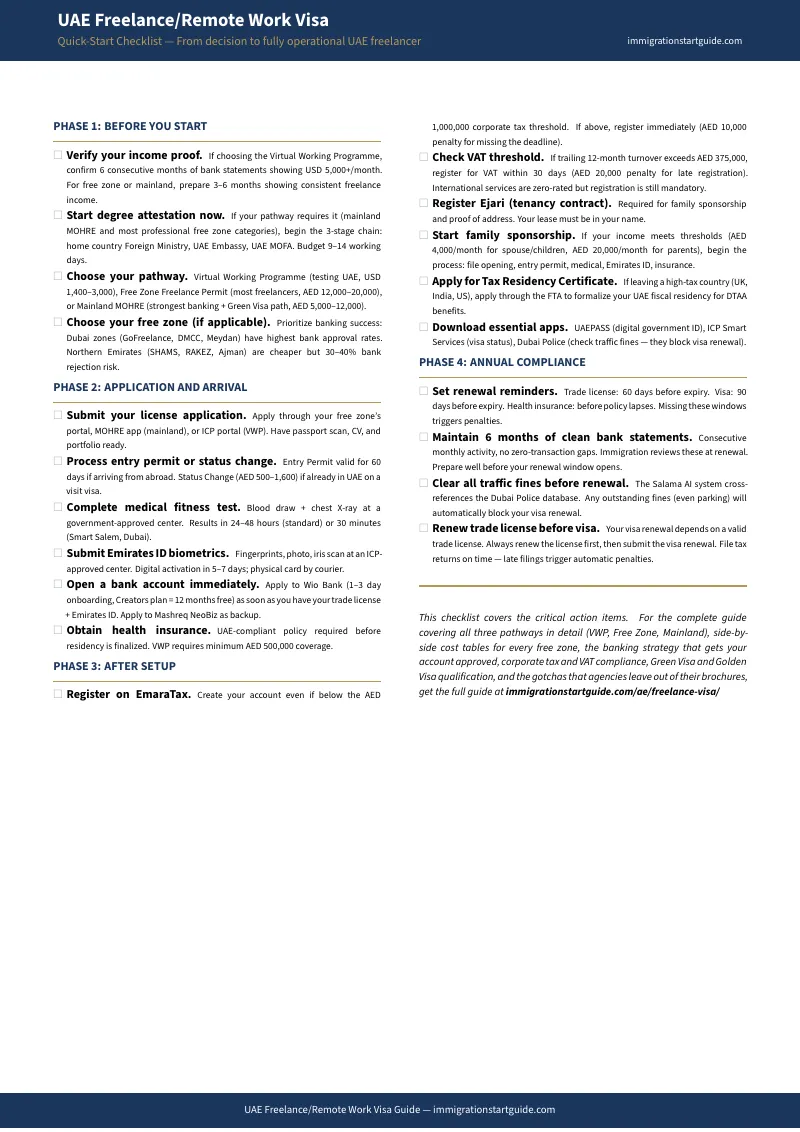
A three-phase action plan covering the essentials: assess your pathway (VWP vs Free Zone vs Mainland), check your degree attestation status, verify your income documentation meets the 2026 six-month bank statement requirement, and identify your target free zone based on banking success rate rather than license fee. Enough to identify your first concrete step tonight.
Who This Guide Is For
This guide is for freelancers, remote workers, and independent professionals who want self-sponsored UAE residency without paying an agency to make the decision for them:
- Freelancers choosing between 40+ free zones who need an unbiased comparison based on total cost, banking success rate, and exit fees — not the free zone that pays the highest referral commission
- Remote workers earning from foreign clients who need to understand whether the Virtual Working Programme, a Free Zone permit, or a Mainland MOHRE permit is the right structure for their income source and long-term plans
- Digital nomads who have been in the UAE on visit visas and want to convert to a proper residency — with a bank account, a tax position, and a path to long-term stability
- Consultants and tech professionals earning above AED 30,000 per month who want to understand the Green Visa and Golden Visa upgrade path before they lock into a one-year permit structure
- Indian, Pakistani, and Filipino professionals who need country-specific degree attestation workflows with timelines and costs, not generic "get your documents attested" advice
- Freelancers who have already been quoted AED 20,000 to AED 25,000 by a setup agency and want to understand what they are actually paying for before they commit
- Anyone who has spent a week on Reddit reading contradictory advice about which free zone to choose and still cannot make a decision
This guide is not for: workers with a UAE employer who want to understand their employment visa and workplace rights (see the UAE Employment Visa Guide), or high-earning professionals and investors seeking the 10-year Golden Visa as their primary residency strategy (see the UAE Golden Visa Guide).
Why Not Free Resources or a Setup Agency?
Free information on UAE freelance visas exists in overwhelming quantities. Here is what each source actually delivers:
- Setup agencies (Virtuzone, Creative Zone, Shuraa) charge AED 5,000 to AED 10,000 in service fees and recommend the free zone that pays them the highest commission. They do not disclose exit costs. They do not guarantee bank account approval. They do not handle tax registration. When your bank application gets rejected because they set you up in a Northern Emirate flexi-desk, they shrug — their job was to process the license, not to ensure you can actually receive money.
- Reddit and Facebook groups are where someone tells you SHAMS is the cheapest option (it was, in 2024), that Wio Bank approves everyone (it does not — crypto-sourced income gets rejected), or that you do not need to register for corporate tax below AED 1 million (you do not need to register, but if you cross AED 1 million mid-year and miss the deadline, the penalty is AED 10,000). You get anecdotes from people who set up under different rules, in different emirates, at different times.
- Free zone websites advertise license fees starting at AED 4,888. They do not advertise the AED 4,600 visa fee, the AED 2,000 establishment card, the medical test, the health insurance, or the Emirates ID cost that bring your total to AED 12,000 to AED 20,000. The license fee is the marketing number. The total cost is the real number.
- YouTube creators are sponsored by setup agencies. Watch for the "use my link for a free consultation" in the description. That consultation is a sales call. The creator gets AED 500 to AED 2,000 per referral. The advice is structurally incapable of being unbiased.
- Typing centres charge AED 500 to AED 2,000 per transaction to enter your data into government portals. They do not advise on free zone selection, banking strategy, or tax compliance. If your application is delayed because of a missing attestation step, they charge you again to resubmit.
This guide fills the decision gap — the space between "I know I want to freelance in the UAE" and "I know exactly which pathway, which free zone, and which bank to use, and I understand the tax and renewal obligations before I spend my first dirham." It delivers the unbiased comparison that commission-based agencies are structurally unable to provide.
— Less Than One Agency's "Processing Fee"
A setup agency charges AED 5,000 to AED 10,000 to choose a free zone for you, type your information into a portal, and hand you a license. They do not tell you that the free zone they recommended has a AED 7,350 exit fee if you ever want to leave. They do not tell you that your flexi-desk address has a 30 to 40 percent bank approval rate at traditional banks. They do not tell you about the Small Business Relief election deadline that triggers an AED 10,000 penalty if you miss it. And they do not tell you that a AED 50-per-day overstay fine starts the day your visa expires with no grace period.
The guide costs less than a single typing centre transaction. It covers the complete decision framework that agencies charge thousands to approximate — and it explains the exit costs, banking realities, and tax traps that agencies have no incentive to mention.
Money-back guarantee, no time limit. If the free zone comparison, the banking strategy, the tax compliance framework, and the step-by-step application guide do not make you materially better prepared to set up in the UAE on your own terms, you pay nothing.
Download the free Quick-Start Checklist to run the three-phase readiness assessment tonight. Check your income documentation against the 2026 six-month bank statement requirement. Identify which pathway matches your income source. Compare your target free zone's banking success rate against its license fee. When you are ready for the full guide — the complete free zone comparison, the banking strategy, the tax compliance system, the degree attestation maps, and the renewal playbook — the complete guide is here.
Setup agencies choose for you. This guide makes sure you choose for yourself.