
Your Total Compensation Says AED 45,000. The System Only Reads AED 22,000. You Just Found Out Why Your Golden Visa Was Rejected. This Guide Makes Sure That Never Happens.
You earn well above the threshold. You have a degree from a respected university. Your job title says "Senior Engineer." Everything looks right — until the GDRFA portal returns a rejection, and the only explanation is a reference number and a line that says "does not meet eligibility criteria."
So you start digging. You discover that the AED 30,000 minimum refers to basic salary only — not your total compensation package. Your housing allowance, transport allowance, school fees, and performance bonuses do not count. Your MoHRE-registered contract shows a basic of AED 22,000, and no amount of bank statements showing AED 45,000 monthly deposits will change what the system reads. You have just lost your application fee and weeks of document preparation because of a distinction that no typing center mentioned and no Gulf News article explained.
Or you are a property investor. You bought an apartment for AED 2.3 million — comfortably above the threshold. But you financed it through a non-UAE bank, and Abu Dhabi requires a No Objection Certificate from a local UAE bank only. Or your off-plan property is registered under Oqood, and the land department's valuation methodology does not match what the developer told you. Or you own two properties jointly with your spouse, and you assumed both of you qualify — but only one spouse can be the primary holder unless total value exceeds AED 4 million.
Here is the structural problem with the UAE Golden Visa: it is a federal program administered differently by every emirate, where the most common rejections happen not because applicants are ineligible, but because their documents do not harmonise across the five government systems that must all agree before the visa is issued. Your MoHRE contract must align with your salary certificate. Your salary certificate must align with your WPS bank transfers. Your job title must map to Occupational Level 1 or 2 under the ISCO classification — and if your employer registered you as a "Technician" when your actual role is "Engineer," you are disqualified at the system level before a human ever sees your application. Your degree must be attested through a four-stage chain that varies by nationality. And an attested degree is not an approved degree — the Ministry of Education equivalency certificate is a separate process that rejects online and distance-learning degrees on sight.
The UAE Golden Visa Guide is a Pre-Submission Audit System — a complete strategic framework for identifying and fixing every disqualification risk, document mismatch, and category-selection error before you pay non-refundable government fees. Not a summary of ICP.gov.ae requirements. Not a typing center's form-filling checklist. This is a 15-chapter guide covering every eligibility pathway (investors, professionals, entrepreneurs, exceptional talents, students, Blue Residency), the Basic Salary Trap and how to restructure your contract, the four-stage attestation chain with country-specific timelines for India, Pakistan, UK, USA, Egypt, and the Philippines, Dubai vs Abu Dhabi process differences, property investor rules for mortgaged, off-plan, and jointly owned assets, ISCO job title classification, MOE degree equivalency, family sponsorship, tax residency strategy, and the top 10 rejection reasons with specific countermeasures for each one.
What's Inside the Pre-Submission Audit System
8 files — the complete guide, a quick-start checklist, and 6 standalone reference tools you can print and use immediately:
The Basic Salary Trap — and How to Fix It (Chapter 3)
This is the number-one hidden rejection cause for professionals. In 2024, the UAE quietly shifted the salary requirement from "total remuneration" to "basic salary only." Thousands of professionals earning AED 35,000 to AED 50,000 per month discovered they were ineligible because their MoHRE-registered base salary sat at AED 20,000 to AED 25,000. The guide explains exactly how the system reads your contract, what counts and what does not, and — critically — how to negotiate a contract restructuring with your employer that costs the company nothing (move AED from allowances to base) but makes you eligible. It also explains the 6-to-12-month WPS payment history that authorities want to see before they approve, so you do not restructure your salary and apply the next day only to be flagged for "salary spiking."
The Document Attestation Chain (Chapter 5)
Every foreign-issued degree, marriage certificate, and birth certificate must pass through a four-stage legalization chain: issuing authority verification, home government attestation, UAE Embassy stamp in your country of origin, and final MOFA attestation inside the UAE. The UAE is not a signatory to the Hague Apostille Convention for incoming foreign documents, so a simple apostille is insufficient. The guide maps the complete chain for six nationalities — India (HRD/SDM then MEA then UAE Embassy Delhi/Mumbai, 10-15 days, INR 11,000+), Pakistan (VFS Global digital attestation, 3-5 days), UK (UAE Embassy London digital service, 3-7 days), USA (state-level notarisation then US State Department then UAE Embassy DC, 3-6 weeks), Egypt (Supreme Council of Universities then MFA Cairo), and the Philippines (W Express/VFS for UAE Embassy Manila). Start this process before anything else. It cannot be rushed and it gates everything downstream.
The Degree Equivalency Barrier (Chapter 6)
An attested degree is not an approved degree. For the professional and student categories, your MOFA-attested degree must then pass through the Ministry of Education equivalency portal. The MOE verifies your university's accreditation, the mode of study, and the programme content against UAE standards. Degrees completed through online or distance learning are frequently rejected for equivalency — which means a professional who spent weeks and hundreds of dirhams completing attestation discovers their degree is ineligible at the final gate. The guide explains which universities and modes of study pass equivalency, what the MOE portal requires, and how to check before you invest in the attestation chain.
Category Optimisation Framework (Chapter 4)
Many applicants qualify under multiple categories. A property investor earning AED 35,000 per month could apply as an investor or a professional. An entrepreneur with a PhD could apply through the talent route or the startup route. The guide provides a decision framework for choosing your strongest pathway — because the documentation burden, rejection risk, and processing time vary dramatically between categories, and switching categories mid-application means starting over.
Dubai vs Abu Dhabi — The Jurisdictional Split (Chapter 7)
The Golden Visa is a federal programme, but Dubai and Abu Dhabi run different systems. Dubai applications go through the GDRFA, using the Cube portal for property investors and Amer centres for general applicants. Abu Dhabi applications often require a nomination from ADRO via the TAMM portal before the federal ICP process can proceed. Mortgage policies differ: Dubai now accepts 100% financing with no minimum down payment, while Abu Dhabi often requires demonstrated equity and uses UAE national banks only. Processing times, degree verification requirements, and even rejection rates differ between the two. Apply through the wrong emirate's process and you waste weeks navigating a system that was never designed for your category. The guide maps both systems step by step.
Property Investor Rules — Mortgages, Off-Plan, and Joint Ownership (Chapter 8)
The AED 2 million threshold sounds simple until you engage with the details. Since February 2026, mortgaged properties qualify based on total contractual value — not equity — which eliminated the old AED 1 million upfront payment requirement. But the bank must be a local UAE-approved institution, you need a No Objection Certificate, and the DLD valuation must match what is registered on your Title Deed. Off-plan properties qualify through Oqood registration, but completion milestones and developer approval matter. Joint ownership between spouses is permitted, but only one spouse is the primary holder unless total value exceeds AED 4 million. The guide covers every permutation — because a AED 2.5 million apartment that is financed, off-plan, or jointly held can still fail if the documentation does not align with the specific emirate's requirements.
Tax Residency Strategy (Chapter 11)
The Golden Visa alone does not make you tax-resident in the UAE. You need a Tax Residency Certificate (TRC) from the Federal Tax Authority, issued via the EmaraTax portal, and you must meet one of three physical presence tests: 183 days in a 12-month period (simplest), 90 days plus a permanent home and centre of interest, or the centre-of-interest test based on financial and personal ties. The financial impact is significant. Indian NRIs save the difference between 30% TDS on NRO account interest and 12.5% under the DTAA — on a substantial deposit portfolio, that is tens of thousands of dirhams per year. UK citizens use the TRC to support non-residency claims to HMRC under the Statutory Residence Test. The guide covers TRC application, the three physical presence tests, Form 10F for Indians, and the DTAA framework — because a Golden Visa without a TRC leaves the headline tax benefit unrealised.
Top 10 Rejection Reasons — With Countermeasures (Chapter 13)
Rejections in 2026 are increasingly driven by back-end system integration between MoHRE, ICP, GDRFA, and the Federal Tax Authority. The guide identifies all ten: the Basic Salary Trap, unattested documents, job title ISCO mismatch, incomplete salary history, passport validity, unpaid fines linked to your Emirates ID, uncancelled previous visa records, poor document scan quality, missing health insurance, and nomination gaps for talent categories. Each one includes the specific countermeasure — the exact check you run, the portal you verify against, and the fix you implement before submitting.
Family Sponsorship (Chapter 10)
Golden Visa holders can sponsor spouses, sons up to age 25, unmarried daughters of any age, parents for multi-year periods, and domestic staff. If the primary holder dies, sponsored family members retain their residency status until its natural expiration. The guide covers every dependent category, the documentation required for each, and the death-of-holder protection that makes the Golden Visa a genuine family security instrument.
Quick-Start Checklist (free download)
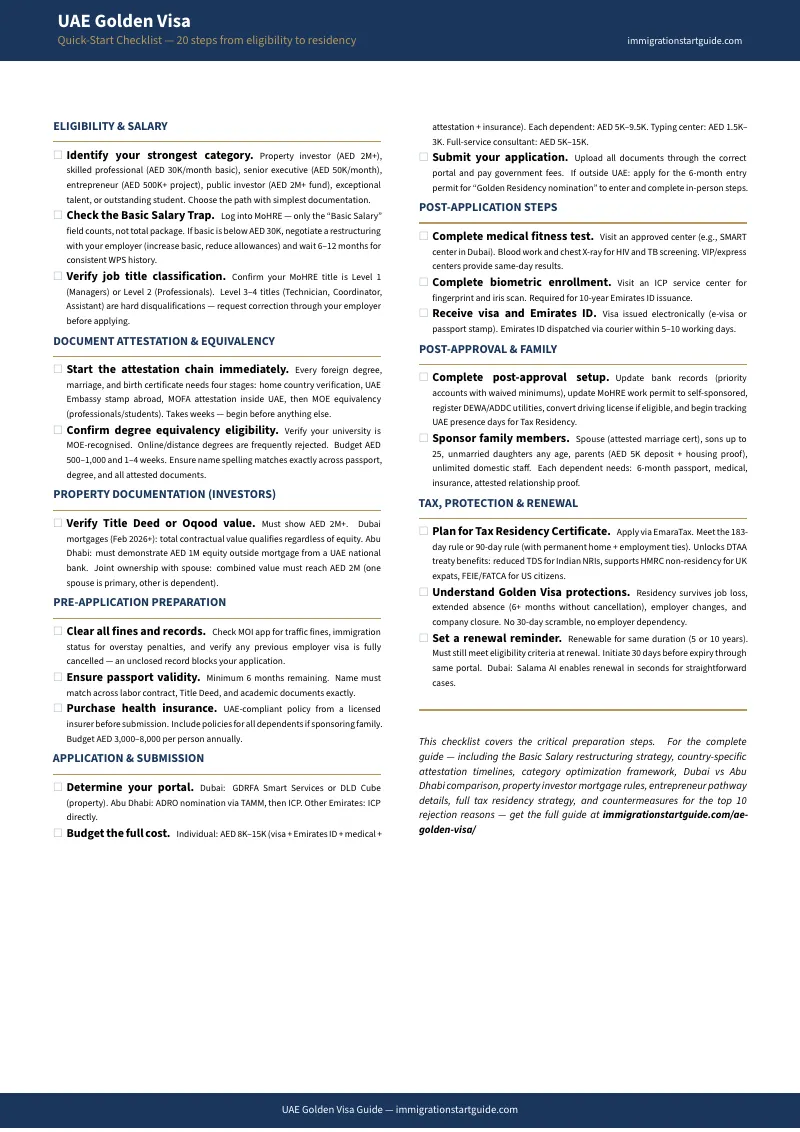
A 20-step action plan covering the essentials: identify your strongest category, check the Basic Salary Trap, verify your ISCO job title, start attestation, confirm degree equivalency eligibility, handle property documentation, run the pre-submission document audit, and prepare your family sponsorship package. Enough to assess your readiness and identify your first concrete step tonight.
Who This Guide Is For
This guide is for investors, professionals, entrepreneurs, and exceptional talents who want long-term self-sponsored residency in the UAE:
- Skilled professionals earning above AED 30,000 basic who want to decouple their residency from their employer — so a job change, corporate restructuring, or redundancy never threatens their family's right to stay
- Professionals who discovered their total package is above AED 30,000 but their basic salary is below it — and need to understand the contract restructuring strategy before they apply
- Property investors who have crossed the AED 2 million threshold and want to convert equity into self-sponsored residency — including those with mortgaged, off-plan, or jointly owned assets
- Entrepreneurs and startup founders building companies in the UAE who want residency independence from a single trade licence or corporate sponsor
- Indian, Pakistani, British, and Egyptian professionals navigating the attestation chain who need country-specific timelines and cost breakdowns rather than generic "get your documents attested" advice
- High-net-worth individuals who want the tax residency benefit — the TRC, DTAA savings, and physical presence strategy — not just the immigration stamp
- Families where the primary earner wants to sponsor a spouse, children, and parents under one 10-year umbrella rather than managing separate employer-tied visas for each family member
- Applicants who have been rejected and need to understand whether the problem was the salary structure, the attestation chain, the job title classification, the equivalency certificate, or the category selection — and how to fix it
This guide is not for: applicants seeking a standard employer-sponsored work visa (see the UAE Employment Visa Guide), freelancers and remote workers on the UAE Freelance Visa (see the UAE Freelance Visa Guide), or tourists on short-stay visit visas.
Why Not a Typing Centre or Free Resources?
Free information on the Golden Visa is abundant. Here is what each source actually delivers:
- ICP.gov.ae and GDRFA portals list the eligibility criteria — AED 30,000 basic salary, AED 2 million property, Occupational Level 1 or 2. What they do not explain: how to check whether your MoHRE contract basic matches, what "Level 1 or 2" means in practice when your employer registered you as a "Coordinator," whether your attested degree will pass equivalency, or which emirate's process you should apply through. You get the rules without the strategy.
- Gulf News and Khaleej Times articles cover policy changes — new categories, salary threshold updates, processing time improvements. They do not cover the Basic Salary Trap mechanics, the attestation chain by nationality, or the Dubai vs Abu Dhabi jurisdictional differences that determine where you actually apply. News tells you what changed. It does not tell you what to do about it.
- Reddit r/dubai threads are where you find someone who got approved in Dubai with a AED 28,000 basic because they applied before the 2024 rule change — and another person who restructured their salary and waited 8 months for WPS history only to be rejected in Abu Dhabi because the TAMM portal flagged a 6-month gap. You get contradictory data points from strangers who applied under different rules, in different emirates, through different categories.
- Typing centres charge AED 1,500 to AED 3,000 and provide exactly one service: data entry. They type your information into the portal, upload your documents, and submit. They do not check whether your basic salary meets the threshold. They do not verify your ISCO job title classification. They do not audit your attestation chain for missing stages. They do not advise you on category selection. If your application is rejected, they shrug — their job was to type, not to strategise.
- Immigration consultants charge AED 5,000 to AED 15,000 for full-service handling. They provide compliance and document management — genuine value for complex cases. But they do not typically provide category optimisation, salary restructuring strategy, or tax residency planning. At AED 5,000+, you are paying for someone to manage the process. The guide teaches you to understand the process — which matters because when the consultant asks you for a "salary certificate showing AED 30,000 basic," you need to know whether your contract actually says that before you discover it does not.
- Real estate agents mention the Golden Visa as a sales incentive — "buy this AED 2.3 million apartment and get a Golden Visa." They do not mention the NOC requirement, the off-plan valuation methodology, the joint ownership limitation, or the Abu Dhabi equity requirement for mortgaged properties. They sell property. The residency is your problem.
This guide fills the strategy gap — the space between "I know the requirements" and "I can verify that every document, threshold, and classification in my application is correct before I submit." It delivers the pre-submission audit framework that typing centres do not provide and consultants charge thousands to perform.
— A Fraction of What One Rejection Costs
A rejected Golden Visa application does not just cost you the government fees. It costs the weeks of attestation work that may need to be redone. It costs the salary restructuring negotiation that took months to implement. It costs the market timing you planned around — the property purchase, the job transition, the family move. And for professionals on employer-sponsored visas, it costs the continued dependence on an employer who could restructure your role at any time.
Typing centres charge AED 1,500 to AED 3,000 to type your data into a portal. Immigration consultants charge AED 5,000 to AED 15,000 for full-service management. Neither one teaches you to audit your own eligibility — which matters because you are the person who needs to restructure your salary, you are the person who needs to verify your job title classification, and you are the person whose degree either passes equivalency or does not. No consultant can change your MoHRE contract for you. The guide gives you the framework to identify every risk and fix every mismatch before the system does it for you with a rejection.
Money-back guarantee, no time limit. If the Basic Salary Trap analysis, the attestation chain maps, the category optimisation framework, and the pre-submission audit checklist do not make your application materially stronger, you pay nothing.
Download the free Quick-Start Checklist to run the 20-point readiness assessment tonight. If your basic salary is below AED 30,000, you will know. If your job title is classified at the wrong ISCO level, you will know. If your degree faces an equivalency risk, you will know. When you are ready for the full category strategy, the complete attestation maps, the property investor rules, the tax residency framework, and the rejection countermeasures, the complete guide is here.
You already qualify. The guide makes sure the system agrees.