
You've Lived in France for Five Years. One Mistake Could Cost You Two More.
You've built your life here. You pay your taxes, you vote in local elections, you raise your children in French schools. But you still carry a titre de séjour that expires every few years—a reminder that your right to stay is conditional. French citizenship would end that precarity forever. So you start the naturalization process, and discover that everything changed in 2026.
The language requirement jumped from B1 to B2. A new mandatory civic exam demands 32 out of 40 correct answers. The Retailleau Circular instructs prefectures to scrutinize your professional stability like never before. The fiscal stamp alone is now €255. And if your dossier has a single inconsistency—a document translation from the wrong type of translator, a gap in your employment history, a birth certificate that expired during processing—you face an ajournement: a two-year mandatory wait before you can reapply.
Two years. Not two months. Two years of continued uncertainty, continued renewals, continued vulnerability to policy changes you have no vote to influence.
The real problem: scattered information, high stakes
The ANEF portal tells you what to upload but not how to build a dossier that actually survives scrutiny. Expat forums are full of contradictory advice from different préfectures in different years—half the posts reference the old B1 requirement that no longer exists. Language schools prepare you for the DELF but say nothing about the civic exam, the assimilation interview, or the documentary requirements that trip up more applicants than grammar ever does.
Immigration lawyers charge €2,000–€5,000 for naturalization dossier preparation. That's the cost of certainty—or at least, that's what they sell. But what they actually provide is someone else managing your paperwork. The knowledge itself isn't proprietary. The process isn't secret. It's just scattered across 47 government circulars, three testing frameworks, and a 258-question interview bank that nobody has assembled into a single coherent system.
Until now.
The Naturalisation Playbook
This guide gives you the complete strategic framework for French citizenship by naturalization in 2026—not just a document checklist, but the decision architecture that determines whether your application succeeds or gets deferred. You'll understand exactly what the prefecture agent evaluates, what triggers an ajournement, and how to build a dossier that leaves no room for subjective doubt.
This is the system that connects the B2 language strategy to the civic exam preparation to the assimilation interview to the ANEF filing—because these aren't four separate tasks. They're four parts of a single argument you're making to the French state: that you belong here permanently.
What's inside
- Complete France Citizenship Guide (guide.pdf) — Covers both pathways (naturalization by decree and citizenship by marriage), the 2026 B2 language requirement with test comparison and preparation strategy, the NAT Civic Exam structure and study framework across all five thematic pillars, assimilation interview preparation with question clustering from the official 258-question bank, the Retailleau Circular's professional stability criteria, document authentication hierarchy by country of origin, ANEF portal navigation and deadline management, financial autonomy thresholds, and your month-by-month action timeline from first eligibility check through decree publication.
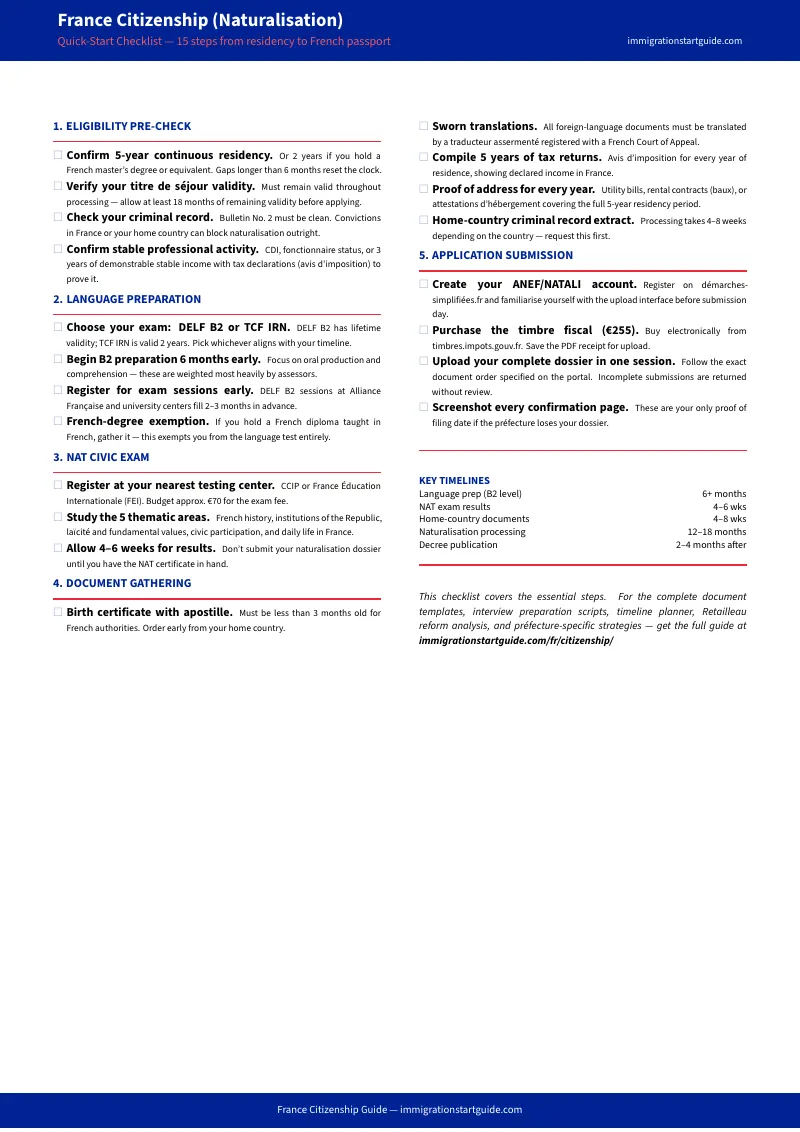
- Quick-Start Checklist (checklist.pdf) — One-page printable tracking every milestone from eligibility verification through decree publication in the Journal Officiel, with key deadlines, cost summary, and the critical 2-month response windows that trigger automatic dossier closure if missed.
- NAT Civic Exam Study Planner (civic-exam-planner.pdf) — Structured study schedule covering all five pillars (Republican values, institutions, rights and duties, history and geography, living in French society) with 262 official questions organized by theme, priority-weighted by frequency of appearance, and practice scoring to ensure you clear the 80% threshold.
- Assimilation Interview Prep Sheet (interview-prep.pdf) — The 50 most common interview questions clustered by theme (personal motivation, Republican values, civic knowledge, current events), with guidance on what agents actually evaluate and the specific answers that raise flags.
- Document Authentication Matrix (document-matrix.pdf) — Country-by-country reference showing whether your birth certificates, marriage acts, and court records need apostille, consular legalization, or simplified authentication—plus sworn translation requirements, validity periods, and the sequence that prevents the "expired document" trap.
- Cost and Timeline Worksheet (cost-timeline.pdf) — Fillable planner covering every expense (€255 fiscal stamp, language test fees, sworn translations, apostille costs) and every deadline (2-month completeness windows, REZE tracking, typical 12-18 month processing) so nothing catches you by surprise.
Who this is for
You've lived in France for five years or more. You hold a valid titre de séjour. You work—ideally on a CDI, but perhaps on a CDD or as an independent. You speak French well enough to function in daily life, but the jump from B1 to B2 feels significant and you're not sure how to bridge it strategically. You want French citizenship for yourself and your family, and you want to file once, correctly, without the two-year penalty of an ajournement.
This is especially relevant if you're from a country where document authentication is complex (North Africa, India, Turkey, non-Hague Convention countries), if your employment history has gaps or contract changes, or if you're approaching eligibility and want to start preparing months before you file.
Why free resources won't get you there
The ANEF portal explains what to upload but not how to build a strategically coherent dossier. Forum advice is fragmented across years and préfectures—the poster who says "B1 is fine" is quoting 2024 rules that no longer apply. Civic exam prep sites cover the test but ignore the interview, the document logistics, and the professional stability assessment that actually determine outcomes. And no free resource anywhere assembles the full picture: language strategy + civic exam + interview prep + document authentication + ANEF navigation + timeline management as one integrated system.
Lawyers solve this by billing €2,000–€5,000. This guide gives you the same strategic framework—the same understanding of what triggers deferrals, what the prefecture actually evaluates, and how to sequence your preparation—for less than the cost of the fiscal stamp itself.
— Less Than the Fiscal Stamp You'll Pay Anyway
The total cost of naturalization in France runs €800–€1,300 when you add the fiscal stamp, language tests, sworn translations, and apostille fees. A single ajournement doesn't just cost you two years—it means paying many of those fees again. This guide is your insurance policy against the most expensive mistake in the process: filing before you're truly ready.
Satisfaction guarantee, no time limit. If the guide doesn't deliver what's promised, email us for a full refund. No questions, no forms, no waiting period.
Start with the free Quick-Start Checklist to verify your eligibility, check your document readiness, and understand the 2026 requirements at a glance. When you're ready for the full system—the B2 strategy, the civic exam study framework, the interview preparation, the document authentication matrix, and the complete ANEF filing timeline—upgrade to the complete guide and file for French citizenship with the confidence of someone who knows exactly what's coming.