
Your French Employer Said Yes. Now You Need Them to File Correctly.
You have a job offer from a French company. The hard part should be over. But in France, the employee doesn't file for their own work permit—your employer does. And if they're a small or mid-sized business that's never sponsored a foreign worker before, you're about to discover why 40% of first-time ANEF filings get rejected or stalled with the dreaded Motif 10 code: "unreliable information."
That's not because applicants lack documents. It's because the employer's filing was inconsistent, incomplete, or contradicted what appeared on the employee's side. One mismatched salary figure. One missing URSSAF attestation. One failure to justify why a shortage-listed role still warrants the hire. And you're back to zero—waiting another 8-12 weeks for a second attempt while your start date evaporates.
The problem isn't you. It's that nobody helps the employer.
Immigration lawyers charge €1,500-€4,000 for employee visa filings. Government portals explain requirements in French administrative language that confuses even native speakers. Expat blogs share anecdotes from 2022 that miss the 2025 ANEF portal redesign and the 2026 civic integration changes. And corporate relocation platforms like Jobbatical only serve tech companies filing Passeport Talent—if you're a chef, nurse, engineer, or hotel manager on the salarié route, you're invisible to them.
Meanwhile, your employer—an SME owner juggling 50 other priorities—is staring at ANEF's autorisation de travail form with no idea what "convention collective applicable" means for your role, whether they need to prove they advertised the position, or how to calculate the sponsorship tax (55% of monthly salary, capped around €2,430).
The Sponsorship Enablement Playbook
This guide does something no other resource does: it equips you to guide your employer through their side of the filing. Not just your documents, your visa appointment, your OFII validation—but the complete employer dossier that actually determines whether your work permit gets approved.
You become the person who hands your HR manager a pre-filled checklist, explains why the métiers en tension list exempts them from labour market testing, and catches the salary discrepancy between your contrat de travail and the ANEF declaration before it triggers a Motif 10 rejection.
What's inside — 7 printable PDFs
- Complete France Employee Visa Guide (guide.pdf) — 15 chapters covering the two-track system, Métiers en Tension strategy, ANEF filing walkthrough, Motif 10 prevention, consular visa application, OFII validation, CIR integration requirements, multi-year card pathway, financial planning, employer sponsorship, country-specific tips, and your month-by-month action plan.
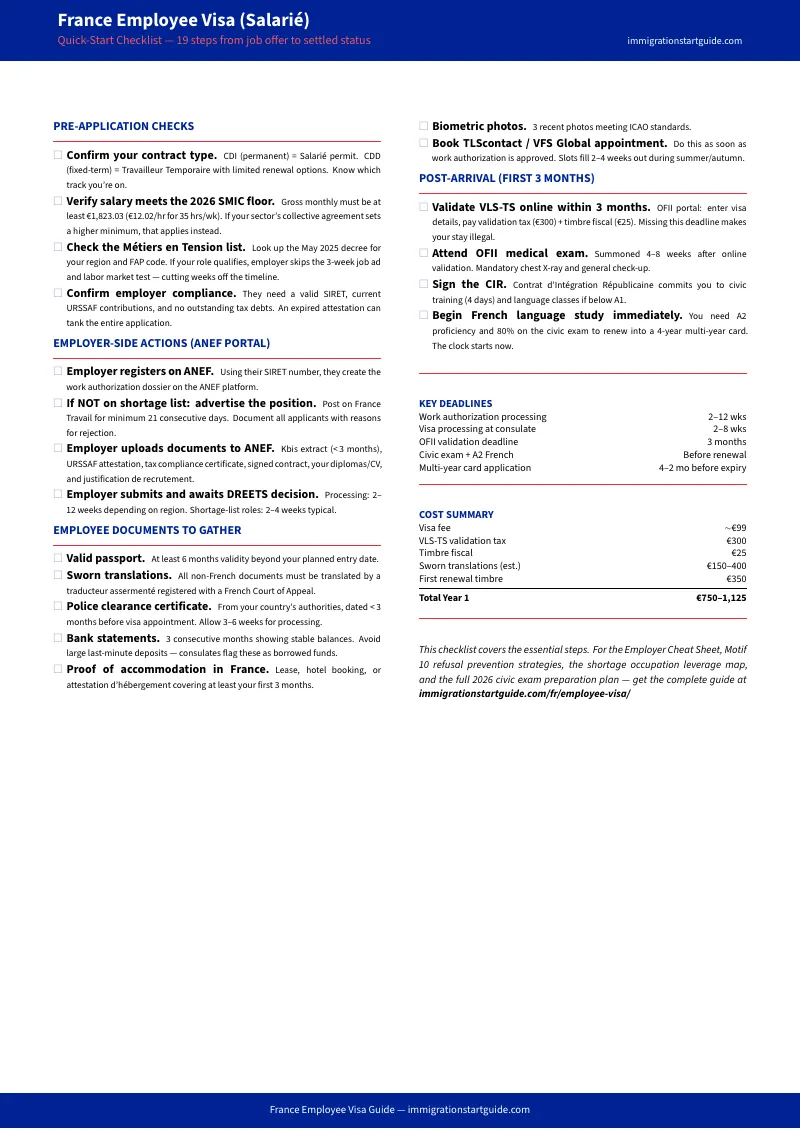
- Quick-Start Checklist (checklist.pdf) — One-page printable tracking every milestone from pre-application checks through post-arrival validation. Includes key deadlines and cost summary tables.
- Motif 10 Prevention Checklist (motif-10-prevention-checklist.pdf) — A cross-reference worksheet ensuring your contrat de travail, employer ANEF declaration, salary figures, and job description all align perfectly before submission. The single most common rejection reason, eliminated before it starts.
- Employer Cheat Sheet (employer-cheat-sheet.pdf) — A 2-page handout designed to give directly to your French employer. Explains what they need to do in 5 clear steps, lists every ANEF upload, and shows the sponsorship tax calculation so there are no surprises.
- Document Requirements Reference Card (document-requirements.pdf) — Every document for your VLS-TS in the order the consulate expects, with apostille requirements, sworn translation specs, and country-specific notes for India, Morocco, Algeria, Tunisia, and the Philippines.
- Fee Breakdown Reference Card (fee-breakdown.pdf) — All employee and employer costs on one page: visa fees, validation taxes, translation estimates, sponsorship tax tiers, and ongoing social charges with a worked example.
- Timeline Planning Worksheet (timeline-planning-worksheet.pdf) — A fillable month-by-month tracker with date fields for every action from job offer verification through multi-year card submission. Print it, fill it in, never miss a deadline.
Who this is for
You have a confirmed job offer from a French employer. You're a skilled worker, chef, nurse, engineer, hospitality professional, or specialist joining a company that wants to hire you but has little or no experience with the autorisation de travail process. Your employer is willing but overwhelmed—and you need to be the one who makes this happen smoothly.
This is especially relevant if your employer is an SME (the vast majority of French businesses) rather than a multinational with a dedicated mobility team.
Why free resources won't cut it
The France-Visas portal explains what documents you need but says nothing about employer-side strategy or how to prevent filing inconsistencies. Immigration forums are full of conflicting advice from different préfectures in different years. And no free resource anywhere addresses the core problem: that your employer needs guidance too, and you're the only person positioned to provide it.
Lawyers solve this by billing €1,500+ and dealing with the employer directly. This guide gives you the same strategic framework—the inconsistency prevention, the shortage list leverage, the ANEF troubleshooting—so you can do it yourself for less than a single hour of a Paris immigration attorney's time.
— Less Than One Hour of a Paris Immigration Lawyer
Immigration attorneys in France bill €150-€400 per hour. Corporate relocation packages start at €3,000. This guide gives you the complete system—both your side and your employer's side—for what you'd spend on a single dinner at a brasserie near your new office.
Satisfaction guarantee, no time limit. If the guide doesn't deliver what's promised, email us for a full refund. No questions, no forms, no waiting period.
Start with the free Quick-Start Checklist to confirm your documents and check whether your role qualifies under the métiers en tension list. When you're ready for the full system—the employer ANEF walkthrough, the Motif 10 prevention framework, the communication templates, and the post-arrival integration timeline—upgrade to the complete guide and turn your job offer into a visa without a lawyer.